



The Desert Extreme
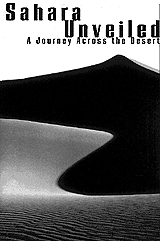 For his latest book, Sahara Unveiled, William Langewiesche traveled 4,000 miles
through a desert the size of the United States. He talked about the
experience with The Atlantic's
For his latest book, Sahara Unveiled, William Langewiesche traveled 4,000 miles
through a desert the size of the United States. He talked about the
experience with The Atlantic's
What interests you about the Sahara?
It is the hottest, driest, and largest of all the deserts -- our planet in its extreme. The size of the United States, the Sahara is so dry that cadavers are mummified and so lonely that birds land beside travelers just for the company. Yet it has also long been inhabited. It is that interplay between death and life in such a place that draws me there.
Excerpts from Sahara Unveiled:
Past Atlantic articles by William Langewiesche.
In the north, where there are roads, by bus and communal taxis. Farther into the roadless desert, by pickup and cargo trucks. There was a lot of breaking down, getting stuck, digging out. In the south I traveled by bus again, and even by pirogue and river steamer up the Niger River, near Timbuktu. Altogether on the trip described in Sahara Unveiled, I traveled about 4,000 miles.
What hasn't been portrayed clearly about the Sahara?
Our view of the Sahara -- camels riding across the desert -- no longer has anything to do with the way the real Sahara is. Most of the Sahara is made up of gravel plains and high volcanic peaks. The central mountains, where much of Sahara Unveiled takes place, rise to 11,000 feet. Only about one fifth of the desert is sand, which forms huge seas of dunes -- some the size of all of France.
I found it interesting that we are so far off-base in our thinking about this isolated part of the world, but what became even more interesting to me was the way that this image plays into the desert itself. We actually affect the way the people in the Sahara see themselves -- through our television, tourism, wealth, and political influence. It's a rather difficult theme to pursue, but in my section on the Tuareg rebellion -- where this has in fact led to war -- I squarely address it. What I'm talking about is the romanticizing of an indigenous people and the environment in which they live. They take this romanticism to heart. I argue that this leads to reactionary wars.
Did you ever find yourself romanticizing it?
I've thought about that question a lot, and I think the answer is no. I never have romanticized the people of the Sahara. Why? It's very hard to romanticize someone whom you really respect. The desert is a romantic and emotionally appealing place to me, but the minute you break down the barriers of distance and stereotype and begin to treat people as equals, you find that indeed they are our equals.
For those who have visited places like Death Valley and arid portions of the American Southwest, can they get a feeling of the terrain and climate of the Sahara?
I don't think you can at all. One thing you can get a feeling for in the American West is the heat. If you go to Death Valley in the summer and expose yourself to that heat -- around 115 or 120 degrees -- for more than about five minutes, you can feel it. You can then use your imagination to put yourself in a place where this heat extends for hundreds, if not thousands of miles, and where you don't have air conditioning, airlines, buses, trains or cars.
Another thing is the vastness of the Sahara. There is nothing like that in the American West. We have a huge desert, of course, but the Sahara is as big as all of the United States including Alaska, a state whose size we can't even imagine. It's so very, very big.
 The final thing that is very different in the Sahara is the feeling of Africa.
That's something that I've felt twice in my travels for The Atlantic.
The first was in the high mountains of the central Sahara at night, standing
and looking at the stars. I was looking to the south and thought that we all
came from somewhere way, way down there, across this horizon and underneath
these stars. It was a powerful, almost instinctive, feeling that the desert
gave me. The other place I felt that was upriver from Khartoum on the Nile. I
looked at the river and realized how far this water had come; I got a sense of
the depth not only of the Sahara and of Africa but of history and the human
experience in this place as well.
The final thing that is very different in the Sahara is the feeling of Africa.
That's something that I've felt twice in my travels for The Atlantic.
The first was in the high mountains of the central Sahara at night, standing
and looking at the stars. I was looking to the south and thought that we all
came from somewhere way, way down there, across this horizon and underneath
these stars. It was a powerful, almost instinctive, feeling that the desert
gave me. The other place I felt that was upriver from Khartoum on the Nile. I
looked at the river and realized how far this water had come; I got a sense of
the depth not only of the Sahara and of Africa but of history and the human
experience in this place as well.
What is life like in the oases?
Oases are not waterholes so much as ancient and fortified trading villages and palm groves located around good wells. In some places the underground water lies so close to the surface that there are ordinances against digging basements because of the threat of uncontrollable flooding. Life in the oases is incestuous, traditional, turned in on itself, maybe a little fearful. It is like life in so many small towns -- only more so because of the hostility of the surrounding land. I visited one fortified oasis in Algeria where the city gates are locked against strangers every night. I think of the oases as islands in the sea.
You use several parables and folk tales throughout the book. Why did you decide to use them and where did you find them?
 I wanted to break up the narrative; I wanted to shake the reader out of one
mood and into another. I discovered these parables in libraries, largely in
France. There's an enormous rich literature that results mostly from French
colonial explorations. In reading these parables and folk tales I found the
connections to what I was seeing and experiencing as I moved through the desert
-- and as I moved as a writer through the book. What they show is the
connection between the past and what I'm looking at in an unromantic way. You
see these strands of thought in the local thinking and ways of doing things.
I wanted to break up the narrative; I wanted to shake the reader out of one
mood and into another. I discovered these parables in libraries, largely in
France. There's an enormous rich literature that results mostly from French
colonial explorations. In reading these parables and folk tales I found the
connections to what I was seeing and experiencing as I moved through the desert
-- and as I moved as a writer through the book. What they show is the
connection between the past and what I'm looking at in an unromantic way. You
see these strands of thought in the local thinking and ways of doing things.
Richard Bernstein, in his New York Times review of your book, says, "Sahara Unveiled is worth its price for Malika and Ameur alone." In your interactions with these two Algerians, what did you learn about relationships between Saharan men and women?
I have discovered -- not just in the Sahara but in my other work for The Atlantic -- that it is possible to be a feminist and an Islamic radical at the same time. The argument used by the Islamic feminists is that the real exploitation of women is the sexual exploitation that occurs in the West. Having true respect for women means that you fight against this. Now, there are big problems with this viewpoint, and I certainly don't support it. But I can understand it in the context. It's very hard for Westerners to understand because the context is so alien.
What I found in the case of Malika and Ameur was a rare entrée into the dynamics of an Algerian relationship. Ameur was a "fixer" in the Third World sense and lived in an oasis in the Sahara. His beautiful wife Malika was not veiled when I met her in her house, which in itself was quite an exceptional sign of friendship on Ameur's part. Slowly -- after Ameur had a car accident that temporarily put him in a coma -- an intimacy developed between Malika and me. What I discovered was her very difficult and tortured existence. She was probably more representative than any political model of what the experience of women is really like in the Sahara, and maybe the Islamic world, right now.
Malika fell in love with Ameur in Algiers. He was a modern man who wanted to make a good life for himself and saw an opportunity in the Sahara. He moved away and she went with him. Then something happened: the Sahara surrounded them. Ameur began to close himself off and eventually he came to mistrust and despise Malika. He kept her pregnant, insisted that she veil herself, and even beat her. He treated her very badly, and in the end he left her with nothing. It's a difficult story.
 The importance of water and the inescapable experience of thirst pervade
Sahara Unveiled. Has your appreciation for water changed?
The importance of water and the inescapable experience of thirst pervade
Sahara Unveiled. Has your appreciation for water changed?
It did right away. Water is life. Now when it rains, I often turn my face up and open my mouth to let the raindrops fall in. Rain is the gift of nature. It's an amazing phenomenon that this life falls from the sky.
What does the average Saharan's diet consist of?
Since there are very poor people in the Sahara who eat very little, it's difficult to know what to say about diet in an average sense. However if you take the core of the Sahara and talk about what people would like to eat if they could eat anything they want, their diets would consist largely of couscous, rice, and palm dates. Saharans are crazy about dates, and as a result they have very bad teeth. Aside from that Saharans eat a range of foods -- from vegetables to dairy products to meat. There's also great bread that's cooked in the sand. After traveling all day in the desert you build a small fire and put the dough under the sand, and after several hours out comes a brick of unleavened bread. It's very good.
The third section of Sahara Unveiled, "The Edge Is A Desert Too," describes the populations you encountered in the cities and on the river boats in Niger, Mali, and Senegal. What do you see as some of the parallels between the Sahara and sub-Saharan Africa?
I think there are many forms of desert. There is the strictly meteorological desert -- less than three inches of rainfall a year -- and there is the functional desert, where there is simply not enough rain for agriculture, vegetables, or goats. Finally, some say the desert is a place where people simply don't have enough. You can carry it as far as you want. I think that to be realistic you have to define the southern edge of the desert, the grassland, the Sahel, and the savanna as being essentially part of the desert. In the beginning of the third section, I wrote, "The Sahel is a band of dry grassland, a savanna with no independent identity, the Sahara's southern shore. The Africans who inhabit it are a desert people. They do not contemplate the tropics to their south, but face instead toward the barren north from which every few years the Sahara surges across them." The focus is very much on the desert even if the land is not itself technically the desert.
How has your understanding of Islam changed from your time spent in the Sahara?
That's difficult for me to answer because I've spent so much time in the Sahara now. I don't even know what my feeling about Islam was before I went there. I would assume that I was a standard American, with a relatively open mind toward all different ideologies, but with a sense that Islam had dragged down a large number of people across history through its insistence on conservative interpretations of the past. This is probably true, but since my time in the Sahara my feelings toward Islam have softened and become more complex. I now recognize another powerful and positive side to Islam -- the ideology of equality. Islam has a strong egalitarian quality that is very appealing.
Can you think of an instance where this positive nature comes through?
It comes through all the time. It comes through in the way people treat the poor in the streets. It comes through in race relations, for instance in the acceptance of black Africans in the middle of the Saharan culture. It is quite different from our race relations. Christianity is also very accepting, but I would say that most people in the Sahara have not strayed as far from their religion and ideology as we have from ours. That may be the real difference. I'm not an apologist for the excess, but I want to recognize the full range of Islam.
Do you have a desire to return to the Sahara?
I don't want take any trips that I've taken before. But I would love to see my friends in the Sahara, and I would love to take my children. It's a wonderful part of the world but it's simply not a safe place now. There are safe and easily accessible parts of the Sahara -- I've spent a lot of time in both Morocco and Tunisia -- but they're not my favorite. Their accessibility has distorted the experience of the Sahara. There are a lot of resort hotels that Europeans appear at in the tens of thousands wearing Bedouin outfits from Saudi Arabia. I tried to write about it but it became uninteresting.
Can you envision the Sahara in a hundred years? How about in a thousand?
 The basic fact of the Sahara is that there is no water. I do not think that is
going to change -- at least not in a hundred years. The hyper-arid core, where
there is not only no vegetation but no bacteria, is expanding. Because of
this, it seems likely that the Sahara will stay pretty much the way it is. A
thousand years from now it's hard to say. The Sahara has gone through many
cycles of dryness and wetness and at times has even been forested with lakes
and rivers. On the southern edge people are now affecting that cycle, through
overgrazing and deforestation.
The basic fact of the Sahara is that there is no water. I do not think that is
going to change -- at least not in a hundred years. The hyper-arid core, where
there is not only no vegetation but no bacteria, is expanding. Because of
this, it seems likely that the Sahara will stay pretty much the way it is. A
thousand years from now it's hard to say. The Sahara has gone through many
cycles of dryness and wetness and at times has even been forested with lakes
and rivers. On the southern edge people are now affecting that cycle, through
overgrazing and deforestation.
Culturally of course it will change, just as the whole world will change. There's nothing to regret about that. Just as we embrace change in our own society and welcome it as healthy, we need to be very careful not to treat other cultures as museum pieces.
What other areas of the world intrigue you?
The entire world fascinates me. I also think the entire world is underreported. The United States and Europe, especially since the demise of the Soviet Union, have been laboring under a set of illusions that are distorting our world view. My job, as I see it, is to break through those illusions and allow people to see clearly. I think this can be applied with great interest almost anywhere. I have a feeling that when I finish my current project, which is a book on aviation, I will be heading for Central Asia and the Himalayas.
Illustrations:
1. Sahara Unveiled: A Journey Across the Desert: Jacket photograph by Gary Faye/Graphistock; jacket design by Kathleen DiGrado.
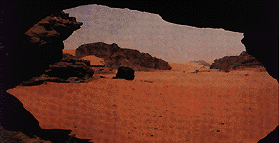
2. The Tadart, south of Djanet in the Algerian Desert. Photo by William Langewiesche.
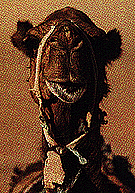
3. Saharan camel. Photo by William Langewiesche.
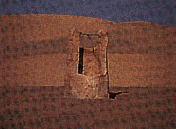
4. Water well, eastern Algeria. Photo by William Langewiesche.
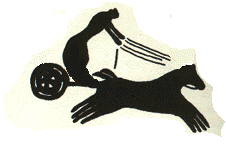
5. Rock art depiction of Berber warrior driving a chariot, c. 1500 B.C.
William Langewiesche is the author of Sahara Unveiled (Pantheon, 1996) and Cutting for Sign (Vintage, 1995). He is a contributing editor to The Atlantic Monthly.
Ryan Nally is a new-media editor at The Atlantic
Monthly.
Copyright © 1996 by The Atlantic Monthly Company. All rights reserved.