

98.03.25
Non-virtual Communities
Competing visions of post-suburban life give new meaning to the "global village."
98.03.18
Gothic Gardening
Martha Stewart it's not.
98.03.11
Pay Day
Slate's big gamble.
98.03.04
Banking on Bright Ideas
What do lost-pet ads, dentist-office ceilings, and in-flight recordings have in common?
98.02.25
ThinkQuest
Techno-savvy kids.
98.02.19
Mapping Cyberspace
Is there a "there" there?
98.02.11
Information-Free
Sometimes the Web can be its own best antidote.
98.02.04
Clintonalia
Investigating rumors of a vast conspiracy.
98.01.28
Eye Candy
Art for the interface's sake.
98.01.22
Alternating Currents
An online exhibit surveys the impact of technology on late-twentieth-century art.
98.01.15
Janeites Unite
Jane Austen's place in cyberspace.
98.01.08
Inquiring Minds
What questions are on our "most complex and sophisticated minds"?
97.12.31
Sites of the Year
A look back at our favorite sites of 1997.
For more, see the complete Web Citations Index.

When it comes to organizing words, the alphabet today rules supreme. ("The dictionary," Anatole France once observed, "is the universe in alphabetical order.") But as the nineteenth-century London physician Peter Mark Roget realized, despite the very helpful existence of alphabetical dictionaries writers still never seem to stop "painfully groping their way and struggling with the difficulties of composition." To help rectify the situation, in 1852 Roget published his Thesaurus of English Words and Phrases Classified and Arranged so as to Facilitate the Expression of Ideas and Assist in Literary Composition. The revolutionary idea of organizing vocabulary by meaning rather than by spelling proved to be enormously popular, but in practice Roget's Thesaurus and its offspring have all been unwieldy and difficult to work with. The problem, quite simply, is that books -- necessarily linear and fixed in print -- are not the proper medium for charting the multiple and unpredictable connections between words. The tool currently best suited to the task, of course, is the computer, but even though a thesaurus is today a standard feature in almost all word-processing programs, the computer's potential to help us reconceptualize language has barely been tapped. There are signs that change is coming, however -- among them a Visual Thesaurus recently produced by Plumb Design.
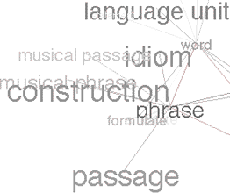 The Visual Thesaurus represents the marriage of Princeton University's
WordNet (an online database that organizes some 50,000 words and 40,000
phrases into synonym sets) and Plumb Design's ThinkMap software (which its
creators describe as "not primarily a data-visualization tool, but rather a
data-animation tool"). The result is enchanting, if hard to describe: any word
typed into the Visual Thesaurus appears onscreen like a spider bobbing at the
center of a web of gently swaying gray filaments, each of which has at its end
a synonym. Click on any one word at the periphery and it moves to the
center of the screen, where a new web of associations emerges. (The old web,
connected by the common synonym, is moved off to the side, where it is still
easily accessible.) Because the display is run by a Java applet, viewers can
customize the display of data: they can favor certain parts of speech,
determine the extent to which synonyms of synonyms are displayed in the
background, toggle between two- and three-dimensional representations of word
associations, and more. The result -- as Marc Tinkler, one of the developers
of the Visual Thesaurus, recently told The New York Times's CyberTimes -- is akin to "information choreography." (Incidentally, if you're using a Macintosh the data dance much better in Internet Explorer than in Netscape.)
The Visual Thesaurus represents the marriage of Princeton University's
WordNet (an online database that organizes some 50,000 words and 40,000
phrases into synonym sets) and Plumb Design's ThinkMap software (which its
creators describe as "not primarily a data-visualization tool, but rather a
data-animation tool"). The result is enchanting, if hard to describe: any word
typed into the Visual Thesaurus appears onscreen like a spider bobbing at the
center of a web of gently swaying gray filaments, each of which has at its end
a synonym. Click on any one word at the periphery and it moves to the
center of the screen, where a new web of associations emerges. (The old web,
connected by the common synonym, is moved off to the side, where it is still
easily accessible.) Because the display is run by a Java applet, viewers can
customize the display of data: they can favor certain parts of speech,
determine the extent to which synonyms of synonyms are displayed in the
background, toggle between two- and three-dimensional representations of word
associations, and more. The result -- as Marc Tinkler, one of the developers
of the Visual Thesaurus, recently told The New York Times's CyberTimes -- is akin to "information choreography." (Incidentally, if you're using a Macintosh the data dance much better in Internet Explorer than in Netscape.)Although the Visual Thesaurus has practical applications -- a version compatible with Microsoft Word will soon be available -- it is obviously also a showpiece for Plumb Design's data-animation technology (which has also recently been put to use in the Smithsonian Institution's first online-only exhibit, the critically acclaimed Revealing Things). There is nothing wrong with that: this is a novel and promising (if embryonic) idea for confronting one of the central problems of the computer age -- namely, how to locate meaning in the masses and masses of inert data available to us. Mr. Roget would surely approve.
Copyright © 1998 by The Atlantic Monthly Company. All rights reserved.
 |
 |
 |
 |
 |
 |