



 July 2, 1998 -- Round Three: Concluding Remarks
June 25, 1998 -- Round Two: Responses
June 18, 1998 -- Introduction and Round One
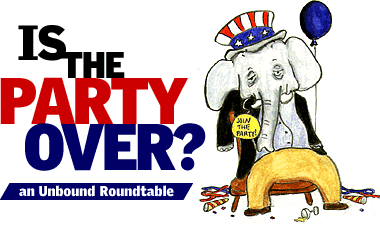
Four years after winning control of the House for the first time in forty years, the Republican Party is obsolescent. That's the argument made by Christopher Caldwell, a senior writer at The Weekly Standard, in The Atlantic Monthly's June cover story, "The Southern Captivity of the GOP." Charting the party's loss of long-time Republican issues to the hardly robust Democrats, Caldwell points to a 1997 Washington Post poll in which voters trusted the Democrats more to handle the economy, balance the budget, deal with crime, and, incredibly, hold down taxes. Caldwell calls the issues remaining for the Republicans to run on in the fall elections a "grab bag ... dredged up from 1988: school choice, the Strategic Defense Initiative, tort reform, abortion. Worthy issues all, but none of them capable of winning elections."
A senior editor at The Atlantic Monthly, Beatty is the author of The World According to Peter Drucker (1997) and The Rascal King: The Life and Times of James Michael Curley (1992).
Christopher Caldwell
A senior writer for The Weekly Standard, Caldwell also writes a weekly Washington column for the New York Press. His articles have appeared in The American Spectator, Commentary, The Wall Street Journal, George, and many other publications.
Stanley B. Greenberg
Greenberg, the Chairman and Chief Executive Officer of Greenberg Research, has served as polling advisor to President Bill Clinton, President Nelson Mandela, Prime Minister Tony Blair, and their national campaigns.
Terence P. Jeffrey
The editor of Human Events, Jeffrey served as presidential- campaign manager for Patrick J. Buchanan in 1996.
Grover Norquist
The president of Americans for Tax Reform, Norquist is a close advisor to the Speaker of the House, Newt Gingrich.
Previous Roundtables:
Above all, with its entire House and Senate top leadership drawn from the South, the GOP has begun to look more and more like a sectional party. This new southern base, Caldwell argues, hurts the GOP elsewhere in the country (notably in California, once a key Republican state in presidential elections), because the "southern morals business" -- the militantly conservative Christianity of Pat Robertson, James Dobson, and others -- is electoral poison beyond the southern and mountain states.
Political demography is turning against the GOP. The most recent presidential election saw young people and Hispanics -- the latter the nation's fastest growing and, Caldwell points out, most strategically situated minority -- voting strongly Democratic, in both cases reversing 1980s trends. In another gloomy indicator for the GOP the 1990 Census revealed that a majority of voters now live in suburbia, making it the new battleground of presidential politics. And Caldwell notes a gathering tension between the suburbs and the South, which were the two props of the GOP presidential victories of the 1980s.
All in all, these trends are worrying for the GOP. So worrying, in fact, that our first question for our Roundtable guests is, quite simply, Is this party over? We'd like you to ponder that question in particular -- and, if you see fit, these others:
- Is the above demographic survey unduly pessimistic? What are the arguments
against this analysis of political demography?
- James Dobson, who claims to have a huge and highly susceptible
following, is the current embodiment of the "southern morals business." What
role is he likely to play in the congressional elections this year? What about
the presidential election in 2000? Why not give us a worst- and a best-case
scenario, from the point of view of the GOP, on Dobson?
- The political scientist Martin Wattenberg has found that one predictor of victory in the general elections of the past thirty years is party unity: the candidate who most convincingly unifies his party behind him before the general election has the best chance of victory. Using this logic, which of the possible GOP contenders in 2000 seems likeliest to unify his party? Give us some rationales or scenarios on how a candidate might rejuvenate the Reagan coalition. What issue or issues, in short, can unify Republicans today as the Cold War and tax cuts unified them yesterday, while also appealing to swing voters?
July 2, 1998Introduction and opening questions by Jack Beatty
Round One: Opening Remarks -- posted on June 18, 1998
Round Two: Responses -- posted on June 25, 1998
Round Three: Concluding Remarks -- posted on July 2, 1998
Illustration by Sage Stossel.
Copyright © 1998 by The Atlantic Monthly Company. All rights reserved.
 |
 |
 |
 |
 |
 |