Arts & Entertainment Preview | April 2001 | Sponsored by Chrysler
by Nancy Dalva and John Istel
Magic Carpet Ride
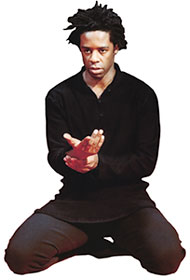
Adrian Lester, in Peter Brook's
The Tragedy of Hamlet
In Peter Brook's The Tragedy of Hamlet, "To be or not to be" is not the question. Instead, the director of acclaimed efforts like Marat-Sade, in the '60s, and The Mahabharata, in the '80s, ends his "condensed" investigation by having Horatio repeat Shakespeare's first line, "Who is there?" Brook thereby questions, as in his '90s adaptation of Oliver Sacks's neurological case histories, The Man Who, the nature of both identity and cultural memory. The most obvious answer is that Adrian Lester, the Jamaican-born English actor best known for his featured role in the film Primary Colors, is Hamlet. Exploring other lines of inquiry, Brook pares the play to two and a half hours, uses only eight actors, and does away with many minor characters. Brook's spare asceticism (he once wrote, "the true process of construction involves at the same time a sort of demolition") was developed on the road. After forming an international acting company and touring villages around the world, he wrote, "During our travels, to Africa and other parts of the world, all we would take with us was a small carpet that defined the area on which we would work." It was his search for the "there" in the theater experience. "We saw that the best way to study Shakespeare was not to examine reconstructions of Elizabethan theatres, but simply to do improvisations around a carpet." This month, Brook brings his carpet to Seattle, where four theaters are coproducing Hamlet in a hockey rink, before limited runs at the Brooklyn Academy of Music and the Chicago Shakespeare Theater, in May. There's another obvious answer to "Who is there?": the audience. Buy a ticket, and you too can respond, "I am, Horatio, I am." —J.I.
Nureyev's Ballet Blanc
La Bayadère, the ballet classic choreographed by Marius Petipa in 1877, was first brought to the West by the Kirov Ballet in 1961, on the same tour from which Rudolf Nureyev so famously defected. This month the Paris Opera Ballet tours it to San Francisco, in the Nureyev version. (After his fabulous dancing years, he became the POB artistic director, a position he held at his death.) His staging of La Bayadère—which has a story preposterous even for an art form rife with dancing vegetables and evil spells—gives full sway to its ephemeral beauty: the miraculous (usually fourth) act called "Kingdom of the Shades." (It takes place in the land of the dead, a not infrequent ballet locale.) Across the back of the stage stretches a ramp down which the corps of ballerinas, ghostly in white tutus, enter one by one, in a mesmerizing repetitive progression. There is no greater role for a corps de ballet than this, and the French corps, famous for their elegance (but of course) and their pliancy, cast a potent spell. That this ballet blanc, or white ballet, preceded minimalism in the dance arts by some one hundred years is an interesting, if peripheral, consideration. Those who love the ballet will simply be enraptured. The rest of the story involves an Indian temple dancer (the eponymous "bayadère"), a handsome but faithless warrior, a poisoning, and such; and there is a fabled pas de deux involving a scarf. Ballet fans, take note! (War Memorial Opera House, San Francisco, April 30, May 1–3; Segerstrom Hall, Costa Mesa, May 8, 9, 11–13.) —N.D.
Meaning in Merce
At the end of Merce Cunningham's dance called Interscape, there is an entrance. Out from the wings steps lovely Jeannie Steele, now the company's senior female. She walks out alone across the stage and stops, as if waiting for something or someone, and right there, in media res, the dance is over. Upon seeing it, you might think something like this: There goes Merce, entering the twenty-first century! Along for the ride is Robert Rauschenberg, who in the middle of the last century was the first artistic director of the Merce Cunningham Dance Company, and is still, from time to time, its scenic artist. Rauschenberg's jewel-colored backdrop, preceded by an identical front curtain in gray scale, is reminiscent of one of his collages, being made up, as it is, of found images of this and that—with that being a huge rendering of a duck. (Why a duck?) (Why not a duck?) The dancers wear unitards that look like postage stamps from exotic climes, as they go about their marvelous business, which—in the usual Cunningham protocol—has nothing to do with the decor or the wonderful sonorous cello score echoing around it. Dancers come and go, appear and disappear. Everything accumulates, and it all must mean something, for how else could a dance fill you with such yearning, such tranquility, such pleasure? How grand, you think, Merce and Bob, still crazy after all these years. (Merce Cunningham Dance Company, City Center, New York City, April 3, 5–7; Zellerbach Hall, Berkeley, California, May 4–5.) —N.D.