


APRIL 1996
FROM LATE BLOOMER TO PERENNIAL FAVORITE
 If The Nutcracker is ballet's winter warhorse,
Swan Lake carries the rest of the calendar. There is no ballet more
popular or more subject to reconsideration. Even during its debut season, in
Moscow in 1877, choreographers and composers were revising the scenario and
adjusting the score, interpolating here and substituting there. Some fifteen
years later, in St. Petersburg (one year after poor Tchaikovsky had died
without a hint of his music's future popularity), Marius Petipa and his
assistant Lev Ivanov rechoreographed the entire ballet, divvying up the acts.
Hence the blockbuster version of Swan Lake. Every serious production
since has stood upon the shoulders of this one, whether faithfully or in full
rebellion.
If The Nutcracker is ballet's winter warhorse,
Swan Lake carries the rest of the calendar. There is no ballet more
popular or more subject to reconsideration. Even during its debut season, in
Moscow in 1877, choreographers and composers were revising the scenario and
adjusting the score, interpolating here and substituting there. Some fifteen
years later, in St. Petersburg (one year after poor Tchaikovsky had died
without a hint of his music's future popularity), Marius Petipa and his
assistant Lev Ivanov rechoreographed the entire ballet, divvying up the acts.
Hence the blockbuster version of Swan Lake. Every serious production
since has stood upon the shoulders of this one, whether faithfully or in full
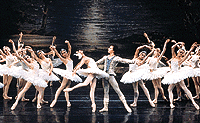
rebellion.In 1940 the San Francisco Ballet, led by William Christensen, was the first company in America to produce a full-length Swan Lake. Following the tradition--but giving it his own spin--the current artistic director, Helgi Tomasson, unveiled his version in 1988. Following the concept of the production's designer, Jens-Jacob Worsaae, this Swan is set in the eighteenth century but with some modern streamlining for dramatic continuity. This month the company takes the ballet (and a mixed bill as well) to Zellerbach Hall, at the University of California at Berkeley (March 29-April 14; 415-865-2000). --N.D.
San Francisco Ballet's Swan Lake
Photo: Jack Mitchell
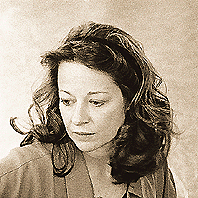 The choreographer Lila York has enjoyed a
long association with the Paul Taylor
Dance Company. For twelve happy years, in more than thirty dances, she filled
the role Taylor called the "runt," although in her case a better term would be
"sprite." She was the troupe's Tinkerbell, light-footed and tenderhearted. York
has gone on to stage Taylor's work for other companies while also making dances
of her own. This month the Pacific Northwest Ballet opens its program with the
first movement of her critically acclaimed Rapture (Seattle Center Opera
House, April 2-6 and 11; 206-292-2787). Meanwhile, the Boston Ballet's Hot
& Cool introduces York's latest, Celts, set to Celtic tunes
(Wang Center for the Performing Arts, March 21-April 7; 617-931-2787). "I took
a lot of the steps and rhythms and shapes of Irish step-dancing and adapted
them to ballet," York says. "It was a good eye-opener, and a mind-opener, too."
And not just for the choreographer: an excerpt from the dance was the featured
half-time entertainment at a Boston Celtics game in November. Slam dunk!
--N.D.
The choreographer Lila York has enjoyed a
long association with the Paul Taylor
Dance Company. For twelve happy years, in more than thirty dances, she filled
the role Taylor called the "runt," although in her case a better term would be
"sprite." She was the troupe's Tinkerbell, light-footed and tenderhearted. York
has gone on to stage Taylor's work for other companies while also making dances
of her own. This month the Pacific Northwest Ballet opens its program with the
first movement of her critically acclaimed Rapture (Seattle Center Opera
House, April 2-6 and 11; 206-292-2787). Meanwhile, the Boston Ballet's Hot
& Cool introduces York's latest, Celts, set to Celtic tunes
(Wang Center for the Performing Arts, March 21-April 7; 617-931-2787). "I took
a lot of the steps and rhythms and shapes of Irish step-dancing and adapted
them to ballet," York says. "It was a good eye-opener, and a mind-opener, too."
And not just for the choreographer: an excerpt from the dance was the featured
half-time entertainment at a Boston Celtics game in November. Slam dunk!
--N.D.
 Three cheers for The Shakespeare Theatre in Washington, D.C., which for its last
show of the season gives the house playwright a rest and welcomes Mosca (the
Fly), Voltore (the Vulture), and all the rest of the bestiary that makes up the
cast of Volpone; or, The Fox (April 16-June 7; 202-393-2700).
Diamond-hard, diamond-clear, Ben Jonson's comedy is a jewel too seldom brought
forth to glitter in the light. The first edition, a quarto of 1607, featured
testimonials by such notables as John Donne and George Chapman, not to mention
a dedication to the universities of Cambridge and Oxford, where the play had
won great favor. Of course, the classical learning that pleased the scholars is
lost on most audiences nowadays. But Jonson's subject (greed) remains as timely
as it ever was; the central conceit still hits the mark (all the world's a
zoo); and the clockwork elegance of his design (a Venetian cotillion of
animals) has lost none of its spring. --A.B.
Three cheers for The Shakespeare Theatre in Washington, D.C., which for its last
show of the season gives the house playwright a rest and welcomes Mosca (the
Fly), Voltore (the Vulture), and all the rest of the bestiary that makes up the
cast of Volpone; or, The Fox (April 16-June 7; 202-393-2700).
Diamond-hard, diamond-clear, Ben Jonson's comedy is a jewel too seldom brought
forth to glitter in the light. The first edition, a quarto of 1607, featured
testimonials by such notables as John Donne and George Chapman, not to mention
a dedication to the universities of Cambridge and Oxford, where the play had
won great favor. Of course, the classical learning that pleased the scholars is
lost on most audiences nowadays. But Jonson's subject (greed) remains as timely
as it ever was; the central conceit still hits the mark (all the world's a
zoo); and the clockwork elegance of his design (a Venetian cotillion of
animals) has lost none of its spring. --A.B.
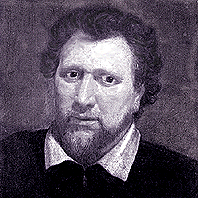
Ben Jonson
Photo: courtesy of The Shakespeare Theatre
