


FEBRUARY 1996
LESS IS MORE IN THE EYES OF A CELEBRATED CHOREOGRAPHER
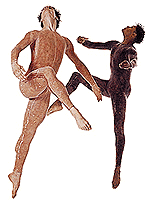 February finds the Merce Cunningham Dance Company
presenting Events at The Joyce Theater, in New York City (February 6-11; for
ticket information call 212-242-0800). The format of the evenings is unique to
the venerable choreographer and his company, who since the first Event (some
thirty years ago, at a museum in Vienna) have performed hundreds of them all
around the world, outdoors and indoors.
February finds the Merce Cunningham Dance Company
presenting Events at The Joyce Theater, in New York City (February 6-11; for
ticket information call 212-242-0800). The format of the evenings is unique to
the venerable choreographer and his company, who since the first Event (some
thirty years ago, at a museum in Vienna) have performed hundreds of them all
around the world, outdoors and indoors.Originally devised for unconventional spaces, in recent years Events have been presented, to great advantage, in proscenium theaters. As Cunningham himself explains, "The Events are a collage . . . made up of elements from the repertory and from new material. Each Event is arranged specifically for the space it will occupy, and is presented without intermission. There is the possibility of several separate and independent activities happening at the same time. Each Event is unique, to allow for not so much an evening of dances as the experience of dance."
Like all of Cunningham's work, Events are conceived and rehearsed without the music that is heard during their performance, and without reference to their eventual costumes and scenery. But here the dances are stripped even of their own context, with the beginning of one dance succeeded, perhaps, by the end of another, followed by the middle of something else.
This is paradigmatic Cunningham: dance for its own sake, liberated from its conventional trappings. And this is the Cunningham paradox: however much he takes away, Merce is left, invariably, with more. A Joyce Event is ninety minutes of brief trysts, random frolics, passing perplexity, and sudden, inexplicable rapture; it contains possibilities for contemplation, meditation, epiphany, and exhilaration.
Inherently theatrical, innately musical, subliminally allusive--Cunningham can dispense with story, score, and decor because in his hands dance already has them. He is our most innovative choreographer, and our least faddish. If George Balanchine's dances are music made visible, Merce Cunningham's dances are the visible made musical.
For some fifty years--in harmony with the natural world and, of late, in collusion with technology, for he is enamored of a program that allows him to choreograph on a computer--Cunningham has kept dance apace with the art, the literature, and the science of the twentieth century. To miss seeing his marvelous company is to miss one of the great events of our time. --N.D.
 In death, John Wilmot, second Earl of Rochester
(1647-1680), leads a double
life. Historians of the Restoration know him as the squalid epitome of the
Restoration rake, a lad of golden promise who desperately quipped, drank, and
fornicated his way into an early grave, leaving behind a legacy of witty, often
scabrous verse. But then he also survives, prettied up, as Dorimant, the
brilliant machinator of The Man of Mode, a comedy by his friend and fellow wit
George Etherege. The new play The Libertine, by Stephen Jeffreys, brings
Rochester back to the stage again, warts and all, corrupting youth, abusing his
wife, alienating his mistress, dissing the King. The (true) spectacle of
self-waste is devastating. "I know he is a Devil," Etherege said of Rochester,
"but he has something of the Angel yet undefac'd in him." In the American
premiere of The Libertine, by Chicago's Steppenwolf Theatre Company, Rochester
is played by John Malkovich, an actor unsurpassed at intellectual bullying and
erotic menace. A glimpse of the unfallen angel may not be too much to hope
for--Malkovich has his silky side. (February 14-April 7; 312-335-1650.)
--A.B.
In death, John Wilmot, second Earl of Rochester
(1647-1680), leads a double
life. Historians of the Restoration know him as the squalid epitome of the
Restoration rake, a lad of golden promise who desperately quipped, drank, and
fornicated his way into an early grave, leaving behind a legacy of witty, often
scabrous verse. But then he also survives, prettied up, as Dorimant, the
brilliant machinator of The Man of Mode, a comedy by his friend and fellow wit
George Etherege. The new play The Libertine, by Stephen Jeffreys, brings
Rochester back to the stage again, warts and all, corrupting youth, abusing his
wife, alienating his mistress, dissing the King. The (true) spectacle of
self-waste is devastating. "I know he is a Devil," Etherege said of Rochester,
"but he has something of the Angel yet undefac'd in him." In the American
premiere of The Libertine, by Chicago's Steppenwolf Theatre Company, Rochester
is played by John Malkovich, an actor unsurpassed at intellectual bullying and
erotic menace. A glimpse of the unfallen angel may not be too much to hope
for--Malkovich has his silky side. (February 14-April 7; 312-335-1650.)
--A.B.
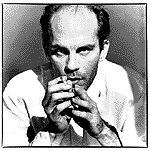
John Wilmot
Photo: The Bettmann Archive
 "We sail with a corpse in the cargo," Ibsen once wrote. In none of his plays is
the dead weight of the past more palpable than in Ghosts. Spotless young Osvald
Alving comes home on the brink of dementia, rotten with syphilis inherited from
his whoring father.
It is easy to blame Osvald's plight solely on Dad (for one thing, the man is
dead). But society at large bears a share of the responsibility, for the poison
of its false pieties, its preoccupation with appearances, its soul-crushing
mediocrity. So does (mostly blameless) Mom, as Ibsen pitilessly forces her to
realize, for knuckling under to bourgeois respectabilities. In the end the best
she can do by her child is to promise to administer, when the time comes, his
precious cache of fatal morphine tablets. Will she have the heart? Ibsen leaves
us very much in doubt. The director Madeleine Pabis, at the Cincinnati
Playhouse in the Park, offers a fresh look at Ghosts (February 20-March 17;
513-421-3888); at Hartford Stage, Mark Lamos, who can strike the tragic chord
without resorting to shopworn histrionics, offers another (March 23-April 27;
203-527-5151). --A.B.
"We sail with a corpse in the cargo," Ibsen once wrote. In none of his plays is
the dead weight of the past more palpable than in Ghosts. Spotless young Osvald
Alving comes home on the brink of dementia, rotten with syphilis inherited from
his whoring father.
It is easy to blame Osvald's plight solely on Dad (for one thing, the man is
dead). But society at large bears a share of the responsibility, for the poison
of its false pieties, its preoccupation with appearances, its soul-crushing
mediocrity. So does (mostly blameless) Mom, as Ibsen pitilessly forces her to
realize, for knuckling under to bourgeois respectabilities. In the end the best
she can do by her child is to promise to administer, when the time comes, his
precious cache of fatal morphine tablets. Will she have the heart? Ibsen leaves
us very much in doubt. The director Madeleine Pabis, at the Cincinnati
Playhouse in the Park, offers a fresh look at Ghosts (February 20-March 17;
513-421-3888); at Hartford Stage, Mark Lamos, who can strike the tragic chord
without resorting to shopworn histrionics, offers another (March 23-April 27;
203-527-5151). --A.B.
Haunted Son
Art: Courtesy of Hartford Stage
