


MARCH 1996
ABOVE THE FLOOR AND ON THE EDGE
 "Skudge. Dominoes. Body pop. Ex-flip. Inside-out. Suicide
dive. Deadman. Slam." This is the movement vocabulary of Elizabeth Streb, the
founder of the no-frills, high-thrills troupe known as Streb/Ringside. At a
moment when a melancholic wave of Euro-style theatricality is washing over even
the most restrained of American postmodernists, this daredevil choreographer
holds the high ground by changing its definition. Streb has not only the desire
to challenge gravity but the means: various equipment of her own devising,
such as flying harnesses, springboards, and aerial platforms. Under Streb's
command the floor is not the floor. The floor is a wall, a ledge, a box, a
thirty-foot-tall six-inches-in-diameter pole, a set of panels, a springboard,
or thin air itself. Down is up, up is every which way, and as for sideways--in
Streb's work sideways is nonexistent, as at a rocket launch. Her latest
ensemble piece, suitably titled Up!,
"Skudge. Dominoes. Body pop. Ex-flip. Inside-out. Suicide
dive. Deadman. Slam." This is the movement vocabulary of Elizabeth Streb, the
founder of the no-frills, high-thrills troupe known as Streb/Ringside. At a
moment when a melancholic wave of Euro-style theatricality is washing over even
the most restrained of American postmodernists, this daredevil choreographer
holds the high ground by changing its definition. Streb has not only the desire
to challenge gravity but the means: various equipment of her own devising,
such as flying harnesses, springboards, and aerial platforms. Under Streb's
command the floor is not the floor. The floor is a wall, a ledge, a box, a
thirty-foot-tall six-inches-in-diameter pole, a set of panels, a springboard,
or thin air itself. Down is up, up is every which way, and as for sideways--in
Streb's work sideways is nonexistent, as at a rocket launch. Her latest
ensemble piece, suitably titled Up!, 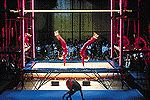 employs six dancers, two twenty-foot
towers, parallel bars positioned as high wires, an Olympic-quality "hot bed"
trampoline with a spring power of up to thirty feet, and some cushioned floor
coverings--all at once. It is the rare work that is actually, rather than
metaphorically, breathtaking.
employs six dancers, two twenty-foot
towers, parallel bars positioned as high wires, an Olympic-quality "hot bed"
trampoline with a spring power of up to thirty feet, and some cushioned floor
coverings--all at once. It is the rare work that is actually, rather than
metaphorically, breathtaking. This is not to say that Streb's pieces do not function as metaphors, both in the imagery they suggest from time to time (dolphins leaping, a cross, a woman trapped in a coffin) and in the nature of the enterprise itself. The choreography can be "read" as a commentary on the nature of dance and as a high-velocity meditation. (Streb's only scores are the miked sounds triggered by the dancers as they hurtle into whatever solid object impedes a given trajectory.) The work recalls Salvador Dalí's marvelous painting The Maximum Speed of Raphael's Madonna. Just as Dalí exploded the Madonna's lovely face into a dazzling geometry, Streb translates planes, rectangles, and the angles of the hypotenuse into dazzling action.
This month Streb/Ringside's PopAction tour will make stops in San Antonio and Dallas (March 16, call 210-207-7211; March 22-23, call 214-768-3129), and in Seattle (March 28-30, call 206-543-4880). --N.D.
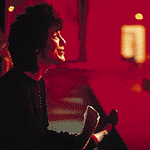
Top: Streb prepares for Action
Bottom: Testing the limits of dance
Photos: Kevin Powell
 Within the setting of a single stately home
Arcadia swirls together--like jam
and rice pudding--personages of the Romantic era and of the present day.
Critics who admired Tom Stoppard's play on Broadway added that the script reads
better than it plays, which is not much of a compliment. In Arcadia's
defense,
it is a play of ideas. But to anyone who has absorbed (in a general way) the
notions of entropy and fractals, or heard (in passing) of Fermat's lately
proven theorem, the exposition of these matters will seem pedantic, and their
application to the dramatic narrative forced. Well, Arcadia made for
plenty of
animated cocktail chitchat, and now it is making the rounds. This month alone
Chicago's Goodman Theatre and Seattle's A Contemporary Theatre reincarnate
Arcadia on terms of their own. Next month new productions will follow in
Pittsburgh and Chapel Hill. Maybe one of these will yet lift Stoppard's
paper-thin chatterboxes off the written page and into the third dimension of
flesh and blood. --A.B.
Within the setting of a single stately home
Arcadia swirls together--like jam
and rice pudding--personages of the Romantic era and of the present day.
Critics who admired Tom Stoppard's play on Broadway added that the script reads
better than it plays, which is not much of a compliment. In Arcadia's
defense,
it is a play of ideas. But to anyone who has absorbed (in a general way) the
notions of entropy and fractals, or heard (in passing) of Fermat's lately
proven theorem, the exposition of these matters will seem pedantic, and their
application to the dramatic narrative forced. Well, Arcadia made for
plenty of
animated cocktail chitchat, and now it is making the rounds. This month alone
Chicago's Goodman Theatre and Seattle's A Contemporary Theatre reincarnate
Arcadia on terms of their own. Next month new productions will follow in
Pittsburgh and Chapel Hill. Maybe one of these will yet lift Stoppard's
paper-thin chatterboxes off the written page and into the third dimension of
flesh and blood. --A.B.
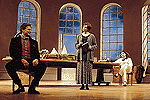
The set of the Broadway production
Photo: Joan Marcus
 More bewildering, more metaphorical, and more
ornate than Oedipus, Pedro
Calderón de la Barca's Spanish Golden Age mystery La vida es
sueño (Life Is a Dream) yet shares some of that primal tragedy's mythic
power. Queen Clorilene of Poland is with child. King Basilio, a great reader of
dreams and omens, foresees that she will bear a monster. Prince Segismundo is
delivered amid ghastly portents, including the queen's death in childbirth. The
boy grows up in chains in a lonely tower, tended only by a loyal tutor. And now
the curtain rises. Basilio has decided to test the prophecies. He will bring
the prince to court. If he displays a noble nature, he will resume his rightful
place. If not, he will be returned forever to the tower, his only comfort a
lie: that he but dreamed. From this fantastical premise Calderón spins a
riveting parable of free will and predestination, of nature versus nurture, of
honor and betrayal, of the revenges of time. This month a production by New
York City's bilingual Repertorio Español is on view both on tour in El
Paso, Texas, and back home, just steps away from that Manhattan oasis of
civility, Gramercy Park (call 212-889-2850 for dates). Performances are in
Spanish, with simultaneous English
translations available on headset. Chances to see Calderón's
disorienting dream play are like eclipses: rare and worth some trouble. --A.B.
More bewildering, more metaphorical, and more
ornate than Oedipus, Pedro
Calderón de la Barca's Spanish Golden Age mystery La vida es
sueño (Life Is a Dream) yet shares some of that primal tragedy's mythic
power. Queen Clorilene of Poland is with child. King Basilio, a great reader of
dreams and omens, foresees that she will bear a monster. Prince Segismundo is
delivered amid ghastly portents, including the queen's death in childbirth. The
boy grows up in chains in a lonely tower, tended only by a loyal tutor. And now
the curtain rises. Basilio has decided to test the prophecies. He will bring
the prince to court. If he displays a noble nature, he will resume his rightful
place. If not, he will be returned forever to the tower, his only comfort a
lie: that he but dreamed. From this fantastical premise Calderón spins a
riveting parable of free will and predestination, of nature versus nurture, of
honor and betrayal, of the revenges of time. This month a production by New
York City's bilingual Repertorio Español is on view both on tour in El
Paso, Texas, and back home, just steps away from that Manhattan oasis of
civility, Gramercy Park (call 212-889-2850 for dates). Performances are in
Spanish, with simultaneous English
translations available on headset. Chances to see Calderón's
disorienting dream play are like eclipses: rare and worth some trouble. --A.B.
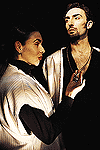
A tragedy played out
Photo: Gerry Goodstein
