


MAY 1996
IN THE BALLET WARS THE AUDIENCE WINS
 This month the American
Ballet Theatre and the New York
City Ballet both come to Lincoln Center, launching two months of ballet wars.
Where to go and what to see? Some nights, if you stand on the plaza between the
Metropolitan Opera House (the ABT's stage) and the New York State Theater
(the NYCB's) at just the right moment, you will be able to see diehard
balletomanes and frazzled dance critics sprint past, switching theaters at
intermission--a premiere here, a debut there. My advice is to stay in your seat
and take in what the companies call an all-choreographer evening. Ballet
companies frequently stage the evening-length classics that fill box-office
coffers; these programs, which present several numbers by a single
choreographer, are something rarer. Their pleasures are many and deep. Whereas
variety bills offer just that (a bit of this and that, something old, something
new, something for everyone), programs devoted to a single maker offer an
experience rather like that of dipping into a volume of collected poetry. There
are connections to be made, threads to follow, patterns to be revealed. The New
York City Ballet (full season April 30-June 30) offers six such programs, three
of Jerome Robbins (May 9 and 21 and June 14; 212-870-5570) and three of
George
Balanchine (May 4, June 1 and 16). Meanwhile, the American Ballet Theatre (full
season April 29-June 22) combines novelty and box-office gold in an
all-Twyla Tharp program (May 3, 4, 20, 23, and 25 and June 12; 212-362-6000).
These days Tharp is the ABT's hottest choreographic draw, and this season
she is not only showing a new dance (still shrouded in mystery and rehearsing
behind closed doors at press time) but also amending Americans We,
new last spring. Coincidentally, May also finds Tharp launching a new
ensemble of unknowns billed as an "event" called--you guessed it--THARP!
Rehearsals are starting now for a fall and winter tour, with twenty cities
on the books, and more signing up every day. --N.D.
This month the American
Ballet Theatre and the New York
City Ballet both come to Lincoln Center, launching two months of ballet wars.
Where to go and what to see? Some nights, if you stand on the plaza between the
Metropolitan Opera House (the ABT's stage) and the New York State Theater
(the NYCB's) at just the right moment, you will be able to see diehard
balletomanes and frazzled dance critics sprint past, switching theaters at
intermission--a premiere here, a debut there. My advice is to stay in your seat
and take in what the companies call an all-choreographer evening. Ballet
companies frequently stage the evening-length classics that fill box-office
coffers; these programs, which present several numbers by a single
choreographer, are something rarer. Their pleasures are many and deep. Whereas
variety bills offer just that (a bit of this and that, something old, something
new, something for everyone), programs devoted to a single maker offer an
experience rather like that of dipping into a volume of collected poetry. There
are connections to be made, threads to follow, patterns to be revealed. The New
York City Ballet (full season April 30-June 30) offers six such programs, three
of Jerome Robbins (May 9 and 21 and June 14; 212-870-5570) and three of
George
Balanchine (May 4, June 1 and 16). Meanwhile, the American Ballet Theatre (full
season April 29-June 22) combines novelty and box-office gold in an
all-Twyla Tharp program (May 3, 4, 20, 23, and 25 and June 12; 212-362-6000).
These days Tharp is the ABT's hottest choreographic draw, and this season
she is not only showing a new dance (still shrouded in mystery and rehearsing
behind closed doors at press time) but also amending Americans We,
new last spring. Coincidentally, May also finds Tharp launching a new
ensemble of unknowns billed as an "event" called--you guessed it--THARP!
Rehearsals are starting now for a fall and winter tour, with twenty cities
on the books, and more signing up every day. --N.D.
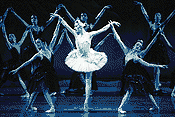
Balanchine's Swan Lake
Photo: Paul Kolnik
 They have their Académie; they have their Alliance. It stands to reason
that the French would also boast the longest unbroken tradition of classic
theater in the West. Indeed, the Comédie-Française, in Paris, can
trace its history back to the reign of the Sun King himself, but in recent
years its visits to America have all but ceased. True, from our perspective the
company's concerns may appear somewhat parochial. Of the dramatists it
principally cultivates, only one (Molière) transcends nationality. But
for that very reason we may look to the Comédie-Française to
preserve in the purest form something individual and essential. This spring the
Brooklyn Academy of Music presents the troupe's celebrated productions of
Molière's Don Juan and Marivaux's intricate The Inconstant
Lovers. More shocking to Molière's contemporaries than any sexual
predation was the wicked hero's attempt to bribe his servant to blasphemy,
which remains strong stuff. In a brighter vein, the Marivaux trifles icily with
the follies of the heart. It would take a subtle historian of culture to
explain why the tortured faith of one play and the snowflake artifice of the
other strike a contemporary nerve--but they do, they do (April 30-May 12;
718-636-4100). --A.B.
They have their Académie; they have their Alliance. It stands to reason
that the French would also boast the longest unbroken tradition of classic
theater in the West. Indeed, the Comédie-Française, in Paris, can
trace its history back to the reign of the Sun King himself, but in recent
years its visits to America have all but ceased. True, from our perspective the
company's concerns may appear somewhat parochial. Of the dramatists it
principally cultivates, only one (Molière) transcends nationality. But
for that very reason we may look to the Comédie-Française to
preserve in the purest form something individual and essential. This spring the
Brooklyn Academy of Music presents the troupe's celebrated productions of
Molière's Don Juan and Marivaux's intricate The Inconstant
Lovers. More shocking to Molière's contemporaries than any sexual
predation was the wicked hero's attempt to bribe his servant to blasphemy,
which remains strong stuff. In a brighter vein, the Marivaux trifles icily with
the follies of the heart. It would take a subtle historian of culture to
explain why the tortured faith of one play and the snowflake artifice of the
other strike a contemporary nerve--but they do, they do (April 30-May 12;
718-636-4100). --A.B.
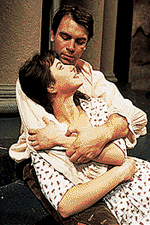
Two inconstant lovers
Photo: Marc Enguerand
