
Return to the December 1997 A&E Preview Cover
|
Arts & Entertainment Preview - December 1997


B Y E L L A T A Y L O R

When to Lead and When to Follow

For the British filmmaker Sally Potter
(Orlando), politics go hand in hand with aesthetics. Her new movie,
The Tango Lesson, is an autobiographical work about a filmmaker who
takes tango lessons to distract herself from the unsatisfying screenplay she's
trying to write. Sally (played by Potter herself) strikes a deal with her young
teacher (Argentinian dancer and choreographer Pablo Verone) -- if he makes a
dancer of her, she will let him star in her next film. She becomes obsessed by
the parallels between the tango, a dance that balances unity with struggle, and
the power shifts that surge between her and the cocksure Pablo. Divided into
numbered "lessons," the movie grows into a meditation on the professional and
private identities of the artist.
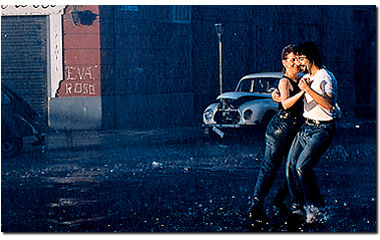
Pablo and Sally perfect their moves
As a treatise on the politics of leading and
following, The Tango Lesson is both over-intellectualized and obvious,
weighed down by a portentous script and burdened with tributary themes that
include Potter's excursions into her newly discovered Jewish identity and some
obligatory digs at callow Hollywood executives who fail to comprehend her
artistry. Potter is no actress: she wears a uniformly beatific smile that looks
more than a little ragged by the end of the movie. No matter: even as a novice
she dances like an angel, as does her ravishingly handsome partner. Gorgeously
shot in black and white by the legendary cinematographer Robby Muller
(Breaking the Waves), The Tango Lesson works magic as a
stunningly erotic dance movie overlaid with a ruefully romantic love story.
The Heart of the Community
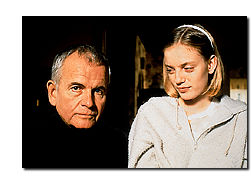 | Ian Holm and Sarah Polley
|
On the face of it there's little to connect the black humor and perverse
sexuality of Canadian director Atom Egoyan's previous film, Exotica,
with The Sweet Hereafter, his brooding adaptation of Russell Banks's
novel about a small town pulverized by a terrible school bus accident. Like
Exotica, though, Egoyan's new movie examines the distorted ways in which
people try to give and receive love and cope with unspeakable loss. When an
ambulance-chasing lawyer (Ian Holm) with a sad burden of his own arrives to
whip up a bogus lawsuit by trading on the town's collective grief, he exposes
the submerged weaknesses and deceptions that make up the secret life of any
community. Bruce Greenwood and Sarah Polley are strong as a bereaved father and
his babysitter who find ways to lead the town back to honesty, acceptance, and
a kind of unity. The movie is graced by elliptical touches (a Pied Piper motif,
a mournful score counterpointed by the false jollity of a fairground) that pay
respect to the novel's project -- the mystery is not the accident but the range
of human response to it -- while imposing a cinematic tone and structure that
lend clarity and urgency to Banks's spiritual inquiry and his alarm at the
growing vulnerability of children. The Sweet Hereafter doesn't go down
easy, but it feeds the soul.
Sarajevo's Children
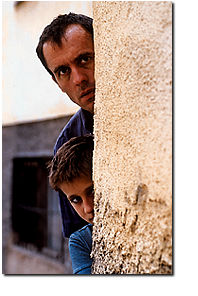 | A reporter gets involved
in the story
|
There's a nervousness to Welcome to Sarajevo, a docudrama by British
filmmaker Michael Winterbottom (Jude), as if the director feared losing
his audience's attention if he failed to pile on the melodrama. Based on a book
by the English foreign correspondent Michael Nicholson (played in the movie by
Stephen Dillane), about his adoption of a young girl (Emira Nusevic) during the
1992 Serbian siege of Sarajevo, the movie mixes television war footage with a
dramatization of the evacuation of a busload of orphaned children through
Serbian lines to the West. In an unnecessary bid to pump up the movie's
box-office appeal with big names, Winterbottom has cast Woody Harrelson and
Marisa Tomei in incongruously minor roles as a flashy American foreign
correspondent and a dedicated aid worker who shepherds the children's
evacuation. The director's scathing indictment of the hands-off policy of
Western politicians is well placed, but it also skirts some important questions
about the difficulty of balancing humanitarian concerns with the larger game of
politicking peace through diplomacy. The movie is strong on the way war
collapses some social conventions (journalistic detachment, for instance) while
raising others (the Miss Besieged Sarajevo beauty pageant) to the level of
absurdist art. By rights this noble failure of a movie ought to be a straight
documentary, but as a piece of impassioned agitprop, Welcome to Sarajevo
can't fail to awaken its audience to the plight of parentless children caught
in a viciously destructive war without winners.
Ella Taylor is a film critic for LA Weekly.
Go to ...
 
Copyright © 1997 by The Atlantic Monthly Company. All rights reserved.
|