Atlantic Unbound

FEBRUARY 1997
THE ARTS &
ENTERTAINMENT PREVIEW

Popular Music and Jazz
By Bob Blumenthal and Charles M. Young
Chrysler Corporation


Carla Bley Album


The Carla Bley Big Band Goes to Church

"One Way"
AU (221k)
Real Audio 28.8 (41k)

"Beads"
AU (243k)
Real Audio 28.8 (45k)

Copyright 1996
Watt Works, Inc./ ECM Records


CARLA BLEY IN THE FIELDS OF THE LORD

Carla Bley
The conductor and
pianist Carla Bley

Photo: Richard D'Albert

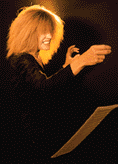
There is no more imposing venue on earth for hearing live jazz than San Francesco al Prato, in Perugia, Italy. This 13th-century church, where wartime damage reveals even older ruins behind what used to be a wall, is the setting for the midnight concert series at Umbria Jazz, one of the most important summer jazz festivals in the world. San Francesco al Prato was also a recording studio last July, when the composer and pianist Carla Bley led her orchestra in a concert of religious-based music now titled The Carla Bley Big Band Goes to Church (WATT). Bley's music, once considered avant-garde, has always contained a healthy dose of bonhomie. As she has gained confidence in her arranging and expanded the size of her ensemble, Bley's writing has taken on even greater melodic clarity. Her church album is a joyful noise that incorporates quotations from "The Old Rugged Cross" and "The Hallelujah Chorus" along with the Carl Ruggles hymn "Exaltation." The primary focus remains on Bley's own majestic themes, which are shouted by the full ensemble or meditated over by such unexpected melodic leads as the electric bass of Bley's longtime partner Steve Swallow. The band is powered by the trumpeter Lew Soloff, the trombonist Gary Valente, and two of Europe's best saxophonists, Britain's Andy Sheppard and Austria's Wolfgang Puschnig; and Valente in particular sounds like Joshua at Jericho. Everything rides on the spirited, detailed percussion of Dennis Mackrel, one young drummer who knows his way around a large jazz group. --B.B.

| February 1997 Cover Page | Classical | Dance and Theater |
Gravikords Cover


Gravikords, Whirlies & Pyrophones: Experimental Musical Instruments

Hans Reichel, "Le Bal"
The Daxophone
AU (221k)
Real Audio 28.8 (41k)
Copyright 1994 AHO Recording / FMP Publishing (GEMA)

Sugar Belly, "Shake Up Adina"
Bamboo Saxophone
AU (221k)
Real Audio 28.8 (41k)
Copyright 1978 Port 'O' Jam

Copyright 1996
Ellipsis Arts


HIP SOUNDS FROM WAY OUT

A wind-sound maker
The Sea Beastie, a wind-sound maker
Photo: Gene Ogami

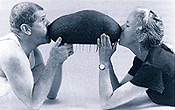
Most creativity seems eccentric when first encountered, so it's probably unfair just to make a lot of jokes about Gravikords, Whirlies & Pyrophones: Experimental Musical Instruments, which is a book-plus-CD-in-a-box compiled by Bart Hopkin, the publisher of a quarterly journal called Experimental Musical Instruments. In fact, it's certainly unfair, because most of the eighteen pieces presented on the CD are more beautiful than hilarious, and because Tom Waits makes plenty of good jokes in his introduction. Comparing various manufactured and "found" noises to "a monkey with his hair on fire" and "a titanic organ at a midget wedding," among other things, Waits makes clear that arranging sound waves in new ways also arranges your imagination in new ways. And if that isn't fun, what is? The body of the book consists of thirty-seven short profiles of inventor-composers whose backgrounds range from religious fanaticism to avant-garde performance art to inexplicable obsession with the sonic qualities of hardware. Hopkin nicely captures both their absurdity and their heroism, but the CD is the main appeal. Only small portions of it sound like a monkey with his hair on fire. Some of it is mystical and meditative, some of it makes you want to dance, and all of it will inspire you to go out in the garage and hit something for the sheer noise of it. Whether plunked, whacked, or tootled, every instrument raises the question "What sounds like that?" And then you can make your own analogies.--C.M.Y.

| February 1997 Cover Page | Classical | Dance and Theater |

What is Jazz? 1996


What Is Jazz? 1996

Charlie Hunter Quartet, "Ashby Man"
AU (216k)
Real Audio 28.8 (41k)

Thomas Chapin Trio, "A Drunken Monkey"
AU (221k)
Real Audio 28.8 (41k)

Myra Melford - The Same River Twice, "Changes I"
AU (221k)
Real Audio 28.8 (41k)

Copyright 1996
Knitting Factory Works


THE PERFECT FIT

Ten years ago the Milwaukee native Michael Dorf opened the Knitting Factory in a converted millinery shop on Manhattan's Lower East Side. The club quickly became the center of New York's "downtown" music scene and in 1994 relocated to a larger facility, on Leonard Street in Tribeca, which is where the Knitting Factory celebrates its tenth anniversary throughout February. A partial list of the participants--David Byrne and Kristin Hersch (February 4), Eric Bogosian (February 12), Don Byron (February 18), and Philip Glass and Cecil Taylor playing solo piano (February 28)--suggests both the diversity of the club's efforts and the stature it has gained.

Dorf has hardly confined his efforts to New York. The Knitting Factory has an Amsterdam office and produces mini-series at major international jazz festivals. It was the first club with a Web site and the first to provide nightly Web broadcasts. Under the logo Knitting Factory Works it has released more than a hundred CDs by such iconoclasts as the alto saxophonist Thomas Chapin, the tenor saxophonist Charles Gayle, and the Jazz Passengers.

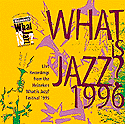
A handy summary of the Knitting Factory experience is provided on What Is Jazz? 1996 (KFW), featuring ten of the dozens of bands that performed in the series that stole the more traditional JVC Jazz Festival's thunder last June. Among several upcoming projects is the release of a pre-Christmas meeting at the Knitting Factory of Pat Metheny and Britain's innovative guitarist Derek Bailey. The operating rule, as usual, is all the music that's fit to knit. --B.B.

| February 1997 Cover Page | Classical | Dance and Theater |


Bob Blumenthal is a jazz critic for The Boston Globe.
Charles M. Young reviews popular music for Playboy, Musician, and other publications.

Discuss this feature in the Arts & Literature conference of Post & Riposte (First-time users enter here).


Copyright © 1997 by The Atlantic Monthly Company. All rights reserved.


Home | Post & Riposte | The Magazine | Atlantic Unbound | The Exchange | Search