|


Return to the May 1997 A&E Preview Cover |
Arts & Entertainment Preview -- May 1997
   Danny Boyle and Andrew MacDonald, who produced Shallow Grave and Trainspotting, are making the rounds of Britain's cities, crowning them with their own exuberantly transgressive brand of grunge cinema. This time it's not Edinburgh but Swansea, dubbed by the Welsh poet Dylan Thomas an "ugly, lovely town" and "the graveyard of ambition."  First-time director Kevin Allen's
Swansea is a graveyard for almost every form of life -- poodles, parents, and
policemen come to baroquely sticky ends in this rowdy black comedy of revenge
among the city's proletarian finest and most profane. If you can survive the
serpentine plot, in which two young car-stealing brothers (known as "The Twins"
even though they're three years apart) seek revenge on a local kingpin for the
death of their father on an unsafe construction site, there's poetry in Twin
Town. Allen's deft, expletive-laden script (co-written with Paul Durden)
leans further toward Tarantino than toward any stereotype of Welsh lyricism,
and there are more massage parlors and trailer homes than coal miners or
daffodils on the mean streets of this city. The effect, as in Trainspotting,
is an elegantly constructed grossness; the movie's vicious denouement
unfolds hand in hand with the delirious beauty of the final
scene, in which a massed Welsh choir sings "Myfanwy" beneath a starry sky on a
Swansea pier. For all its excess, Twin Town offers a more authentic -- and
more genuinely literary -- vision of provincial Britain than any you'll see on
PBS of a Sunday night. That's if you can stand the movie's rancid cynicism. First-time director Kevin Allen's
Swansea is a graveyard for almost every form of life -- poodles, parents, and
policemen come to baroquely sticky ends in this rowdy black comedy of revenge
among the city's proletarian finest and most profane. If you can survive the
serpentine plot, in which two young car-stealing brothers (known as "The Twins"
even though they're three years apart) seek revenge on a local kingpin for the
death of their father on an unsafe construction site, there's poetry in Twin
Town. Allen's deft, expletive-laden script (co-written with Paul Durden)
leans further toward Tarantino than toward any stereotype of Welsh lyricism,
and there are more massage parlors and trailer homes than coal miners or
daffodils on the mean streets of this city. The effect, as in Trainspotting,
is an elegantly constructed grossness; the movie's vicious denouement
unfolds hand in hand with the delirious beauty of the final
scene, in which a massed Welsh choir sings "Myfanwy" beneath a starry sky on a
Swansea pier. For all its excess, Twin Town offers a more authentic -- and
more genuinely literary -- vision of provincial Britain than any you'll see on
PBS of a Sunday night. That's if you can stand the movie's rancid cynicism.
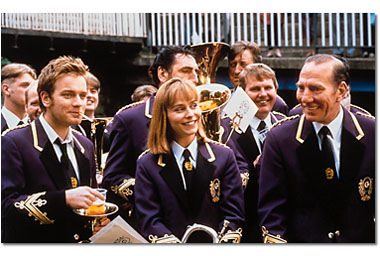 Mark Herman's Brassed Off is a cheery crowd-pleaser set against the Yorkshire coalpit closures during the Thatcher era. Pete Postlethwaite plays Danny, the devoted leader of a brass band struggling for life while its members struggle with the threat of unemployment. When Gloria (Tara Fitzgerald), the glamorous granddaughter of a former band leader, returns with horn in hand to her home town, she jazzes not only the band but her childhood sweetheart Andy (Trainspotting's Ewan McGregor). They're not as impressed to discover that Gloria works for the British Coal Board. Yet Gloria is less of a class enemy than it seems. Just when things fall apart for everyone, including Danny, who is hospitalized with pneumoconiosis, she finds a way to ensure the band's comeback. Brassed Off is as delightful a celebration of working-class life as it is politically naive. For, as the CEO heedlessly but accurately declares, "coal is history." Thatcher's treachery was not in closing the pits but in failing to create viable alternatives for workers stranded in company towns.
"Never underestimate Australians. They're not as silly as they sound." They are and they aren't in Children of the Revolution, a tragicomedy by Australian filmmaker Peter Duncan about the costs of political blind faith. The movie opens as farce with Judy Davis as Joan, a wild-eyed Commie who, on a trip to Moscow, sleeps with both Stalin (F. Murray Abraham) and Australian double agent "Nine" (Sam Neill) in the same night. 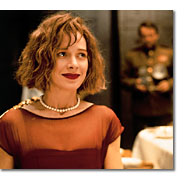 She returns home pregnant, marries
her faithful lover Welch (Shine's Geoffrey Rush), and continues to root
for Stalin long after he lies dead and disgraced. Raised by Welch and visited
by Nine, Joan's son Joe (played by Ben McIvor as a child, Richard Roxburgh as a
grown-up) shows a passion for prisons as a boy and sprouts a bushy moustache
and a penchant for paranoid authoritarianism as an adult. When Joe marries a
cop (Rachel Griffiths of Muriel's Wedding) and rises from prison
officers' union rep to government higher-up, more than his mother's heart is
broken. Children of the Revolution is shot like a documentary but plays
as a situation comedy with an insistent undertone of trouble that erupts into
flat-out tragedy. The shift of tone is jarring, but usefully so in underscoring
the havoc wrought by evil people and their misguided acolytes. One only wishes
that Duncan hadn't conflated doctrinaire communism with all forms of social
protest. She returns home pregnant, marries
her faithful lover Welch (Shine's Geoffrey Rush), and continues to root
for Stalin long after he lies dead and disgraced. Raised by Welch and visited
by Nine, Joan's son Joe (played by Ben McIvor as a child, Richard Roxburgh as a
grown-up) shows a passion for prisons as a boy and sprouts a bushy moustache
and a penchant for paranoid authoritarianism as an adult. When Joe marries a
cop (Rachel Griffiths of Muriel's Wedding) and rises from prison
officers' union rep to government higher-up, more than his mother's heart is
broken. Children of the Revolution is shot like a documentary but plays
as a situation comedy with an insistent undertone of trouble that erupts into
flat-out tragedy. The shift of tone is jarring, but usefully so in underscoring
the havoc wrought by evil people and their misguided acolytes. One only wishes
that Duncan hadn't conflated doctrinaire communism with all forms of social
protest.Ella Taylor is a film critic for LA Weekly.
 
Copyright © 1997 by The Atlantic Monthly Company. All rights reserved. | ||||||||||||
 | |||||||||||||