
Return to the February 1998 A&E Preview Cover
|
Arts & Entertainment Preview - February 1998


B Y A U S T I N B A E R

A More Perfect Union

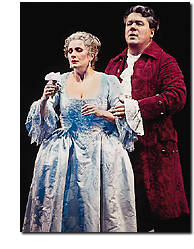 | Håkan Hagegård (right)
|
Just about everyone acknowledges that The Marriage of Figaro is the
perfect opera. But where is a perfect cast? Record collectors (a fanatical
breed) and hoarders of pirated tapes (still more fanatical) tend to find their
favorites in the archives. True enough, stellar artists have been serving
Mozart's wondrous comedy gloriously since the dawn of recorded sound, but the
parade continues. This month the Lyric Opera of Chicago fields what would rank
as a dream ensemble in any age (February 11 - March 8; 312-332-2244, ext. 500).
At the top of the comedy's social ladder are Håkan Hagegård and
Renée Fleming as the jealous philanderer Count Almaviva and his dejected
Countess. Bryn Terfel and Elizabeth Futral appear as their quick-witted
servants Figaro and his bride-to-be, Susanna, on whom the Count has cast his
roving eye. Susan Graham adds to the erotic confusion as the skirt-chasing
pageboy Cherubino, aflame with teenage hormones. Critics often say that
although today's opera stars have a facility with different styles and
languages which earlier generations would envy, they lack the spark of
personality. In the case of the Lyric's Figaro team no such complaint
applies. Terfel, in particular, is a grand original. As Figaro, he never leaves
any doubt of his tenderness for Susanna, yet he has a temper. Departing from
sprightly tradition, he plays a possessive man and a dangerous one. The opera
ends on a famously conciliatory note, but the play by Beaumarchais on which it
is based was incendiary: a harbinger if not indeed a cause of the French
Revolution. Without playing Mozart false, Terfel brings out the
undercurrents.
Another Season Under His Baton
Other orchestras tour with their music directors. For the Vienna Philharmonic
Orchestra that is not an option. Unlike any other symphony orchestra of
significant standing, the VPO is self-governing. The players themselves, not
some authority figure with a stick, take charge of shaping their collective
identity. For its annual visits to Carnegie Hall since 1984 -- concerts
invariably numbered among the season's brightest -- the VPO has deliberately
rotated maestros, drawing from an all-star stable including Karajan, Solti,
Bernstein, Maazel, Abbado, Levine, Ozawa, and Barenboim. This year's leader is
Riccardo Muti, which is cause for special celebration. His seasons as the music
director of the Philadelphia Orchestra, from 1980 to 1992, live in memory as a
golden age, but of late the maestro has been a stranger to his American public,
dividing his time chiefly between Milan's fabled opera house, La Scala, and the
VPO.
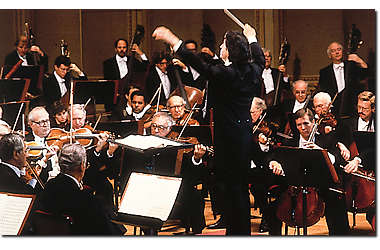
Riccardo Muti conducting the VPO
An immaculate technician blessed with a rare dramatic intensity and an
exceptional flair for pulse and color, Muti has long enjoyed a unique
rapport with the VPO. Paradoxically, material that the players possess as if by
birthright sounds under his baton not "classical" but fresh-minted.
The New York programs begin with Mozart, in which the Muti-VPO partnership
sets standards for transparency, grace, and sense of drama. Muti makes no
specialty of Mahler, whose largely tortured, self-lacerating canon he mostly
leaves to others, but his reading with the VPO of the sunny Symphony No. 4
casts a golden glow. Beethoven, Brahms, and Hindemith complete what will surely
be three evenings to remember (February 27 - March 1; 212-247-7800).
The Gospel According to Bach
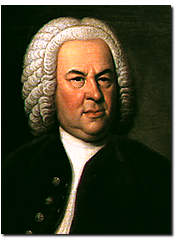 | Bach's Passion comes alive
|
In the history of Western painting and sculpture Jesus Christ has been a
superstar for centuries. In music only Johann Sebastian Bach ever brought Him
to life in any fashion that music lovers and the faithful deem sufficient. In
fact, he did so more than once, but most memorably in the majestic St.
Matthew Passion. The oratorio interpolates ornate arias and chorales in a
congregational style into a setting of the gospel text that is mostly spare in
the extreme. The part of Jesus adds not a syllable to what we read in the
Bible. Except for His last words ("My God, why hast Thou forsaken me?"), His
utterances are accompanied by the string section, creating a halo of sound, but
only once does the vocal line rise to true song. The passage occurs during the
Last Supper, when Jesus invites the disciples to drink the wine. This month, in
performances by the New York Philharmonic under Kurt Masur, these haunting
lines are entrusted to Matthias Goerne (February 12 - 17; 212-875-5030). At
Easter time Wolfgang Holzmair delivers them with the Boston Symphony Orchestra
under Seiji Ozawa, in Boston (April 8 - 11; 617-266-1200) and at Carnegie Hall
(April 15, 16; 212-247-7800). These are artists between whom it is simply
impossible to choose. Goerne's is the more dramatic instrument, Holzmair's the
more lyrical. But on recent albums of Schubert songs (Goerne's on Hyperion and
London, Holzmair's on Philips) both baritones reveal the same almost scary
ability to dive beneath the surface, capturing in an inflection the deepest,
most evanescent states of soul and mind.
Austin Baer is a writer based in New York.
Go to ...
 
Copyright © 1998 by The Atlantic Monthly Company. All rights reserved.
|