
Return to the July 1998 A&E Preview Cover
|
Arts & Entertainment Preview - July 1998


B Y A U S T I N B A E R

Stanley Sings (Sort Of)

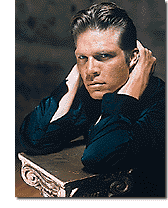 | Rodney Gilfry
|
Working with a living composer always brings a few
surprises. When Rodney Gilfry, the athletic California-born baritone whom
glossies have variously dubbed the Matthew McConaughey and the Brad Pitt of
opera, was studying the score of André Previn's new opera, A
Streetcar Named Desire, he couldn't tell if the top note in a certain
passage for Stanley Kowalski (Gilfry's part) was a G-flat or a B-flat. In Act
I, which had already been printed, such problems did not arise. But this was
Act II, which at this point existed only in far-from-tidy manuscript. Gilfry
needed to know, so he asked. Previn's answer, in effect: What would you
like it to be? "B-flat's a little high," the singer observed, "but I could
do it in falsetto." A reporter wonders: would Stanley, the husky "Polack"
who made a star of Marlon Brando and a fashion statement of torn T-shirts, sing
falsetto? "Good point," Gilfry answers, allowing that when he first looked at
the music, he felt a little disappointed. The lustrous soprano Renée
Fleming, who sings the snooty, sex-starved, self-deluding Blanche ("I have
always depended on the kindness of strangers") Dubois, gets an aria. So does
Elizabeth Futral, the eye- and ear-catching soprano who plays her sister,
Stella, working-class by marriage to Kowalski. "From a selfish point of view,"
Gilfry says, "I asked myself, What is there for me? But then I realized,
Stanley is a character with no music in him. André has really caught
that. It's a great role, but it isn't about voice." A pity, in a way, since
Gilfry's instrument has stood out for its suave beauty in roles from Mozart's
Don Giovanni to Britten's Billy Budd, in which looks also happen to matter.
But when the curtain of the San Francisco Opera rises on Streetcar's
world premiere, count on Gilfry for the animal magnetism that Tennessee
Williams was banking on above all else when he wrote his classic play
(September 19-October 11; 415-864-3330).
Umbrella, Adieu
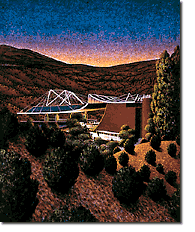 | The new Santa Fe Opera House
|
When rain falls in the desert, all kinds of strange flora sprout in a hurry, and few strains more instantaneously than the garden variety umbrella in the middle rows of The Santa Fe Opera, with its auditorium open to the sky. As of this
season, however, the nylon forest -- one of the quaintest phenomena on the
international festival scene -- is gone for good, and few are likely to mourn
its passing. The time-honored opera house has given way to a new, improved
model that preserves the best features of the old (sides and back of the stage
open to the awe-striking New Mexico skyscape) while correcting that one
egregious design flaw. Of the season's five offerings, the impeccably cast
Beatrice and Benedict (July 18, 22, 31, and August 6, 13, 20;
505-986-5900), adapted from Shakespeare's Much Ado About Nothing by
Hector Berlioz, should prove the most entrancing. Aptly enough, its loveliest
pages are a duet sung at night in a garden. Adding to its impressive list of
thirty-five American premieres in forty-one seasons, the company presents A
Dream Play, drawn from August Strindberg's symbolist drama by his fellow
Swede Ingvar Lidholm. As is usual at Santa Fe, the casts and production teams
for these works, and for the more familiar Madama Butterfly, The
Magic Flute, and Salome, have been chosen with exceptional care. Now
that visibility is no longer weather-dependent, the only potential problem is
the racket of raindrops (or hailstones) on the roof.
Following in Bach's Footsteps
If the composer Krzysztof Penderecki, of Poland, does not go down in music
history as the conscience of our century, it won't be for lack of trying. Since
making his name with the soul-searching Threnody for the Victims of
Hiroshima, in 1959, he has weighed in with the St. Luke Passion, the
Polish Requiem, and The Seven Gates of Jerusalem. The severe,
jagged, often violent character of his scores has never prevented them from
gaining wide appeal. Though never ingratiating, they convey messages that
demand to be heard. Penderecki's latest is Credo, an hour-long setting
of the most personal section of the liturgical mass -- for a believer, the most
austere yet universal text of all. It receives its world premiere on July 11,
closing night of the Oregon Bach Festival, in Eugene, under the baton of the
artistic director, Helmuth Rilling. Weighty fare for a summer eve, but that is
the sort of festival that Rilling runs. And talk about raising the stakes. On
opening night, June 26, Rilling pairs Penderecki's creed with J. S. Bach's own
Mass in B Minor, a monument to the expression of faith by musical means that to
date remains unsurpassed. For full details on the festival call 541-682-5000.
Austin Baer is a writer based in New York.
Go to ...
 
Copyright © 1998 by The Atlantic Monthly Company. All rights reserved.
|