
Return to the March 1998 A&E Preview Cover
|
Arts & Entertainment Preview - March 1998


B Y B O B B L U M E N T H A L & C H A R L E S M. Y O U N G

Group Effort

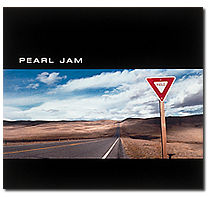 | The Seattle sound moves on
|
Despite a worshipful response to their multiplatinum first album, Ten
(Epic), Pearl Jam inspired a certain cynicism and accusations of pretension and
narcissism with their subsequent efforts. Yield, their fifth album,
feels like a declaration of partial compromise with their critics. "I'm not
trying to make a difference," Eddie Vedder chants in the song "No Way." But he
hasn't given up his artistic ambition either. If he's yielding to anything,
it's the creative process in the context of a group. All the members of Pearl
Jam contribute fully to the writing here, and it feels like they've learned
something about songcraft over the years, leading to a band and an album that
are greater than the sum of their parts. Stone Gossard and Mike McCready have
been justly celebrated as a guitar duo, providing grit in the riffs and fire in
the solos throughout their career, but have achieved here an organic interplay
and musicality that equals and sometimes transcends Ten. The bassist
Jeff Ament contributes two songs: "Pilate," about losing yourself (inspired by
the novel The Master and Margarita), and "Low Light," about finding
yourself. Not a new theme, exactly, but certainly an apt one at this point in
his band's career. The opening cut, "Brain of J," is a frenzied, surreal
speculation on the true outcome of JFK's autopsy, setting the tone with a
bizarre element of modern mythology. Watch for the single "Given to Fly," about
a benign messiah coming to terms with his power: the guitars are monstrous, and
U2 will wish they wrote it. Given Pearl Jam's long-standing fight with
Ticketmaster, there's no telling how or when or if they'll tour. If they do,
it'll be an event. --C.M.Y.
Free To Do Her Own Thing
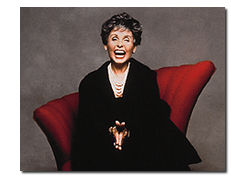 | Lena Horne as herself
|
At age eighty, Lena Horne is looking as beautiful as ever. Her new album,
Being Myself (Blue Note), reveals that the years have been just as kind
to her voice.
One critic has described Horne's singing as "jazz-friendly rather than
jazz as such," but her mobile phrasing and quietly insistent beat are as much
the mark of a jazz singer as scat interludes. She knows how to inhabit her
material, a talent that gives her interpretations of such standards as
"Imagination" and "Willow Weep for Me" the weight of an instrumental
improvisation.
Horne has stated that with age she has been freed of the need to conform to
show-business stereotypes. In the context of Being Myself this means
that the oversized productions that usually surround vocal icons have been
stripped away. Only two tracks include a string section, and these remain
within the intimate bounds of the other performances, in which Horne is
supported by a rhythm section and an occasional saxophone. This is the
equivalent of an unretouched photo for someone of Horne's age, yet her voice
retains the insinuating strength that has always marked her work. She gets help
from several outstanding musicians in sustaining the after-hours mood, with
major credit going to Rodney Jones, her producer and guitarist, a probing
experimenter in other contexts who trims his conceptual sails for bluesy solos
on "How Long Has This Been Going On?" and "After You" that almost upstage the
diva. --B.B.
Not Far From the Madding Crowd
In interviews to support last year's double live album Living in Clip
(Righteous Babe), Ani DiFranco disparaged much of her past studio work as
sterile. Her first love is performing, she explained, and she needs crowd
chemistry to emote properly. Most of her fans would disagree with that
analysis, and on her latest studio album, Little Plastic Castle, they
have conclusive evidence that they're right.
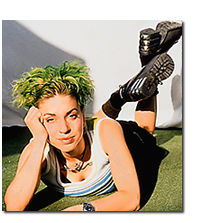 | Punk-folk diva Ani DiFranco
|
Not that they needed much. Since
founding her own label, at the age of twenty, in 1990, DiFranco has built a
legend on her spectacular reinvigoration of folk music and her ferociously
independent business sense in refusing to sign with any of the usual
entertainment conglomerates. Accompanied by bass, drums, her own acoustic
guitar, and an occasional horn on LPC, DiFranco emotes properly and then
some, hooking you with the versatility of her voice and the mostly mid-tempo
grooves of her band. She does not hook you with simplistic sentiments and
booming, chanted choruses. In other words, she writes like a poet rather than a
lyricist, and you have to listen more than once to figure out what's going on.
And what is going on? DiFranco cogitates on the individual versus the generic,
the real versus the unreal, history versus the minute details that make
and break relationships. Her feminism emerges at odd intervals when she wants
to underline a larger point, but it's well anchored in sharp, original
observation. Sometimes she dispenses with words altogether, vocalizing in
something that is halfway between baby talk and scat singing. Whether she's
articulating or inarticulating, DiFranco leaves you with that feeling of
freedom that just isn't available on television. --C.M.Y.
Bob Blumenthal is a jazz critic for The Boston Globe.
Charles M. Young reviews popular music for Playboy, Musician, and other publications.
Go to ...
 
Copyright © 1998 by The Atlantic Monthly Company. All rights reserved.
|