
Return to the May 1998 A&E Preview Cover
|
Arts & Entertainment Preview - May 1998


B Y E L L A T A Y L O R

The Con Games People Play

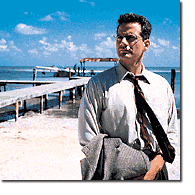 | Scott is caught in
the scam
|
If it were merely another clever
thriller about corporate intrigue, David Mamet's new movie would still be a
great night out at the multiplex. But The Spanish Prisoner is also a
malevolently funny chapter in the chronicles of the great con game that, in the
gospel according to Mamet (who wrote the screenplay for the serendipitously
topical Wag the Dog), lies at the core of American life. Campbell Scott
plays ordinary Joe Ross, an honest but insecure young go-getter from the wrong
side of the tracks who, while trying to reap his cut of the profits from a
"formula" he invented for a "process" in a company whose product is never
named, becomes the bull's-eye in multiple stings by strangers claiming to be
his protectors. Accepting an offer of help from the high-living Jimmy Dell
(played with casual menace by Steve Martin), who may or may not be a
businessman, Joe finds his world transformed into an ominous funhouse of
portents and coincidences that are either pregnant with meaning or entirely
without significance. Each successful con forces Joe back on a new rescuer,
until he comes to rest, or so he believes, under the wing of a pretty and
apparently ingenuous company secretary (Rebecca Pidgeon). Couched in the
deliberately stilted dialogue and stiff acting that in Mamet's work flags the
treachery of received language and manifest reality, this elegantly tailored
movie reaches into and beyond the conventions of the thriller to comment on the
lethal stew of innocence, deception, and venality that is, in every sense,
business as usual in America.
Desperate Times
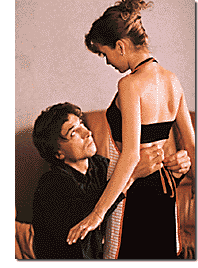 | A comedy of errors
|
Set in brassy post-Soviet Ukraine, where fortunes are made overnight on the
wrong side of the law while ordinary citizens barely scratch out a living, A
Friend of the Deceased (Ukraine's entry for Best Foreign Film at this
year's Academy Awards) stars the sultry Alexandre Lazarev as Anatoli, a Kiev
translator demoralized into near-catatonia by unemployment and the imminent
departure of his wife, a qualified philologist making her pile as an
advertising executive. The desperate Anatoli hires a hit man to kill him, and
when the hit is temporarily aborted, heads for a drunken night on the town,
only to find himself trapped in a seedy, anarchic hell run by mobster
entrepreneurs. An equable man, and obedient to a fault, Anatoli livens up as he
becomes entangled with a variety of kooks -- a vivacious hooker, a contract
killer who prefers to stay home and fish, a pretty young widow bizarrely
linked to Anatoli by her husband's death -- who, like him, compromise their
fundamental decency daily as they struggle to stay afloat. Ukrainian director
Vyacheslav Krishtofovich, who made the charming 1991 film Adam's Rib,
about three generations of Soviet women living in a tiny apartment, brings the
same ruefully comic edge to this understated drama of a world bustling with new
wealth and opportunities, yet jeopardized by near-total normative collapse.
"Friendship disappeared with our glorious Soviet past," sighs Anatoli's old
comrade and benefactor, at once sardonic and wistful. "Now there's no
friendship -- only business relationships."
Britain's Back-to-the-Land Movement
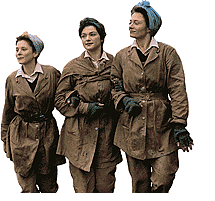 | The land girls
|
Heartening though it is to see modest little films like The Full Monty
and The Crying Game earn box-office gold this side of the Atlantic, the
trend also has its downside. While American distributors snap up British
comedies with more haste than discrimination, a freshly juiced British film
industry happily lobs indifferent TV movies across the water as fast as they
can be cobbled together. One such is The Land Girls, a Second World War
tale that manages to tame its promising material -- the story of the young women
who fanned out through the British countryside to work the farms while the men
went into battle -- into such rosy flab that you feel as though you're trapped
for life inside a particularly mushy Hallmark card with a hint of
bodice-ripper. Directed by David Leland, who made the far superior Wish You
Were Here, the movie stars Catherine McCormack (who played Mel Gibson's
doomed wife in Braveheart), Rachel Weisz, and Anna Friel as three
dewy-eyed maidens, carefully accented to run the gamut of the English class
structure, who till the soil for a farm couple by day and vie for the body of
the couple's handsome son (Steven Mackintosh) by night. Much female bonding and
quarreling ensues, amorous fortunes rise and fall, the group becomes a family,
and the occasional enemy plane crashes and burns for added excitement.
Banalized into insignificance, the true drama of the land girls' heroic and
largely unsung role in the war slinks off, unnoticed, into deep background. The
1940s dresses, however, are to die for.
Ella Taylor is a film critic for LA Weekly.
Go to ...
 
Copyright © 1998 by The Atlantic Monthly Company. All rights reserved.
|