
Return to the October 1998 A&E Preview Cover
|
Arts & Entertainment Preview - October 1998


B Y A U S T I N B A E R

Dutch Treat

Well before the director Julie Taymor woke up Broadway and made her fortune with The Lion King, her wizardly theater of masks and puppets was attracting convention-averse opera impresarios on three continents. For Seiji Ozawa's Saito Kinen Festival, in Japan, she mounted Stravinsky's Oedipus Rex, eerily haunted by ravens. Since then Mozart's The Magic Flute has taken her to Italy, Richard Strauss's Salome to Russia, and Wagner's The Flying Dutchman to Los Angeles. A revival of Dutchman now opens the Houston Grand Opera's new season (October 23-November 8; 713-227-2787). In Los Angeles, Taymor's Dutchman was best regarded as a work in progress. A recurrent mime sequence featured a stooped old émigré shuffling wearily toward a park bench that pulled away every time he tried to sit down. This was the Wandering Jew, the Dutchman's prototype, and each time he appeared, the audience's hilarity grew louder.
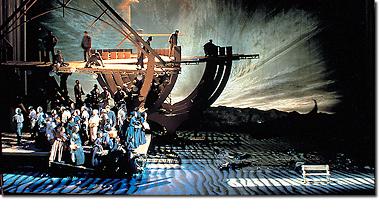
Taymor's The Flying Dutchman
Now these problematic episodes are undergoing total revision, and puppet passages previously omitted on financial grounds are seeing the light at last. If everything falls into place, the Houston Dutchman could be one of the defining opera productions of the nineties. Even as it was, the Los Angeles vision at its best proved Taymor's genius for dressing the tale of sin and redemption in images of all but primal power. At one point a flotilla of model ships sailed by: hats borne on the heads of unsmiling women in billowing skirts who strode purposefully across the stage. They were a sea personified, and at floor level, unregarded by those mighty goddesses, male dancers (naked or nearly so) went swimming by like leviathans of the deep. At moments like these Taymor's Dutchman matched the majesty of great set pieces of The Lion King. (The music, need we add, is a good deal better.)
Manageable Mahler
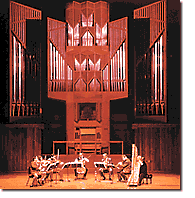 | The Chamber Music Society
of Lincoln Center
|
Now that CD buyers can listen to virtually anything they want on demand, we forget how rare the opportunity to hear a given piece of music used to be. This month the Chamber Music Society of Lincoln Center drives the point home in somewhat uncommon fashion. On October 18 and 20 the principal work on the program is Gustav Mahler's sprawling six-movement song cycle Das Lied von der Erde (The Song of the Earth). It is not an especially noisy piece -- much of it is in fact very quiet. But for every timbre Mahler imagined, he posited the instrument and the player, and his palette was immense. Performances early in the century were too scarce for the liking of Arnold Schoenberg, so he arranged Das Lied -- as he and his circle arranged other works by their contemporaries -- for more manageable forces, replacing Mahler's grand panoply with just thirteen players. The Chamber Music Society fields an all-star ensemble for the occasion, several members (such as the flutist Ransom Wilson and the violinists Ani Kavafian and Cho-Liang Lin) taking time out from major solo careers. The vocalists merit special attention too. The punishing, high-flying tenor part is sung by Anthony Dean Griffey, a strapping young powerhouse whose performance as Lennie in Carlisle Floyd's Of Mice and Men at Glimmerglass Opera, the closely watched summer festival in Cooperstown, New York, served notice that a major talent had arrived. (Next month Of Mice and Men travels to the New York City Opera; for tickets call 212-307-4100.) The soulful mezzo-soprano part, blessed with perhaps the most deeply otherworldly music Mahler ever wrote, goes to Lorraine Hunt, an artist who makes every phrase she sings indelibly her own. If this is not the performance Mahler imagined, it should be one that would have touched him to the soul. (For tickets call 212-875-5788.)
Ives Lives
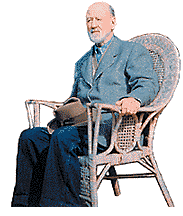 | Charles Ives
|
A world premiere by Charles Ives? More than four decades after the death of the rugged eccentric, the prospect would seem, to put it gently, remote. Yet exactly that is promised by Christoph von Dohnányi, the Cleveland Orchestra, and the pianist Alan Feinberg at Cleveland's Severance Hall (October 1-4; 800-686-1141). The Emerson Concerto, as the piece is called, shares material with the widely performed Concord Sonata. Ives, it seems, despaired of hearing any of his orchestral works performed. That fact goes far toward explaining the chaotic state of the manuscript of his heaven-storming Universe Symphony, which could not be realized without tremendous leaps of faith (and much conjecture). The Emerson Concerto, Feinberg says, presents no such editorial problems, though he describes the demands on the pianist as "hair-raising." Feinberg, a specialist in what might be termed outsider music, with more than 200 premieres to his credit, is just the man to take them on. Dohnányi's credentials and the Cleveland's, of course, are every bit as impressive.
Austin Baer is a writer based in New York.
Go to ...
 
Copyright © 1998 by The Atlantic Monthly Company. All rights reserved.
|