

Return to the February 1999 A&E
Preview Cover
|
Arts & Entertainment Preview - February 1999

B Y B O B B L U M E N T H A
L & C H A R L E S M.
Y O U N G

An Eye on Spy

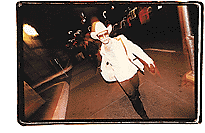 | Joshua Ralph of Spy
|
The problem with all the techno-weirdness that was supposed to take over
the world a couple of years ago was that it could catch the
ear but not hold it outside a dance club where the spinal column could
undulate properly. To hold the ear in other environments, you need a song
with structure and hooks. On Music to Mauzner By (Lava/At-
lantic), Spy sounds state-of-the-techno-weirdness-art, with its dizzying,
computerized manipulations of sound, but it's also got highly distinctive,
often hilarious songs. And it drops a large dollop of humanity on
techno-weirdness with its use of vintage instruments played by live human
beings on many tracks. Spy consists mostly of Joshua Ralph, a
twenty-three-year-old graduate of New York University's film school, whose
good-natured bellowing in a variety of styles from around the world takes
your mind off computer chips in a sterile recording studio. Biggest
surprise: first single, "Baby." It rollicks, is irresistibly danceable, has
an insanely catchy hook, and will garner some early nominations for "Song
of the Year." Imagine Nine Inch Nails in a happy mood. There isn't much to
analyze: "Baby baby, every time I get next to you/Baby baby, all I want is
what's next to you." But then who wants to analyze when you're chanting
along? Second biggest surprise: the final cut, "Untitled 17." It's a
classical composition recorded with a fifty-six-piece orchestra. The melody
is so gorgeous that you assume you must have heard it when Lee surrendered
to Grant in Ken Burns's Civil War documentary. In between, the only fault
you'll find is the occasional chorus stretched too far, which isn't much of
a fault. "Baby" and "Untitled 17" alone would be worth the price of the
album. Truly an important debut. And what does it mean to "mauzner"? Ralph
has a wild and adventurous friend by that name. With a little luck and
proper marketing, he'll enter the language.
--C.M.Y.
Earth Tones
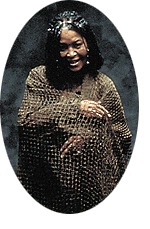 | Abbey Lincoln
|
Abbey Lincoln has always dealt in broader issues than moon-June romance. In
the early sixties she became jazz's unflinching voice of the civil-rights
movement. After an extensive period when her focus shifted to acting,
Lincoln has re-emerged as a sage who meditates on simple joys and
transcendent possibilities of the universe. Lincoln has carried off this
precarious artistic pose in a series of albums without sappiness or
true-believer zeal. Wholly Earth (Verve), her latest collection of paeans
and parables, is another lesson in how to mesmerize and instruct. To a
gritty voice that recalls Billy Holiday in texture and emotional
commitment, Lincoln adds personal magnetism and a knack for fashioning
programs as surely paced as they are eccentric. She borrows from films,
building the sky-seeking "Another World" out of the main theme from Close
Encounters of the Third Kind, and finding unexpected depth in "If I Only
Had a Brain." But she also creates her own stark original melodies, which
are featured on the majority of the tracks. Record companies love to deploy
artists on their rosters as special guests, and Verve has provided two name
sidemen for Lincoln. The young trumpeter Nicholas Payton banks his usual
fire in four reflective supporting appearances, while Bobby Hutcherson, who
is simultaneously releasing his own invigorating album, Skyline, adds an
international flavor with his vibes and marimba that make Lincoln's musings
quietly bristle.
--B.B.
The Elements of Jazz
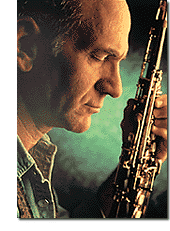 | David Liebman
|
David Liebman may be the most prolific recording artist in jazz. In
addition to discs by his working quintet, the soprano and tenor saxophonist
has produced numerous special projects, including tributes to his idol John
Coltrane and his former employer Miles Davis. Liebman reveals his most
personal ideas on album-length suites with nature themes. The Elements:
Water (Arkadia Jazz) is the first of a four-CD cycle, and it takes a
lyrical opening theme through calms and storms. The bassist Cecil McBee and
the drummer Billy Hart, who partnered with Liebman on his poetic The
Seasons (Soul Note), bring the same eloquence to this more nuanced
cycle, while Pat Metheny adds a critical fourth voice, on guitar, that
alternately soothes and cries. Moving among two acoustic models and a
forty-eight-string Picasso guitar that has the enveloping quality of a
harp, Metheny reinforces the work's thematic distinctions. Relentless
power, a Liebman trademark, is stressed in such movements as "White Caps"
and the climactic "Ebb and Flow"; yet he also takes his primary horn, the
soprano sax, into gentler areas on "Heaven's Gift" and "The Baptismal
Font." Notwithstanding the affinity demonstrated by this particular
quartet, Liebman promises a different ensemble for each succeeding element.
--B.B.
Bob Blumenthal is a jazz critic for The Boston
Globe.
Charles M. Young reviews popular music for Playboy, Musician, and
other publications.
Go to ...
 
Copyright © 1999 by The
Atlantic Monthly Company. All rights reserved.
|