
Return to the January 1999 A&E Preview Cover
|
Arts & Entertainment Preview - January 1999


B Y A U S T I N B A E R

Born of Silence

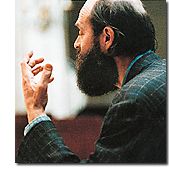 | Arvo Pärt
|
Kanon Pokajanen, a major new score by the Estonian mystic Arvo Pärt, is a setting of a canon of repentance attributed to Saint Andrew of Crete (ca. 660-740). Eighty-three minutes of a cappella chant in ancient Church Slavonic may seem a recipe for ungodly tedium, but the recording by the Estonian Philharmonic Chamber Choir under Tõnu Kaljuste offers sheer transcendence (ECM New Series). Listening without attempting to follow the text, you may be startled to hear words you understand (within the first few moments, "Israel" and "Pharaoh"). That, in turn, may move you to read along -- no easy proposition. The liner notes include the original plus translations into English, French, and German, but they are printed one after another, rather than parallel. Even for someone with a knowledge of Cyrillic, Church Slavonic poses problems in the form of unfamiliar letters and numerous abbreviations. Perseverance pays off, because Pärt's inspiration derives from the cadences of the language, which start to register more quickly than you might think possible. But even the unaided ear can hear both the strict musical grammar of Kanon Pokajanen and the wondrous flexibility of its poetic expression. Recurrent formulae -- cries for mercy, benedictions, and the like -- keep changing, like spontaneously mutating carillons. Music springs from silence to which it is destined to return, and the soul communes with the eternal. There are truths here beyond doctrine.
A Sympathetic Ear
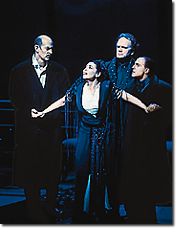 | Janácek's
The Makropulos Case
|
One Saturday afternoon last April the American soprano Catherine Malfitano celebrated her fiftieth birthday at the Met as the protagonist of Leos Janácek's The Makropulos Case. Broadcast live around the world (audio only, alas), it was a performance few who witnessed it will ever forget. Malfitano's role -- a sort of female Dorian Gray -- is an enigmatic, egomaniacal diva with a past. Despite her ravishing voice and looks, she is 337 years old. But time is running out on her at last. Without another dose of the elixir she drank three centuries ago, she will soon have warbled her last. The opera revolves around her attempt to recapture the formula, and her realization that immortality is no blessing -- that what makes life worth living is the prospect of death. The Met's first attempt, a few seasons back, starring Jessye Norman, was a disappointment on virtually every count. But with Malfitano blazing at the center -- a harpy with a heart of ice warming at last to the pathos of her common humanity -- even the undistinguished production suddenly looked magnificent, and the music took fire. Impresarios wax sanctimonious about Janácek, congratulating themselves when they put on his operas and letting audiences know that he is good for them. But it takes performances of genius to lift the exercise beyond the realm of the academic. Malfitano's sympathy with his characters and their music runs deep. Three cheers for
the Met, which has asked her back to anchor this season's revival of Kát'a Kabanová, an unsparing study of emotional tyranny, adultery, and suicide on the banks of the Volga (January 2, 5, 9, 13, 16, 21; 212-362-6000).
Rolling Along
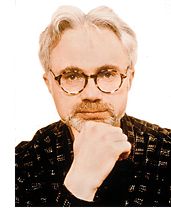 | John Adams
|
"I was listening very late one night to recordings of piano-roll music from the 1920s -- everything from Jelly Roll Morton and Gershwin to Paderewski and Rachmaninoff. No matter what the music was, when it was translated through the medium of the piano roll, it came out on the other end with a unique quality to it that could not have been imagined by either a composer or a performer. I used that impression as a conceit for a sound world to base a piano concerto on." Thus the composer John Adams, on whose voluptuously patterned music the label of minimalism sits a bit awkwardly, explains the background of Century Rolls, which The Philadelphia Orchestra introduces to its audiences January 8, 9, and 12 (215-893-1999). "The idea isn't literal but sort of poetic. I wanted to get that slightly punchy, highly energized quality that the piano roll seemed to give to every piece. And since I was writing for one of the most poetic and least mechanical pianists on the planet, I certainly didn't want to turn him into an automaton." That pianist is Emanuel Ax, who has already played the piece on two continents. "It's an amazing experience," the composer reports. "It has really challenged him to go into new areas, particularly rhythmically. My music -- this piece in particular -- owes a lot to jazz and a kind of spiky, syncopated style of performance that's light years away from
Schubert, Brahms, and Chopin, which are his normal habitat."
Austin Baer is a writer based in New York.
Go to ...
 
Copyright © 1999 by The Atlantic Monthly Company. All rights reserved.
|