

Return to the March 1999 A&E
Preview Cover
|
Arts & Entertainment Preview - March 1999

B Y N A N C Y D A L V
A & J O H N I S T E L

Taylor Made for Spring

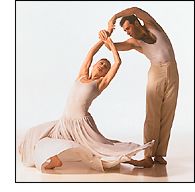 | Paul Taylor's Roses
|
That perfect harbinger of spring, the Paul Taylor Dance Company, swoops into New York's City Center this month (March 2-14; 212-581-1212), and then moves on to a tour of California (Santa Rosa, March 27; Acadia, April 3; San Francisco, April 7-18; Santa Cruz, April 20; Escondido, April 22; Glendale, April 24-25). To Manhattan, Taylor brings a couple of new works and a compelling list of revivals that includes the 1976 Cloven Kingdom. This quirky, dark-minded romp boasts a peerless men's section -- leaping, incredibly handsome guys wearing tuxedos, and holding their hands like rabbit paws. The entire divinely memorable dance is deeply rooted in the contradictions that make up human nature. Another revival, the 1985 Roses, represents the choreographer at his most romantic and his most classical. Taylor being Taylor, he manages both modes at the same time, creating an Elysian playground where lovers meet in a series of ravishing duets. There is no dance more beautiful than this one anywhere, with the exception of Balanchine's shimmering Liebeslieder Waltzer. Roses shimmers too, yet is infinitely more playful. (One viewer has called it, with a nod to the Wagner score, "Prom Night at Valhalla.") Also on the revival slate is Taylor's Nightshade, a Gothic nightmare of transcendent loopiness. The pleasure in seeing these older pieces highlights one of the great ironies of creative art: long after the artist has moved on to something else, the audience seeks out, again and again, what it knows and loves. With literature the book resides on the shelf, waiting to be read. With paintings it is much the same. But with dance the only way we get to see old works is in seasons like the Taylor Company's, when the choreographer indulges us with another look at the beloved. Even then the revisit has its perils: Will the current cast live up to the cast we first saw? Is the dance all that we remember? With Paul Taylor the answers are always yes and yes. Don't miss it.
--N.D.
Sharpshooters
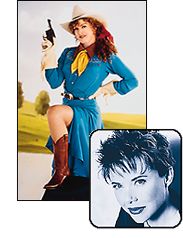 | Bernadette Peters (top)
and Annette Bening
|
Except for their obsession with pistols, the stage characters Hedda Gabler and Annie Oakley don't have a lot in common. This month, however, each character strides onstage in a high-caliber revival: Annette Bening shoots for Hedda in Ibsen's classic at the Geffen Playhouse, in Los Angeles; Bernadette Peters plays the eponymous sharpshooter in Irving Berlin's Annie Get Your Gun, which opens at the Kennedy Center in Washington, D.C., and then goes to Broadway. Bening hasn't been onstage since her heralded New York debut, more than ten years ago, in Coastal Disturbances -- she's been too busy getting good film notices (The Seige, The Grifters) and raising her children with her husband, Warren Beatty. The Geffen's creative team promises to make her return a memorable one: Dan Sullivan (The Heidi Chronicles) directs Hedda Gabler in a new adaptation by the acclaimed playwright Jon Robin Baitz. In some ways Peters has the more difficult task: she confronts the memory of Ethel Merman, who originated the role of Annie in 1946. Luckily, like Bening, Peters gets strong artistic backup: Peter Stone (Titanic, 1776) has rewritten Herb and Dorothy Fields's outdated libretto, deepening the character for Peters while ditching the lines originally written expressly for La Merm. Although both projects insist that, indeed, you can't get a man with a gun, they do suggest that with top-of-the-line talent and a willingness to rewrite, you can produce a show as close to a sure shot as show business knows.
--J.I.
Deep Freeze
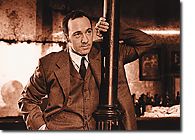 | Kevin Spacey in The Iceman Cometh
|
From the raunchy joke that gives the play its title -- and ultimately its tragedy -- to its four-and-a-half-hour length, The Iceman Cometh serves as Eugene O'Neill's most audacious work. Taking place in a single night in a seedy Bowery bar in 1912, the play centers on Hickey, a salesman for whom the denizens of Harry Hope's bar rapturously wait. As they slurp and sleep, lulled by the opiate of their own "pipe dreams," O'Neill goes for broke. Who else would dare to combine the overt symbolism of characters named Harry Hope and Jimmy Tomorrow with bouts of hyper-reality that make Gorky's Lower Depths look like a nineteenth-century tea room, and then top it off with an intoxicating deluge of language, culminating in Hickey's final fifteen-minute confessional monologue? José Quintero's first production, in 1956 at Circle in the Square, ten years after Iceman's debut, fueled the off-Broadway movement, and ran for more than 500 performances -- the most of any O'Neill play. Its action in inaction predicted Waiting for Godot; its skewering of American optimism suggested Death of a Salesman; and its jokey morbidity prepared the way for the onslaught of irony and the theater of the absurd. After Quintero stunningly remounted this dramaturgical Everest in the early 1980s, with the premier O'Neill interpreter Jason Robards as Hickey, few would have expected to see another first-class production in their lifetime. Starting March 29 one of America's finest stage actors, Kevin Spacey, appears as Hickey in the award-winning British production directed by Howard Davies (Brooks Atkinson Theatre; Tickets 212-307-4100). Don't miss this chance to visit Harry's saloon.
--J.I.
Nancy Dalva's essays appear in the magazine 2wice.
John Istel is a senior editor at Stagebill.
Go to ...
 
Copyright © 1999 by The
Atlantic Monthly Company. All rights reserved.
|