The Mysterious, Enchanting Qualities of Chocolate
Its flavor can transport you, maybe not always to faraway places but certainly out of reality.
The piano was a grand, not a Steinway or a Fazioli, but like them it had a curve that made me want to trace its shape through the air with my finger. Despite its narrow legs, the piano did not teeter as the impeccable waiter carried it on a silver platter and set it down before me. I was 7 years old and sitting with my mother, as I did every afternoon that summer, at a small, round table at Confiserie Sprüngli in Zurich, perhaps the most famous temple of chocolate in Switzerland. Sunlight poured in through the tall second-floor windows, bathing the café in warmth and cheer.
The dessert was a masterpiece: a dark-chocolate body so smooth it glistened, white-chocolate keys, minor notes of a chocolate so dark as to be almost black, foot pedals brushed in gold leaf. Its lid was propped open on a thin rod, revealing an interior of milk-chocolate mousse so light that it vanished on my tongue, leaving an echo that lingers more than 40 years later. Adding to the magic was a small chocolate stool. I spent a few moments studying the fine treble and bass strings drawn across the mousse with, I imagined, the tines of a small fork. Later, I carefully wrapped the stool in a napkin and brought it to our hotel. My hunger for fantasy prevailed over my appetite.
We were not in Switzerland for happy reasons. My father, following a car crash in Spain, had been transferred to the intensive-care unit at a hospital in Zurich. After long mornings at my father’s bedside, my mother and I arrived at Confiserie Sprüngli weary and afraid. She bore the mature burden of knowledge. I, however, was able, for an hour or so, to lose myself in the dream of my chocolate piano. How could tragedy occur in the face of such delicious perfection? After all, chocolate promises a happy ending. It can transport you, maybe not always to faraway places but certainly out of reality.
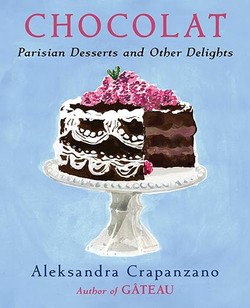
When I was 10, we moved to Paris and I became an incurable Francophile—a pleasurable condition I continue to indulge. I came of age in Paris; it was my culinary awakening, and other lovely awakenings happened there, too: first kiss, first love. Although it is undeniably true that Switzerland, right next door to France, makes some of the very best chocolate in the world, it is also undeniably true that many of the most beloved chocolate desserts in the world had their origins in France. It’s nearly impossible to walk for more than five minutes in Paris without passing a chocolaterie. These are serious temples of pleasure, with irresistible aromas wafting out and window displays beckoning with equal measures of art and enticement. And they are the sights, scenes, and tastes of my childhood—my Proustian madeleine, if you will, is made of pure French chocolate, an ingredient so delicious and evocative that it inspired my new cookbook, Chocolat: Parisian Desserts and Other Delights.
Chocolate is different from other sweets, imbued with properties that reach beyond the palate. The Maya hungered for it thousands of years ago, believing it to be the elixir of the gods. Its history is marked both by those who celebrated its mystical powers and by those who were convinced it was the devil’s temptation. But the French, above all, have been positively intoxicated by chocolate for a good four centuries. In 1615, Anne of Austria was shipped off to France to marry the future King Louis XIII. Their meeting was awkward at best. Thankfully, Anne (or, more likely, some wise adult in her circle) had thought to pack a trunk full of chocolate as a gift to the groom. Louis took one bite of what was still a novelty to the French and was smitten. Within a few short decades, it had become de rigueur among the nobility to have a private chocolate maker in their employ. Louis XIV, for example, famously demanded that his chocolatier concoct a confection daily. (Later in life, however, he fell in love with Madame de Maintenon, a young, puritanical beauty who wished chocolate forbidden at Versailles. To the dismay of his courtiers, the besotted king acquiesced.)
Considered an aphrodisiac, chocolate was taken by many with ritualized attention and timing. So serious was Louis XV about its powers that he insisted on cooking his and his mistress Madame du Barry’s chocolat chaud himself, in his private apartments, the better to guard the secret recipe of his seduction from his enormous kitchen staff. His insistence in this matter only added to chocolate’s legend. The king would melt bars of chocolate with water in a 1-to-1 ratio, then thicken the mixture gently over low heat, slowly whisking in an egg yolk to give the drink a smooth richness. Finally, he’d decant the warmed, velvety mixture into two cups, which the lovers would drink together.
In the years leading up to the French Revolution, Marie Antoinette lived under intense scrutiny and was prone to headaches and, no doubt, her fair share of hangovers, given the constant indulgences of palace life. In 1779, the royal pharmacist, Sulpice Debauve, noticed that the queen’s lips puckered at the bitterness of the headache remedies she consumed. Considering the royal fondness for chocolate, Debauve decided to mix the medicine with cocoa and almond milk, creating, in essence, the first chewable chocolate. Marie Antoinette adored these remedies, named them pistoles, and then requested a steady supply of nonmedicated pistoles so that she might partake of them as she pleased.
Although Marie Antoinette was guillotined in 1793, Debauve survived the revolution—one of the few members of the royal retinue not condemned to death. In 1800, Debauve was named chocolatier to the future emperor Napoleon Bonaparte, and he would ultimately reclaim the title of chocolatier to the crown in 1825. Along with his nephew Jean-Baptiste Gallais, Debauve would create a chocolate in the shape of a fleur-de-lis, the royal flower of the House of Bourbon, to celebrate the coronation of Charles X. Today, les Fleurs de Lys and les Pistoles are among the top-selling chocolates at Debauve & Gallais on the Rue des Saints-Pères in Paris. Try one and you will immediately understand why Debauve managed to outlast multiple political regimes and always come out on top. His shop remains a Parisian favorite, and his chocolate has been enjoyed by Balzac, Proust, Rimbaud, and Baudelaire.
The history of chocolate is dotted with controversy. Some 17th-century Jesuits attempted to ban it, as many believed it was the dangerous stuff of witchcraft, although the Vatican wavered on the issue, even as priests continued to order pounds of cocoa for their own consumption; the Marquis de Sade was reviled after courtesans he’d had over for an orgy fell unconscious, having consumed too many chocolate pastilles he’d laced with the powerful, and poisonous, aphrodisiac Spanish fly; Casanova, Italy’s notorious gentleman-seductor, drank his chocolate the way a soldier might gird his loins for battle. For hundreds of years, physicians and scientists wrote treatises on its health benefits. It was used to treat melancholia and, of course, hangovers, presumably due to its high caffeine content. Today, scientists are still studying its properties, and the high priests of the antisugar brigade are still condemning it, while its romantic and even erotic reputation remains well fortified by Valentine’s Day.
Not until 2013, however, did French chocolate undergo a more explicit change. That year, in Paris, the internationally renowned chef Alain Ducasse made every step of the chocolate-making process, from choosing cacao beans all the way to forming exquisite little chocolates, visible to anyone: He opened his bean-to-bar shop, Manufacture de Chocolat, at 40 Rue de la Roquette, just north of the Bastille, with glass partitions allowing customers to watch every part of his treats’ creation. For Ducasse, chocolate is not made or processed; it is lovingly, tenderly stewarded though many stages that begin in the cacao fields of, among other countries, Peru, Ecuador, and Madagascar. Within a few years, bean-to-bar became something of a manifesto and spread throughout Europe and the United States, giving rise to artisanal chocolatiers. Chocolate “sommeliers” now speak of terroir and the nuances of roasting times and temperatures.
Behind the window of Manufacture de Chocolat, dressed in chef’s whites, there are those who sort the best of the beans, those who calibrate the roasting time and temperature according to provenance and desired taste, those who supervise the removal of their shells. The remaining cacao nibs are heated, ground to a paste, and mixed with the barest amount of sugar and, if making milk chocolate, milk powder, before being transferred to a refiner. When the paste emerges, it is warm and glossy, its aroma enthralling. For the next 10 to 48 hours, the paste is gently stirred over very low heat, a step that cooks away any excess bitterness, acidity, and liquid. To taste one hot off the press, so to speak, is an experience not to be missed; the flavor is so complex, the mouthful so round, the texture so yielding.
The true beauty of chocolate, however—what makes it more than simply delicious—is that no amount of knowledge about how it is made can rob it of its mystique. Months after my family returned home to New York from Switzerland, my father well on his way to recovery, I dutifully banged out scales on our all-too-real piano, but my touch was leaden. No matter how hard I tried, I could neither make music nor, by some alchemy, transform my instrument into silken chocolate. Then, one night, my mother made a chocolate mousse, ever so slightly perfumed with Poire William. It was at once dense and featherweight, rich and ethereal—miraculous. I took a second bite and glanced surreptitiously at my father—there, at the head of the table, alive and well. A promise, delivered.
This article was adapted from Aleksandra Crapanzano's new book, Chocolat.
When you buy a book using a link on this page, we receive a commission. Thank you for supporting The Atlantic.