Why Justin Bieber Played YouTube Onstage for Thousands of People
The pop star transformed the normal act of browsing your laptop into something interesting—and unsettling.
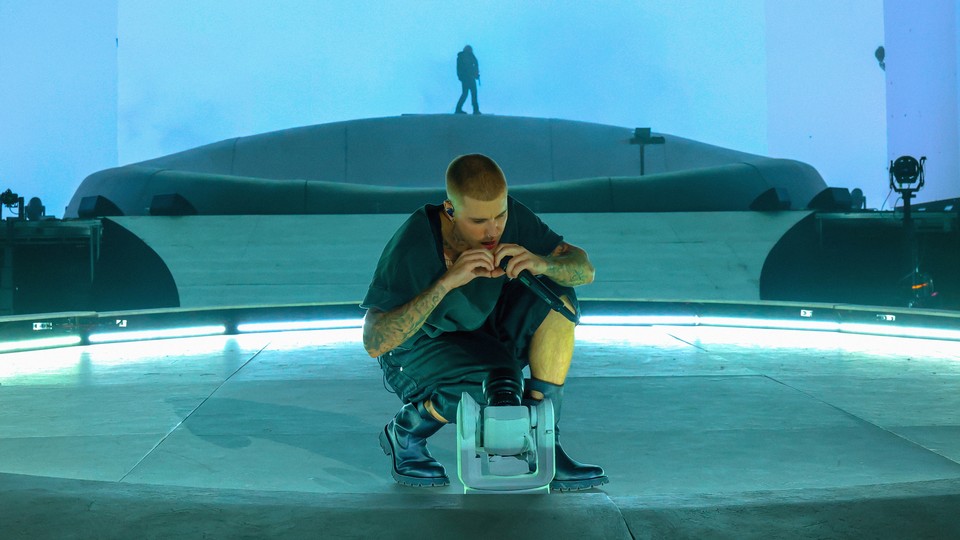
When word started to arrive earlier this month that Justin Bieber had put on a pretty weird performance for the first of his two Coachella sets, my protective instinct kicked in. Discovered on YouTube when he was young and that platform was even younger, Bieber is pop culture’s great test case for what growing up online and in public does to a person. Ever-seesawing between scandals and successes, he’s conveyed a lesson that the world keeps relearning: We need to give our social-media stars a little grace.
Bieber’s first concert in four years was indeed a bit surprising, in that it was a full-on confrontation with the alienation and idiosyncrasies of a generation that has grown up watching YouTube. In front of a sprawling crowd at the most important American musical festival—with a daily attendance of 125,000—he spent a good deal of time … browsing the internet. Hunched over a laptop, he pulled up videos and performances from earlier in his career and alternated between singing along and just bobbing his head to the sound of his cute-little-boy voice. He also played a couple of random viral videos, such as the 2010 internet classic “Double Rainbow Oh My God!”
A lot of reviews of the performance labeled it boring and lazy, but the first clips I saw were actually pretty amazing. The camera by Bieber’s laptop captured him at an angle we never see pop stars in, as he messed around online like we all do. This tattooed married dad was watching his bowl-cutted teenage self in front of a crowd who’d grown up watching the same—and in front of viewers livestreaming on YouTube at that very moment. He was out of the realm of pop music and into the realm of performance art, provoking complex feelings about the passage of time and digital culture.
But then I watched the full stream of his set and started to understand the “lazy” accusations better. The YouTube portion came midway through a more conventional concert. The stage was designed to look like a beige, featureless crater, and the performance itself felt just as barren. Encased in a hoodie and sunglasses for much of the set, Bieber played only music from last year’s Swag and Swag II—whose songs, while lovely, are as minimal and fragile as rolling papers. He showed little discernible emotion other than, perhaps, a few hints of fear.
Watching, one couldn’t help but think about dollars and cents. Bieber has long been open about his struggles with sickness, addiction, and fame. In 2022, he suddenly quit a lengthy stadium tour, citing health issues. With his career essentially on hiatus, he sold his back catalog in 2023 for $200 million. He was believed to be Coachella’s highest-paid booking ever. Given his seeming reluctance to even be onstage, browsing YouTube in front of an audience may have been less of a clever artistic maneuver and more of a way to kill time on the way to a paycheck.
The set also triggered other depressing thoughts, such as about the communal burnout of the 2020s. Bieber is a generational icon not simply because he was discovered online but because he—hailing from a working-class, Christian family in Canada—fits certain stereotypes of the kid next door. During this set, he was “normal” in a different way from before: moping around in athleisure, scrolling through content and thinking about better days. He was once the next great showman; now he was the picture of post-pandemic social isolation and internet addiction.
But that wasn’t the end of the story. Coachella runs over two weekends with nearly identical lineups, and from the opening seconds of his second set this past Saturday, something was different. As before, he performed “All I Can Take”—the sublimely ambivalent opening track to Swag—while singing directly into the camera and crouched as if to avoid predators. Yet the numbness in his earlier performance was gone. His body was pulsing more, and his voice was expressing more. He seemed alive, happy to be there.
For the second song, “Speed Demon,” he did something new: He threw himself onto the barricades between himself and the crowd. Fans freaked, grasped for him—crying, screaming, filming. Bieber stood and sang, and then moved down the barricade, letting others touch him. Many of those audience members were surely lifelong fans. Later, one famous Belieber, Billie Eilish, joined him onstage to be serenaded; she seemed unable to contain her emotion as he hugged her tightly.
For an entertainer to gain strength from one performance to the next is not necessarily shocking. But in this case, the superiority of Bieber’s second set carried special weight. Much of the internet had spent the previous week arguing with itself over what to think about his first Coachella performance. The drama apparently caused fans to clamor for last-minute tickets, causing the resale price of Coachella tickets to more than double. Onstage the second weekend, Bieber seemed to have benefited from the Tinkerbell effect: restored to vitality by others’ attention.
Within the context of what was now a high-energy pop set, the YouTube segment suddenly landed much better. It captured the idea that the internet is not only a time suck, and not only a voyeurism machine, but also a source of inspiration and connection. Bieber told the audience that it had been “challenging, to say the least,” to have his entire life on display for all of these years, but that “the beautiful thing about this journey, y’know, is that we all kind of grew up together.” He seemed to really believe that.
The internet has begun strip-mining Bieber’s second performance for controversy, as it is wont to do with everything. When Bieber went out into the crowd, some of the fans were a bit too grabby; social-media pundits are excoriating at least one of them as a harasser. Certainly, Bieber should not have his bodily autonomy or safety compromised when he interacts with his fans. But risk is always inherent in dragging oneself out of one’s bedroom and into the world to bump up against other human beings. Bieber seemed to have briefly reminded himself, and his audience, that real life is worth it.