A Constantly Rebooting Children’s Franchise That’s Actually Good
Teenage Mutant Ninja Turtles: Mutant Mayhem is one of the summer’s surprise hits, highlighting the unlikely endurance of the wisecracking reptiles.

In 1984, the comic-book artists Kevin Eastman and Peter Laird created Teenage Mutant Ninja Turtles, a dark and snarky satire starring the cartoonish crime fighters. Then, in 1987, Eastman and Laird licensed their characters to a toy company, and shortly after, a bright and colorful children’s animated series emerged. Since then, the Turtles brand has morphed and evolved in various directions, with many a reboot along the way.
Movies, TV shows, comics, video games, and whole universes of toys have kept the characters fresh for each subsequent generation of children. But the latest feature film, Teenage Mutant Ninja Turtles: Mutant Mayhem, a surprise hit this summer, is the first entry in the franchise to successfully merge both strands of Turtledom, a creatively engaging animated movie aimed at kids that bubbles with the punkier energy of yore. Its success highlights something sort of unbelievable: A concept centered on wisecracking ninja reptiles has been viable for nearly 40 years. Surely nobody would’ve predicted that when it launched.
The Teenage Mutant Ninja Turtles were introduced as four turtles who had mysterious chemical ooze spilled on them after a car accident, a parody of the Marvel superhero Daredevil’s origin story. Their biggest enemy was a ninja clan called the Foot, whereas Daredevil battled a group called the Hand; the Turtles are mentored by a giant rat named Splinter, whereas Daredevil’s ninja mentor was called Stick. You get it.
Eastman and Laird quickly expanded the world around their quippy teenage-turtle cast, creating an archenemy called Shredder and an ally in the reporter April O’Neil, but the series was intensely referential of dark ’80s action comics—in particular, the writer and artist Frank Miller’s legendary take on Daredevil. The character had been around since the ’60s, but Miller used Daredevil to launch a revolution in superhero storytelling, diving into the blind crime fighter’s psychological demons and having him fight gangland villains in the alleys of Hell’s Kitchen. And for all their satirical import, the Teenage Mutant Ninja Turtles comics were grim and gritty, stuffed with black-and-white action that saw the turtles mowing down foes with their swords and nunchucks without cracking a single joke.
It was only as the comic progressed over the years, and then migrated into television and movies, that many of its hallmarks sprouted: the reptile teens’ love of pizza and yelling “cowabunga,” their rebellious instinct to escape the dour Master Splinter and tool around above their sewer home. This turned an indie smash into a kids’ favorite that has, for most of its run, felt deeply uncool. A 1990 live-action movie that starred actors in rubber suits was a box-office success, but its two sequels played to diminishing returns, remembered now mostly for their glorious cheesiness (the second one has a dance sequence featuring Vanilla Ice). A 2007 animated feature called TMNT acknowledged those movies but leaned heavily on self-seriousness, and was a small commercial success. Then, in 2014, Michael Bay produced another live-action film that rebooted the series and starred four motion-capture CGI monstrosities, earning some money along with plenty of critical jeers.
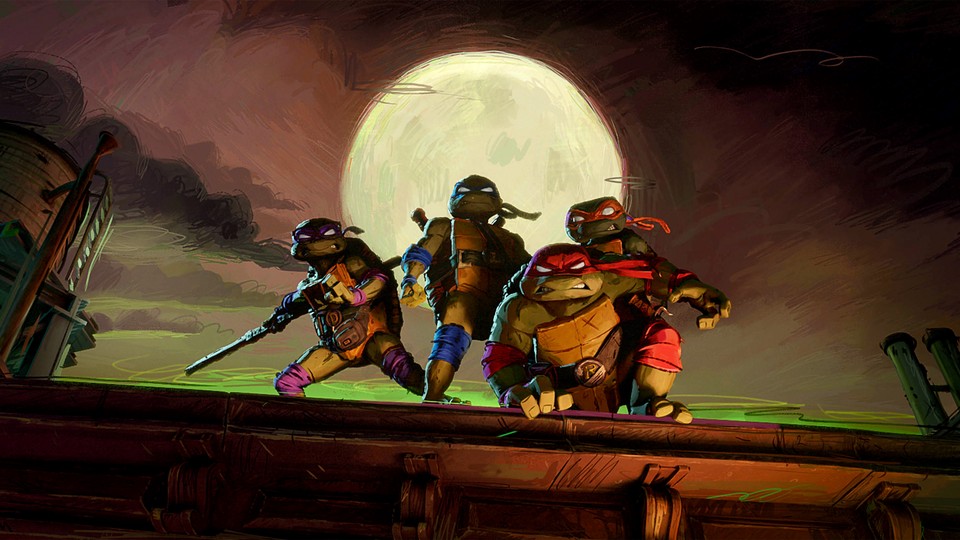
It’s not clear why studios kept making these movies live action; embracing realism is a downright baffling challenge for a film starring very tall turtle people. So much of Mutant Mayhem’s success boils down to the simple, smart choice of having the film be wholly animated, and vibrantly so, reflecting the format-breaking visuals that have made the Spider-Verse movies such a smash. Mutant Mayhem, directed by Jeff Rowe, buzzes with spiky, exaggerated energy, sometimes resembling the sketches in the back of a kid’s schoolbook. Rowe and his team tap into the underground feeling of those early comics, but they inject it with the color and verve of the later cartoons, and that approach carries over into the characterization of the turtles themselves.
As originally written, Eastman and Laird’s four turtles (in case you live under a rock, their names are Leonardo, Raphael, Michelangelo, and Donatello) were more solemn assassin types, but they were teenagers, still learning on the job and eager to please their sensei. Mutant Mayhem retains that dynamic but casts the turtles with actual teen voices, each of them prone to babbling with unrestrained glee and monologuing in excited run-on sentences. April O’Neil, usually a TV-news reporter, is now a high-school journalist voiced by Ayo Edebiri, as sweetly amateurish and eager as her turtle pals. The script includes contributions from Seth Rogen and Evan Goldberg, who wrote the teen classic Superbad, and although Mutant Mayhem doesn’t have that film’s raunch, it does have its understanding of youthful awkwardness.
Mixed in with all of that teen authenticity is some genuinely barnstorming action; Rowe has claimed movies such as Oldboy as an influence. The film’s mutant enemies feel gnarly and gross, and the thrumming score by Atticus Ross and Trent Reznor is as far from Vanilla Ice as possible. Rowe and his team successfully thread a needle between adolescent glee and bone-crunching action; Mutant Mayhem is a martial-arts movie for kids that seems to have earned its PG rating by the skin of its teeth.
Most important for old farts like me, it appeals to people who grew up playing with Turtle toys without coming off as a pandering nostalgia play. Perhaps the secret to the brand’s endurance is the simplicity and flexibility of the original concept; if it stretches too far toward grit or silliness, the next rebrand can easily backtrack. The whole enterprise could quickly crumble; toys always need to be sold, and chintzy fast-food tie-ins might loom on the horizon. But as Hollywood continues to strip-mine 20th-century pop culture wherever it can, Mutant Mayhem is worth acknowledging as the rare reboot that harkens back to its franchise origins while presenting something new.