A University in a Class by Itself
(May 24, 2004)
"Not many people know that the UN has a university of its own. It has no basketball team nor even a traditional campus. It is a research institution that serves as a think tank for the United Nations."
Millions of People Worldwide on the Move
(May 17, 2004)
"Migrations, particularly illegal movements of people, are cause for concern in every region. There has never been a migration study this big or ambitious. The topic has some built-in tensions, and opening it up for world scrutiny risks some hazards."
No Simple Place to Pin Blame for Iraq Oil-For-Food Problems
(May 10, 2004)
"The U.S. General Accounting Office is documenting what a shambles the U.S. made of the oil-for-food program after it took over in November, and warning that the new Iraq must be watched closely or history will repeat itself."
Reducing Poverty Takes More Than Just Money
(May 3, 2004)
"Poverty has so many other facets beyond what it takes to live from day to day.... Unless all countries and international financial institutions look at the big picture, people in developing countries don't stand a chance of significant gains."
Losing Faith In Democracy: A Warning From Latin America
(April 26, 2004)
"The publication last week of an alarming report ... from Latin America will only confirm for many that the euphoria of the early 1990s over the spread of democracy is now history."
Oil-For-Food: Where Was the Security Council?
(April 19, 2004)
"Some U.N. officials may have been complicit in Saddam Hussein's illegal profiteering from the 'oil-for-food' program that sustained Iraqi civilians from 1997 until last November."
Low-Tech Solutions Often Key to Third World Problems
by Barbara Crossette
....
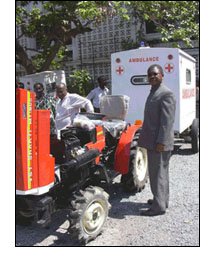
Moses Mukasa gives new tractor- ambulances to the country's Ministry of Health. (Photo by Barbara Crossette)
ACCRA, Ghana—Moses Mukasa, the U.N. Population Fund's representative in Ghana, took a short trip to the Ghanaian Health Ministry the other day to deliver an unusual gift. Parked outside the ministry here in Accra was the donation: a row of bright red tractors hitched to small trailers just big enough for a cot, a chair and an oxygen supply.
The tractor-driven emergency vehicles, designed by Ghanaians to serve as ambulances where there are no roads, are practical and relatively inexpensive, and could be used anywhere in the developing world where people die needlessly because there is no way to get to professional medical help. This Ghanaian project, supported by the U.N. agency, is intended to be a model solution.
These tough and flexible ambulances, a dozen in the first batch, are only one example of how creativity born of necessity can help make life longer and better in the poorest countries.
In some of the poorest places in the world, any motorized transportation that can be used is usually prohibitively expensive to run. Even those with vehicles who would help their relatives or neighbors willingly need money to pay for the necessary fuel for unexpected trips. Taxis, if any are available, often boost their rates if drivers know the people in distress have no other choice.
In Uganda, Mukasa said in an interview, small Japanese cars were converted for medical emergency use in hilly areas. In southern Africa, he added, motorcycle-driven ambulances came into use. In Southeast Asia, a reworked tuk-tuk sometimes did the job.
Health authorities in Himalayan regions have experimented with solar-powered, refrigerated backpacks when medicines and vaccines have to be carried by foot along narrow mountain paths. Near Lukla, the airport closest to Mount Everest, I saw a woman being rushed down a hill in a large basket, strapped to the back of a sure-footed porter with experience working for mountaineers.
At the local level in many developing countries, effective if low-tech equipment is what people say they need most immediately from foreign assistance. A bag of cement and a glazed ceramic toilet seat, worth no more than about $10 for both, can change the life of a Third World family and improve the health of a village. A concrete floor and solid roof to prevent village markets from turning into seas of mud in rainy seasons is also health-enhancing—not to mention a psychological boost to stallholders and shoppers.
In Accra, innovation has helped refugees as well as local people. Ghana has recently become a transit country for people fleeing fighting in neighboring Ivory Coast and heading for other French-speaking countries. UNFPA program officer Mercy Osei-Konadu found a little extra money somewhere to assemble basic hygiene kits for refugee women, with small luxuries such as soap, a toothbrush and items to meet other needs. The kit comes in two versions, one for pregnant women.
The rural ambulances that Mukasa, who is from Uganda, was turning over to the government of Ghana were devised for use in West Africa, but they are powered by an Indian-made Shakti tractor. The Shakti is a dwarf of a machine when compared to the gigantic farm equipment more commonly seen in industrialized countries where farming has turned into agribusinesses that demand much more powerful tractors.
But the Shakti is big enough to pull the ambulance box coupled to it over rough and hilly terrain. Smaller Southeast Asian tractors, the "iron buffalos" built for work in rice fields, may be able to pull a farm cart over reasonably flat land—and they do, sometimes delivering sick people to hospitals, too—but they would have to struggle on African hills.
Kamal Ram of Foundries and Agricultural Machinery Ghana Ltd., which produced the ambulances, was at the Health Ministry making the final checks on the tractor ambulances being turned over to the Ghanaian government. He said the price of about $6,000 for both the tractor and trailer made the ambulance far cheaper than a rig put together with larger machinery, which could cost $30,000 or more.
In Ghana, there have been other ad hoc arrangements for helping the sick, pregnant women and people injured in accidents, Mukasa said. Among them is the "red card" system recognized by truckers as a signal for help.
In the vast expanses of Africa devoid of railways, trucks do almost all of the work of hauling goods within and between countries, and there is always a truck around somewhere. Mukasa described how in at least one region of Ghana, members of the Ghana Private Road Transport Union have agreed to involve drivers in a rescue plan. Village women get red cards to hold up at the roadside in case of emergency, and drivers taking part in the program are expected to stop and offer assistance—usually a ride to the nearest town big enough to have an adequate clinic.
The system—any ad hoc system—isn't perfect, and many people still die for lack of medical attention. Better local clinics and more rural hospitals would be a lot more welcome. But advanced medical centers in the countryside will not materialize for many people during their lifetime, so they do what they can with what they have.
What do you think? Discuss this article in the Foreign Affairs conference of Post & Riposte.