We’ve Been Thinking About the Internet All Wrong
Instead of imagining online life as a massive town square, we should be turning to the field of public health for inspiration.
For years, a primary metaphor for the internet has been the “town square,” an endless space for free expression where everyone can have their say. But as scaled digital platforms have grown to dominate most of modern life, metaphors centered solely on speech have failed to explain our current civic dysfunction.
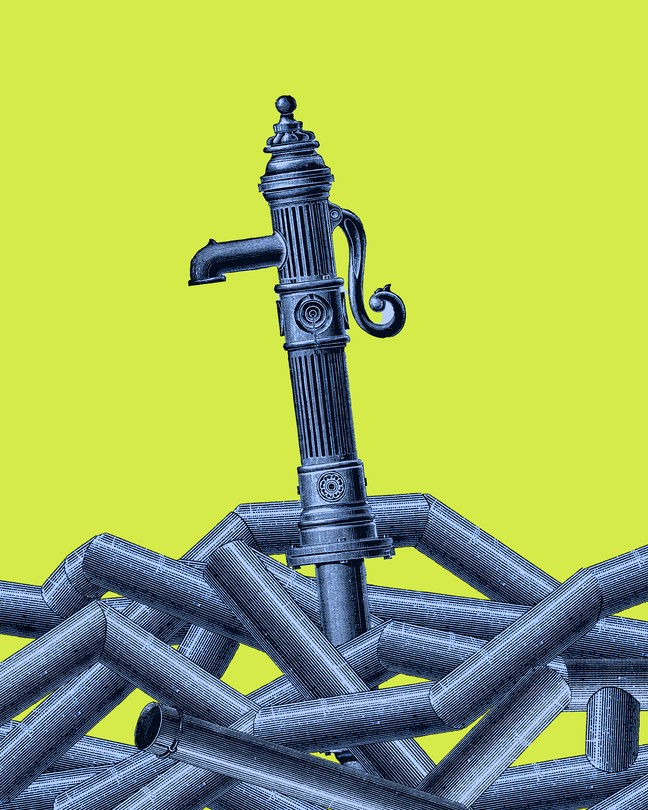
Perhaps the better way to understand the internet is to compare it to a much older infrastructure problem: citywide sanitation systems. Posted content is akin to water; websites and other interfaces are analogous to pumps; and unintended feedback loops correspond to risk of infection. A public-health framework for understanding the internet would focus not on online information itself but on how it is generated, spread, and consumed via digital platforms.
This model’s genesis lies in the two-century-old story of early advocates for clean water in Victorian England. At the time, the life-threatening diseases that ravaged cities—cholera, typhus, tuberculosis, and scarlet fever—were not new. What were new were modern living conditions. Infections that might have taken weeks to spread through a village suddenly ravaged whole populations within days, and no one understood what was causing the massive outbreaks.
The Victorian working classes knew whom to blame when disease broke out: doctors. Mobs assaulted members of the medical establishment, leaving government officials unsure how to weigh the safety of physicians against the public interest. Why the rage? The traditional response to disease—quarantines—had become ineffective in industrialized cities, prompting the public to distrust those who profited from treatment.
The first serious approach to the problem was taken by a coalition of doctors, liberal advocates, and social reformers starting in the 1830s. Known as miasmists, they pushed the idea that noxious air was the culprit in epidemics. If a neighborhood could not pass the smell test, the argument went, one immediately knew it was already too late to be saved.
Miasmists, including prominent ones such as Florence Nightingale, have an ambivalent legacy. They were among the first to emphasize that disease had not just biological but also social and economic causes, a crucial insight. But simultaneously, they were dead wrong about the role of air in the spread of the common diseases of the time, a reflection of an elitist worldview and overprescribed morality.
This tension revealed itself during two key events. One was the Great Stink of 1858, in which a combination of hot weather and poor waste disposal transformed the Thames into a cesspool. The stench was so bad that even the curtains of the houses of Parliament had to be caked with lime. No one was safe from the foul air, and by the miasmists’ assumptions, that meant that no one was safe from disease. But, in fact, no major outbreak followed the Great Stink.
Second was the groundbreaking work of a brilliant doctor, John Snow, who had suspected for years that water (not air) was the actual cause of urban epidemics. In a painstaking natural experiment, Snow demonstrated that the Broad Street pump was the source of the 1854 cholera epidemic in the Soho area of London. His data revealed that residents living across the city became sick if they happened to get water from the pump, even while a nearby brewery that drew its water from a different source had no recorded cases. There was no other reasonable explanation: Some as-yet-undiscovered mechanism, localized at the pump, was responsible for infection. Though Snow was careful to frame his results so as not to explicitly reject the miasma theory, the implications were obvious.
After much debate, over the next 20 years London implemented the world’s first modern sewer system. And from 1850 to 1900, urban illness was reframed from a problem of individual circumstance and negligence to one of economic dependency and social interconnectedness. Once it became clear that not only medical professionals but also effective water piping and safety valves were needed, public policy shifted from one-off treatments to longitudinal assessment of population health, fueled by new mechanisms for evaluation. The stakes of public health had shifted: If cholera epidemics continued, they did so only because cities refused to provide potable water to vulnerable populations.
Today we are living in an online version of the Great Stink, and have dire need of John Snow’s methods. Evidence is building rapidly that social media causes great harm at scale, especially in terms of declining mental health and societal trust. But because these effects are not directly measurable (except for what’s been revealed from whistleblowers and difficult natural experiments), like Snow, we are left to speculate about causes while trying to source better data.
What would it take to build something similar to sanitation infrastructure for social media or generative AI? As we argue in detail in a recently released project, it would mean building assessment tools to connect design features—such as the feedback loops embedded in content-recommendation systems—with population outcomes such as mental-health effects.
To extend the metaphor, current technology interventions tend to focus on moderation strategies centered on specific users and individual pieces of content. This is akin to the role of nurses in public health, crucial and under-resourced providers of well-being. But just as nobody should think that good nursing is the best way to address unclean water, content moderation is insufficient to address dysfunctional platform architectures.
Modern platforms already operate as experimental laboratories, running randomized controlled trials over and over to improve outcomes based on companies’ goals. What we need are tools to assess the pump—the models and interfaces of platforms that determine how populations are exposed to content over time—to gauge whether restrictions need to be implemented to protect at-risk groups. For potential problems such as mental-health impacts or systemic reductions of trust, platform effects would be assessed alongside internal metrics for growth and revenue. And just as epidemiologists learned to focus on infants and children as particularly vulnerable subpopulations, today’s researchers must give special consideration to crucial risk vectors, such as chronic use of social media by adolescents.
Sanitation didn’t just make epidemics easier to control and mitigate; it made the diseases themselves easier to understand, leading eventually to germ theory. Beginning with the early experiments of Louis Pasteur, the new science of bacteriology confirmed the existence of microorganisms, as John Snow only suspected. Once the specific bacterium responsible for cholera was identified under a microscope, a new cornerstone of public health was established.
We are at a similar moment now: We have strong ideas about the causal mechanisms that may be mediating harms from products (such as interpersonal comparisons among teenagers leading to mental-health issues). But just as 1850s London did not need germ theory to start evaluating the effects of water and establish sanitation systems, the first step for mitigating harms in large-scale models is to establish baseline effects independent of explanation. The lesson of public health is that such baselines will be necessary in order to build consensus on what platforms and large language models need to measure and optimize for.
We can continue to treat technology platforms as a town square where the loudest, ugliest voice wins the day. But instead of metaphors that blame individuals, or encourage us to just sign out when things get noxious, we can embrace the standard of public health. The solution won’t come from more content moderators or ever-smarter chatbots but from new infrastructural commitments: pipes, valves, and pumps that would actually keep users safe.