What to Do When Your Political Party Loses Its Mind
I was a Conservative until Boris Johnson expelled me. It was a painful experience, but here’s what I’ve learned.
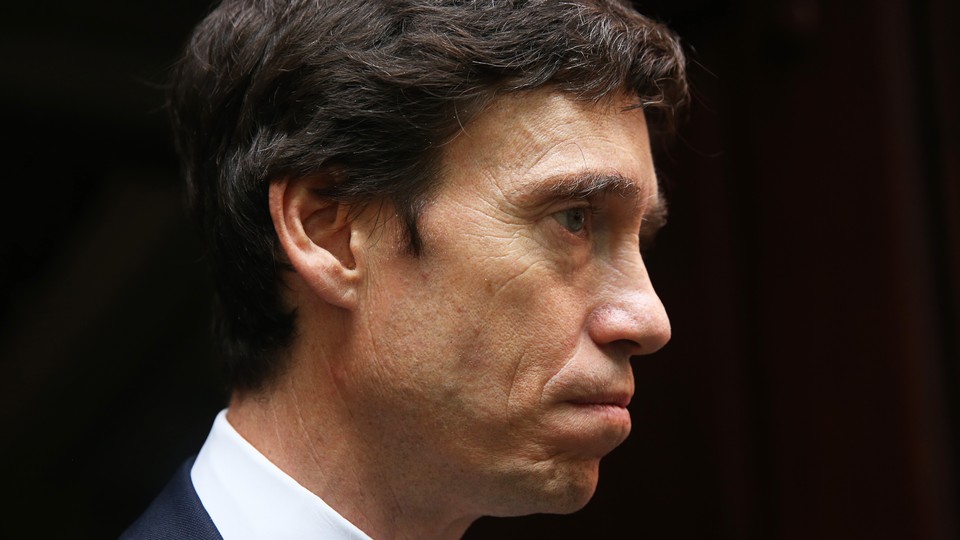
For three years now, I’ve had a recurring dream. I am walking into the British Parliament, which seems to have become a cathedral. Passing beneath coffered ceilings, Gothic wallpaper, and sinuous brass work, I arrive at a marble version of the debating chamber, in which I can see my sometimes-antagonist, the Conservative member of Parliament Jacob Rees-Mogg, lying in what appears to be a bishop’s surplice on one of the pews. When I step in to join my other colleagues, a large man in a tailcoat intercepts me, indicates courteously that this place is no longer for me, and escorts me out.
I had thought that I was reconciled to my break with Britain’s Conservative Party. My dreams suggest otherwise.
That break was sudden. Four years ago, Boris Johnson became prime minister. Almost overnight, the liberal-centrist tradition of the Conservative Party, which I had championed, was replaced by a right-wing, anti-immigrant platform for populists who reveled in stoking culture wars. The new prime minister threatened that MPs who tried to block his hard-Brexit proposals would be expelled from the party. Twenty-one of us chose to do so. He was true to his word: We all lost our seats. The party that I had served in Parliament for nearly a decade, and latterly for several years as a government minister, disinherited me. Friends turned against me.
Reckoning with Johnson’s legacy has made me very conscious of Donald Trump’s takeover of the Republican Party, and I often wonder what general lessons can be drawn about alienation from a political party as it shifts from the center-right to the extreme. I can hardly claim to have found a formula, but I am beginning to believe that conservative populism can be defeated and that there is a route back to the center ground of democratic politics, where I believe most voters naturally are.
I was once a Labour Party member, but my years working in Iraq and Afghanistan alienated me from Tony Blair’s technocratic triumphalism. I was drawn to David Cameron’s Tory Party because I felt it better reflected my instincts about tradition, country, the wisdom of local communities, restraint abroad, and prudence at home. But perhaps because I had been a civil servant, I still largely viewed becoming a politician as a practical administrative challenge, rather than an exercise in party politicking.
I became a member of Parliament in 2010, when Cameron led a coalition government of the Conservative and Liberal Democrat parties. We campaigned and voted together not only for localism, but also for gay marriage, net-zero emissions growth, and far more spending on international development. When later, as a government minister with responsibility first for prisons and then for the environment, I moved to reduce the number of people incarcerated and double the U.K.’s expenditure on tackling climate change, I did not feel any friction with my party.
Of course, I was aware of other traditions of Toryism: I had colleagues who still supported the death penalty, tough restrictions on immigration, and draconian laws on crime. Margaret Thatcher might have mistrusted people like me—liberal Tories whom she perceived as “wets”—yet she always included some of them in her cabinet. Thirty years after the end of her leadership, the Conservative Party still had room for us.
Even after the Brexit referendum of 2016, and the election of Theresa May as prime minister, Tories of all stripes—“one nation” centrists, admirers of pageantry, libertarian free-marketeers, Catholic conservatives, advocates for same-sex marriage—continued mostly to vote in a single bloc. Colleagues more right-wing than me nevertheless invited me to speak to their constituents, traveled with me on international trips, and included me in conversations about their favorite subjects: the Victorians, military history, and Christianity.
In retrospect, I see that the unraveling began in October 2018, when I became one of the most prominent supporters of Prime Minister Theresa May’s proposals for a moderate “soft Brexit.” I had voted to remain in the European Union, but in the aftermath of the close result in the referendum (Brexit won 52–48), her approach seemed the only sensible course of action—a way to forge a compromise between bitterly divided Remain and Leave voters. But in the eyes of hard Brexiteers, my decision marked me as a careerist and a traitor.
Three MPs with whom I felt I had a friendly and respectful relationship attacked me in the press as “a laughing stock,” a hypocritical “huckster,” and a “narcissist.” The Daily Telegraph, the champion of the Tory right, claimed that when I was in Afghanistan, soldiers had nicknamed me “Florence of Belgravia” because of a supposed “propensity to want to compromise with the very terrorists who were killing British troops.” (I had, in fact, established a nonprofit, Turquoise Mountain, which restored a section of the old city of Kabul and supported women and men producing traditional crafts.)
Despite the rising intransigence of the Brexiteer wing of the party, these factional fissures need not have been fatal. The collapse came not when the right showed its teeth, but when the center enabled the right’s worst excesses.
The problem began at the top. All of my fellow cabinet ministers had spent two years studying Brexit. They had endorsed May’s moderate approach because they understood that a no-deal scenario—which would have involved the U.K. pulling out of the EU with no agreement on trade, market access, or the status of Northern Ireland—would be catastrophic. But some of the most senior people in the party were ambitious to replace May as prime minister and began to deny the risks of “no deal” in order to win over the support of party members who were significantly more right-wing than the general population (for they would be the electorate in a leadership election). May resigned in May 2019.
At this point, I decided to put myself forward for the party’s leadership election. Surely, I reasoned, a candidate of the center could still beat the leading contender of the right, Johnson? The public knew, I believed, that he was an insubstantial clown, with a rackety private life and rickety personal finances. MPs understood that he would use evasions, half-truths, and lies to mobilize a right-wing voter base and further polarize an already divided country. His Brexit proposals were incoherent and dangerous. But I soon realized that I’d underestimated the hold populism had taken on the party: Johnson was winning the support of moderate MPs, who saw him as their best electoral prospect.
“How can you possibly support him?” I asked a Yorkshire MP whom I had previously trusted.
“Because he is a winner.” Trying to ignore the obvious implication that I was a loser, I objected: “But he will make a terrible prime minister.”
“No one will be prime minister if we don’t win the next election.”
Johnson, of course, became prime minister. Many of those who backed him were rewarded with a seat in his cabinet—and then went out to the television studios to defend his blunders, his gross carelessness, and his ever-more blatant lies. Before it came time to vote on his no-deal Brexit proposals, in September 2019, some 100 Conservative MPs had seemed determined to take a stand against him. In the end, this number dwindled to just 21, though among us were six cabinet ministers, two former chancellors of the Exchequer, and Winston Churchill’s grandson. Together with opposition-party MPs, we had the votes to block his plan.
At other times, voting against your party and government had been an acceptable part of British politics and parliamentary procedure—in fact, in the context of our first-past-the-post electoral system and unwritten constitution, it was a precious guarantee of independence for the legislature and a way of maintaining a broad coalition of opinion in Parliament. But the Tory Party in full populist ferment was not interested in constitutional conventions: Johnson responded by expelling us from the Conservative Party caucus, then he dissolved Parliament and called an election. In so doing, he decreed that only MPs who were prepared to back a possible no-deal Brexit could stand as Conservative candidates—thus ensuring that we rebels could not reenter Parliament.
The price of our opposition was exclusion from political life. I watched from this exile as Johnson proceeded to abolish my former Department for International Development, slash the overseas-aid budget, break his international legal obligations to the EU, flout his own pandemic regulations, and generally heap one scandal or shame upon another.
My failures to beat Johnson in the leadership contest, and to prevent him, as the prime minister, from leading a hard Brexit and the rightward lurch of the Conservative Party, were the most painful of my life. After losing the leadership race, I spent 11 days in a silent retreat, during which my chagrin at Johnson seemed to translate into an intense pain in my left knee.
Johnson got his comeuppance when, deserted by cabinet colleagues, he was forced to resign in July 2022. But he left his brand of right-wing populism deeply embedded in the party.
It has taken me a long time to acknowledge how and why my center-right tradition failed. But I am beginning to grasp how the Tory Party I signed up to spent too much time making technocratic arguments about policy, which offered no emotional connection for voters. The political class to which I belonged upheld a system that distanced us from a proper sense of shame at how bad things in our country had become.
Politicians like me were slow to acknowledge our past mistakes: how market orthodoxies and globalization had led to stagnant incomes, inequality, and lost industries; how the fantasies of nation-building in Iraq and Afghanistan were brutally exposed; and how the rise of China undermined our complacent assumptions about prosperity, democracy, and global security. These were the failures that populism exploited, and we could not defeat populism by defending the system that created it.
We need to reject the old ideas and develop new ones: trade and industrial policies that evaluate investments for more than simply financial returns, and that consider their consequences for the environment and social justice; climate-change policies that do not hit the poorest hardest; economic policies that deliver results for the middle class without reducing foreign policy to domestic self-interest. And we need to convince a polarized world not with sermons but with political deftness, emotional connection, an inspiring moral vision, and a bit more ease and humor.
It’s taken me a long time to get to this realization. Many are the false steps before the glimmers of progress in learning how not to be a politician.