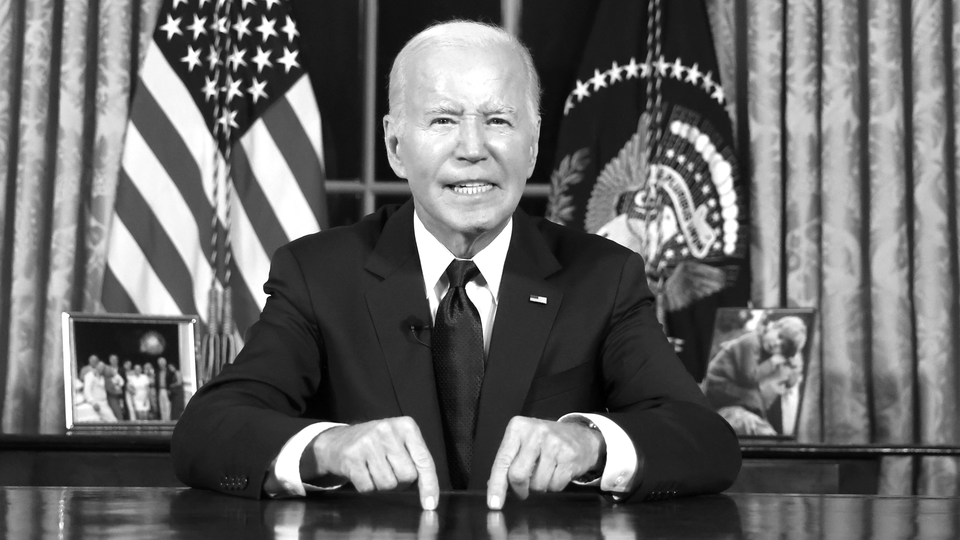
The significance of President Joe Biden’s Oval Office address to the nation last night was signaled in the opening sentence: “We’re facing an inflection point in history.”
What followed was a speech that may well define Biden’s presidency.
The proximate cause for the speech was Biden’s desire to urge Americans to stand with Israel in its war against Hamas and Ukraine in its war against Russia. The president is expected to ask Congress for emergency assistance for the two nations in a $100 billion spending package. But the speech was not primarily about money; it was about America’s teleology, about how Biden sees the role of the United States in a world that is fraying and aflame.
Biden used phrases loaded with meaning. America is “the arsenal of democracy,” he said, invoking a phrase from a 1940 speech by Franklin D. Roosevelt. But in case that wasn’t clear enough, Biden said America is “the essential nation” and the “indispensable nation.” It “holds the world together,” Biden said. Israel and Ukraine are 1,200 miles apart. The conflicts are quite different; Ukraine is battling a world power, and Israel a terrorist organization. But Biden twinned the two conflicts, presenting the outcome of these wars as vital to America’s national security.
“History has taught us that when terrorists don’t pay a price for their terror, when dictators don’t pay a price for their aggression, they cause more chaos and death and more destruction,” he said, while promising to keep American troops out of harm’s way. “They keep going. And the cost and the threats to America and the world keep rising.”
Biden displayed “a passion, emotion and a clarity that is usually missing from the president’s ordinarily flat and meandering speeches,” according to David Sanger of The New York Times. In an act of extraordinary solidarity, Biden has traveled to both Israel and Ukraine in the midst of their wars. One gets the sense that Biden believes this isn’t just America’s moment; it is his moment. It is as if he has found his purpose.
Biden’s speech illustrated the profound shifts we’re seeing in American politics and within the two major parties. The commander in chief Biden most sounded like was Ronald Reagan, using phrases such as “pure, unadulterated evil” to describe the actions of Hamas (Reagan described the Soviet Union as the “evil empire”) and “beacon to the world” to describe America (Reagan often described the United States as a “shining city on a hill”).
Meanwhile, Republicans have become the more isolationist party, deeply wary of America providing moral leadership in the world. In last fall’s midterm elections, well over half of voters for Republican candidates—56 percent—said the U.S. should take a less active role in world affairs.
It is the American right, much more than the American left, that is disparaging of NATO, critical of aid to Ukraine, and appeasement-minded toward Russia. Donald Trump—the dominant and defining figure in the GOP—has repeatedly praised Vladimir Putin, among other brutal dictators, holding Putin up as a model and, at various points, denigrating America in the process. He even sided with Russian intelligence over U.S. intelligence at a joint press conference with Putin in Helsinki.
And so it was a bit disorienting for some of us who are conservative and who were shaped by the Reagan era—and in my case, who worked as a young man in the Reagan administration—to see our foreign-policy principles championed last night not by the Republican Party but by the Democratic president, who spoke with impressive moral force and moral clarity. Our journey through the looking glass continues.