The Actual Path to a Palestinian State
Diplomatic recognition sends a message, but only a real peace process can deliver on Palestinian aspirations.
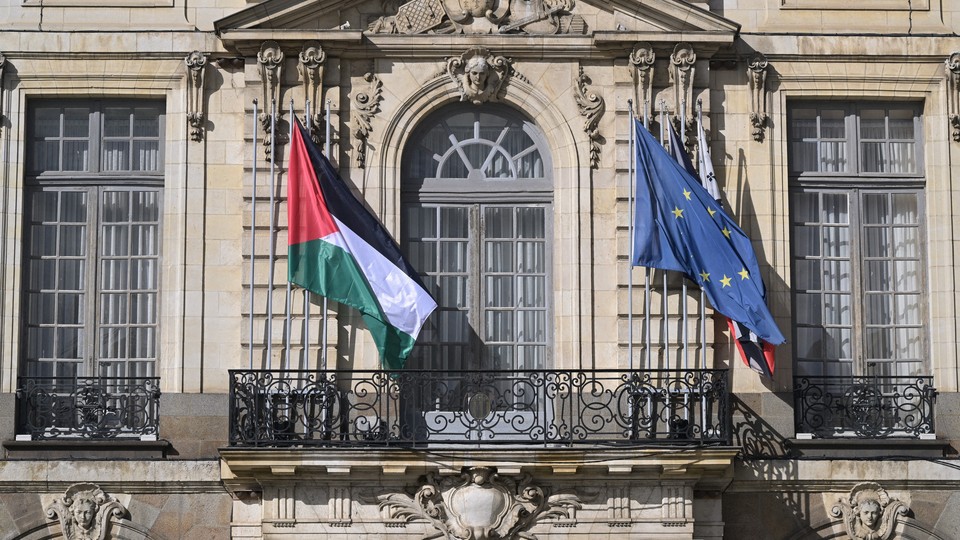
Yesterday, the United Kingdom and several other countries recognized the State of Palestine, a diplomatic move designed to keep alive the prospect of a two-state solution to the Israel-Palestine conflict. This action is largely symbolic, however, a means of signaling the growing international recognition of the Palestinian people’s right to self-determination and frustration over continuation of the war in Gaza and the impasse in the peace process.
Recognition of Palestine without efforts to influence and change Israeli and U.S. policy are empty of practical consequence. France and Saudi Arabia are currently hosting a meeting on the margins of the United Nations General Assembly to showcase a declaration supported by more than 140 countries that lays out a process for reaching an Israeli-Palestinian peace accord. This meeting will have a strong public-relations impact but achieve little else. Indeed, the Trump administration announced that it would not issue a visa for Palestinian President Mahmoud Abbas to attend this meeting or the General Assembly.
Without moving from rhetoric and symbolic actions toward more concrete steps, the impasse between Israel and Palestine will continue. There’s no way to avoid the simple truth that turning a Palestinian state into a reality ultimately requires a negotiated peace between the Israelis and the Palestinians.
The legal basis for the decision to recognize a Palestinian state is murky at best and subject to significant debate. In 1933, the Montevideo Convention stipulated four criteria for statehood: a permanent population; a defined territory; a functioning government; and the capacity to enter into relations with other states. A government’s monopoly over the elements of power within society is often cited as a fifth criteria. The applicability of these criteria to the Palestinian case constitutes the crux of the debate over recognition.
The government of the Palestinian Authority does not exercise full control over all the territory occupied by Israel in 1967—the presumed territory of the State of Palestine. In 2007, Hamas ousted the PA from Gaza, and PA control over the West Bank is weak. The PA can claim that Israel’s occupation prevents it from exercising full control—and, indeed, ending the occupation is the underlying reason for supporting a Palestinian state—but the reality today argues against this important criterion in the definition of the Convention.
The U.K. stated that its recognition related to Palestine’s provisional borders, based on the 1967 lines, with the understanding that these borders will be determined in negotiations with Israel, including land swaps to which the two sides have agreed in principle in previous negotiations. The U.K. did not refer to the fact that the PA and the Palestine Liberation Organization do not have a monopoly on the use of force within Palestine.
What makes this debate over recognition of Palestine interesting is the fact that Israel and the future state of Palestine share a common legal basis—the partition resolution passed by the UN General Assembly in 1947. Resolution 191 called for the creation of “independent Arab and Jewish states.” The resolution was adopted over Arab-state opposition, and a civil war and the invasion of Palestine by Arab states followed. The resolution formed the legal basis for Israel’s declaration of independence in May 1948, notwithstanding the fact that the Israel-Arab war was ongoing and that Israel had no fixed borders. Israel’s de facto borders today—the so-called Green Line, or the lines that existed between 1948 and 1967—were fixed later in armistice agreements signed with each of its neighbors.
In 1974, the General Assembly designated the PLO as “the sole legitimate representative of the Palestinian people.” The same resolution also reaffirmed the Palestinian people’s right to self-determination, national independence, and sovereignty. In 1988, the Palestinian National Council declared the establishment of an independent state, referencing UN resolution 181. In 1993, in the Oslo Accords, Israel recognized the PLO as representing the Palestinian people but did not recognize a Palestinian state. Today, about 150 countries recognize the State of Palestine. Since 2012, under resolution 67/19, the State of Palestine enjoys the status of a nonmember observer state in the United Nations. The U.S. has blocked full member status for Palestine through its veto power in the UN Security Council.
Diplomatically, almost nothing will change as a result of increased international support for Palestinian statehood. The Palestinians will enjoy enhanced standing in some international forums, such as the International Criminal Court, but that will not materially change their experience.
The practical implications of Palestine’s recognition by the U.K. and others are mixed. As a symbolic move, it strengthens the Palestinians’ claim to independence and isolates Israel and the United States as among the very few countries to oppose Palestinian recognition. For the United States, the issue is even more complex because, in 2002, President George W. Bush recognized the right of the Palestinians to an independent state, albeit with certain conditions. This has been U.S. policy since then, although the first Trump administration waffled on the issue and said it would support whatever the two sides could agree upon.
Israel’s prime minister, Benjamin Netanyahu, tried to preempt the recent moves toward diplomatic recognition by declaring categorically that no Palestinian state will be permitted west of the Jordan River. Although Israel has no veto power over international recognition of the State of Palestine, it controls the territory and thus controls whether anything comes of diplomatic recognition.
Creeping annexation has turned into galloping annexation, and members of Netanyahu’s coalition are pressing for the Knesset to formally annex parts of the occupied West Bank and to resettle Gaza. The situation on the ground is thus heading in exactly the opposite direction from the international diplomacy surrounding recognition of Palestinian statehood.
The action by the U.K. and others is important as a message to Israel and the United States, but it will have no real significance unless accompanied by concrete actions to reactivate the process of peacemaking. This will require an end to the war in Gaza, return of the hostages, humanitarian aid, a transitional regime for governance and security in Gaza until the PA is ready to resume control, and an active, determined push by the United States and others to set Israel and the Palestinians on a direction of peacemaking. This is not an impossible agenda, as I’ve argued before, but it is one that requires immediate attention.