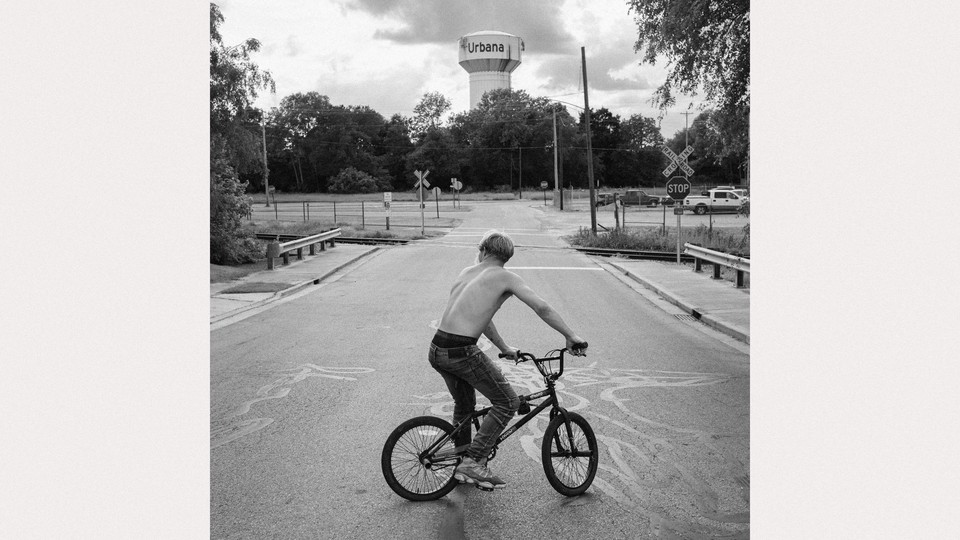
There was a time when nearly every airplane made in America used lights manufactured in Urbana, Ohio, my hometown. When the economy was good, my mom soldered those lights at Grimes Manufacturing, founded in 1933 by a high-school dropout who ended up inventing the airplane-light navigation system still in use to this day. By the time I was growing up, in the ’70s, everyone called him Old Man Grimes because he basically ran the town, serving as its largest employer and, for some years, its mayor. He gave away Ohio State scholarships, bought radio equipment for the police department, and supported the construction of the hospital where I was born.
Today it often feels like there are two Americas: wealthy cities and suburbs where parents obsess over their children’s schools, and poor towns and rural counties where college is largely unattainable. The Urbana of my youth wasn’t so starkly divided. Although the place was not a utopia for me—I was among the poorest kids in my class, and I felt it—I grew up around the corner from grand old houses and well-off families. My teachers always told me that I could find a path to the middle class. And I did. If I were born even 10 years later, I would never have made it out.
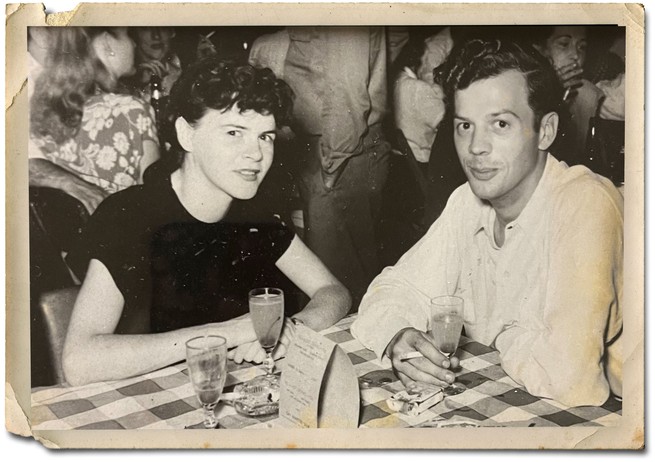
Mom was born to an alcoholic father and a mentally ill mother, then had the bad luck to marry another drunk—a junior-high dropout who served in World War II. They met at the Dayton filling station where he worked, in boom-time America. An early photo at a bar shows them dark, handsome, and lithe, Dad with a drink and a cigarette in the same hand. He was a sporadically employed housepainter, and when the bills got paid, it was on Mom to pay them, even if that meant showing up at the VFW hall on Friday nights to snag Dad’s infrequent paychecks before he drank or gambled them away.
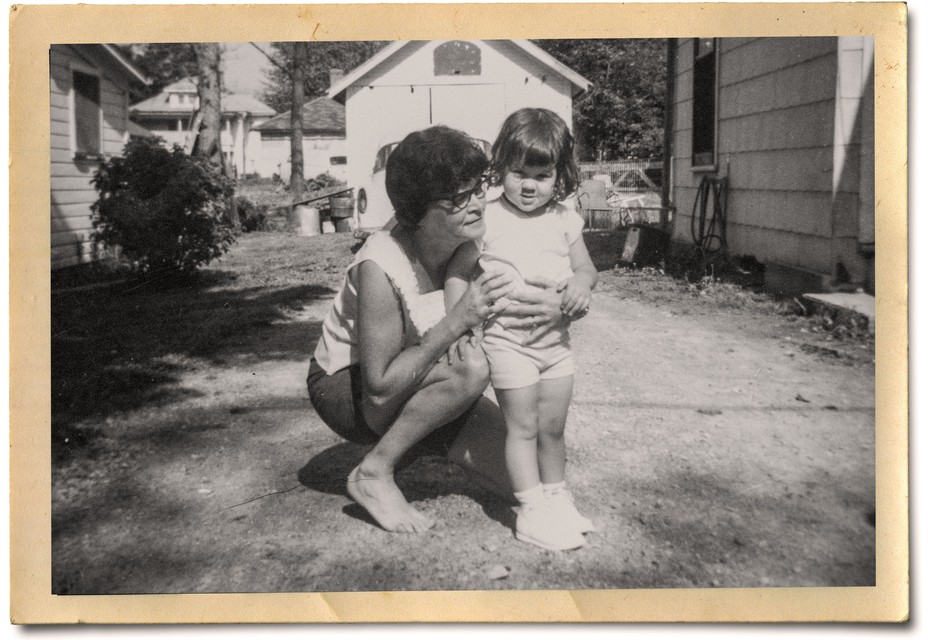
A child of the Depression, Mom was grateful for our rations of government cheese and wasn’t above spending five minutes scraping the last teaspoon of mayonnaise from the jar. At the height of her earnings, she test-drove cars for a Honda subcontractor, making $8,000 a year. But she could stretch a dime further than anyone I knew. She even put me on layaway. When I was in my mid-20s, she handed me a small, yellowed folder she’d tucked away for posterity—the record of her installment payments for her prenatal visits and my birth. “You owe me 110 bucks,” she said.
I was by far the youngest of four, the midlife accident. My sisters, Terry and Cookie, were 15 and 13 years older than me, respectively, and our lives diverged early on. Cookie got pregnant her senior year of high school, when I was 5, then married and divorced. Three daughters later, after her second marriage had failed, she was a single mom working for Old Man Grimes, checking her mailbox for child support that rarely came. In the mid-’70s, she made $1.67 an hour putting together helicopter instrument panels, before the factory was sold, resold, and then finally became part of the international conglomerate Honeywell Aerospace.
Dad was mainly an absent figure in my life. By the time I was 16, he had emphysema and late-stage alcoholism, and sometimes he turned mean, once beating me with a bent coat hanger he’d been using to scratch the itch beneath the cast on his leg, which he’d broken in a bar fight. After Terry married and moved out, one night in an alcoholic rage Dad wanted me to know that she had always been his favorite child, and that I was a slut. Such eruptions were rare and impossible to predict, so I avoided him and adopted a kind of vigilance in the form of a knife I sometimes tucked into my back pocket, vowing to myself that he would never touch me again.
I found refuge in my friends’ homes and on the pleather ottoman in the living room of my Grandma Macy, who taught me to read and write at the age of 4—my own private Head Start. I took solace in the nearby public library, the public school I could also walk to, and the women in charge of these sacred places. My family read widely, books and newspapers, and watched Walter Cronkite every night. Before I was out of diapers, President Lyndon B. Johnson told the nation, “The answer for all of our national problems—the answer for all the problems of the world—comes down, when you really analyze it, to one single word: education.”
It was the dawn of his Great Society, a time when most Americans believed both the president and Cronkite, when every house in my neighborhood read the Urbana Daily Citizen, and many also took the bigger Springfield News-Sun or the much bigger Columbus Dispatch on Sundays. I know because I delivered the Daily Citizen door-to-door six days a week on my Huffy ten-speed. My route customers called me “Paper Girl” with a wry smirk. I’d pursued the job so I could buy my own clothes, and I desperately wanted to go on the seventh-grade field trip to Washington, D.C., so I could experience, for the first time, what it felt like to cross the Ohio state line.
A few years before that field trip, a blue-blooded Rhode Island senator named Claiborne Pell had designed what he called the “G.I. Bill for everybody,” so that promising poor kids would have the same right to a higher education as those whose families, like Pell’s, had gone to the Ivy League. The formula for administering the new federal financial-aid program had come to him as he was skiing in the Swiss Alps. Although Pell and I didn’t seem to inhabit the same universe, his ability to see outside the comforts of his waterfront mansion would transform this layaway baby’s life.
It was a miracle that, in 1982, I left Urbana for Bowling Green State University, just south of Toledo. Mom drove me there in her rusted Mustang, and I prayed the whole way that its slippy clutch would not give out. The Pell Grant paid for the entirety of my tuition, my room and board, and my textbooks; I even had federally funded work-study jobs so I could buy pizza and beer like everyone else.
Mom intuited that I would not return home and that it would be good for me but hard on our relationship. I still have a photo of her waving goodbye from the driver’s seat and pretending to cry—or pretending not to cry; it’s hard to tell. When I called her two weeks into the first semester, homesick and crying myself, it took everything she had not to tell me to come home. And when I left the state for my first daily-newspaper job, in Georgia in 1987, she knew I’d probably never move home again.
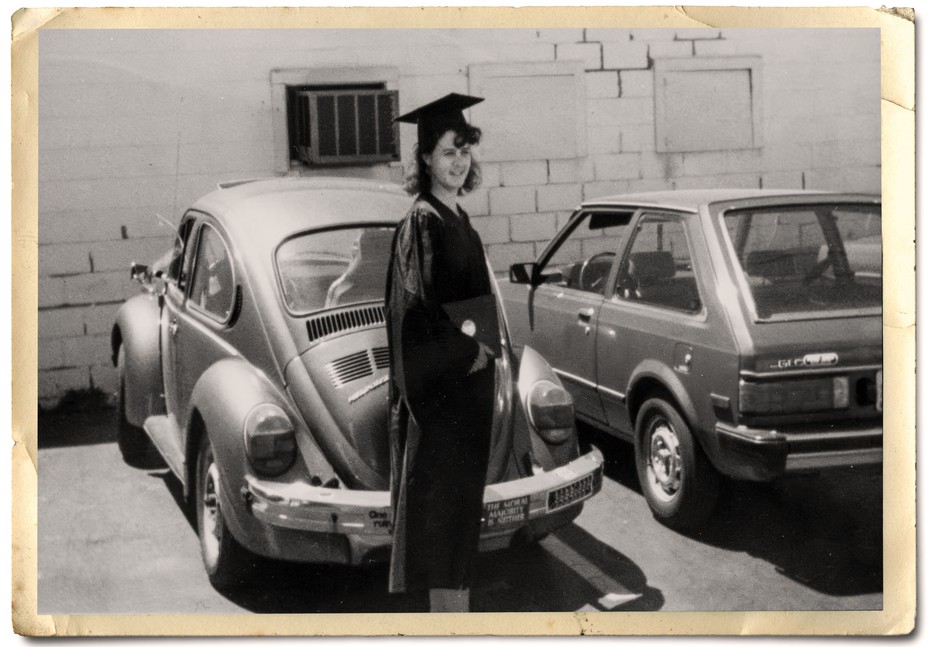
She was right. The few poor rural people who do get a bachelor’s degree typically move to cities for better jobs and rarely live near their family again, and I was no different. After my job in Georgia, I made my way to Roanoke, Virginia, where I spent 25 years as a newspaper reporter before leaving to write books full-time. I’ve also lived in New York and Boston, cities my mother never saw. But the major themes of all my books—the decline of factory towns, racial history, addiction—were born of my Ohio childhood, and what it feels like to be an outsider and an underdog. They grew, in a sense, out of my survivor’s guilt. I wanted to tell the stories of the ones who hadn’t escaped.
Even though Urbana inspired my work, until Mom began her descent into dementia in 2015, I rarely returned home, save for holidays and class reunions. Fortunately, she still had plenty of support: My siblings all lived nearby. As a single mom, Cookie found solace in a Pentecostal church, where she met her third husband. Terry graduated from high school with honors but stayed home, worked in an optometry office, and helped Mom pay the bills before marrying John, an early computer technician. My brother, Tim, who’d left high school when his girlfriend got pregnant, started out as an automotive-store clerk and eventually became an airbag designer on Honda’s research-and-development team.
The weekend we moved Mom into assisted living, she cried and begged Terry not to take her, exclaiming, “But I took care of you!” It was my youngest, Sasha, then a college music major, who was finally able to distract her by singing and dancing.
While some people’s personalities change with dementia, my mom’s feistiness only got stronger. Her hearing was terrible, but she refused to get hearing aids, saying, “They’re for old people.” (She was 88 years old.) On her last Valentine’s Day, I mailed her a bar of chocolate and a card. A few days later on the phone, she had no recollection of the gift but she was sharp enough to snap, “If you’d sent me two chocolates, I would have remembered!”
During trips home to see her, I began to notice another kind of decline. Something was rotting beneath the surface of my postcard-cute hometown, and its descent had begun long before my mother’s. The newspaper I used to deliver and later wrote for no longer employed paper girls like me, or much of anyone. With a newsroom of two, the Urbana Daily Citizen largely fills its pages with press releases and high-school sports. Published for decades by a local family, it’s now owned by a Texas-based media company.
Factories consolidated, too. After Grimes was sold and resold, it was acquired by the conglomerate now known as Honeywell Aerospace, its workforce having dwindled from 1,400 employees in its postwar heyday to roughly 650. In letters Mom sent me over the years, she described the closures of other factories where her friends worked, including the Windex maker and a union shop that made appliance parts. When the Corn Nuts facility shut down, it hurt not only workers but also local corn growers, she told me.
In a county where Donald Trump took 73 percent of the vote in 2020, readers regularly phoned the newspaper’s editor, Brenda Burns, to castigate her for running Associated Press wire copy, which they deemed fake news. “The AP is a bunch of liberal wokesters not reporting the truth,” one woman shouted on the phone, begging Burns to run copy from The Epoch Times, a far-right religious newspaper, instead. A schoolmate of mine from a prominent Republican family, the caller had taken her children out of school to attend the January 6, 2021, riot at the Capitol. Some of my old friends were finding community not in religion but in QAnon, sharing links to stories about Tom Hanks’s alleged pedophilia and the belief that Michelle Obama is a trans woman. An ex-boyfriend, a liberal Deadhead I hadn’t seen in 38 years, was now an ardent fan of Vladimir Putin.
It is no longer unusual to drive through Urbana—once a Union stronghold and a proud stop on the Underground Railroad—and see Confederate flags. For a decade, I’d also clocked growing tension over politics among my family and friends, most of whom now hated “the media,” even though that group included me. I’d been closest to Tim, who used to visit us in Virginia every spring and fall to see our youngest in high-school plays. But we, too, had grown apart since Trump’s election in 2016. Tim had missed the invitation to Sasha’s senior play, which he would have loved—Guys and Dolls—after unfriending me on Facebook. “Because of all the liberal shit you post,” he explained. A group planning our 40th high-school reunion nearly fell apart because of a political Facebook post; one organizer received a death threat.
On our old block, many homes now have security cameras perched along the porch rafters—including one with a motion-sensor recording that startled me as I walked past on the sidewalk, blaring: “You. Are. Being. Recorded.” In a twist, our old house is now the nicest one on the block, its front porch teeming with well-tended houseplants. But the current owner, a factory middle manager, refused to let me see the place after I asked him in a letter, a response for which his wife later apologized. “My husband is paranoid about a stranger going through the house,” she explained when I spotted her on the front porch and stopped to talk.
Months later, in early 2024, the family finally let me peek inside. The kitchen had been modernized, and in the living room, deer heads hung near the corner where Dad’s recliner used to sit. The family’s grown daughter still lived at home, along with her fiancé and two kids. When I asked what year she graduated from Urbana High, she said she’d been homeschooled by her mom, a housekeeper at nearby Urbana University, before it closed in 2020.
In the past six years, the number of Urbana’s homeschoolers has doubled. A nationwide trend, homeschooling is the fastest-growing form of education in the United States. But it’s just one reason my high school went from 163 seniors in my graduating class, 1982, to 94 students four decades later. School absenteeism, particularly after COVID-19, was a factor. But the decline seemed to mainly stem from increased rates of addiction, trauma, and poverty. No longer was there a stable of middle-class and upper-middle-class students for a poor kid like me to learn from and aspire to emulate.
Even for those who do graduate, college can seem impossibly out of reach. Average tuition has more than tripled since my days as a student, and the neediest students at public colleges now have only 30 percent of their costs covered by Pell Grants, thanks to paltry budget allotments advanced by Congress. Today just 36 percent of Americans over the age of 25 have a bachelor’s degree. In Urbana, that number is a mere 18 percent. That means that most Urbanans end up with far less earning potential, and endure higher levels of family instability and mental distress.
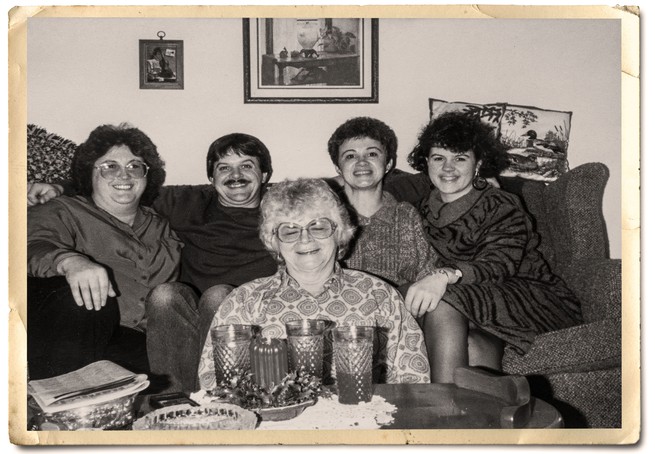
After our mother’s death in 2020, Terry worried that, with Mom gone, so were our family ties. “She really was the glue,” she said. Was she right? Did anything remain of my family and community? Sometimes I felt that if I could understand the changes that had taken place in the 40 years since I left Urbana, maybe I could figure out what was happening to our country—and why one-fifth of Americans were now estranged from a family member because of politics.
I was most shocked by what I gleaned from people I’d known the longest. My childhood friend Joy, a Black lay minister who had conducted my mom’s celebration of life, revealed that she didn’t believe George Floyd was killed by Derek Chauvin. My niece’s husband, a Type 1 diabetic, turned down not one but two life-saving transplants because the donors had taken COVID vaccines. When I spoke with my sister Cookie about my oldest son, Max, who was about to marry his husband, she used scripture from Leviticus to condemn homosexuality.
A friend asked recently what it felt like to spend time in a place I had once loved but no longer connected with, and I had to admit that my predominant emotion was pain. Often, I’d leave two or three days before my rental was up, eager to return home to my husband, my dog, and my largely privileged circle of friends who don’t espouse beliefs that repulse me.
I haven’t spent much time with Cookie since her comments about my son’s engagement; my sisters are both disabled, and sibling reunions are rare. But Tim and I have reunited, even after my musician kid came out as nonbinary, a term that Tim had never heard of. He’s now a Facebook superfan of Sasha’s band, Palmyra, and regularly drives out of state to see the band’s shows. He and his wife gladly attended Max’s wedding. And in March, my husband and I drove home for Tim’s 70th birthday party, held at a Fraternal Order of Eagles chapter, where the parking lot was packed with motorcycles and Ford F-150s. “I’m sorry we don’t serve IPAs here,” my brother said, smiling wryly.
The idea that America has sorted itself into two countries is not wrong, exactly. But it ignores all the stories of people like me. Girls whose mothers worked in factories but believed in the power of education. Women who have tasted the good life but were raised on government cheese. Sometimes it’s tempting to think that Senator Pell put me on an airplane bound for a better future, and in a sense he did. But a part of me is still the paper girl on her ten-speed. And for all the devastating ways that it has changed, Urbana is still full of people like me, who are worthy of a different life than the one they were born into. That’s the news I have to deliver.
This article has been adapted from Beth Macy’s new book, Paper Girl: A Memoir of Home and Family in a Fractured America.
When you buy a book using a link on this page, we receive a commission. Thank you for supporting The Atlantic.