The Coup in Niger Is About Power. Russia Will Exploit It.
The most exciting explanations for Niger’s upheaval are globe-sweeping and probably wrong.
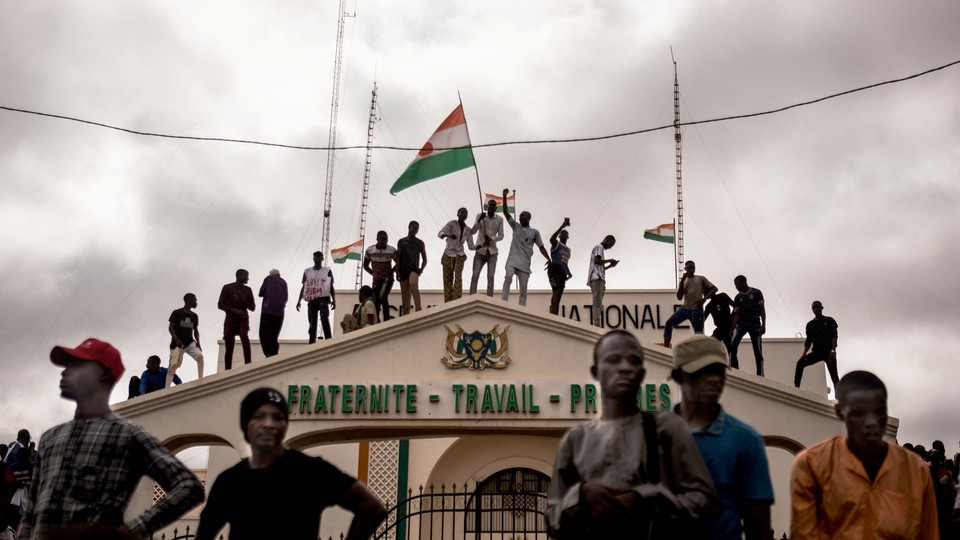
Late last month, armed troops in Niger overthrew the government, arrested the elected president, and seized power for themselves. Soon after, a small group of Nigeriens who supported the coup in the capital city, Niamey, gathered to show their support for the military government, some waving the Russian flag. They denounced the West in general, and France, the former colonial power, in particular. “Long live Putin!” they chanted. “Down with France!”
The coup has created considerable alarm in Western capitals, and with good reason. Since 2020, there have been coups throughout the Sahel, the strategically important belt of hot, semiarid land stretching across Africa just below the Sahara desert. In 2020, Mali’s government fell. In 2021, the same thing happened in Sudan, Chad, and Guinea. Last year, a coup took place in Burkina Faso. Niger was seen as the Sahel’s final bulwark against chaos and instability, the last regime standing. The United States had a drone base in Niger, and France had stationed troops there, a crucial line of defense against surging West African jihadism. Now all of that is at risk.
Few Americans are in the habit of giving much thought to Niger (“Do you mean Nigeria?”), but this summer’s events seemed to offer a stark takeaway: Pro-Russian soldiers overthrew a pro-Western government. Democracy was uprooted by military dictatorship. To anyone who lived through the Cold War, the story felt familiar. The fact that Niger exports uranium—a crucial resource for nuclear reactors—makes its struggle even easier to understand as a geopolitical chess game. Niger was a pawn, and coups happen when pawns are pulled between geopolitical kings. And so, the coup has quickly become a story about America, Russia, and France—and not about Niger.
When explaining major events in international news, particularly those that take place in unfamiliar locations, we all tend to exhibit geopolitical bias, a mindset that filters every incident through the prism of international grand strategy—and makes the moral of every story about us. Simplistic, familiar narratives trounce nuanced explanations that involve political actors few nonspecialists have heard of, known by obscure acronyms and hard-to-pronounce names.
The military coup in Niger has already become fodder for sensational headlines and political statements linked to grand geopolitical tropes. A senior adviser to Ukraine’s president insisted, without evidence, that Russia instigated the coup. Bloomberg covered the coup as the latest evidence for the “Long Arm of the Kremlin.” Newsweek declared that Niger’s coup means “The Countdown to the Next Great War Has Begun in Africa.”
Russia will likely expand its influence because of the Niger coup (and there have been reports that the junta is requesting help from the Wagner Group mercenaries). But much of the speculation about the extent of Russia’s involvement so far is based on extremely thin evidence—a few hundred people, in one protest, in one city, a handful of them carrying Russian flags, in a country that’s twice the size of France and home to more than 25 million people. Even before the coup, Niger’s capital city was an opposition stronghold, so one should hardly be surprised that some people who live there would demonstrate in support of soldiers who overthrew a president they loathed.
The impetus behind the coup is very likely complex, nuanced, and less about the Kremlin than about domestic dynamics. The possibility of a more banal local cause doesn’t negate the real anger that many Nigeriens feel toward France, or the misguided impulse some have to turn to Russia as an alternative international sponsor that’s explicitly anti-Western. But the simple explanation for why the coup happened, as reported in the local media, is plausibly the right one.
The incumbent president, Mohamed Bazoum, had been planning to fire a general, Abdourahamane Tchiani, who commanded the elite presidential guard. Now that the coup has happened, General Tchiani isn’t going to be fired. Instead, he has proclaimed himself the head of the new military junta, which calls itself the National Council for the Safeguard of the Homeland.
The Occam’s-razor explanation may just be correct: A general who was going to be fired decided to fire the president instead. Many coups have such simple origin stories, triggered by factional rivalries within the military, and ambitious, self-serving men who would happily swap the barracks for the palace.
Whatever the reason for his gamble, Tchiani likely didn’t anticipate the intense opposition he has faced since seizing power. Most international actors, including Russia, have condemned the coup (though the Kremlin’s statement about respecting the constitution is best consumed with a grain of salt). And perhaps the most surprising threat to Tchiani’s plans has emerged from a major regional power broker, the Economic Community of West African States. The bloc of 15 West African countries, with Nigeria as its most powerful member, has taken a hard-line stance against the coup, even threatening military intervention. As a result, some have painted ECOWAS as a puppet of the West, the sharp end of the European and American spear.
Yet again, a simpler (and less geopolitically exciting) explanation is likely correct. ECOWAS may not be taking a tough stance against this coup because it’s a marionette or because it has an ideological aversion to Vladimir Putin; the governments of its member states may just be concerned about their own self-preservation.
“One reason why regional presidents are interested in military intervention is because they’re increasingly scared of being taken out themselves,” says Professor Nic Cheeseman, an expert on African politics at the University of Birmingham. “It comes after several other coups in the region, and they realized that they could be next if they didn’t draw a line in the sand.”
Niger’s coup may not have originated in great-power competition so much as in politics and other dynamics nearer at hand—but it could still have serious international repercussions. The security situation in the Sahel is deteriorating as jihadism rises. The junta governments that have taken power in the past three years have proved unable to combat it. Moreover, although many of the new military regimes—notably in Mali and Burkina Faso—have allied themselves with Russia, the Russian government and the Wagner Group are not exactly flush with spare cash or bursting with well-trained troops waiting to deploy to Africa, bogged down as they are by their debacle in Ukraine. In the coming months, the postcoup regimes in the Sahel are likely to realize that they’ve swapped Western partners, which had deep pockets and a long-term commitment to supplying foreign aid, for a diminished Kremlin that will inevitably overpromise and under-deliver. The money will eventually run out.
Europe has skin in the game: France, which is mostly powered by nuclear energy, gets roughly 10 to 15 percent of its uranium supplies from Niger. Moreover, in 2015, the European Union paid Niger’s government to effectively create a European “Sahel border,” shutting down pathways of migration through Niger toward the Mediterranean. The coup could reopen that route, reinvigorating the formerly thriving transit hub of Agadez. The United States cares about Agadez too: The American drone base Niger Air Base 201 is just outside the town.
If Niger’s junta manages to stay in power, it will almost certainly align itself with Russia. The interim regime has already announced the cancellation of several military agreements with France. But it’s in for a rude awakening if it cozies up to the Kremlin. Russia, as Mali and Burkina Faso are finding out, is rich enough to pay for small contingents of mercenaries and to line the pockets of greedy soldiers, but it is nowhere near rich enough to help provide for the broader population of one of the world’s poorest countries, where the GDP per capita is less than $600 a year.
As is so often the case in sub-Saharan Africa, the victims will be those who can least endure it. The broader population of Niger will suffer as soldiers turned politicians enrich themselves. And that story, which is not about geopolitics, but rather about the ordinary distress of millions of vulnerable people, will be one that garners substantially less ink.