


Go to this issue's Table of Contents.
M A R C H 2 0 0 0
 N a classic paper published in 1942, the sociologist Robert K. Merton likened the culture of science more to the ideals of communism than to capitalism, because intellectual property was commonly shared and discoveries were freely exchanged. "The scientist's claim to 'his' intellectual 'property,'" Merton wrote, was "limited to that of recognition and esteem," and scientific knowledge was assumed to be a public good.
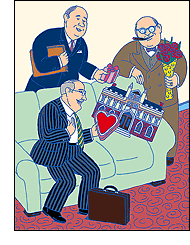 Today scientists who perform industry-sponsored research routinely sign agreements requiring them to keep both the methods and the results of their work secret for a certain period of time. From a company's point of view, confidentiality may be necessary to prevent potential competitors from pilfering ideas. But what constitutes a reasonable period of secrecy? The National Institutes of Health recommends that universities allow corporate sponsors to prohibit publication for no more than one or two months (the amount of time ordinarily necessary to apply for a patent), but lengthier delays are becoming standard. Berkeley's contract with Novartis, for example, allows the company to postpone publication for up to four months. A survey of 210 life-science companies, conducted in 1994 by researchers at Massachusetts General Hospital, found that 58 percent of those sponsoring academic research require delays of more than six months before publication.
"One of the most basic tenets of science is that we share information in an open way," says Steven Rosenberg, of the National Cancer Institute, who is among the country's leading cancer researchers. "As biotech and pharmaceutical companies have become more involved in funding research, there's been a shift toward confidentiality that is severely inhibiting the interchange of information." A few years ago Rosenberg confronted this problem firsthand when he tried to obtain information on safe-dosage levels for a reagent he sought to use in a clinical trial involving an experimental cancer treatment. The company asked Rosenberg to sign a confidentiality agreement, and when he refused, they withheld the information. Rosenberg has become so alarmed about secrecy that he now urges all scientists and research institutions to reject confidentiality restrictions on principle. Few have heeded his call. A 1997 survey of 2,167 university scientists, which appeared in the Journal of the American Medical Association, revealed that nearly one in five had delayed publication for more than six months to protect proprietary information -- and this was the number that admitted to delay. "The ethics of business and the ethics of science do not mix well," Rosenberg says. "This is the real dark side of science."
Nelson Kiang, a professor emeritus at the Massachusetts Institute of Technology and at Harvard, who recently organized an MIT conference on "Secrecy in Science," worries in particular that students, rather than learning proper scientific protocol, are being taught to accept the inhibiting power of money over science. "One hears of many students at MIT who complain about not being able to publish their theses in a timely fashion," Kiang says, "but when we tried to involve them in the conference, not a single one would come forward, and they actually asked us specifically not to be named. Of course, it's not surprising. They fear that if they come forward, they might get into trouble with their supervisors."
Worse than the problems of enforced secrecy and delay, however, is the possibility that behind closed doors some corporate sponsors are manipulating manuscripts before publication to serve their commercial interests. In the summer of 1996 four researchers working on a study of calcium channel blockers -- frequently prescribed for high blood pressure -- quit in protest after their sponsor, Sandoz, removed passages from a draft manuscript highlighting the drugs' potential dangers, which include stroke and heart failure. The researchers aired their concerns in a letter to the Journal of the American Medical Association: "We believed that the sponsor ... was attempting to wield undue influence on the nature of the final paper. This effort was so oppressive that we felt it inhibited academic freedom." Such meddling, though generally difficult to document, may well be common. A study of major research centers in the field of engineering found that 35 percent would allow corporate sponsors to delete information from papers prior to publication.
"Brown University supports the academic freedom of Dr. David Kern"
Official Brown University press release concerning David Kern's research.
"A letter from the dean of medicine and biological sciences regarding the issue of academic freedom"
A letter from Donald J. Marsh, M.D., Brown University dean of medicine and biological sciences on the matter of David Kern.
Mildred Cho, a senior research scholar at Stanford's Center for Biomedical Ethics, warns that for every David Kern who steps forward in such cases, an unknown number of researchers voluntarily toe the company line. "When you have so many scientists on boards of companies or doing sponsored research," Cho explains, "you start to wonder, How are these studies being designed? What kinds of research questions are being raised? What kinds aren't being raised?" In a 1996 study published in the Annals of Internal Medicine, Cho found that 98 percent of papers based on industry-sponsored research reflected favorably on the drugs being examined, as compared with 79 percent of papers based on research not funded by industry. More recently, an analysis published in the Journal of the American Medical Association found that studies of cancer drugs funded by pharmaceutical companies were roughly one eighth as likely to reach unfavorable conclusions as nonprofit-funded studies. Might the public begin to see academics less as stewards of truth than as hired hands?
Or worse than hired hands: interested parties. More and more, professors not only accept industry grants to perform research but also hold stock or have other financial ties to the companies funding them. In a study of 800 scientific papers published in a range of academic journals, Sheldon Krimsky, a professor of public policy at Tufts University and a leading authority on conflicts of interest, found that slightly more than a third of the authors had a significant financial interest in their reports. Michael McCarthy, an editor at the British medical journal The Lancet, says such links are now so common that he "often can't find anyone who doesn't have a financial interest" in a drug or therapy the journal would like to review. Although Krimsky doesn't believe that the mere existence of such ties makes an academic study suspect, he advocates full disclosure. Yet in none of the nearly 300 studies in which Krimsky found a conflict of interest were readers informed about it.
The Securities and Exchange Commission has also detected this trend and is now investigating numerous academic researchers suspected of engaging in insider trading. In a case filed recently in Pennsylvania, the SEC charged Dale J. Lange, a Columbia University neurologist, with pocketing $26,000 in profits after Lange bought stock in a company that was about to release promising new findings concerning a drug to treat Lou Gehrig's disease. Lange expected the stock to soar because he had conducted the confidential clinical trials.
The growing concern about potential conflicts of interest has prompted some universities to forbid professors to perform sponsored research for companies in which they hold equity. The federal government is also taking steps. In 1996 the Public Health Service issued guidelines that require all academic researchers to report it to their schools if they have received payments of more than $10,000 from a company or if they hold at least five percent of its stock. At most universities, however, such information is kept private, which means that frequently neither journal editors nor academic peers know who has ties to industry and who hasn't.
More than a year before fen-phen, the appetite suppressant, was pulled off the market because it seemed to be implicated in a number of deaths, a group of researchers published a study in The New England Journal of Medicine warning that drugs like fen-phen could have potentially fatal side effects. But the same issue contained a commentary from two academic researchers that downplayed the health dangers of fen-phen. Both authors had served as paid consultants to the manufacturers and distributors of similar drugs -- connections that were not mentioned. "I was outraged when I saw that," Stuart Rich, a professor at Rush Medical College, told the Chronicle of Higher Education when the ties were exposed. "The study was the only scientific study that said these diet pills kill people." Like universities, some journals have begun requiring academic contributors to disclose corporate financial ties. But in a study released last year Sheldon Krimsky and another researcher examined 62,000 articles and found that these ties were disclosed in only 0.5 percent of them.
"A Good Climate for Investment," by Ross Gelbspan (June, 1998)
Reducing reliance on carbon for energy -- to safeguard our atmosphere and our climate -- could bring about not personal deprivation but a worldwide economic boom
"The Prison-Industrial Complex," by Eric Schlosser (December, 1998)
Correctional officials see danger in prison overcrowding. Others see opportunity. The nearly two million Americans behind bars -- the majority of them nonviolent offenders -- mean jobs for depressed regions and windfalls for profiteers.
 OME would argue that such relationships, far from being unseemly, are in keeping with the utilitarian strain that runs through the history of American higher education. Certainly, in comparison with their European counterparts, U.S. universities have always displayed a pragmatic bent. Whereas in Europe universities took pride in pursuing knowledge for its own sake and in remaining aloof from the outside world, in America educators from Thomas Jefferson to John Dewey have argued that universities ought to be engaged in the world, and that knowledge exists to be put to use. When Congress passed the Morrill Act, in 1862 (which gave rise to America's public land-grant universities, including Berkeley), it specifically instructed the states to establish schools that would teach "agriculture and the mechanical arts ... in order to promote the liberal and practical education of the industrial classes," rather than the classical curriculum.
Thus it is hardly surprising that, as the historian David Noble documents in his book America by Design (1977), the rapid growth of the U.S. industrial economy at the turn of the century coincided with a surge in university-industry collaboration. Engineering and chemical giants underwrote research in exchange for the services of academic scientists; universities established industrial-research centers to furnish corporations with personnel; some schools even went into business themselves, with the University of Minnesota operating its own mine and New York University running a macaroni factory. Such entanglements inspired the radical economist Thorstein Veblen to comment acerbically in 1908 that "business principles" were transforming higher education into "a merchantable commodity, to be produced on a piece-rate plan, rated, bought, and sold by standard units, measured, counted and reduced to staple equivalence by impersonal, mechanical tests."
"As We May Think," by Vannevar Bush (July, 1945)
"Dr. Bush calls for a new relationship between thinking man and the sum of our knowledge."
The Bayh-Dole Act changed this, and not simply by creating incentives for corporations to invest in academic research. What is ultimately most striking about today's academic-industrial complex is not that large amounts of private capital are flowing into universities. It is that universities themselves are beginning to look and behave like for-profit companies.
(The online version of this article appears in four parts. Click here to go to part one, part three, or part four.)
Eyal Press is a contributing writer at Lingua Franca. Jennifer Washburn is a writer based in New York. They are both fellows at the Open Society Institute, where they are examining the privatization of the public sphere.
Illustrations by Seymour Chwast.
Copyright © 2000 by The Atlantic Monthly Company. All rights reserved.
The Atlantic Monthly; March 2000; The Kept University - 00.03 (Part Two);
Volume 285, No. 3; page 39-54.