


Go to this issue's Table of Contents.
J U N E 2 0 0 0


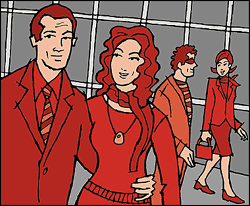
In this work of "comic sociology" David Brooks presents a conceptual key to American society
BOBOS IN PARADISE: THE NEW UPPER CLASS AND HOW THEY GOT THERE
by David Brooks. |
More on books in The Atlantic Monthly and Atlantic Unbound.
More on politics and society in The Atlantic Monthly and Atlantic Unbound.
From the archives:
"A Cartoon Elite," by Nicholas Lemann (November 1996)
Is there a class of "pampered meritocrats" who run America?
From Atlantic Unbound:
Interviews: "A Kinder, Gentler Overclass," (June, 2000)
An Atlantic Unbound conversation with David Brooks, the author of Bobos in Paradise.
Elsewhere on the Web
Links to related material on other Web sites.
"Why Bobos Rule" (March 29, 2000)
The transcript of an online conference at Newsweek.com with David Brooks, the author of Bobos in Paradise.
Wayne, Brooks writes, has changed from "strictly a white bread" bedroom community into a place with "six gourmet coffeehouses," a "fabulous independent bookstore," and "Studio B, a gift emporium that hosts creative birthday parties to ensure that self-esteeming kids get even more self-esteeming." Like Westport, it has evolved from the bourgeois toward the bohemian (Brooks admits to a very broad use of the latter term), whereas what Brooks calls "Latte Towns" have gone in the other direction, grafting a new respect for consumer capitalism onto their raffish, sometimes radical pasts. The Latte Towns are "often university based," and demonstrate a cultural peace that allows "the Babbitt lion [to] mingle with the beatnik lamb." In Burlington, Vermont, Brooks's LT paradigm, the Ann Taylor franchise is right next to the Peace and Justice thrift shop. If Latte Towns are "havens for everything that now goes by the name 'alternative' -- alternative music, alternative media, alternative lifestyles -- they are also fantastic business centers," ones in which you hear much about "socially responsible investing" by manufacturers of expensively natural items like Summer Glory Vinegar and Putney Pasta.
Brooks traces the marriage of bourgeois and bohemian to some early-1960s matchmaking by the author Jane Jacobs, whose book The Death and Life of Great American Cities decried big development and urban renewal in favor of ad hoc patchwork neighborhoods like Greenwich Village. Admiring both the shopkeeper and the artist renting an apartment above his store, Jacobs reconciled "the bourgeois love of order with the bohemian love of emancipation." Brooks now sees these two sensibilities coupling every Sunday on the Weddings pages of The New York Times, which he brightly analyzes (or "deconstructs," as Bobos with Brown diplomas would say) in an early chapter. Brains have replaced old money; accomplishment now trumps religion and wealth; a pair of "awesome r�sum�s" unite in meritocratic contentment. The truest Bobo match comes when a "predator" (an MBA, say, and usually the groom) weds a "nurturer" (a liberal-arts major now working as a foundation officer). To compute the status of these savvy, compassionate duos, you take each person's "net worth and multiply it by his antimaterialistic attitudes."
In Bobos in Paradise, Brooks argues that "a new reconciliation has been forged." His Bobos "march under reconciling banners such as compassionate conservatism, practical idealism, sustainable development, smart growth, prosperity with a purpose." Like Luther Burbank admiring his hybrids, or the designer-coffee man dispensing a new blend from behind his butcher-block countertop, Brooks makes an appreciative, witty survey of the various ways in which "the bohemians and the bourgeois co-opted each other." He's especially good on the new world of commerce, where countercultural references drive the ads of hip-capitalist companies (the safely dead William S. Burroughs for Nike and Jack Kerouac for The Gap) whose offices exhibit a decor of "pseudo-transgressions" and "socially approved deviances" -- "the remnants of a comic book collection may be tacked to the wall near the torn cover from a Curious George book or a photo of Gandhi." Pace Marx, social classes now define themselves by their means of consumption rather than of production, and Daniel Bell's "cultural contradictions of capitalism" -- his prediction that the system would create the very leisure and hedonism needed to undo it -- are, Brooks declares, "Resolved!" The Bobos love work too much ever to clock out; they go in for "utilitarian pleasures" -- running, for example -- that render them even fitter to do their jobs. Similarly, in the ethical algebra of Bobo consumption, spending great sums on top-of-the-line kitchens is better than buying jewelry. "It's egalitarian to spend money on parts of the house that would previously have been used by the servants."
BROOKS, a senior editor at The Weekly Standard, does not survey popular culture with anything like the revulsion registered by Gertrude Himmelfarb (The De-Moralization of Society) and other neoconservatives. He is relaxed about -- even to a great degree approving of -- what he sees, and a far better, more specific observer than many neocon scolds. He characterizes his method as "comic sociology," and up against other wits of the right he comes across as less pleased with himself than P. J. O'Rourke, less fundamentally pissed-off than Joe Queenan, and less loudly delighted with everything before his eyes than Tom Wolfe -- though Brooks gives even the last some competition with his gaudy nomenclature and excellent ear. For example, you "will want to perfect a code to subtly downplay your academic credentials" if you're a budding Bobo. "If asked where you went to school, you will reply 'Harvard?' with a little upward lilt at the end of your pronunciation, as if to imply, 'Have you ever heard of it?'"
Bobos does most of its work through set pieces. Brooks recounts his failure to have a transcendent moment in Montana, that Range Rovered garden of Bobo exstasis, and offers an upward-mobility primer on "How to Be an Intellectual Giant": you proceed methodically from ghostwriting op-ed pieces to appearing on television, where Brooks himself is an increasingly frequent presence these days. He also explains "Status-Income Disequilibrium" (SID), a condition endured by chattering-class Bobos, whose pay tends to be much more modest than the social position afforded by their jobs.
At work they go off and give lectures -- all eyes upon them -- appear on TV and on NPR, chair meetings. If they work in the media or in publishing, they can enjoy fancy expense-account lunches. All day long phone messages pile up on their desks -- calls from rich and famous people seeking favors or attention -- but at night they realize the bathroom needs cleaning so they have to pull out the Ajax.
Brooks creates his social types and scenes with such imaginative particularity that you can count on it that some Bobo editor will soon sign him up to write a novel -- if he isn't writing one already.
Brooks's then-and-now assessment of intellectual life makes for the first in a series of stimulating quarrels that the reader may be inclined to pick with Bobos. The author knows that the disappearance of fifties middlebrow culture has been a bad thing, but insists that at the top, all things considered, "intellectual life has been improved." Where the old-style Partisan Review crowd was superior and standoffish, today's intellectuals -- among them "such six-figure celebrities as Henry Louis Gates" -- fit in with the mass culture of their time.
Intellectuals have come to see their careers in capitalist terms. They seek out market niches. They compete for attention. They used to regard ideas as weapons but are now more inclined to regard their ideas as property.
Brooks acknowledges that the pseudo-debates on cable TV -- the screen now split four ways instead of two -- produce "symbiotic bogeyman relationships" whose jawing participants are expected to be rigidly predictable instead of thoughtful. But even so, he seems too willing to equate opinions with thought, and too complacent about a world in which Laura Ingraham and Joe Conason can be regarded as serious thinkers. Looking back to the 1950s and 1960s, he admires the books of such uncredentialed intellectuals as Jacobs, Betty Friedan, Rachel Carson, and William H. Whyte (The Organization Man), pointing out that these writers achieved far more impact than the old academics and Partisans. Can he really say that the overbooked TV talkers of today are likely to go home and produce work anywhere near as influential as that of Jacobs and company? These strident new creatures are made solely for the producer's Rolodex, not for the library shelf.
The Bobos' spiritual life provokes greater unease. Brooks seems skeptical, even contemptuous, of the group's soft, ecumenical pieties, which he calls "spirituality without obligation" and "Orthodoxy without obedience." Living in their "moral temperate zone," Bobos find a measure of good in all religions, choosing to emphasize each creed's bland possibilities for social improvement and fellowship rather than any stringent sacrifice that may once have been required for salvation.
Sometimes it will be the religious objects of an oppressed culture that will be displayed in an educated home: Amazonian figures, Native American totems, Egyptian deities, animistic shells, or Shinto statuettes. It is acceptable to display sacred items in an educated person's home so long as they are from a religion neither the host nor any of his or her guests is likely to profess.
The almost always good-natured author allows himself a measure of genuine irritation over "too many compromises and spiritual fudges," though one would like him to go further, in the manner of Flannery O'Connor, who at a 1950s dinner party responded to someone's characterization of the Eucharist as a healthful symbol by saying, "Well, if it's a symbol, to hell with it." (Vatican II, with its handshakes of peace, guitar-strumming, and audience participation, might be described as the Bobos' first great awakening to the delightful knowledge that faithwise it's really all about us, not Him.)
Brooks argues that current politics proceeds from the great irony that "when the children of the 1960s achieved power, they produced a style of governance that was centrist, muddled, and if anything, anti-ideological." Disliking conviction politicians at either end of the spectrum, Bobo Boomers reject "authority as physics -- one powerful body exerting pressure on a smaller body" in favor of "authority as biology, with all the members of the ecosystem exerting a gradual and subtle pressure on the others so the whole network can thrive." The new Bobo establishment may have lurched through a phase of campus speech codes and overzealous rules against sexual harassment, but out of those missteps, Brooks believes, "a shared set of understandings and practices has cohered into a widely accepted set of social norms." The good news is all around: a less violent, more civil society. "Don't Ask, Don't Tell," he argues, is just the sort of "reconciling banner" under which Bobos like to march.
But even by its proponents' admission "Don't ask, don't tell" has been a failure; and I would argue that certain organisms in this new biological authority -- say, Hillary Clinton and Ira Magaziner, the chief designer of the Administration's 1993 health plan, were held in check by a penicillin known as the Republican Congress. If that medicine had been withdrawn, they would have been delighted by the chance to break out of quarantine and start a brand-new "authority of physics" through some good old social engineering. Just look at academe -- the one world that young, politicized Boomers, those Bobos aborning, did manage to redesign, straight through the Reagan years, and which they still rule today. Their curricular monstrosities are now as firmly rooted as the Plasticrete campus architecture. In the larger world their Third Way has been an insincere substitute for the managed utopia they would still, in their heart of hearts, like to enforce.
Brooks views the Bobos as a still-young elite just beginning to develop a "public-service ethos." He wishes they would grow beyond "the comforts of private and local life" to move the country toward a "unique historical mission." This sounds like the "national-greatness conservatism" that the author and William Kristol advocated a couple of years back, though I'm not sure what Bobo-backed form it could take. A mission to Mars? Bobos would veto that as inconsistent with what the President likes to call "our values"; the money, after all, could be better spent on The Children.
OUTSIDE Bob Jones University we are all Bobos now, I suppose. Brooks himself slips into the first-person plural on a couple of occasions, and although he regrets the Bobos' tendency to be "too easy on ourselves," he cheerfully offers himself as "on balance ... a defender of the Bobo culture." Still, there are one or two remarks I wish Brooks wouldn't make with quite so straight a face. "Bobos are pleasant to be around," he says. And -- sounding a bit like that other Brooks, Mel -- he declares, "It's good to live in a Bobo world."
"America's Forgotten Majority," by Joel Rogers and Ruy Teixeira (June 2000)
Forget the "soccer mom." The new white working class is the key to twenty-first-century politics.
From Atlantic Unbound:
Politics & Prose: "Joe Sixpack's Revenge," by Christopher Caldwell (May 17, 2000)
If the authors of two new books are right, it's time for Republicans to give class warfare a chance.
None of these objections would surprise Brooks, I'm sure. He has done exactly what one ought to do in spotting and describing a new social phenomenon, whether it's the Lonely Crowd or the Organization Man or just the Right Stuff. And that is to overstate the case a little, with vividness and style. Up to now the Bobos may have been oft discerned, but ne'er so well anatomized.
How long they will be around is an interesting question. Brooks again takes care to sound some qualifying notes ("barring a severe economic downturn"), but he bets that the Bobos will be difficult to unseat from their socioeconomic horse. I'm not so sure. A few weeks ago I was in Seattle, the new heart of the country, and at the offices of Amazon.com (full of the playful "pseudo-transgressive" personal decoration Brooks gets so right) much of the talk was about layoffs. I'm inclined to think that at some point a hard rain's gonna fall. But as it drums on the caf� roof, it will be difficult to imagine sharing that last decaf mocha cappuccino with more-intelligent company than David Brooks.
Thomas Mallon is a novelist whose books include Dewey Defeats Truman (1997) and Two Moons (2000).
Illustration by David Navascues.
Copyright © 2000 by The Atlantic Monthly Company. All rights reserved.
The Atlantic Monthly; June 2000; A New Social Type is Born - 00.06;
Volume 285, No. 6; page 112-117.