


Go to this issue's Table of Contents.
J U L Y 2 0 0 0

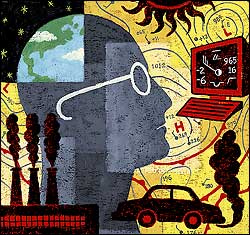
Both sides on the issue of greenhouse gases frame their arguments in terms of science, but each new scientific finding only raises new questions -- dooming the debate to be a pointless spiral. It's time, the authors argue, for a radically new approach: if we took practical steps to reduce our vulnerability to today's weather, we would go a long way toward solving the problem of tomorrow's climate
by Daniel Sarewitz and Roger Pielke Jr.
 N the last week of October, 1998, Hurricane Mitch stalled over Central America, dumping between three and six feet of rain within forty-eight hours, killing more than 10,000 people in landslides and floods, triggering a cholera epidemic, and virtually wiping out the economies of Honduras and Nicaragua. Several days later some 1,500 delegates, accompanied by thousands of advocates and media representatives, met in Buenos Aires at the fourth Conference of the Parties to the United Nations Framework Convention on Climate Change. Many at the conference pointed to Hurricane Mitch as a harbinger of the catastrophes that await us if we do not act immediately to reduce emissions of carbon dioxide and other so-called greenhouse gases. The delegates passed a resolution of "solidarity with Central America" in which they expressed concern "that global warming may be contributing to the worsening of weather" and urged "governments, ... and society in general, to continue their efforts to find permanent solutions to the factors which cause or may cause climate events." Children wandering bereft in the streets of Tegucigalpa became unwitting symbols of global warming.
More on politics and society in The Atlantic Monthly and Atlantic Unbound.
See more Atlantic articles on the environment
From the archives:
"The Liquid Earth," by Brenda Bell (January, 1999)
Landslides and other "ground failures" cost more lives and more money each year than all other natural disasters combined, and their incidence appears to be rising. Nevertheless, the government devotes few resources to their study -- and the foolhardy continue to build and live in places likely to be consumed one day by avalanches of mud.
"The Great Climate Flip-flop," by William H. Calvin (January 1998)
"Climate change" is popularly understood to mean greenhouse warming, which, it is predicted, will cause flooding, severe windstorms, and killer heat waves. But warming could lead, paradoxically, to drastic cooling -- a catastrophe that could threaten the survival of civilization.
"A Good Climate for Investment" by Ross Gelbspan (June 1998)
Reducing reliance on carbon for energy -- to safeguard our atmosphere and our climate -- could bring about not personal deprivation but a worldwide economic boom.
Elsewhere on the Web
Links to related material on other Web sites.
EPA Global Warming Site
The EPA's page on all things global-warming-related. Offers news, reference materials, events listings, answers to common scientific questions, and proposed action plans.
Global Warming
Information on climate change from the National Oceanic and Atmospheric Administration.
At the heart of this dispiriting state of affairs is a vitriolic debate between those who advocate action to reduce global warming and those who oppose it. The controversy is informed by strong scientific evidence that the earth's surface has warmed over the past century. But the controversy, and the science, focus on the wrong issues, and distract attention from what needs to be done. The enormous scientific, political, and financial resources now aimed at the problem of global warming create the perfect conditions for international and domestic political gridlock, but they can have little effect on the root causes of global environmental degradation, or on the human suffering that so often accompanies it. Our goal is to move beyond the gridlock and stake out some common ground for political dialogue and effective action.
N politics everything depends on how an issue is framed: the terms of debate, the allocation of power and resources, the potential courses of action. The issue of global warming has been framed by a single question: Does the carbon dioxide emitted by industrialized societies threaten the earth's climate? On one side are the doomsayers, who foretell environmental disaster unless carbon-dioxide emissions are immediately reduced. On the other side are the cornucopians, who blindly insist that society can continue to pump billions of tons of greenhouse gases into the atmosphere with no ill effect, and that any effort to reduce emissions will stall the engines of industrialism that protect us from a Hobbesian wilderness. From our perspective, each group is operating within a frame that has little to do with the practical problem of how to protect the global environment in a world of six billion people (and counting). To understand why global-warming policy is a comprehensive and dangerous failure, therefore, we must begin with a look at how the issue came to be framed in this way. Two converging trends are implicated: the evolution of scientific research on the earth's climate, and the maturation of the modern environmental movement.
Since the beginning of the Industrial Revolution the combustion of fossil fuels -- coal, oil, natural gas -- has powered economic growth and also emitted great quantities of carbon dioxide and other greenhouse gases. More than a century ago the Swedish chemist Svante Arrhenius and the American geologist T. C. Chamberlin independently recognized that industrialization could lead to rising levels of carbon dioxide in the atmosphere, which might in turn raise the atmosphere's temperature by trapping solar radiation that would otherwise be reflected back into space -- a "greenhouse effect" gone out of control. In the late 1950s the geophysicist Roger Revelle, arguing that the world was making itself the subject of a giant "geophysical experiment," worked to establish permanent stations for monitoring carbon-dioxide levels in the atmosphere. Monitoring documented what theory had predicted: atmospheric carbon dioxide was increasing.
In the United States the first high-level government mention of global warming was buried deep within a 1965 White House report on the nation's environmental problems. Throughout the 1960s and 1970s global warming -- at that time typically referred to as "inadvertent modification of the atmosphere," and today embraced by the term "climate change" -- remained an intriguing hypothesis that caught the attention of a few scientists but generated little concern among the public or environmentalists. Indeed, some climate researchers saw evidence for global cooling and a future ice age. In any case, the threat of nuclear war was sufficiently urgent, plausible, and horrific to crowd global warming off the catastrophe agenda.
Continued research, however, fortified the theory that fossil-fuel combustion could contribute to global warming. In 1977 the nonpartisan National Academy of Sciences issued a study called Energy and Climate, which carefully suggested that the possibility of global warming "should lead neither to panic nor to complacency." Rather, the study continued, it should "engender a lively sense of urgency in getting on with the work of illuminating the issues that have been identified and resolving the scientific uncertainties that remain." As is typical with National Academy studies, the primary recommendation was for more research. In the early 1980s the carbon-dioxide problem received its first sustained attention in Congress, in the form of hearings organized by Representative Al Gore, who had become concerned about global warming when he took a college course with Roger Revelle, twelve years earlier. In 1983 the Environmental Protection Agency released a report detailing some of the possible threats posed by the anthropogenic, or human-caused, emission of carbon dioxide, but the Reagan Administration decisively downplayed the document. Two years later a prestigious international scientific conference in Villach, Austria, concluded that climate change deserved the attention of policymakers worldwide. The following year, at a Senate fact-finding hearing stimulated by the conference, Robert Watson, a climate scientist at NASA, testified, "Global warming is inevitable. It is only a question of the magnitude and the timing."
At that point global warming was only beginning to insinuate itself into the public consciousness. The defining event came in June of 1988, when another NASA climate scientist, James Hansen, told Congress with "ninety-nine percent confidence" that "the greenhouse effect has been detected, and it is changing our climate now." Hansen's proclamation made the front pages of major newspapers, ignited a firestorm of public debate, and elevated the carbon-dioxide problem to pre-eminence on the environmental agenda, where it remains to this day. Nothing had so galvanized the environmental community since the original Earth Day, eighteen years before.
Historically, the conservation and environmental movements have been rooted in values that celebrate the intrinsic worth of unspoiled landscape and propagate the idea that the human spirit is sustained through communion with nature. More than fifty years ago Aldo Leopold, perhaps the most important environmental voice of the twentieth century, wrote, "We face the question whether a still higher 'standard of living' is worth its cost in things natural, wild, and free. For us of the minority, ... the chance to find a pasque-flower is a right as inalienable as free speech." But when global warming appeared, environmentalists thought they had found a justification better than inalienable rights -- they had found facts and rationality, and they fell head over heels in love with science.
Of course, modern environmentalists were already in the habit of calling on science to help advance their agenda. In 1967, for example, the Environmental Defense Fund was founded with the aim of using science to support environmental protection through litigation. But global warming was, and is, different. It exists as an environmental issue only because of science. People can't directly sense global warming, the way they can see a clear-cut forest or feel the sting of urban smog in their throats. It is not a discrete event, like an oil spill or a nuclear accident. Global warming is so abstract that scientists argue over how they would know if they actually observed it. Scientists go to great lengths to measure and derive something called the "global average temperature" at the earth's surface, and the total rise in this temperature over the past century -- an increase of about six tenths of a degree Celsius as of 1998 -- does suggest warming. But people and ecosystems experience local and regional temperatures, not the global average. Furthermore, most of the possible effects of global warming are not apparent in the present; rather, scientists predict that they will occur decades or even centuries hence. Nor is it likely that scientists will ever be able to attribute any isolated event -- a hurricane, a heat wave -- to global warming.
A central tenet of environmentalism is that less human interference in nature is better than more. The imagination of the environmental community was ignited not by the observation that greenhouse-gas concentrations were increasing but by the scientific conclusion that the increase was caused by human beings. The Environmental Defense Fund, perhaps because of its explicitly scientific bent, was one of the first advocacy groups to make this connection. As early as 1984 its senior scientist, Michael Oppenheimer, wrote on the op-ed page of The New York Times,
With unusual unanimity, scientists testified at a recent Senate hearing that using the atmosphere as a garbage dump is about to catch up with us on a global scale.... Carbon dioxide emissions from fossil fuel combustion and other "greenhouse" gases are throwing a blanket over the Earth.... The sea level will rise as land ice melts and the ocean expands. Beaches will erode while wetlands will largely disappear.... Imagine life in a sweltering, smoggy New York without Long Island's beaches and you have glimpsed the world left to future generations.
Preserving tropical jungles and wetlands, protecting air and water quality, slowing global population growth -- goals that had all been justified for independent reasons, often by independent organizations -- could now be linked to a single fact, anthropogenic carbon-dioxide emissions, and advanced along a single political front, the effort to reduce those emissions. Protecting forests, for example, could help fight global warming because forests act as "sinks" that absorb carbon dioxide. Air pollution could be addressed in part by promoting the same clean-energy sources that would reduce carbon-dioxide emissions. Population growth needed to be controlled in order to reduce demand for fossil-fuel combustion. And the environmental community could reinvigorate its energy-conservation agenda, which had flagged since the early 1980s, when the effects of the second Arab oil shock wore off. Senator Timothy Wirth, of Colorado, spelled out the strategy in 1988: "What we've got to do in energy conservation is try to ride the global warming issue. Even if the theory of global warming is wrong, to have approached global warming as if it is real means energy conservation, so we will be doing the right thing anyway in terms of economic policy and environmental policy." A broad array of environmental groups and think tanks, including the Environmental Defense Fund, the Sierra Club, Greenpeace, the World Resources Institute, and the Union of Concerned Scientists, made reductions in carbon-dioxide emissions central to their agendas.
The moral problem seemed clear: human beings were causing the increase of carbon dioxide in the atmosphere. But the moral problem existed only because of a scientific fact -- a fact that not only provided justification for doing many of the things that environmentalists wanted to do anyway but also dictated the overriding course of action: reduce carbon-dioxide emissions. Thus science was used to rationalize the moral imperative, unify the environmental agenda, and determine the political solution.
(The online version of this article appears in three parts. Click here to go to part two or part three.)
Daniel Sarewitz is a research scholar at Columbia University's Center for Science, Policy and Outcomes. Roger Pielke Jr. is a scientist with the Environmental and Societal Impacts Group at the National Center for Atmospheric Research. They are the editors, with Radford Byerly Jr., of Prediction: Science, Decision Making, and the Future of Nature (2000).
Illustration by James Steinberg.
Copyright © 2000 by The Atlantic Monthly Company. All rights reserved.
The Atlantic Monthly; July 2000; Breaking the Global-Warming Gridlock - 00.07;
Volume 286, No. 1; page 54-64.