


Go to this issue's Table of Contents.
N O V E M B E R 2 0 0 0



The Consumer Products Safety Commission was created to ensure the safety of products for infants, among others. But it can't
More on politics and society in The Atlantic Monthly and Atlantic Unbound.
From the archives:
"Regulation by Shaming," by Mary Graham (April 2000)
Forcing companies to disclose health and safety information can improve customer choices and industry practices -- but it can also distort perceptions of what should be changed.
"Told You So," by Cullen Murphy (September 1999)
The writing on the wall -- and the bottle, the box, the stroller, the doe...
Elsewhere on the Web
Links to related material on other Web sites.
The Danny Foundation
"The primary mission of the Foundation is to educate the public about crib dangers and to eliminate the millions of unsafe cribs currently in use or in storage." The site offers crib safety news, a crib-safety-checklist, information about product-safety laws, and related links.
Product Recalls
A regularly updated index of recalled children's products, posted at a site promoting the book Child Safe: A Practical Guide for Preventing Childhood Injuries.
National Safe Kids Campaign
"The National Safe Kids Campaign's mission is to prevent the number one killer of children -- unintentional injury." The site offers a wide variety of child-safety information, including information about car seats, school-zone traffic, product recalls, safety tips for scooters, bicycles, rollerblades, and more.
For Baby's Sake
A site "dedicated to the safety of your child" that describes potential hazards of everyday baby products, lists product recalls, and offers an index of related resources.
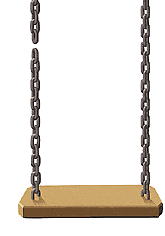
The Consumer Product Safety Commission is the federal agency charged with ensuring the safety of consumer goods. Last year the CPSC recalled ninety-five toys and infant products, adding up to tens of millions of units. Recalls have included certain models of Cosco tandem strollers, after 3,000 complaints that the locks on the folding mechanism failed. This could cause the stroller to collapse unexpectedly, and it resulted in injuries to more than 200 babies, including head injuries and lacerations requiring stitches. Also recalled were some Evenflo Snugli soft infant carriers, after thirteen reports that babies had fallen through the leg openings, and seven million Graco infant swings made before November of 1997 -- after 181 falls were reported, twenty-two infants were caught at the neck or the chest, and six children died.
When the CPSC initiates the recall of a product, it generally persuades the manufacturer to notify retailers that the product can no longer be sold and to issue a joint press release specifying why the product has been recalled and what people who own it should do (for example, stop using it and request further instructions from the company). The CPSC sends these press releases to television stations, magazines, and newspapers, and also makes them available on its Web site, at www.cpsc.gov (the commission's hotline phone number is 800-638-2772).
 Manufacturers know that strongly worded, alarming press releases are likely to attract reporters' attention. And they know that well-publicized recalls can invite product-liability suits, damage their corporate image, and reduce the value of their stock. The language used in recall press releases is negotiated at highly secretive meetings between CPSC staff members and manufacturers' lawyers, product engineers, and public-relations experts. "The manufacturer wants to minimize the hazards, and the CPSC wants to maximize them," says Bengt Lager, whose company, Regal Lager, is the exclusive U.S. distributor of Baby Bj�rn products. Manufacturers try to avoid press-release headlines that announce a straight "recall,"because they fear that consumers will think the product must be returned. Instead a "recall to repair" will instruct customers to get in touch with the company for a free repair kit. A recall notice in 1995 for the Playskool 1-2-3 high chair (cracked joints sometimes caused the chair to collapse) was headlined "Recall to Repair."In 1997 a press release issued for some models of the same product (this time the restraint bar broke) was headlined "Recall to Repair Restraint Bar,"and mentioned nothing about the weak joints. (Hasbro, the owner of the Playskool brand, received at least 4,500 consumer complaints before the chair was recalled the first time.)Thus it is not surprising that these press releases are not always considered newsworthy.
On the afternoon of May 12, 1998, in Chicago, a sixteen-month-old, Danny Keysar, was put down for a nap in a Playskool Travel-Lite portable crib by his day-care provider, Anna. When Anna checked on Danny a little while later, she found that the crib had collapsed while he was standing, trapping his neck in the V of its folded rails. Danny was no longer breathing. Though the toddler weighed only twenty-five pounds, the rails collapsed under his weight, folding shut at the center hinges.
Anna had been caring for the child in her home for ten months, and as a licensed day-care provider, she was required to undergo periodic safety inspections. Illinois inspectors had been to the home just eight days before the incident occurred. After Danny's funeral a newspaper reporter discovered that his death was not an isolated incident: four other children had died in Playskool Travel-Lite cribs. (One other child died three months later.) The government had deemed the Travel-Lite dangerous and had ordered it off the market five years earlier, in a product recall. But it was not the only portable crib that had been recalled. From 1993 to 1997 more than 1.5 million portable cribs with a similar design (center hinges on the top rails) -- marketed by other companies whose names parents associate with good products for children, such as Baby Trend, Century Products, and Evenflo -- were recalled (see the CPSC Web site for model numbers). In 1991 an eleven-month-old in Los Angeles became the first baby known to have died in one of these cribs, and Danny is believed to have been the twelfth.
After Danny died, his parents, Linda Ginzel and Boaz Keysar (both professors at the University of Chicago), founded Kids in Danger (www.kidsindanger.org), a nonprofit organization that is dedicated to teaching parents how to protect their children from unsafe products. Ginzel and Keysar initiated and championed the Children's Product Safety Act, which was signed into law in August of last year by the governor of Illinois, George Ryan. The law makes it illegal to sell or lease a children's product that has been recalled, and ensures that recalled products are not used in licensed day-care facilities. Hailed as model legislation by the CPSC, the law was enacted in Michigan last June.
HOW did such a product make its way to store shelves in the first place? When I called the CPSC for an explanation, Russ Rader, the public-affairs officer, told me that his agency was prohibited by the Consumer Product Safety Act from releasing all of the product-specific information I wanted. For thorough answers I turned to the Freedom of Information Act, which provides the public with direct access to documents held by federal agencies.
I filed a request for documents on Baby Trend, Century Products, Draco (not to be confused with Graco, another manufacturer of products for infants), Evenflo, and Playskool portable cribs. It was months before the documents arrived. Section 6(b) of the Consumer Product Safety Act was largely to blame for this delay. Sometimes referred to as a "reverse FOIA,"6(b) requires the CPSC to allow the manufacturer an opportunity to comment on the information (including testing data, consumer complaints, warranty claims)that the CPSC plans to release in response to a FOIA request if the company is identified by name. The CPSC is the only health-and-safety agency with such a restrictive statute.
Over the next year I filed dozens more requests for CPSC files on products certain models of which had been associated with the injury or death of children, including Safety 1st bed rails and bath seats, Century TraveLite Sport strollers, Century Lil'Napper infant swings, Baby Bj�rn infant carriers, Playskool 1-2-3 high chairs, and Cosco cribs, toddler beds, and infant swings. Most of my requests were answered within three months. But the files had obviously contained information that someone didn't want me to see: individual pages or entire documents had been removed, and sentences had been deleted by hand, with swipes of a black felt-tip pen.
(The online version of this article appears in two parts. Click here to go to part two.)
E. Marla Felcher is the author of It's No Accident: How Corporations Sell Dangerous Baby Products (forthcoming).
Illustrations by Adam Niklewicz.
Copyright © 2000 by The Atlantic Monthly Company. All rights reserved.
The Atlantic Monthly; November 2000; Children's Products and Risk - 00.11;
Volume 286, No. 5; page 36-42.