Contents | April 2001
In This Issue (Contributors)
"Word Fugitives" (February 2001)
For more by Barbara Wallraff, see The Court Record.
See a collection of Atlantic articles on language.
Submit an entry to Word Fugitives.
The Atlantic Monthly | April 2001
Word Fugitives
 by Barbara Wallraff
 his column appeared in The Atlantic for the first time in February—just a few weeks before the current issue went to press. It introduced readers to the idea of "word fugitives"—empty mental spaces that await words to fill them—and invited anyone interested to propose words sought by two readers of the magazine's Web site, where Word Fugitives began. So that correspondents will have time to weigh in, we will publish responses to those queries in the June issue. In the meantime, here are two further exchanges adapted from the Web site, and two new calls for words.
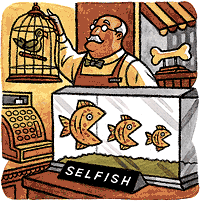
AMY MARSMAN, of New York, New York, wrote, "I am interested in either learning or coining a word that emphasizes the positive aspects of selfishness. Selfishness has such negative connotations, yet looking out for one's health and well-being first and foremost is considered emotionally and physically sound. Why should that have negative connotations? I hear a lot of people apologize for this enlightened view, because they have to use the nasty word selfish to describe themselves."
When this note was published in Atlantic Unbound, a number of people seem to have stayed up late writing responses to it, including treatises that quoted or paraphrased such thinkers as Adam Smith, John Maynard Keynes, Abraham Maslow, S. I. Hayakawa, and, most often, Ayn Rand. Spencer Star, of Emeryville, California, wrote, "You might call yourself a utilitarian, though that term is usually associated with Jeremy Bentham and John Stuart Mill." Austin Peterson, of Evanston, Wyoming, wrote, "Instead of our being concerned about another person's accusation that we are selfish, which drives us to justify our behavior with a substitute word, why not rely on the old-fashioned word responsible?"
And top honors go to Ann Franchi, of Eaton Park, Florida, for her suggestion of selfism and selfist. These words appear in unabridged dictionaries, but they are heard and seen only rarely; when they do appear in print, they are likely to carry roughly the meaning that Amy Marsman is seeking. Despite a proliferation of words like racism and sexist, speciesism and ageist, the suffixes -ism and -ist for the most part have neutral connotations. A student radical I knew in my college days, explaining why he considered himself a Trotskyist, not a Trotskyite, once told me sternly, "It's like the difference between a socialist and a socialite." It's not, of course—but no one who hears that seems to have trouble ever again remembering which term is pejorative.
RALPH W. MILLIGAN, of Lake Charles, Louisiana; Marion Greenman, of Oak Park, Illinois; and Jack Wilson, of Wayland, Massachusetts, all separately sought one particular word—a pretty good hint that the lack of it is widely felt. As Milligan explained the word fugitive in question, "The English language desperately needs a word for an offspring who is an adult. My eldest daughter is still my daughter, but she is certainly no longer my child."
Michael Fischer, of Minneapolis, Minnesota, responded with a list: "For the pedantic, there are progeny and scions; for insurance purposes, there is descendants; and if you want to be biblical, there is begats." Carolyn Roosevelt, of Cambridge, Massachusetts, reported, more flippantly, "My cousin calls her grown progeny my adults." And Dan Dillon, of Chicago, Illinois, thought to coin unchildren.
Top honors, though, are due Charles Harrington Elster, of San Diego, California, a professional wordsmith and a vice-president of the Society for the Preservation of English Language and Literature. "Assuming the child has left home," he wrote, "how about offsprung?"
NOW PAUL M. KINTER, of Hendersonville, North Carolina, writes, "We need a word to describe the act of having tongue-in-cheek wit taken literally—a particularly exasperating experience."
AND HARRIET REISEN, of Arlington, Massachusetts, writes, "The verb to dial in reference to the telephone seems antiquated already, and it will only become more obscure in origin as rotary phones go from scarcity to extinction. We need a good neologism to replace it."
She's right—but please don't call The Atlantic and dial my extension to share your ideas about this word fugitive.
Send words that serve Paul Kintner's or Harriet Reisen's purposes to Word Fugitives, The Atlantic Monthly, 77 North Washington Street, Boston, MA 02114 or visit the Word Fugitives page on our Web site, at www.theatlantic.com/fugitives. Submissions must be received by April 30. Use the same addresses to submit word fugitives that you'd like The Atlantic's help in finding. Letters become the property of Word Fugitives and may be edited.
Readers whose queries are published and those whose words are singled out for top honors will each receive, with our thanks, a selection of recent autographed books by Atlantic authors. The next installment's correspondents will be sent Drowning Ruth, by Christina Schwarz; Breathing Room, by Peter Davison; and Fast Food Nation, by Eric Schlosser.
Illustration by Sean Kelly.
Copyright © 2001 by The Atlantic Monthly Group. All rights reserved.
The Atlantic Monthly; April 2001; Word Fugitives- 01.04; Volume 287, No. 4; page 116.