Contents | May 2001
In This Issue (Contributors)
More on language from The Atlantic Monthly.
From the archives:
The Court Record
Language columns by Barbara Wallraff, from The Atlantic Monthly and Atlantic Unbound.
Word Improvisation
Investigations of slang by J. E. Lighter, the editor of the Random House Dictionary of American Slang.
Word Watch
A selection of terms that have newly been coined, that have recently acquired new currency, or that have taken on new meanings, compiled by Anne H. Soukhanov, the U.S. general editor of The Encarta World English Dictionary (1999).
"A War That Never Ends" (March 1997)
The laws of grammar may be arbitrary, as those who would simply dismiss them assert. But arbitrary laws are just the ones that need enforcement. By Mark Halpern
"Elegant Variation and All That" (December 1996)
A modernized edition of a venerable classic of English usage brings changes that are vast and controversial—and almost always sensible. By Jesse Sheidlower
"The E Word" (September 1996)
Why euphemisms warrant a statistical index all their own. By Cullen Murphy
"The Decline of Grammar" (December 1983)
"Is the English language—or to put it less apocalyptically, English prose writing—really in a bad way? How would one tell?" By Geoffrey Nunberg
Elsewhere on the Web
Links to related material on other Web sites.
Roget's International Thesaurus of English Words and Phrases
An online version of the 1922 edition of Roget's Thesaurus. Includes Roget's introduction, and synopses of his categorization methods. Posted by Bartleby.com, an online publisher of literary and reference works.
The Atlantic Monthly | May 2001
Centerpiece
Word Imperfect
 Roget's Thesaurus has long been considered one of the great lexicographical achievements in the history of the English language, a reference work of astonishing ubiquity and far-reaching influence. But now the author of The Professor and the Madman—the best-selling tale of the making of the Oxford English Dictionary—questions the legacy of the definitive list of synonyms that the brilliant Peter Mark Roget compiled 150 years ago. Is the name Roget becoming a synonym for intellectually second-rate?
by Simon Winchester
.....
But a more potent clue is to be found whenever one tries, using modern equipment, to write anything about Roget. The spell-checker that is provided on most computers these days has no listing whatsoever for Roget. The old-fashioned Oxford English Dictionary has a listing, naturally, and makes it clear that the word—as in, for example, to look it up in Roget—is now so well known as to have the status of an eponym. (It has to be said, however, that the name is not in Oxford's Dictionary of Eponyms.) But no readily available computer-program-integrated dictionary seems to agree with the OED: none I used lists the word, even though Microsoft Word (which not unreasonably sports its company name in its own dictionary) has a fair enough share of other eponymous and similar words and phrases that might be thought of as equally significant—boycott, thermos, Kodak, and bowler hat among them.
No, if you attempt to write the word Roget using any of Bill Gates's spectacular software, you get a squiggly red line underneath, indicating that you have written a word the software doesn't recognize. Even worse, if you happen to enter the same word in the thesaurus that comes with Microsoft Word (but which is made under contract by a firm with the name—somewhat less than encouraging for lexicographers—Soft-Art Inc.), you will be obligingly informed that what you must have been thinking of, when you were so slack as to write by mistake the name of literature's most celebrated helpmeet, was in fact the word rogue. Don't know a good synonym for philistine? Why not look it up in rogue?
Yet what some will see as just another melancholy comment on the degraded state of contemporary language has for me turned out to be rather helpful. I bless the operatives at Soft-Art and their fine economy of word association. For what I am trying to grapple with, and what might otherwise have resulted in little more than a hymn of praise to a man I see (for his myriad other achievements) as one of the great unsung heroes of all time, has been distilled into an elegant and nicely challenging proposition: Perhaps Peter Mark Roget actually deserves to be regarded as the very rogue that this sparkling new twenty-first-century thesaurus would make him. If so, it is because the evident decline in language is something for which at least partial blame must be laid at his door; it has its origins in the extraordinary eponymous volume that he single-handedly created almost 150 years ago.
To put it more forcefully: Roget's Thesaurus no longer merits the unvarnished adoration it has over the years almost invariably received. It should be roundly condemned as a crucial part of the engine work that has transported us to our current state of linguistic and intellectual mediocrity.
ore than 30 million copies of Roget's Thesaurus of English Words and Phrases have been sold since the book was first published, in London, by the firm of Longman, Brown, Green and Longmans, in May of 1852. It is, by any standard, one of the most popular reference books ever written—a "treasure-house" indeed, as thesaurus translates from the Greek. Rare is the household without a dog-eared copy somewhere—perhaps a holdover from school days; perhaps bought years ago with good intent, along with Merriam-Webster and Bartlett's Familiar Quotations; perhaps twinned with a book of crossword puzzles or acrostics. The motives for owning Roget—improving that essay, finding that eight-letter word beginning with t, getting the mot juste for that Rotary Club or senate-campaign speech—are manifold.
There have been countless editions. Roget himself presided over twenty-five of the twenty-eight—each one subtly different—that were published during the two decades in which he continued to work on his magnum opus. The book has been published in America continuously since 1854. A considerable industry has arisen alongside Roget, devoted to books with a similar function and with similar titles. Many of these works once used the word Roget in their titles, as the name of the original author or, quite often, as a purely descriptive term. C.O. & Sylvester Mawson's A Dictionary of Synonyms and Antonyms; Being a Presentation of Roget's Thesaurus ... in Alphabetical Form (1931), is one example. Amazon lists 935 works for sale that include thesaurus in the title. (An impressive number, one might think—though it is perhaps worth noting that the same catalogue lists 21,782 products that incorporate the word dictionary in their titles, and 10,748 that call themselves encyclopedias. Roget may sell phenomenally well, but it has much less competition than do many other great works of reference.)
However defining and useful Roget's Thesaurus may have proved to be over the past 150 years, it was not the first book of its kind. Actually it would be more accurate to say that earlier books performed the function that Roget's Thesaurus is believed to perform—a distinction that makes it necessary to focus at the outset on three questions: What books of similar intent existed in published form before 1852? What exactly was Roget trying to do when he first sat down to assemble his famous work? And what did he in fact achieve?
he answer to the third question is, superficially at least, self-evident: Roget's Thesaurus is a stylish and comprehensive list of synonyms. The other questions are less straightforward, however, and to answer them we must first consider sixteenth- and seventeenth-century English society—particularly the eagerness among its most prominent members to make sure they looked and sounded elegant and learned.
This period of English history was witness to an explosion of intellectual energy. It was the time of Newton and Dryden, Bunyan and Purcell, Halley and Wren, Aphra Behn and Beau Nash. These great thinkers and creators radiated energy; the nation basked in their glory; and those who were rich and grand enough but less talented did their corporate best to sparkle in all the reflected luminance.
The style of the times was all about glitter and reflection: the houses, the parties, the gardens, the games, the flowery rituals of mannered society—all pointed to a fascination with the baroque complications of an ever accelerating civilization. The dress of the day suggested much the same. Fashionable foppishness also exceeded all reason in what may strike us today as the most ludicrous of English affectations at that time: the laboriously convoluted language. The way the upper classes and those who aspired to join them tortured the tongue positively beggars belief.
Nor was there any irony in the widespread use of what were called (dismissively, by truly learned folk) "inkhorn terms." The language spoken in the overheated "withdrawing rooms" of Belgrave Square and Pimlico was larded with them: phrases such as ingent affabilitie and dominicall superiorite; verbs such as revolute and deruncinate; and adjectives—rather fewer, mercifully—such as magnifical and splendidious. The relative lack of adjectives hints that perhaps some vocabulary god thought this nonsense was dreadful enough without further qualification.
In due course, in 1604, a Coventry schoolteacher named Robert Cawdrey came to the aid of those who were floundering. He gathered together some 2,500 words, arranged them in alphabetical order, and offered his volume,120 pages and bound octavo.
The book was called A Table Alphabeticall ... of Hard Usuall English Wordes, and it became—this first-ever true dictionary of the English language—a best seller. Cawdrey noted without a hint of condescension that he intended it "for the benefit & helpe of Ladies, Gentlewomen, or any other unskilfull persons."
For a while Cawdrey's book did the trick. But before long one of the axiomatically inherent flaws of alphabetical dictionaries in general became apparent: it is not possible to look up a word if you don't know what that word is.
"Of course," one would say today. "That stands to reason." But in the sixteenth and seventeenth centuries, when the cataloguing of words was an altogether brand-new skill, it took time to understand. And once it had sunk in, the need arose for quite another kind of book—one that would lead the inquirer to a particular word if he knew roughly what it was that he wanted to say but had no firm idea of the assemblage of letters and syllables that would enable him to say it.
The first notable book to do so was by one John Trusler, and its portmanteau title was The Difference Between Words Esteemed Synonymous in the English Language; and the Proper Choice of Them Determined. Trusler's volume (one of the first to incorporate a word derived from synonym in the title), more than any other, was the true precursor if not specifically of Roget's Thesaurus then of what the Thesaurus has since erroneously (as we shall see) been perceived to be. It was, in essence, the first real synonym finder.
Trusler's work answered the prayers of the drawing-room dandy, because it meant that at last he could look up a word without knowing what it was. He simply had to look up a word of similar meaning, and lo!—if his synonym finder was a good one (as John Trusler's was), then a suitable word would be listed; he could select one and promptly delight the world.
Trusler's book, though, was essentially a catalogue of synonyms: it merely listed them, noting their existence but making no attempt to prescribe which words should be used in which situations. It was left to a friend of Samuel Johnson's, Hester Lynch Piozzi, to create the first prescriptive work on British synonymy. Although Piozzi's book had many detractors (Roget was probably among them), it also persuaded literate Britain to start thinking hard about a question that lies at the core of this examination of Roget: what exactly is a synonym?
Piozzi's book, British Synonymy; or, an Attempt at Regulating the Choice of Words in Familiar Conversation, came out in 1794, nearly sixty years before Roget's first thesaurus was published—but, according to his writings, only a decade before Roget started planning it. The links between Piozzi's book and his are vague, but her volume's fame was such that he no doubt knew of it. British Synonymy was published in Dublin and ran to 427 pages, and it was directed, as D. J. Emblen wrote in his biography Peter Mark Roget (1970), at "those coming up in society and ... eligible foreigners" who might not be familiar with the shades and nuances of the language, and who might want to avoid embarrassing themselves.
The language of the day was becoming ever more complex: thanks to new discoveries in science and geography, and to the ever multiplying energies of writers, vocabulary choices were increasing almost by the day. To use English properly was, in a word, daunting. Opportunities for making oneself look and sound foolish were everywhere. Hence the need for the balm of Piozzi's enormous book. She would show one how to sound one's best.
The way she tried to accomplish this, mind you, ruffled some feathers. It was unimportant to her if what one said was lexically imperfect—that was just a matter of pedantry. Style and the veneer of sophistication were all. "Synonymy," she reassured her readers, with a remark that would have infuriated Roget, "has more to do with elegance than truth."
The organization of Piozzi's book is peculiar compared with that of modern synonymies. She grouped what she regarded as synonymous words together and then explained in a longish paragraph the nuances that distinguished them. Take, for example (as quoted in Emblen's book),
AFFABILITY, CONDESCENSION, COURTESY, GRACIOUSNESS
Are nearly synonymous, though common discourse certainly admits that an equal may be affable, which I should still think wrong in a printed book, and unpleasing everywhere, because the word itself seems to imply superiority. We will allow however that the lofty courtesy of a princess loses little of its graciousness, although some condescension be left visible through the exterior affability; but that, among people where talents or fortune only make the difference, a strain of polished familiarity, or familiar politeness (call it as you will) is the behaviour most likely to attract affectionate esteem.
In Piozzi's view, a slight but important difference of class association existed in the employment of these four words. The manner in which each was used—except among those whose "talents or fortune" rather than rank distinguished them—depended on who was being affable or courteous to whom: a duke might be affable to a commoner; it behooved a commoner to be courteous in return, and most decidedly not affable.
Other synonymies were published between Piozzi's and Roget's—the biggest and most durable being George Crabb's work of 1816, English Synonymes Explained, in Alphabetical Order; With Copious Illustrations and Explanations Drawn From the Best Writers. It was a cumbersome book, widely criticized for being prolix in style and maddeningly circular in argument. But it, too, answered a seemingly urgent need: sixteen editions were printed over the thirty-six years before Roget swept the board.
Crabb's success spawned other synonymies: in the decade before Roget fourteen synonym finders were published, known today to the small fraternity of thesaurus collectors by the names of their compilers—among them William Carpenter (1842), George Graham (1846), James Jermyn (1848), and James Rawson (1850). Many such books could have helped users to jog their memories. It is rather charming to suppose that such a book, slipped furtively from a partygoer's pocket, might act as a sort of hip flask for the conversationally parched. The image may strike us as more than a little awkward, but perhaps the etiquette of the time made the use of such a little book no trickier than the use of a phrase book when abroad.
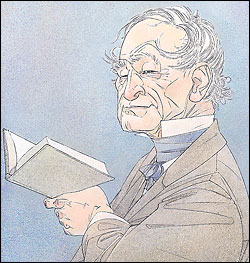
Illustration by David Johnson.
Copyright © 2001 by The Atlantic Monthly Group. All rights reserved.
The Atlantic Monthly; May 2001; Word Imperfect - 01.05; Volume 287, No. 5; page 54-86.