



by David M. Kennedy
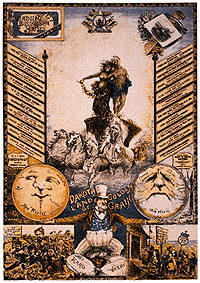
An 1888 lithograph urged newly arrived immigrants fleeing the "tired" Old World to settle in the promising Dakota Territory. (From The Granger Collection, New York) |
 HE question in my title implies a premise: that
historically the United States
has well afforded to be a nation of immigrants -- indeed, has benefited
handsomely from its good fortune as an immigrant destination. That proposition
was once so deeply embedded in our national mythology as to be axiomatic. More
than a century ago, for example, in the proclamation that made Thanksgiving Day
a national holiday, Abraham Lincoln gave thanks to God for having "largely
augmented our free population by emancipation and by immigration."
HE question in my title implies a premise: that
historically the United States
has well afforded to be a nation of immigrants -- indeed, has benefited
handsomely from its good fortune as an immigrant destination. That proposition
was once so deeply embedded in our national mythology as to be axiomatic. More
than a century ago, for example, in the proclamation that made Thanksgiving Day
a national holiday, Abraham Lincoln gave thanks to God for having "largely
augmented our free population by emancipation and by immigration."Lincoln spoke those words when there were but 34 million Americans and half a continent remained to be settled. Today, however, the United States is a nation of some 264 million souls on a continent developed beyond Lincoln's imagination. It is also a nation experiencing immigration on a scale never before seen. In the past three decades, since the passage of the Immigration and Nationality Act Amendments of 1965, the first major revision in American immigration statutes since the historic closure of immigration in the 1920s, some 20 million immigrants have entered the United States. To put those numbers in perspective: prior to 1965 the period of heaviest immigration to the United States was the quarter century preceding the First World War, when some 17 million people entered the country -- roughly half the total number of Europeans who migrated to the United States in the century after 1820 (along with several hundred thousand Asians). The last pre-war census, in 1910, counted about 13.5 million foreign-born people in the American population, in contrast to about 22.5 million in 1994. Historians know a great deal about those earlier immigrants -- why they came, how they ended up, what their impact was on the America of their day. Whether America's historical experience with immigration provides a useful guide to thinking about the present case is the principal question I want to address. I want not only to explore the substantive issue of immigration but also to test the proposition that the discipline of history has some value as a way of knowing and thinking about the world.
With respect to immigration itself, I intend to explore two sets of questions.
- Why did people migrate to America in the past, and what were the
consequences, for them and for American society, once they landed?
- Why are people migrating to America today, and what might be the
consequences, for them and for American society, of their presence in such
numbers?
The Pull of America
 generation or two ago upbeat answers to the first pair of
questions so pervaded the culture that they cropped up in the most exotic
places -- in Tunisia, for example, on July 9, 1943. The occasion was the
eve of the invasion of Sicily, and General George S. Patton
Jr. was addressing his troops, who were about to embark for the battle.
He urged, "When we land, we will meet German and Italian soldiers whom it
is our honor and privilege to attack and destroy. Many of you have in your
veins German and Italian blood, but remember that these ancestors of yours
so loved freedom that they gave up home and country to cross the ocean in
search of liberty. The ancestors of the people we shall kill lacked the
courage to make such a sacrifice and continued as slaves."
generation or two ago upbeat answers to the first pair of
questions so pervaded the culture that they cropped up in the most exotic
places -- in Tunisia, for example, on July 9, 1943. The occasion was the
eve of the invasion of Sicily, and General George S. Patton
Jr. was addressing his troops, who were about to embark for the battle.
He urged, "When we land, we will meet German and Italian soldiers whom it
is our honor and privilege to attack and destroy. Many of you have in your
veins German and Italian blood, but remember that these ancestors of yours
so loved freedom that they gave up home and country to cross the ocean in
search of liberty. The ancestors of the people we shall kill lacked the
courage to make such a sacrifice and continued as slaves."
In his own inimitable idiom Patton was invoking what for most Americans was -- and still is -- the standard explanation of who their immigrant forebears were, why they left their old countries, and what was their effect on American society. In this explanation immigrants were the main-chance-seeking and most energetic, entrepreneurial, and freedom-loving members of their Old World societies. They were drawn out of Europe by the irresistible magnet of American opportunity and liberty, and their galvanizing influence on American society made this country the greatest in the world.
A radically different explanation of immigration has also historically been at work in the American mind. As the noted social scientist Edward Alsworth Ross put it in 1914:
Observe immigrants not as they come travel-wan up the gang-plank, nor as they issue toil-begrimed from pit's mouth or mill-gate, but in their gatherings, washed, combed, and in their Sunday best. . . . [They] are hirsute, low-browed, big-faced persons of obviously low mentality. . . . They simply look out of place in black clothes and stiff collar, since clearly they belong in skins, in wattled huts at the close of the Great Ice Age. These ox-like men are descendants of those who always stayed behind.Ross was describing in these invidious terms what he and his turn-of-the-century contemporaries called the "new" immigrants -- new because they came predominantly from eastern and southern Europe, as distinct from the "old," early-and-mid-nineteenth-century immigrants, who had come mainly from northern and western Europe. Ironically, Ross was also talking about the parents of those very troops (at least the Italian-American troops) whom Patton addressed in 1943.
Between those two poles of explanation American views of immigration have oscillated. On the one hand, as Patton reminds us, immigrants were judged to be noble souls, tugged by the lodestone of American opportunity, whose talents and genius and love of liberty account for the magnificent American character. On the other hand, as in Ross's view, especially if they had the misfortune to arrive on a more recent boat, immigrants were thought to be degraded, freeloading louts, a blight on the national character and a drain on the economy -- the kind of people described all too literally, so the argument goes, by Emma Lazarus's famous inscription on the base of the Statue of Liberty: "your tired, your poor . . . the wretched refuse of your teeming shore."
Yet for all their differences, the two views have several things in common. Both explain immigration in terms of the moral character of immigrants. Both understand immigration as a matter of individual choice. And both implicitly invoke the American magnet as the irresistible force that put people in motion, drawing them either to opportunity or to dependency.
Those concepts do not bear close analysis as adequate explanations for the movement of some 35 million human beings over the course of a century. This was a historical phenomenon too huge and too specific in time to be sufficiently accounted for by summing 35 million decisions supposedly stimulated by the suddenly irresistible gravitational attraction of a far-off continent.
The Push of Europe
 OR the first three centuries or so after the European discovery of the New
World the principal source of immigrants to the two American continents and the
Caribbean was not Europe but Africa. Only in the early nineteenth century did
the accumulated total of European settlers in the New World exceed the
approximately 10 million Africans who had made the trans-Atlantic voyage in the
years since 1492. To explain the African diaspora by citing entrepreneurial
instincts, the love of democracy, or the freely chosen decisions of migrants to
follow the lodestar of American promise would be a mockery. Clearly, the
involuntary movement of those 10 million Africans is best explained not in
terms of their individual characters and choices but in terms of the
catastrophically disruptive expansion of large-scale plantation agriculture and
its accursed corollary, large-scale commercial slavery.
OR the first three centuries or so after the European discovery of the New
World the principal source of immigrants to the two American continents and the
Caribbean was not Europe but Africa. Only in the early nineteenth century did
the accumulated total of European settlers in the New World exceed the
approximately 10 million Africans who had made the trans-Atlantic voyage in the
years since 1492. To explain the African diaspora by citing entrepreneurial
instincts, the love of democracy, or the freely chosen decisions of migrants to
follow the lodestar of American promise would be a mockery. Clearly, the
involuntary movement of those 10 million Africans is best explained not in
terms of their individual characters and choices but in terms of the
catastrophically disruptive expansion of large-scale plantation agriculture and
its accursed corollary, large-scale commercial slavery.
A comparable -- though, to be sure, not identical -- element of involuntariness characterized emigration from nineteenth-century Europe. Any generalization about what prompted a phenomenon as long-lived and complicated as the great European migration must, of course, be subject to many qualifications. All discussions of the migration process recognize both push and pull factors. But at bottom the evidence convincingly supports the argument that disruption is essential to the movement of people on such a scale. And, as in the African case, the best, most comprehensive explanation for a process that eventually put some 35 million people in motion is to be found in two convulsively disruptive developments that lay far beyond the control of individual Europeans. Those developments had their historical dynamic within the context of European, not American, history.
The first of these needs little elaboration. It was, quite simply, population growth. In the nineteenth century the population of Europe more than doubled, from some 200 million to more than 400 million, even after about 70 million people had left Europe altogether. (Only half of these, it should be noted, went to the United States -- one among many clues that the American-magnet explanation is inadequate.) That population boom was the indispensable precondition for Europe to export people on the scale that it did. And the boom owed little to American stimulus; rather, it was a product of aspects of European historical evolution, especially improvements in diet, sanitation, and disease control.
The second development was more complex, but we know it by a familiar name: the Industrial Revolution. It includes the closely associated revolution in agricultural productivity. Wherever it occurred, the Industrial Revolution shook people loose from traditional ways of life. It made factory workers out of artisans and, even more dramatically, turned millions of rural farmers into urban wage-laborers. Most of those migrants from countryside to city, from agriculture to industry, remained within their country of origin, or at least within Europe. But in the early stages of industrialization the movement of people, like the investment of capital during the unbridled early days of industrialism, was often more than what the market could bear. In time most European societies reached a kind of equilibrium, absorbing their own workers into their own wage markets. But in the typical transitional phase some workers who had left artisanal or agricultural employments could not be reabsorbed domestically in European cities. They thus migrated overseas.
The large scholarly literature documenting this process might be summarized as follows: Imagine a map of Europe. Across this map a time line traces the evolution of the Industrial Revolution. From a point in the British Isles in the late eighteenth century the line crosses to the Low Countries and Germany in the early and mid nineteenth century and to eastern and southern Europe in the late nineteenth and early twentieth centuries. Across the same map a second line traces the chronological evolution of migration to the United States. As it happens, the two lines are almost precisely congruent -- migration came principally from the British Isles in the eighteenth and early nineteenth centuries, then mainly from Germany, and finally from the great watersheds of the Vistula and the Danube and the mountain ranges of the Apennines and Carpathians to the south and east.
The congruence of those lines is not coincidental. Industrialization, in this view, is the root cause and the most powerful single variable explaining the timing, the scale, the geographic evolution, and the composition of the great European migration.
For another perspective on the importance of understanding the European migration from a European point of view, consider the lyrics of a nineteenth-century Italian folk song called "The Wives of the Americans." In this case, the "Americans" were men who had gone off to America and left their wives behind in Italy -- specifically, the southern region of Campania. In fact, men, young men in particular, predominated in the nineteenth-century migratory stream, and their predominance constitutes a reliable indicator of their purposes. Many of them never intended to settle permanently elsewhere but hoped to work abroad for a time and eventually return to the old country. Repatriation rates for European immigrants averaged nearly 40 percent. Only the Jews and the Irish did not go home again in significant numbers. For some later, "new" immigrant groups, especially from the southern Danube regions, repatriation rates ran as high as 80 percent.
The song describes the wives of the Americans going to church and praying, "Send money, my husband. Send more money. The money you sent earlier I have already spent. I spent it on my lover. I spent it with pleasure. Send more money, you cornuto fottuto [damnable cuckold]." Those lyrics conjure an image of immigration quite different from the one General Patton urged on his Italian-American troops in 1943. Together with the figures on repatriation, they offer a strong corrective to uncritical reliance on the American-magnet explanation for the past century's European migration.
The Immigrants in America
 HAT happened to European immigrants, and to American society, once they
arrived? Much historical inquiry on this point focuses on immigrant hardship
and on recurrent episodes of nativism, anti-Semitism, anti-Catholicism, and
anti-foreign-radicalism, from the Know-Nothing movement of the 1850s to the
American Protective Association of the late nineteenth century and the revived
Ku Klux Klan of the early twentieth century, culminating in the highly
restrictive immigration legislation of the 1920s. Those are important elements
in the history of American immigration, and we would forget them at our peril.
But getting the question right is the most challenging part of any historical
investigation, and there is an analytically richer question to be asked than
Why did immigrants meet sometimes nasty difficulties?
HAT happened to European immigrants, and to American society, once they
arrived? Much historical inquiry on this point focuses on immigrant hardship
and on recurrent episodes of nativism, anti-Semitism, anti-Catholicism, and
anti-foreign-radicalism, from the Know-Nothing movement of the 1850s to the
American Protective Association of the late nineteenth century and the revived
Ku Klux Klan of the early twentieth century, culminating in the highly
restrictive immigration legislation of the 1920s. Those are important elements
in the history of American immigration, and we would forget them at our peril.
But getting the question right is the most challenging part of any historical
investigation, and there is an analytically richer question to be asked than
Why did immigrants meet sometimes nasty difficulties?
An even more intriguing question is How did tens of millions of newcomers manage to accommodate themselves to America, and America to them, without more social disruption? How can we explain this society's relative success -- and success I believe it was -- in making space so rapidly for so many people?
The explanation is surely not wise social policy. Beyond minimal monitoring at the ports of entry, no public policy addressed the condition of immigrants once they were cleared off Castle Garden or Ellis Island. But three specific historical circumstances, taken together, go a long way toward composing an answer to the question.
First, somewhat surprisingly, for all their numbers, immigrants -- even the 17 million who arrived from 1890 to 1914 -- never made up a very large component of the already enormous society that was turn-of-the-century America. The census of 1910 records the highest percentage of foreign-born people ever resident in the United States: 14.7 percent. Now, 14.7 percent is not a trivial proportion, but it is a decided minority, and relative to other societies that have received large numbers of immigrants, a small minority. The comparable figures in Australia and Canada at approximately the same time were 17 percent and more than 20 percent, and even higher in Argentina. So here is one circumstance accounting for the relative lack of social conflict surrounding immigration a century ago: at any given moment immigrants were a relatively small presence in the larger society.
A second circumstance was economic. Immigrants supplied the labor that a growing economy urgently demanded. What is more, economic growth allowed the accommodation of newcomers without forcing thorny questions of redistribution -- always the occasion for social contest and upheaval. Here, as so often in American history, especially during the period of heavy immigration before the First World War, economic growth worked as a pre-emptive solution to potential social conflict.
The third circumstance was more complicated than sheer numbers or economic growth. I call this circumstance "pluralism" -- by which I mean simply that the European immigrant stream was remarkably variegated in its cultural, religious, national, and linguistic origins. These many subcurrents also distributed themselves over an enormous geographic region -- virtually the entire northeastern quadrant of the United States -- and through several political jurisdictions. By the 1920s immigrants were distributed widely across the great industrial belt that stretched from New England through New York, New Jersey, Pennsylvania, and beyond: Ohio, Indiana, Illinois, Michigan, Wisconsin, and Minnesota. The states with the most immigrants, not incidentally, also had per capita incomes higher than the national average -- an important fact pertinent to understanding the relationship between immigration and economic vitality.
The varied composition and broad dispersal of the immigrant stream carried certain crucial implications, one being that no immigrant group could realistically aspire to preserve its Old World culture intact for more than a few generations at best. To be sure, many groups made strenuous efforts to do just that. Legend to the contrary, last century's immigrants did not cast their Old World habits and languages overboard before their ship steamed into New York Harbor. In fact, many groups heroically exerted themselves to sustain their religions, tongues, and ways of life. The Catholic school system, which for a generation or two in some American cities educated nearly as many students as the public school system, eloquently testified to the commitment of some immigrant communities to resist assimilation. But circumstances weighed heavily against the success of such efforts. The virtual extinction of the parochial school system in the past generation -- the empty schools and dilapidated parish buildings that litter the inner cores of the old immigrant cities -- bears mute witness both to the ambition and to the ultimate failure of those efforts to maintain cultural distinctiveness.
A second and no less important implication of pluralism was that neither any single immigrant group nor immigrants as a whole could realistically mount any kind of effective challenge to the existing society's way of doing things. No single group had sufficient weight in any jurisdiction larger than a municipality to dictate a new political order. And there was little likelihood that Polish Jews and Italian Catholics and Orthodox Greeks could find a common language, much less common ground for political action.
To recapitulate: The most comprehensive explanation of the causes of immigration a century ago is to be found in the disruptions visited on European society by population growth and the Industrial Revolution. The United States was, to use the language of the law, the incidental beneficiary of that upheaval. The swelling immigrant neighborhoods in turn-of-the-century American cities were, in effect, by-products of the urbanization of Europe. And once landed in America, immigrants accommodated themselves to the larger society -- not always easily assimilating, but at least working out a modus vivendi -- without the kinds of conflicts that have afflicted other multinational societies. That mostly peaceful process of accommodation came about because of the relatively small numbers of immigrants at any given time, because of the health of the economy, and because of the constraints on alternatives to accommodation inherent in the plural and dispersed character of the immigrant stream.
Having lit this little lamp of historical learning, I would like to carry it forward and see if it can illuminate the present.
Today's Immigration
HE biggest apparent novelty in current immigration is its source, or sources.
Well over half of the immigration of the past thirty years has come from just
seven countries: Mexico, the Philippines, China (I am including Taiwan),
Vietnam, Korea, India, and the Dominican Republic.
Not a single European country is on that list. Here, it would seem, is something new under the historical sun. Europe has dried up as a source of immigration and been replaced by new sources in Latin America and Asia.
And yet if we remember what caused the great European migration, the novelty of the current immigration stream is significantly diminished. Though particular circumstances vary, most of the countries now sending large numbers of immigrants to the United States are undergoing the same convulsive demographic and economic disruptions that made migrants out of so many nineteenth-century Europeans: population growth and the relatively early stages of their own industrial revolutions.
Mexico, by far the leading supplier of immigrants to the United States, conforms precisely to that pattern. Since the Second World War the Mexican population has more than tripled -- a rate of growth that recollects, indeed exceeds, that of nineteenth-century Europe. And as in Europe a century ago, population explosion has touched off heavy internal migration, from rural to urban areas. By some reckonings, Mexico City has become the largest city in the world, with 20 million inhabitants and an in-migration from the Mexican countryside estimated at 1,000 people a day.
Also since the Second World War the Mexican economy, despite periodic problems, has grown at double the average rate of the U.S. economy. Rapid industrialization has been accompanied by the swift and widespread commercialization of Mexican agriculture. A Mexican "green revolution," flowing from improvements in mechanical processing, fertilizers, and insecticides, has in fact exacerbated the usual disruptions attendant on rapid industrialization: depopulation of the countryside, urban in-migration, and movement across the national border. But as in nineteenth-century Europe, most of the movement has been within Mexico itself. Since 1970 some five million Mexicans have entered the United States to stay; probably more than 10 million have moved to Mexico City alone.
Thus we are in the presence of a familiar historical phenomenon, impelled by developments that are for all practical purposes identical to those that ignited the great European migration of a century ago.
What Does the Future Hold?
 F the causes of present-day immigration are familiar, what will be the
consequences for today's immigrants and tomorrow's America?
F the causes of present-day immigration are familiar, what will be the
consequences for today's immigrants and tomorrow's America?
I have suggested that three historical circumstances eased the accommodation between immigrants and the American society of a century ago -- the relatively small number of immigrants present at any given time, the needs and vitality of the economy, and the plural and distributed character of the immigrant stream. How do those factors weigh in an analysis of immigration today?
With respect to numbers, the historical comparison gives a basis for confidence that the answer to our original question -- Can we still afford to be a nation of immigrants? -- is yes. The U.S. Census Bureau reports that as of 1994 foreign-born people represented 8.7 percent of the American population, or just a bit more than half the proportion they made up in the census of 1910. (Comparable recent numbers for Canada and Australia, incidentally, are approximately 16 percent and 22 percent.) So, with reference to both American historical experience and contemporary experience in other countries, the relative incidence of current immigration to the United States is rather modest. Surely the United States at the end of the twentieth century is resourceful enough to deal with an immigrant inflow proportionally half what American society managed to deal with quite successfully in the early years of this century.
With reference to the needs and vitality of the economy, the historical comparison is more complicated. Economic theory suggests that immigration is a bargain for any receiving society, because it augments the labor supply, one of the three principal factors of production (along with land and capital), essentially free of cost. The sending society bears the burden of feeding and raising a worker to the age when he or she can enter the labor market. If at that point the person emigrates and finds productive employment elsewhere, the source society has in effect subsidized the economy of the host society. That scenario essentially describes the historical American case, in which fresh supplies of immigrant labor underwrote the nation's phenomenal industrial surge in the half century after the Civil War.
The theory is subject to many qualifications. Unskilled immigrant workers may indeed increase gross economic output, as they did from the Pittsburgh blast furnaces to the Chicago packinghouses a century ago, and as they do today in garment shops and electronic assembly plants from Los Angeles to Houston. But as productivity has become more dependent on knowledge and skill, the net value of unskilled immigrant labor has decreased, a point that informs much of the current case for restricting immigration. Yet it is important to note that argument on this point turns on the relative contribution of low-skill workers to overall output; the theory is still unimpeachable in its insistence on the absolute value of an additional worker, from whatever source, immigrant or native. Nevertheless, large numbers of unskilled immigrants may in the long run retard still higher potential outputs, because the inexpensive labor supply that they provide diminishes incentives to substitute capital and improved technology for labor, and thus inhibits productivity gains. On the other hand, just to complicate the calculation further, insofar as the host society continues to need a certain amount of low-skill work done, the availability of unskilled immigrants may increase the economy's overall efficiency by freeing significant numbers of better-educated native workers to pursue higher-productivity employment. And overhanging all this part of the immigration debate is the question of whose ox is gored. Low-skill immigrants may benefit the economy as a whole, but may at the same time impose substantial hardships on the low-skill native workers with whom they are in direct competition for jobs and wages.
Of course, the theory that immigration subsidizes the host economy is true only insofar as the immigrant in question is indeed a worker, a positive contributor to the productive apparatus of the destination society. Even the crude American immigration-control system of the nineteenth century recognized that fact, when it barred people likely to become social dependents, such as the chronically ill or known criminals. The issue of dependency is particularly vexatious in the United States today for two reasons. First, the 1965 legislation contained generous clauses providing for "family reunification," under the terms of which a significant portion of current immigrants are admitted not as workers but as the spouses, children, parents, and siblings of citizens or legally resident aliens. In 1993, a typical year, fewer than 20 percent of immigrants entered under "employment-based" criteria.
Because of family-reunification provisions, the current immigrant population differs from previous immigrant groups in at least two ways: it is no longer predominantly male and, even more strikingly, it is older. The percentage of immigrants over sixty-five exceeds the percentage of natives in that age group, and immigrants over sixty-five are two and a half times as likely as natives to be dependent on Supplemental Security Income, the principal federal program making cash payments to the indigent elderly. Newspaper accounts suggest that some families have brought their relatives here under the family-reunification provisions in the law expressly for the purpose of gaining access to SSI. Thus it appears that the availability of welfare programs -- programs that did not exist a century ago -- has combined with the family-reunification provisions to create new incentives for immigration that complicate comparisons of the economics of immigration today with that in the nineteenth century.
But on balance, though today's low-skill immigrants may not contribute as weightily to the economy as did their European counterparts a hundred years ago, and though some do indeed end up dependent on public assistance, as a group they make a positive economic contribution nevertheless. It is no accident that today's immigrants are concentrated in the richest states, among them California (home to fully one third of the country's immigrant population), just as those of the 1920s were. And just as in that earlier era, immigrants are not parasitic on the "native" economy but productive participants in it. The principal motivation for immigration remains what it was in the past: the search for productive employment. Most immigrants come in search of work, and most find it. Among working-age males, immigrant labor-force-participation rates and unemployment rates are statistically indistinguishable from those for native workers. The ancient wisdom still holds: Ubi est pane, ibi est patria ("Where there is bread, there is my country"). Not simply geography but also that powerful economic logic explains why Mexico is the principal contributor of immigrants to the United States today: the income gap between the United States and Mexico is the largest between any two contiguous countries in the world.
One study, by the Stanford economist Clark W. Reynolds, estimated the future labor-market characteristics and prospects for economic growth in Mexico and the United States. For Mexico to absorb all the new potential entrants into its own labor markets, Reynolds concluded, its economy would have to grow at the improbably high rate of some seven percent a year. The United States, in contrast, if its economy is to grow at a rate of three percent a year, must find somewhere between five million and 15 million more workers than can be supplied by domestic sources. Reynolds's conclusion was obvious: Mexico and the United States need each other, the one to ease pressure on its employment markets, the other to find sufficient labor to sustain acceptable levels of economic growth. If Reynolds is right, the question with which I began -- Can we still afford to be a nation of immigrants? -- may be wrongly put. The proper question may be Can we afford not to be? (For another perspective on this question see this month's article by George J. Borjas.)
The Reconquista
 UT if economic necessity requires that the United States be a nation of
immigrants into the indefinite future, as it has been for so much of its past,
some important questions remain. Neither men nor societies live by bread alone,
and present-day immigration raises historically unprecedented issues in the
cultural and political realms.
UT if economic necessity requires that the United States be a nation of
immigrants into the indefinite future, as it has been for so much of its past,
some important questions remain. Neither men nor societies live by bread alone,
and present-day immigration raises historically unprecedented issues in the
cultural and political realms.
Pluralism -- the variety and dispersal of the immigrant stream -- made it easier for millions of European immigrants to accommodate themselves to American society. Today, however, one large immigrant stream is flowing into a defined region from a single cultural, linguistic, religious, and national source: Mexico. Mexican immigration is concentrated heavily in the Southwest, particularly in the two largest and most economically and politically influential states -- California and Texas. Hispanics, including Central and South Americans but predominantly Mexicans, today compose 28 percent of the population of Texas and about 31 percent of the population of California. More than a million Texans and more than three million Californians were born in Mexico. California alone holds nearly half of the Hispanic population, and well over half of the Mexican-origin population, of the entire country.
This Hispanicization of the American Southwest is sometimes called the Reconquista, a poetic reminder that the territory in question was, after all, incorporated into the United States in the first place by force of arms, in the Mexican War of the 1840s. There is a certain charm in this turn of the wheel of history, with its reminder that in the long term the drama of armed conquest may be less consequential than the prosaic effects of human migration and birth rates and wage differentials. But the sobering fact is that the United States has had no experience comparable to what is now taking shape in the Southwest.
Mexican-Americans will have open to them possibilities closed to previous immigrant groups. They will have sufficient coherence and critical mass in a defined region so that, if they choose, they can preserve their distinctive culture indefinitely. They could also eventually undertake to do what no previous immigrant group could have dreamed of doing: challenge the existing cultural, political, legal, commercial, and educational systems to change fundamentally not only the language but also the very institutions in which they do business. They could even precipitate a debate over a "special relationship" with Mexico that would make the controversy over the North American Free Trade Agreement look like a college bull session. In the process, Americans could be pitched into a soul-searching redefinition of fundamental ideas such as the meaning of citizenship and national identity.
All prognostications about these possibilities are complicated by another circumstance that has no precedent in American immigration history: the region of Mexican immigrant settlement in the southwestern United States is contiguous with Mexico itself. That proximity may continuously replenish the immigrant community, sustaining its distinctiveness and encouraging its assertiveness. Alternatively, the nearness of Mexico may weaken the community's coherence and limit its political and cultural clout by chronically attenuating its members' permanence in the United States, as the accessibility of the mother country makes for a kind of perpetual repatriation process.
In any case, there is no precedent in American history for these possibilities. No previous immigrant group had the size and concentration and easy access to its original culture that the Mexican immigrant group in the Southwest has today. If we seek historical guidance, the closest example we have to hand is in the diagonally opposite corner of the North American continent, in Quebec. The possibility looms that in the next generation or so we will see a kind of Chicano Quebec take shape in the American Southwest, as a group emerges with strong cultural cohesiveness and sufficient economic and political strength to insist on changes in the overall society's ways of organizing itself and conducting its affairs.
Public debate over immigration has already registered this prospect, however faintly. How else to explain the drive in Congress, and in several states, to make English the "official" language for conducting civil business? In previous eras no such legislative muscle was thought necessary to expedite the process of immigrant acculturation, because alternatives to eventual acculturation were simply unimaginable. Less certain now that the traditional incentives are likely to do the work of assimilation, we seem bent on trying a ukase -- a ham-handed and provocative device that may prove to be the opening chapter of a script for prolonged cultural warfare. Surely our goal should be to help our newest immigrants, those from Mexico especially, to become as well integrated in the larger American society as were those European "new" immigrants whom E. A. Ross scorned but whose children's patriotism George Patton could take for granted. To reach that goal we will have to be not only more clever than our ancestors were but also less confrontational, more generous, and more welcoming than our current anxieties sometimes incline us to be.
The present may echo the past, but will not replicate it. Yet the fact that events have moved us into terra nova et incognita does not mean that history is useless as a way of coming to grips with our situation. To the contrary, the only way we can know with certainty as we move along time's path that we have come to a genuinely new place is to know something of where we have been. "What's new in the starry sky, dear Argelander?" Kaiser Wilhelm I is said to have asked his state astronomer, to which Argelander replied, "And does Your Majesty already know the old?" Knowing the old is the project of historical scholarship, and only that knowledge can reliably point us toward the new. As Lincoln also said, "As our case is new, so we must think anew, and act anew. We must disenthrall ourselves, and then we shall save our country."
Copyright © 1996 by The Atlantic Monthly Company. All rights reserved.
The Atlantic Monthly; November 1996; Can We Still Afford to be a Nation of Immigrants?; Volume 278, No. 5; pages 52-68.
 |
 |
 |
 |
 |
 |