


Return to the Table of Contents.
S E P T E M B E R 1 9 9 7


by Barbara Wallraff
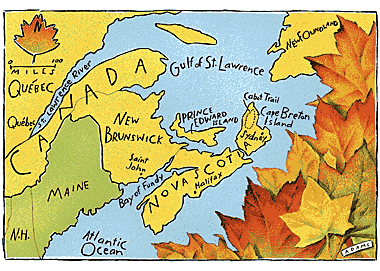
WHEN my mother came from Arizona to visit me in Boston two Octobers ago, my husband and I took her on some little drives in the countryside. Each time we passed a tree whose leaves had turned bright red or yellow, she would -- uncharacteristically -- exclaim in delight or even emit a little sigh of pleasure. We who live in New England may be more attuned than she to the imperfections in our foliage season. On peak weekends the scenic roads are likely to be as heavily trafficked as any urban freeway, rooms in cozy inns and tables at good restaurants will have been snapped up long before we thought to make plans, and prices for whatever scraps are left will be high. Even New Englanders might prefer to go leaf-peeping, as the experience is known, in Canada's Maritime Provinces. Indeed, a few New Englanders do go, and last year my husband and I were among them. We found our fellow tourists to be sparse and hotel reservations easy to come by. We found that food and lodgings cost perhaps a third less than they would have near home, for the U.S. dollar was (and is) strong. And though differences in the composition of the forests of New England and the Maritimes mean the two regions don't give the identical effect, we found that the foliage -- tucked into villages or arrayed between quaint farms or splashed across hillsides -- was every bit as magnificent as New England's. A red maple leaf is Canada's national symbol for good reason.
Related link:
Information about the region, places to stay, and local events, restaurants, and points of interest.
From the archives:
Autumn is again upon us, bringing fresh delight in woodsmoke, hot cider, tart apples, colorful foliage, and crisp cold air. Atlantic contributors have waxed poetic about the season over the years, and we thought you'd enjoy a fall sampler.
 Planning a vacation around viewing foliage is, unfortunately, a bit like
planning a train trip without a timetable. If you can't expect your timing to
be perfect (and how can you?), it's better to be a little early than a little
late -- in this case because green trees are more attractive than bare branches.
Curiously, a number of Canadians in the parts of the Maritimes we visited -- Nova
Scotia's Cabot Trail, coastal and south-central New Brunswick, and Prince
Edward Island -- insisted that the foliage would be at its peak at their
Thanksgiving time, which is our Columbus Day weekend, around October 12. I even
heard this maxim last October 6, while standing on a hillside where the leaves
were already the color of toast and dropping to the ground. It was a good thing
these locals were wrong. Our trip had been planned for the last days of
September and the first week of October by the provincial tourist boards, which
served as our hosts, and it was timed just about right, give or take a few
days.
Planning a vacation around viewing foliage is, unfortunately, a bit like
planning a train trip without a timetable. If you can't expect your timing to
be perfect (and how can you?), it's better to be a little early than a little
late -- in this case because green trees are more attractive than bare branches.
Curiously, a number of Canadians in the parts of the Maritimes we visited -- Nova
Scotia's Cabot Trail, coastal and south-central New Brunswick, and Prince
Edward Island -- insisted that the foliage would be at its peak at their
Thanksgiving time, which is our Columbus Day weekend, around October 12. I even
heard this maxim last October 6, while standing on a hillside where the leaves
were already the color of toast and dropping to the ground. It was a good thing
these locals were wrong. Our trip had been planned for the last days of
September and the first week of October by the provincial tourist boards, which
served as our hosts, and it was timed just about right, give or take a few
days.If it hadn't been, or if the weather had been less agreeable than it was (on average some rain falls about one day out of three in the autumn in the Maritimes, a proportion of rainy days similar to that in New England), not all would have been lost. Visitors to this part of the world can indulge a taste for salmon fishing, fine crafts, traditional folk music, golf, whale watching, or Acadian or Scottish culture. There are impressive historical attractions, such as Nova Scotia's Fortress of Louisbourg reconstruction and, in New Brunswick, the King's Landing settlement. The birdwatching is excellent too: the region is awash in blue herons, and bald eagles are frequently seen. A well-planned foliage trip will take much the same form as a trip undertaken just to get to know the region, because leaf-peepers need destinations to look forward to during and after their forays to see the trees.
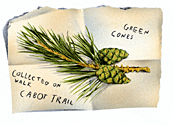
ONE destination I could happily visit often is the Cabot Trail, a 186-mile circular drive on Cape Breton Island, in northeastern Nova Scotia.
The best-known and oldest of five scenic drives on the island, the Cabot Trail, which was laid out as a gravel road in the 1930s and was paved in its entirety by the 1960s, is spectacular in the summer, too. With its views of steep rocky headlands falling away beneath wooded hillsides, the trail reminded me of California's Highway One, only with black-and-white-painted churches instead of the Esalen Institute, and sturdy fishermen instead of Henry Miller and Jack Kerouac. (In fact Alan Arkin and Philip Glass, among other celebrities, have houses along the coast south of the trail.) You get there by flying to Halifax and then making an hour-long hop in a smaller plane to Sydney, renting a car, and lighting out. The Cabot Trail and environs are worth devoting three or four days to. This will give you time to wait out a day or so of bad weather, if need be, and also time to do some looking around off the trail -- preferably off all five of the scenic drives. As local people will tell you (and here they'll be right), some of the best foliage viewing is on dirt roads or roads that require you to double back, and no such roads were allowed to be part of the drives.
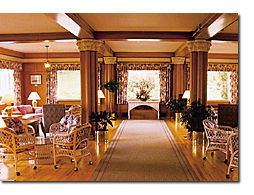 |
| The Keltic Lodge, in Cape Breton Highlands National Park |
Driving on through the park, we arrived at various oceanside beauty spots where the scenery, made up largely of evergreens, lichen-dappled rocks, and blue sea, looked just as it would have at the height of summer. A bit farther on, the primarily deciduous forest we had come to see returned. Before and after this trip I took part in a few debates about whether it's nice to have some evergreens in the forest where one is leaf-peeping. Previously I had said, Who needs them? But Canada proved to me that red, orange, and yellow trees look jauntier and brighter where they are set off with a touch of green.
Almost exactly halfway around the trail from the Keltic Lodge we turned off to thread our way through a cluster of picture-perfect villages in the Margaree Valley. Fog had settled into the hollows, lending an eerie Halloween glow to the trees. Soon we reached the Normaway Inn, a rustic sprawl of rooms and cabins reminiscent of a camp that has been in the hands of a well-to-do family for generations. Down the hall from the front desk, in the opposite direction from the pleasant restaurant, is a living room with a big fireplace, board games and card tables, comfortable sofas and chairs, and teetering stacks of magazines. The staff will bring you wine or any of half a dozen or so good Scotches as you while away the time before or after dinner. After our pleasant dinner we wandered out into the crisp night and over to the barn, where a folk band was holding forth to great acclaim.
Once the performance was over, we turned in, and how we slept -- how we slept throughout our trip! In the Maritimes we slept soundly, dreamlessly, all night long, beside ocean bays, beside rivers, beside fields of woolly Highland cattle. We slept as if we had a talent for it, except at the occasional bed-and-breakfast that made us nervous. Sometimes B&B proprietors seem to think that the core of their job is not providing hospitality but doing the place up like a museum of knickknacks. Eek! There's no place to put your things, and while the owners have been focusing on appearances, they've forgotten to replace the mattress.
Nonetheless, the Maritimes are chockablock with simple, hospitable B&Bs and clean, quiet motels and cabins (some of these -- beware -- shut down at the end of September). An agency called Canada Select rates tourist accommodations on a five-star scale. Though it does not appear to deduct points for clutter on the tabletops, it is otherwise quite strict and accurate, so visitors will have a good idea in advance how plain or deluxe a given hostelry is. (For tourist information of all kinds about the Maritimes, call 800-565-2627.) The Keltic Lodge (902-285-2880), which is a four-star establishment, and the Normaway Inn (800-565- 9463), which has chosen to be unrated in recent years, number among the nicest places to stay on Cape Breton, and their rates for two start at, respectively, around $190 U.S. a night, including breakfast and dinner, and $80 a night, including breakfast. To seek out other special places I would begin by consulting an annual guide called Where to Eat in Canada (published in this country by the Harvard Common Press), which also lists a few favorite inns, or the widely available Fodor's Canada, which I thought gave the soundest advice of any general guidebook.
 FROM here you could go on to discover other parts of Nova Scotia. Or you could
see a bit of New Brunswick, where last year the leaves were a few days behind
Cape Breton's. I would begin by flying to the old port city of Saint John and
pausing for a day or so there. Saint John's historic district, which was
largely built during the prosperous shipbuilding times of a century and more
ago, is fun to poke around in. So is the omnibus New Brunswick Museum at Market
Square, which has well-mounted displays of everything from whale skeletons to
antique timbering tools to contemporary craft work. Furthermore, Saint John is
home to the Reversing Falls, where, depending on the tide level in the Bay of
Fundy, water rushes into or out of the Saint John River. New Brunswick has more
than its share of gee-whiz attractions, such as the world's largest ax and a
supposedly magnetic hill that is said to pull cars up it, against gravity.
From Saint John I'd drive the sixty miles southwest to St. Andrews, and settle
in for a few nights. The drive itself is pretty, combining ocean and foliage
views. And St. Andrews is a very posh little seaside town: on its shopping
street you'll find French faience pottery and thousand-dollar vests made in
Scotland of pheasant feathers. There's a fine golf course at the Algonquin
Hotel and an ambitious botanical work in progress in the Kingsbrae
Horticultural Garden, which will open to the public next year. Franklin Delano
Roosevelt's vacation home on Campobello Island is within reach, and out in the
bay is Minister's Island, where you can tour the mansion that a century ago was
the home of William Cornelius Van Horne, the builder and later the chairman of
Canadian Pacific Railways. Part of the fun of an excursion to Minister's Island
is that it's accessible only at low tide: you rendezvous at the end of a road
and drive in convoy behind your guide across tidal flats where great blue
herons, gulls, and people are busy scrounging up a seafood dinner. Within four
hours or so you'd better be out of there (you will be), or else you'll have to
wait half a day to return.
FROM here you could go on to discover other parts of Nova Scotia. Or you could
see a bit of New Brunswick, where last year the leaves were a few days behind
Cape Breton's. I would begin by flying to the old port city of Saint John and
pausing for a day or so there. Saint John's historic district, which was
largely built during the prosperous shipbuilding times of a century and more
ago, is fun to poke around in. So is the omnibus New Brunswick Museum at Market
Square, which has well-mounted displays of everything from whale skeletons to
antique timbering tools to contemporary craft work. Furthermore, Saint John is
home to the Reversing Falls, where, depending on the tide level in the Bay of
Fundy, water rushes into or out of the Saint John River. New Brunswick has more
than its share of gee-whiz attractions, such as the world's largest ax and a
supposedly magnetic hill that is said to pull cars up it, against gravity.
From Saint John I'd drive the sixty miles southwest to St. Andrews, and settle
in for a few nights. The drive itself is pretty, combining ocean and foliage
views. And St. Andrews is a very posh little seaside town: on its shopping
street you'll find French faience pottery and thousand-dollar vests made in
Scotland of pheasant feathers. There's a fine golf course at the Algonquin
Hotel and an ambitious botanical work in progress in the Kingsbrae
Horticultural Garden, which will open to the public next year. Franklin Delano
Roosevelt's vacation home on Campobello Island is within reach, and out in the
bay is Minister's Island, where you can tour the mansion that a century ago was
the home of William Cornelius Van Horne, the builder and later the chairman of
Canadian Pacific Railways. Part of the fun of an excursion to Minister's Island
is that it's accessible only at low tide: you rendezvous at the end of a road
and drive in convoy behind your guide across tidal flats where great blue
herons, gulls, and people are busy scrounging up a seafood dinner. Within four
hours or so you'd better be out of there (you will be), or else you'll have to
wait half a day to return.But all these things are really just excuses to come stay at the extraordinary Kingsbrae Arms, which when it opened last year became the first inn to receive Canada Select's five-star rating. Adjacent to the Kingsbrae Horticultural Garden, the inn's hundred-year-old building presents a severe façade of vertical gray cedar shingles and shuttered windows. But the inn has a garden of its own around back, and the interior has been decorated so avidly, so intensely, with pillows and patterns and fabrics and fringes and marble and gleaming wood, that a guest seems to have wandered into some Maritime Shangri-La, friendly Lhasa apsos and all. There's plenty of room for your things: in fact, to make sure there would be, the owners, Harry Chancey Jr. and David Oxford, commissioned mahogany armoires from a local craftsman. In the sitting room there's a bar where you can pour yourself a warming glass of sherry or what-have-you after your rambles, and upstairs there's a pantry full of complimentary snacks to raid at will. Chancey and Oxford have refined their interior-design and guest-pampering skills over almost a decade of owning and operating Centennial House, in East Hampton, New York. They and their staff cook breakfast for everyone, and elegant lunches and dinners on request. Rates at Kingsbrae Arms start at about $125 U.S. for two, including breakfast; call 506-529-1897.
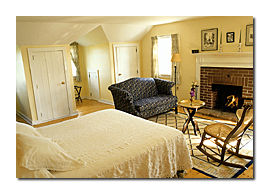 |
| The Inn at Bay Fortune, on Prince Edward Island |
Then again, you could continue your trip by wending your way slowly south to New England, following the turning of the leaves. But why would you want to do that?
Barbara Wallraff is a senior editor of The Atlantic and the author of the bimonthly feature Word Court.
Illustrations by Lisa Adams
Photograph of The Keltic Lodge by Warren Gordon; Photograph of The Inn at Bay Fortune by Jack Leclair
Copyright © 1997 by The Atlantic Monthly Company. All rights reserved.
The Atlantic Monthly; September 1997; Peeping in Peace; Volume 280, No. 3; pages 30 - 34.
 |
 |
 |
 |
 |
 |