


Return to this issue's Table of Contents.
O C T O B E R 1 9 9 9


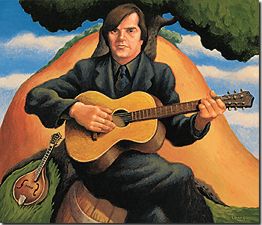
Steve Earle draws on the surprisingly recent roots of bluegrass to make pleasingly extreme music
More on arts & culture in The Atlantic Monthly and Atlantic Unbound.
From the archives:
"Cornbread When I'm Hungry," by William Hogeland (November, 1998)
The music of the banjo player and singer Dock Boggs is enjoying a revival. The music criticism that comes with it is a small price to pay.
Related links:
The Original Unofficial Steve Earle Site
News, photos, song lyrics, sound clips of recordings, links to articles and reviews, tour dates, and more.
Liner notes for The Mountain, and the way the album was marketed to the press and the public, have made it easy to define simply as "Steve Earle's bluegrass album" -- the consummation of Earle's attraction to classic country music. But The Mountain isn't what would now be called a classic bluegrass album. There hasn't been much like The Mountain on record since the 1940s.
EARLE'S liner notes make clear that when he calls The Mountain a bluegrass album, he doesn't mean a bluegrass-inspired rock album, or a "newgrass" or "groovegrass" or "new acoustic" album. Working with the Del McCoury Band, Earle taps a style of bluegrass neither frozen in the past nor experimenting with the future but simply played, without drums, on mandolins, banjos, guitars, fiddles, and upright basses. It's the kind of music that attracts intermittent attention from hipsters but gets its real support from middle-American families -- including some who travel every summer from festival to festival, camping in RVs and gathering in parking lots for informal picking sessions. Festival bluegrass is virtually worshipped as more than music -- a medium for fellowship, an escape from shallowness and insincerity in modern life. Most bluegrass bands lack, to put it mildly, the swing and polish of the Del McCoury Band, but such is the devotion of festival fans that they will cheer the umpteenth band's close-enough harmony singing and predictable breakneck soloing through yet another rendition of "Footprints in the Snow." The air of religious camp meeting that pervades the festivals has been widely noted -- it's inescapable. The scene is reminiscent, too, in its communality, of a G-rated Woodstock.
Earle expresses the reverence common among festival-bluegrass fans for Bill Monroe, the "Father of Bluegrass." Monroe, a singer, mandolinist, songwriter, and bandleader who began his professional career in the late 1920s and died in 1996, is widely credited with having created a new and seminal form that kept country music true to its rustic origins and fended off the depredations of slick commerciality. He was a disciplined and adventurous musician and an imposing, laconic figure who seemed, despite having come from western Kentucky, to have been carved from Appalachian granite. That he "single-handedly," as Earle says in his liner notes, "invented" a new form of music, and that, as some have suggested, the music he played is uniquely close to country music's true sources are exaggerations at best. But they help to illuminate the unusual virtues of The Mountain.
Until 1945 Bill Monroe and His Blue Grass Boys (the name referred not to a style of music but to Monroe's home state) was one of many bands playing the music called first hillbilly and later country and western. Some, like Roy Acuff and His Smoky Mountain Boys, were stars; others, like Da Costa Woltz's Southern Broadcasters, were obscure. The most successful bands of the 1930s and 1940s were in effect variety shows that drew on blues, boogie, jazz, Anglo-American balladry, Appalachian fiddle tunes, southern church singing, Victorian sentimental song, minstrelsy, dancing, and cornpone comedy. Monroe's lead singing, based on hymn-singing techniques he had learned in his youth, had a piercing presence. Instrumentation was, naturally, eclectic: an accordion would annoy fans of classic bluegrass today, but Monroe relied on it for some of his best early-1940s recordings. At times he also incorporated spoons, jug, and harmonica.
In a superb 1930s duet act with his brother Charlie, Monroe had begun developing an unusually fluid mandolin style. Inspired in part by the country-jazz hybrid called western swing, Monroe and his musicians sometimes took turns playing lead and made virtuoso displays in "Blue Grass Special" and similar numbers.
The Blue Grass Boys had catholicity and showmanship in common with other popular bands. Like other bands, they employed their strengths to great effect on Nashville's Grand Ole Opry radio broadcast; but their sound was narrowed to a set of instantly recognizable "bluegrass" signatures only after the arrival in 1945 of the banjoist Earl Scruggs.
Earl Scruggs brought to the Blue Grass Boys a loud, rapid-fire banjo style that raised the instrument from the drowned-out state to which it had been consigned in most hillbilly bands, amazed listeners, and spawned imitators. Scruggs and the singer-guitarist Lester Flatt left the Blue Grass Boys in 1948 and popularized many of the formulas that, when adopted by a host of others (including Monroe himself, who hired a banjoist to play in Scruggs's style), became indelibly associated with classic bluegrass: vocal harmony that while retaining a powerful tension in the tenor is smooth, even suave, compared with Monroe's singing of the early 1940s; soloists' stylized movements toward and away from a single microphone (a thicket of instrument necks could, if mishandled, take out someone's eye); and a trick known as the Lester Flatt G-run, in which an instrument concludes its solo break with a strong bass figure -- an unmistakable trademark of classic bluegrass.
The online version of this article appears in two parts. Click here to go
to part two.
William Hogeland has written about music for New York Press and Salon.
Illustration by Loren Long.
Copyright © 1999 by The Atlantic Monthly Company. All rights reserved.
The Atlantic Monthly; October 1999; Old-New Bluegrass - 99.10;
Volume 284, No. 4; page 94-98.