Police removed protestors demonstrating against a North Dakota pipeline, the Oregon militiamen were acquitted, groping allegations of Clarence Thomas, and more from across the United States and around the world.
—Police officers wearing riot gear have started removing hundreds of people protesting a controversial crude oil pipeline at its construction site in North Dakota on Thursday. More here
—Ammon Bundy and six other co-defendants were found not guilty Thursday of federal conspiracy and weapons charges stemming from their armed takeover of a federally owned wildlife sanctuary in Oregon earlier this year. More here
—An Alaska lawyer has accused Justice Clarence Thomas of groping her at a dinner party in 1999. More here
—We’re live-blogging the news stories of the day below. All updates are in Eastern Daylight Time (GMT -4).
President Obama commuted the sentences of 98 federal prisoners on Thursday, his latest small step in a broader effort to reduce excessive sentences in the criminal-justice system.
Forty-two of the 98 inmates who received clemency today had been serving life sentences. All had been convicted for nonviolent drug offenses. Obama’s latest round of pardons comes as the White House tries to clear a lengthy backlog before his term ends in January. The Washington Posthas more:
The administration's highly-touted clemency initiative had been tangled up by bureaucratic delays after it got underway. Though the pace of commutations he has granted has worried activists — and, as of earlier this month, there were more than 11,000 petitions pending, according to the Justice Department — there has been a flurry of activity on this front recently.
In August, Obama commuted the sentences of 214 inmates, setting a single-day record for his administration, and the 111 commutations he handed down a few weeks later also helped set a single-month record. Earlier this month, Obama granted clemency to an additional 102 inmates.
Today’s move brings Obama’s total number of commutations to 872, including 688 acts of clemency in 2016 alone. According to the White House, Obama has now commuted more sentences than every post-World War II president combined. (That number excludes mass pardons, like the one granted to Vietnam War draft-dodgers by President Jimmy Carter.)
Six years after a secret recording allegedly led a Rutgers University student to commit suicide, the man who recorded the video has pled guilty to attempted invasion of privacy.
Using a hidden webcam, Dharun Ravi recorded his roommate, Tyler Clementi, kissing another man and shared it with others. Clementi jumped off the George Washington Bridge three days after he found about about the recording. The case sparked a national discussion about cyberbullying and discrimination against the LGBT community.
The plea deal comes after a New Jersey appeals court last month threw out Ravi's 2012 conviction on 15 counts, including invasion of privacy and bias intimidation. The appellate court decision came after the state Supreme Court last year ruled that the laws under which Ravi was convicted were unconstitutional and that the ruling could be applied retroactively.
In the third-degree felony plea deal, Ravi was sentenced to the 20 days he already served. He’s previously paid a $10,000 fine. Clementi’s parents, who started a foundation in honor of their son, said after the plea deal, “We have learned that witnesses or bystanders need to become upstanders for those in our society like Tyler, who cannot stand up for themselves.”
Ammon Bundy and six other co-defendants were found not guilty Thursday of federal conspiracy and weapons charges stemming from their armed takeover of a federally owned wildlife sanctuary in Oregon earlier this year.
For 41 days in January and February, members of a militia occupied the Malheur National Wildlife Refuge, demanding the federal government give up control of 188,000 acres of public lands. The men made a national call for arms and aid as they controlled the facility near Burns, Oregon, even as police blocked off roads that led to the refuge.
The Oregoniancalled the acquittal a “stunning verdict, undoubtedly a significant blow to federal prosecutors.”
The New York Timesexplains how the men were able to avoid conviction:
Their lawyers argued that prosecutors did not prove that the group had engaged in an illegal conspiracy that kept federal workers—employees of the Fish and Wildlife Service and the Bureau of Land Management—from doing their jobs.
The episode launched a national debate about who can control public lands, even getting initial support from Republicans like Ted Cruz and Rand Paul. The Bundy family previously led another standoff with federal authorities in 2014 in Nevada over similar issues.
Opponents of the Dakota Access Pipeline form a blockade on a highway near Cannon Ball, North Dakota, on October 26, 2016. (James MacPherson / AP)
Police officers wearing riot gear have started removing hundreds of people protesting a controversial crude oil pipeline at its construction site in North Dakota on Thursday.
An estimated 200 protesters built an encampment of hundreds of tents directly in the path of the Dakota Access Pipeline, a $3.8 billion, 1,1172-mile pipeline near Cannon Ball, North Dakota, Reuters reports. Morton County Sheriff Kyle Kirchmeier said the roadblocks constructed by the protesters “forced law enforcement to respond.” The sheriff’s department also claimed the protesters had set fire to a bridge.
As my colleague Robinson Meyer previously reported, the pipeline has drawn criticism from members of the Standing Rock Sioux Tribe and environmental activists, who say the project’s construction threatens to destroy sacred tribal sites and contaminate the Missouri River, the Sioux’s sole water source.
Demonstrations against the pipeline have been held for several months, resulting in the arrests of more than 100 people. The protests have drawn nationwide attention, including from civil-rights activists, celebrities, and presidential candidates.
Colombia has suspended peace talks with its second-largest Marxist rebel group, the National Liberation Army (ELN), because the government says the rebels have not released their last remaining hostage.
Peace talks were set to begin Thursday in Ecuador at 6 p.m. local time, but the Colombian government canceled them at the last minute, demanding the release of former congressman Odin Sanchez. Colombia’s chief negotiator with ELN, Juan Camilo Restrepo, said Monday negotiations will be stalled until Sanchez is let go.
But there seems to be some confusion over whether Sanchez has been released or not. The ELN took Sanchez in April. He had offered himself in exchange for his brother, a former governor whom rebels kidnapped three years ago, and who had become ill while captive. The guerrilla group initially asked for a hefty ransom in exchange for Sanchez’s release, but the government insisted rebels set him free as a gesture of good faith before the peace talks. After the government insisted on his release, news organizations reported rumors that ELN had prepared to release Sanchez in the Darien Jungle, and some reports said the ELN already had. But on Wednesday, the Red Cross, which had been appointed to handle the recovery, said it had not been officially alerted of his release, and so had not activated its recovery protocols.
The breakdown in talks is yet another another bump in the negotiations to disarm a decades-old rebel group in Colombia. The ELN and Colombia’s largest, most well-known guerrilla group, the Revolutionary Armed Forces of Colombia (FARC), both emerged around the same time in the 1960s to fight for land reform. About 250,000 people have been killed in the fighting between government forces and the rebels since they took up arms. And though their numbers have drastically declined, FARC still has about 8,000 soldiers; the ELN has about 2,000. Last month, Colombia successfully negotiated a peace deal with FARC, but earlier this month Colombian voters rejected it.
Lawyer Accuses Justice Clarence Thomas of Groping Her in 1999
Justice Clarence Thomas (Joshua Roberts / Reuters)
An Alaska lawyer has accused Justice Clarence Thomas of groping her at a dinner party in 1999.
In interviews with the National Law Journalpublished Thursday, Moira Smith, who is now the general counsel for Enstar Natural Gas Company, said she met the justice while she was a Truman Foundation scholar living in Washington, D.C. During that time, the foundation asked Thomas to present an award it had recently created.
The night before the ceremony, Thomas dined with Smith and other Truman scholars and fellows at the home of Louis Blair, the foundation’s executive secretary. According to Smith, she was helping set up before the dinner when the alleged incident occurred.
Alone with Thomas, “I was setting the place to his right when he reached out, sort of cupped his hand around my butt and pulled me pretty close to him,” Smith said in an interview. “He said, ‘Where are you sitting?’ and gave me a squeeze. I said, ‘I’m sitting down at the garden table.’ He said, ‘I think you should sit next to me,’ giving me squeezes. I said, ‘Well, Mr. Blair is pretty particular about his seating chart.’ I tried to use the seating chart as a pretext for refusing. He one more time squeezed my butt and he said, ‘Are you sure?’ I said yes, and that was the end of it.”
Smith said the other guests then assembled for the dinner and she went to the garden table to take her seat. Buckley said she did not recall seeing anything unusual that evening. Smith recalled being “shell-shocked, but also I was there for work. I had a job to do, to be genial as sort of a stand-in hostess.”
The Journal spoke with four other people, including Smith’s roommates at the time, who recalled her sharing her story around the time it allegedly occurred. Blair and two other dinner attendees told the Journal they didn’t know about the incident until now.
Thomas, who joined the Court 25 years ago this week, emphatically denied Smith’s allegations. “This claim is preposterous and it never happened,” he said to the Journal in a statement.
The justice last faced sexual-misconduct allegations in 1991 during one of the most contentious confirmation battles in Supreme Court history. Anita Hill, the law professor, testified before the Senate Judiciary Committee that Thomas had verbally sexually harassed her while she worked for him at the Equal Employment Opportunity Commission. Thomas vehemently denied the allegations and described the hearings as a “high-tech lynching.” The Senate confirmed him in a 52-to-48 vote.
Smith first went public with her allegations in a Facebook post on October 7, shortly after the Washington Post published video clips from 2005 in which Donald Trump, the Republican nominee for president, brags about sexually assaulting women. In the post, Smith also noted two other times she had been assaulted by different men.
“I do not take the decision to share these incredibly personal and painful moments lightly,” she wrote. “I also do not share this because of the election, or even really because of Donald Trump. I share this because if this can happen to me—a privileged white woman—three times in ten years, how bad must it be for those who are not as privileged?”
Internal Feud at Tata Sons, the Indian Conglomerate, Spills Out Into the Open
Cyrus Mistry (Rajanish Kakade / AP)
Tata Sons, one of India’s most venerable companies, is in the midst of a very public corporate feud.
At issue is the ousting this week of Cyrus Mistry, the company’s chairman, by the board. He was replaced on an interim basis by his predecessor, Ratan Tata, who ran the company from 1991 to 2012. The news was unexpected and has dominated the headlines of Indian media. Part of the reason for this is not only the company’s size ($103.5 billion in revenues), but the Tata family’s outsized influence on the Indian consciousness for nearly 150 years. The Tata name dominates salt, steel mills, cars, and luxury hotels, and its global acquisitions in the late 1990s and early aughts—Tetley Tea, Jaguar Land Rover, Corus Steel—were a matter of pride for many Indians.
Although Mistry was the company’s first chairman in nearly eight decades to come from outside the Tata family, he was by no means an outsider. His family, a major Tata shareholder since the 1930s, owns about 18 percent of the company; his sister is married to Ratan Tata’s half-brother, Noel; and he was Ratan Tata’s handpicked successor to become chairman.
But Mistry did not take his firing well and his letter to the Tata Sons board, of which he remains a member, was leaked to the media. In it he claimed he was a “lame duck” figure, said the group faced about $18 billion in write-downs, and raised enough questions about the financial health of the Tata Group’s various holdings that it got India’s financial regulators interested. On Thursday, Tata Sons, the holding company that owns the Tata Group, responded, calling the leak “unseemly and undignified,” and Mistry’s claims “unsubstantiated and malicious.”
“It has taken everyone by surprise,” J. N. Gupta, a former executive at India's markets regulator and now managing director at Stakeholders Empowerment Services, told the BBC. “Nobody would have thought such things could happen at Tata.”
A Judge Awards a Historic Settlement in the Philadelphia Amtrak Crash
Joseph Kaczmarek / AP
A Pennsylvania judge has approved a historic—possibly the largest ever—settlement for victims of the 2015 Amtrak passenger train crash just outside Philadelphia that killed eight people and injured about 200 others.
U.S. District Court Judge Legrome Davis for the Eastern District of Pennsylvania awarded plaintiffs a $265-million settlement. It’s believed to be the largest ever, because last year Congress raised the settlement cap on a single rail accident from $200 million to $295 million. Lawyers arrived at this lower price because they believed it would be the maximum allowed once future inflation is accounted for because the settlement will likely drag out for years in litigation.
The Amtrak train crashed May 12, 2015, as it passed through Philadelphia. More than 240 passengers rode the train that day, and it crashed after it entered a curve at 106 miles per hour, more than double the recommended speed. The National Transportation Safety Board released a report in May that found the driver, Brandon Bostian, became distracted while listening to radio chatter of another train struck by a rock. Bostian then lost track of his own train’s location and speed. As my colleague David Graham has written, such a tragedy might have been avoided if that portion of the track were outfitted with positive train control, a technology that automatically regulates the speed of trains.
Amtrak has declined to comment on the settlement’s amount.
U.S. Charges Dozens for Multimillion-Dollar Call-Center Scam
Leslie R. Caldwell, the U.S. Assistant Attorney General, addresses the indictment in a news conference on October 27, 2016. (Pablo Martinez Monsivais / AP)
The U.S. Department of Justice charged Thursday more than 60 people and entities in India and the U.S. for allegedly taking part in a multimillion dollar international scheme extorting tens of thousands of people of more than $300 million.
The defendants, including 24 people in the U.S. and 32 people and five call centers in India, were charged with conspiracy to commit identity theft, false impersonation of an officer of the United States, wire fraud, and money laundering. One of the defendants was also charged with passport fraud.
Here’s how the Justice Department says the scam works: Potential victims received calls from an operator located in call centers in Ahmedabad, India. These operators, impersonating officials from the Internal Revenue Service or Immigration and Customs Enforcement, would threaten potential victims with “arrest, imprisonment, fines or deportation” if they did not pay an immediate fine, often for a fictitious tax violation. Once the victim pays the fine, the U.S.-based collaborators would launder the funds through prepaid debit cards or wire transfers using stolen or fake identities.The defendants also allegedly offered victims short-term loans or grants, asking them for good-faith deposits in order to receive the funds.
In one case, the Justice Department says, a victim from Hayward, California, lost $136,000 after receiving multiple calls over a 20-day period from purported IRS agents demanding payment for alleged tax violations.
“Today’s actions will not only bring a sense of justice to the victims in this case, but this significant investigation will also help increase awareness of this type of fraud,” Peter Edge of the U.S. Immigration and Customs Enforcement’s Homeland Security Investigations said Thursday in a statement.
He added: “To potential victims, our message today is simple: U.S. government agencies do not make these types of calls, and if you receive one, contact law enforcement to report the suspected scam before you make a payment.”
SeaWorld Makes a Wetsuit for a Featherless Penguin
Reuters
An Adelie penguin at SeaWorld has been outfitted with a custom-made wetsuit after she lost some of her feathers.
The wardrobe department at the Orlando theme park sewed the suit for Wonder Twin, who became unable to regulate her body temperature after experiencing some feather loss. Adelie penguins, which are only found in Antartica, can experience this condition in the wild, where it could prove harmful.
Wonder Twin now swims, eats, and sleeps in the suit, which keeps her warm:
Wonder Twin is part of Seaworld Orlando’s colony of Adelie penguins, which you can follow in this live webcam from inside their enclosure (it’s OK, research has shown that watching videos of cute animals at work may actually boost your productivity).
Users on social media are swooning over the suit, which is good news for SeaWorld. The company has been trying to repair its public image since the controversial 2013 documentary Blackfish claimed that the park’s orcas suffered in captivity. SeaWorld announced last November it would stop its orca performance shows, and said in March it would end orca-breeding programs.
Twitter to Cut 9 Percent of Its Global Workforce, Kill Vine
(Richard Drew / AP)
Updated at 12:38 p.m. ET
Twitter announced that it is killing off Vine, its video app.
“Today, we are sharing the news that in the coming months we’ll be discontinuing the mobile app,” Twitter and Vine said in statement.
Twitter, which bought Vine in late 2012, launched it in 2013. The app played six-second video on a loop, but never quite developed a broad following.
Our original post:
Twitter said Thursday it will cut 9 percent of its 3,860-strong global workforce in a bid to becoming profitable in 2017.
Additionally, Twitter, in its third-quarter results, announced better-than-expected earnings. It earned 13 cents per share on revenue of $616 million, up 8 percent year over year. Analysts surveyed by Thompson Reuters expected Twitter to post earnings of 9 cents per share on $606 million in revenue.
The company also said the number of active monthly users was up 3 percent to 317 million. There was also a 7 percent increase, the company said, in its number of daily active users. Advertising revenue was $545 million, up 6 percent year-over-year. Of this, 90 percent was mobile-advertising revenue, the company said.
Twitter was reportedly courted by several major companies, including Salesforce and Google, but no formal offer was made to buy the social-media giant.
News of the job cuts and the better-than-expected results pushed Twitter’s stock up more than 3 percent in pre-market trading.
Humans on Track to Kill Off One-Third of World's Wildlife by 2020
Kim Hong-Ji / AP
If you care about wild animals or wild habitats, prepare to be depressed. A new report on the status of wildlife populations—the most comprehensive to date—by the Zoological Society of London and the World Wildlife Foundation found a 58 percent decrease in Earth’s animal population from 1970 to 2012—and humans are to blame.
Researchers analyzed 14,000 populations of 3,700 vertebrate species that are regularly used to measure conservation efforts. They found huge population drops across animals in all different types of environments. They also predicted the planet will have lost more than one-third of its animal life by 2020.
Animal populations in river and lake environments were the most affected; they fell by 81 percent since 1970. Major factors included excessive water use, pollution, and dams. Globally, the largest cause of wildlife depletion is owed to habitat loss from farming and logging by humans. But hunting is also to blame. Humans are currently eating more than 300 mammal species into extinction, according to an earlier report.
Humans now dominate nearly all landmass, with just 15 percent reserved for protection. The new report suggested that wildlife loss will cause increase human conflict due to “the risk of water and food insecurity and competition over natural resources.”
There is a bit of good news. Some species have seen their numbers rebound after human intervention. The report cited tigers as an example, as well as pandas, which were recently removed from the endangered-species list.
Indian officials said 35-year-old Mahmood Akhtar, a staffer in the Pakistani High Commission’s visa section, was arrested outside the gates of the Delhi zoo Wednesday after being caught exchanging sensitive documents for cash with two Indian men, who were also arrested, Pakistani newspaper Dawn reports. Akhtar was later released and told he had 48 hours to leave the country.
New Delhi accused Akhtar of misusing his consular status to gather intelligence. Pakistani officials rejected the accusation, and condemned “the detention and mishandling of Pakistan High Commission Staff,” a move they said violates the 1961 Vienna Convention, which guarantees their agents diplomatic immunity from the criminal jurisdiction of the state where they are serving.
Using diplomatic missions as a cover for espionage, however, isn’t unheard of in India and Pakistan. As A. S. Dulat, the former special director of India’s Intelligence Bureau, toldThe New York Times Thursday: “It’s been like that between India and Pakistan of late, everything is getting hyped.”
He added: “Let me put it this way: If it was a Chinese or Russian or American, they would not bother too much.”
Hype or not, this incident is the latest salvo in the deterioration of relations between the two neighbors. Last month, India blamed a deadly attack on an army base in Indian-administered Kashmir on Pakistan, though Islamabad denied the claim. Shortly thereafter, India said it launched a series of “surgical strikes” on Pakistani-administered Kashmir in retaliation, but Islamabad denied that, too.
U.S. Calls Off the Search for a Lost Chinese Sailor Out to Break a World Record
AP
The U.S. has called off its search to find a Chinese sailor trying to break the world record for crossing the Pacific Ocean alone on a boat.
Guo Chuan’s team noticed his ship had slowed and tried to contact him Tuesday, but were unable reach him by satellite phone or through the internet. Three years ago, Guo became the first Chinese sailor to circumnavigate the globe on a non-stop solo sail. On October 18, Guo left San Francisco, with hopes to reach Shanghai in 20 days—a speed that would break the current record by a day. The ship was a 97-foot red-colored trimaran with text on the sails that read: “Peace and Sport.”
The U.S. Coast Guard dispatched a helicopter and airplane to find Guo, whose boat had slowed around the Hawaiian islands. On Thursday rescuers found Guo’s boat drifting hundreds of miles away from the U.S. island chain. They found his lifejacket on the ship, but Guo was not aboard. Searchers also found a broken sail, something that could have led to Guo slipping off if he had tried to repair it. Guo had previously told a reporter with Xinhua, China’s state-run news agency, his greatest fear was the thought of falling off the boat and into the ocean.
Brigham Young University, the Mormon-owned school in Utah, will no longer investigate students who report themselves as victims of sexual assault for simultaneously violating the school's strict honor code that prohibits activities like drinking alcohol and premarital sex. The school will accept 23 changes recommended by an internal advisory council, an inquiry that began after several sexual-assault victims said the school opened an honor-code investigation against them after they reported abuse.
Some of the victims toldThe Salt Lake Tribune the changes satisfied them. The biggest difference comes in the form of amnesty for students who report sexual abuse. The school’s sexual-assault investigation office—the Title IX office—will also no longer share victims’ names with the honor-code department, and the two will no longer share physical space. BYU said it will hire a victim’s advocate, publicize resources for victims, and report to the Mormon church how local clergy leaders respond to reports of abuse. This was one aspect of the policy changes still being criticized, because critics said the recommendations did not go far enough to monitor how Mormon clergy, especially bishops in the church, would handle reports of sexual abuse because those leaders communicate frequently with the school.
Awareness of BYU’s policies began in April, when Madi Barney, a former student, told people at a campus rape conference she’d been sexually assaulted and investigated by the school. Her story generated protests and a petition online to change the policy. She also filed a complaint with the U.S. Department of Education, which opened an investigation on the school in August. BYU is the third school in Utah to be investigated for similar claims. Sexual assault on campus has gained nationwide attention—with nearly 200 colleges under investigation.
The U.K.’s Office of National Statistics said Thursday the country’s economy grew 0.5 percent in the three months after the Brexit vote to leave the European Union. The number, though preliminary, is better than the 0.3 percent growth forecast by economists.
Growth was driven solely by the services sector, which grew 0.8 percent. All other sectors of the U.K. economy shrank in the July-September period. Growth in the previous quarter was 0.7 percent.
“The economy has continued to expand at a rate broadly similar to that seen since 2015 and there is little evidence of a pronounced effect in the immediate aftermath of the vote,” the agency said.
The data are expected to lower expectations that the Bank of England, the country’s central bank, will cut interest rates next week.
At issue is the Comprehensive Economic and Trade Agreement (CETA). Twenty-seven of the EU’s member states wanted the deal with Canada to go ahead, citing potential trade benefits. But Belgian law mandates that any such agreement must have a buy-in from all of the country’s regions. Earlier this week, the deal looked dead when Charles Michel, the Belgian prime minister, said Wallonia, the Brussels city government, and the French community had rejected CETA.
Wallonia, the French-speaking region of 3.6 million people, expressed fears CETA would degrade consumer, labor, and environmental protections, while granting excessive power to multinational corporations.
Details of the deal Michel secured with the French-speaking region haven’t yet been made public, and they will have to be approved by other EU members for CETA to go into effect. Canadian Prime Minister Justin Trudeau had been due in Brussels Thursday to sign CETA, but canceled the trip after it appeared there would be no agreement. There’s no word yet on when—or whether—he’ll reschedule.
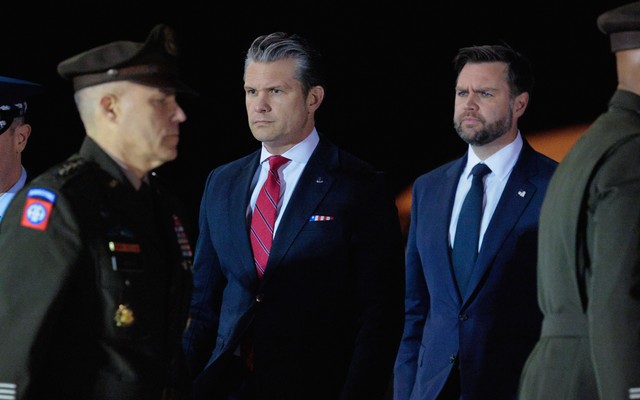
Vice President Vance is worried that the U.S. is running low on weapons.
In closed-door meetings, J. D. Vance has repeatedly questioned the Defense Department’s depiction of the war in Iran and whether the Pentagon has understated what appears to be the drastic depletion of U.S. missile stockpiles.
Two senior administration officials told us that the vice president has queried the accuracy of the information the Pentagon has provided about the war. He has also expressed his concerns about the availability of certain missile systems in discussions with President Trump, several people familiar with the situation told us. The consequences of a dramatic drawdown in munitions reserves are potentially dire: U.S. forces would need to draw from these same stockpiles to defend Taiwan against China, South Korea against North Korea, and Europe against Russia.
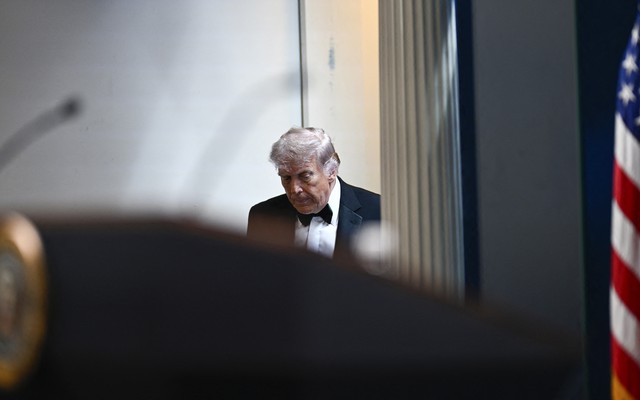
For a brief moment this weekend, the president appeared introspective.
This article was featured in the One Story to Read Today newsletter. Sign up for it here.
For a guy who had just been rushed out of a ballroom at the sound of gunfire, he seemed remarkably calm. For a president who regularly attacks the press, he seemed unusually gracious. For a fleeting period on Saturday night, Donald Trump appeared introspective, or at least as introspective as he’s capable of being in public.
“It’s always shocking when something like this happens,” he told reporters in the White House briefing room, standing in his tux and appearing to speak without notes. He briefly seemed to consider how familiar he was with threats to his life, and how the shock doesn’t fade: “Happened to me a little bit. And that never changes.”
The legal right spent decades empowering the presidency. Now it must reckon with the system it helped create.
Julius Caesar styled himself as a servant of the republic, claiming to speak for the people even as he disregarded laws and norms to govern by caprice. The Roman republic did not survive him.
The second Trump administration has revealed American Caesarism in nearly full bloom. Despite ambitions to fundamentally change the course of the country, this administration has no real legislative agenda. Instead, the president governs by executive orders, emergency decrees, and extortionate transactions, using his power to reward his friends and punish his enemies. He’s launched foreign military adventures and full-blown wars seemingly based on personal whim, and has made the military a political prop and a tool for domestic law enforcement. With Congress sidelined and the courts reluctant to check Donald Trump’s excesses, America has been left with what some legal scholars have described as an “executive unbound”—and with a president who threatens to supplant the republic in all but name.
For the richest men on Earth, everything is free and nothing matters.
At the end of Paul Thomas Anderson’s 2007 movie, There Will Be Blood, Daniel Day-Lewis’s oil-baron character, old now and richer than Croesus, beats Paul Dano’s preacher to death with a bowling pin. Dano’s Eli Sunday, a nemesis of Day-Lewis’s Daniel Plainview during his seminal, wealth-building years, has come to sell Plainview the oil-rich land that he once coveted. But Plainview doesn’t need the land anymore, because—as he explains in one of the most famous monologues in modern cinema—he has sucked out all the oil hidden beneath it from an adjoining property, like a milkshake.
Desperate for money, Eli begs for a loan. Instead, Plainview chases him around a bowling alley and murders him with great enthusiasm. Once it’s over, a butler comes to see what all the noise was about. “I’m finished,” Plainview yells.
To understand the significance of someone running a marathon in less than two hours, you also need to understand that, until recently, the notion of this actually happening was truly, utterly absurd. Sure, a physiologist named Michael Joyner had floated the idea that such a feat might be humanly possible in a journal paper way back in 1991. But his peers laughed off the idea, and not much changed over the succeeding decades. In Runner’s World in 2014, I predicted that it would happen in 2075. Frankly, even that forecast seemed overly optimistic to me, but I figured I’d be dead by then, so no one would be able to call me on it.
Well, I was wrong. Yesterday morning, the two-hour marathon barrier finally went down. A relatively unheralded 31-year-old Kenyan named Sabastian Sawe won the London Marathon with a time of 1:59:30. That is, for reference, 26.2 miles run at an average of 4:34 a mile—or, put another way, a pace that most recreational runners would struggle to sustain for more than a few seconds, if they could hit it at all. Perhaps even more arresting was the fact that the man who took second place, Ethiopia’s Yomif Kejelcha, also ran under two hours, finishing just 11 seconds behind Sawe.
The administration could exert much greater control over the industry—but just how far would it go?
AI companies are beginning to entertain the possibility that they could cease to exist. This notion was, until recently, more theoretical: A couple of years ago, an ex-OpenAI employee named Leopold Aschenbrenner wrote a lengthy memo speculating that the U.S. government might soon take control of the industry. By 2026 or 2027, Aschenbrenner wrote, an “obvious question” will be circling through the Pentagon and Congress: Do we need a government-led program for artificial general intelligence—an AGI Manhattan Project? He predicted that Washington would decide to go all in on such an effort.
Aschenbrenner may have been prescient. Earlier this year, at the height of the Pentagon’s ugly contract dispute with Anthropic, Secretary of Defense Pete Hegseth warned that he could invoke the Defense Production Act (DPA), a Cold War–era law that he reportedly suggested would allow him to force the AI company to hand over its technology on whatever terms the Pentagon desired. The act is one of numerous levers the Trump administration can pull to direct, or even commandeer, AI companies. And the companies have been giving the administration plenty of reason to consider doing so.
The Israeli prime minister’s focus is, as always, on himself and his near-term political needs. The plight of American Jews is simply not his concern.
The relationship between the United States and Israel is in crisis. Six in 10 Americans have a negative view of Israel, and a majority of those under 50 in both major parties view Israel as well as its prime minister, Benjamin Netanyahu, negatively. After the brutal Gaza war, a large percentage of liberal-leaning Generation Z considers Israel a pariah state. Democratic candidates are scrambling to distance themselves from Israel and its controversial leader; earlier this month, 40 of the 47 Democratic senators voted against a military aid package for the country. And hostility toward Israel is spilling over into hostility toward Jews. Liberal influencers, activists, podcasters, and even politicians are invoking age-old anti-Semitic tropes with frightening regularity.
Instead of a crackdown on his enemies, Trump wants his ballroom.
When an assassin murdered Charlie Kirk in September 2025, the MAGA movement seized the moment to demand a campaign of repression. Vice President Vance called for an ambitious program to “go after the NGO network that foments, facilitates, and engages in violence.” He named the Ford Foundation, Open Society Foundations, and The Nation magazine as examples of candidates for the retaliation he had in mind. The people who faced consequences after the killing almost universally did so for things they had written or said, not for acts of violence. In November, Reuters counted some 600 cases of people who were fired, suspended, or otherwise disciplined for their speech about Kirk’s life and death.
Now another gunman has attacked political targets. At the White House Correspondents’ Association Dinner, a man discharged a firearm in the vicinity of hundreds of people from the worlds of politics, media, and business—among them, the president and vice president of the United States. Although much about the event remains unclear, the available evidence suggests that the gunman was motivated by an anti-Trump agenda. Yet this time, MAGA’s immediate response to political violence has been much less aggressive. At his press conference after yesterday’s attempted shooting, President Trump cited the attack as proof of the need for his wished-for White House ballroom. Social-media accounts that take their cues from the White House promptly echoed the message.
The pontiff has proved unwilling to subordinate his faith to politics, or to adjust his commitment to the Gospel in exchange for access to power.
American presidents and popes have clashed before, but the battle of words and wills between Donald Trump and Pope Leo XIV is unprecedented.
The distinctiveness of their clash is not due mainly to the fact that Robert Francis Prevost is the first American-born pope, though that is significant. After all, Leo can’t be dismissed as a foreigner who is speaking about a country and culture he doesn’t understand. When he is critical of America, on matters ranging from war to mass deportation to those who “manipulate religions and the very name of God,” it comes from a place of love and devotion.
Nor does it have to do solely with the nature of the disagreements, most specifically the war waged by Trump against Iran. Past popes have criticized past presidents for going to war.
What makes the Trump-Leo collision most unusual is the manner of the disagreement, not on the part of the pope—whose criticisms have been direct but restrained—but on the part of the president.
A manifesto-like email allegedly sent by the dinner shooter suggests a murderous obsession with Trump’s politics.
The line “I experience rage thinking about everything this administration has done” could probably have been written in an email to friends by any number of the attendees at last night’s White House Correspondents’ Association dinner. But the line was apparently written by a man who showed up with a shotgun and pistol and was ready to kill “most everyone” there to get to Donald Trump and assassinate him and his Cabinet. In a manifesto-like email that he reportedly sent to family minutes before allegedly shooting, Cole Tomas Allen wrote that the assembled journalists and machers “chose to attend a speech by a pedophile, rapist, and traitor, and are thus complicit.” Allen never came near the president or the gala floor. A Secret Service agent was shot in the vest before Allen was tackled and arrested.