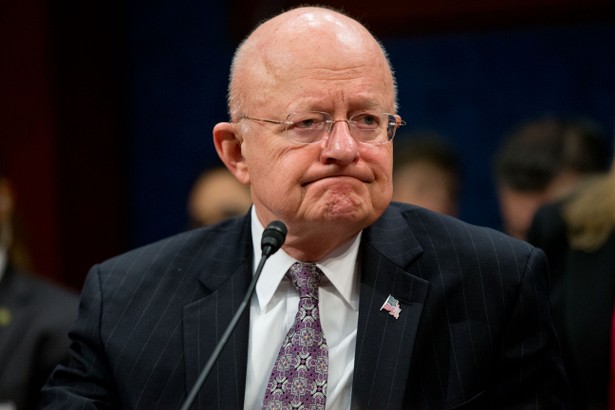
Senior members of the U.S. intelligence community are appearing Thursday morning before the Senate Armed Services Committee. The hearing was billed as covering foreign threats to American cybersecurity, and the officials are expected to discuss Russia’s interference in the U.S. election.
James Clapper, the director of national intelligence; Admiral Mike Rogers, head of the National Security Agency and U.S. Cyber Command; and Marcel Lettre, the undersecretary of defense for intelligence are testifying before the committee, which is chaired by Arizona Republican John McCain.
Intelligence officials have said Russia deliberately tried to influence the November election by hacking into the Democratic National Committee and into the personal emails of John Podesta, Hillary Clinton’s campaign chairman, among other targets. McCain in particular has been sharply critical of Russia’s meddling, calling the attacks an “act of war.” President-elect Donald Trump, on the other hand, has repeatedly cast doubt on officials’ assessment of Russia’s involvement.
We’ll update this live-blog as the hearing proceeds.
Lindsey Graham: ‘When One Political Party Is Compromised All of Us Are Compromised’
Ints Kalnins / Reuters
Republican Senator Lindsey Graham, a frequent critic of Donald Trump during his presidential run, issued a warning to the president-elect on Thursday.
“I want to let the president-elect to know that it’s okay to challenge the intel … but what I don’t want you to do is undermine those who are serving our nation in this arena until you’re absolutely sure they need to be undermined. And I think that they need to be uplifted not undermined,” Graham said at the Senate hearing.
The remarks take aim at Trump, who has cast doubt on the conclusions of the U.S. intelligence community. “The ‘Intelligence’ briefing on so-called ‘Russian hacking’ was delayed until Friday, perhaps more time needed to build a cast. Very strange!” Trump tweeted on Tuesday.
“[Russian President Vladimir] Putin’s up to no good, and he better be stopped,” Graham went on to say Thursday. “And Mr. President, when you listen to these people, you can be skeptical, but understand they’re the best among us and they’re trying to protect us.” Earlier in the hearing, Graham said: “The foundation of democracy is political parties, and when one political party is compromised all of us are compromised.”
Trump tweeted Thursday that “the media lies to make it look like I am against ‘Intelligence’ when in fact I am a big fan!”
Director of National Intelligence James Clapper, prompted by Lindsey Graham, the Republican senator from South Carolina, distinguished between routine espionage and interference in another country’s affairs. Espionage, Clapper said, is the passive collection of information—something all countries routinely do to each other. Retaliating, he said, would be akin to living in a “glass house and throwing rocks.” Interference, though, is active, Clapper added. Graham said the United States should respond to the interference in the U.S. election “with a rock.”
Intelligence Officials Respond Directly to Trump's Comments on Their Work
Kevin Lamarque / Reuters
The officials were asked specifically if Donald Trump's "dismissive attitude" toward the intelligence community—as one Democratic senator characterized it—has affected morale among their employees. James Clapper, the director of national intelligence, responded briefly that he "hardly think[s] it helps." But National Security Agency Director Mike Rogers replied in more detail about his concerns:
I don't want to lose good, motivated people who want to help serve this nation because they feel they are not generating value to help that nation. And I'm the first to acknowledge there's room for a wide range of opinions of the results we generated—we don't question that for one minute and every intelligence professional knows that. I have had plenty of times in my career when I have presented my intelligence analysis to commanders and policymakers and they just looked at me and say, “Hey, Mike, thanks, but that is not the way I see it or you're gonna have to sell me on this.” That doesn't bother any of us. What we do, I think, is relevant, and we realize that what we do is—in no small part—driven in part by the confidence of our leaders in what we do. And without that confidence, I just don't want a situation where our workforce decides to walk, because I think that really is not a good place for us to be.
Clapper: 'There's a Difference Between Skepticism and Disparagement'
Senator Claire McCaskill, the Missouri Democrat, asked Director of National Intelligence James Clapper about who gains when elected officials question the assessments of the intelligence community. She did not explicitly name President-elect Donald Trump, but he seemed to be the target of her query. Clapper responded that skepticism of intelligence information is healthy, but “there's a difference between skepticism and disparagement.”
Those are the most direct public comments yet by an intelligence official about the impact Trump’s sometimes-dismissive remarks are having on the intelligence community.
Senator John McCain asked Director of National Intelligence James Clapper whether Julian Assange is a credible source of information. “Not in my view,” Clapper responded.
Assange is the founder of WikiLeaks, the website that came to prominence by publishing classified U.S. diplomatic cables in 2010 and also published the hacked emails from the Democratic National Committee. His supporters see him as an advocate for transparency, while his detractors believe he should be tried for publishing secrets. Assange has said the DNC emails did not come from Russia, and that the hack could have been carried out by a “14-year-old.” President-elect Donald Trump, who has been skeptical of the intelligence community’s assessment of Russian hacking, seemed to agree with Assange’s assessment on Wednesday, though he appeared to walk back some of that support Thursday.
The dishonest media likes saying that I am in Agreement with Julian Assange - wrong. I simply state what he states, it is for the people....
More Public Information on Russian Hacks Expected Next Week
Paul Holston / AP
In his opening remarks, James Clapper, the director of national intelligence, suggested the public will soon learn more about Russia's involvement in the election, when officials release a report with additional details about the hacks. Acknowledging the “great interest” in the election interference, Clapper said officials “plan to brief the Congress and release an unclassified version of this report to the public early next week.” But “until then, we’re really not prepared to discuss this beyond standing by our earlier statements.”
Intelligence officials have also scheduled briefings on the report in the next two days: They’ll meet with President Obama, who requested the report, on Thursday and with President-elect Donald Trump on Friday.
Senator John McCain, who chairs the Senate Armed Services Committee, said the goal of the hearing isn’t to challenge the results of the election. “As both President Obama and President-elect Trump have said, our nation must move forward,” he said in his opening statement. “But we must do so with full knowledge of the facts.”
But he added, given the scale of Russia’s actions, “every American should be alarmed by Russia’s attacks on our nation. There is no national-security interest more vital to the United States of America than the ability to hold free and fair elections without foreign interference. That is why Congress must set partisanship aside, follow the facts, and work together to devise comprehensive solutions to deter, defend against, and, when necessary, respond to foreign cyberattacks.”
But McCain was quick to add that the cyberthreats the United States faces are a consequence of its own “indecision and inaction.”
“Our nation has had no policy, and thus no strategy, for cyber deterrence,” he said. “This appearance of weakness has been provocative to our adversaries, who have attacked us again and again, with growing severity. Unless we demonstrate that the costs of attacking the United States outweigh the perceived benefits, these cyber threats will only grow.”
In a joint statement timed to today’s hearing, James Clapper, the director of national intelligence; Admiral Mike Rogers, head of U.S. Cyber Command and the National Security Agency; and Marcel Lettre, the undersecretary of defense for intelligence, said:
Russia is a full-scope cyber actor that poses a major threat to US. Government, military, diplomatic, commercial, and critical infrastructure and key resource networks because of its highly advanced offensive cyber program and sophisticated tactics, techniques, and procedures. In recent years, we have observed the Kremlin assume a more aggressive cyber posture. Russian cyber operations targeted government organizations, critical infrastructure, think tanks, universities, political organizations, and corporations often using campaigns. In foreign countries, Russian actors conducted damaging and/or disruptive cyber- attacks, including attacks on critical infrastructure networks. In some cases Russian intelligence actors have masqueraded as third parties, hiding behind false online personas designed to cause the victim to misattribute the source of the attack. We assess that only Russia's senior-most officials could have authorized the recent election-focused data thefts and disclosures, based on the scope and sensitivity of the targets. Russia also has used cyber tactics and techniques to seek to influence public opinion across Europe and Eurasia. Looking forward, Russian cyber operations will likely target the United States to gather intelligence, support Russian decision-making, conduct influence operations to support Russian military and political objectives, and prepare the cyber environment for future contingencies.
Kash Patel has alarmed colleagues with episodes of excessive drinking and unexplained absences.
On Friday, April 10, as FBI Director Kash Patel was preparing to leave work for the weekend, he struggled to log into an internal computer system. He quickly became convinced that he had been locked out, and he panicked, frantically calling aides and allies to announce that he had been fired by the White House, according to nine people familiar with his outreach. Two of these people described his behavior as a “freak-out.”
Patel oversees an agency that employs roughly 38,000 people, including many who are trained to investigate and verify information that can be presented under oath in a court of law. News of his emotional outburst ricocheted through the bureau, prompting chatter among officials and, in some corners of the building, expressions of relief. The White House fielded calls from the bureau and from members of Congress asking who was now in charge of the FBI.
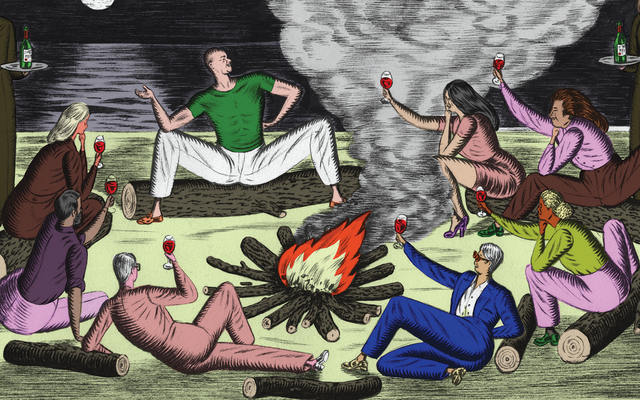
For the richest men on Earth, everything is free and nothing matters.
At the end of Paul Thomas Anderson’s 2007 movie, There Will Be Blood, Daniel Day-Lewis’s oil-baron character, old now and richer than Croesus, beats Paul Dano’s preacher to death with a bowling pin. Dano’s Eli Sunday, a nemesis of Day-Lewis’s Daniel Plainview during his seminal, wealth-building years, has come to sell Plainview the oil-rich land that he once coveted. But Plainview doesn’t need the land anymore, because—as he explains in one of the most famous monologues in modern cinema—he has sucked out all the oil hidden beneath it from an adjoining property, like a milkshake.
Desperate for money, Eli begs for a loan. Instead, Plainview chases him around a bowling alley and murders him with great enthusiasm. Once it’s over, a butler comes to see what all the noise was about. “I’m finished,” Plainview yells.
I spent 10 months working at the institution because I thought I could help protect it. What I observed there is far worse than the public knows.
On the day I was laid off from the Kennedy Center, I felt a little like Dolley Madison saving the Stuart portrait of Washington before the British sacked the capital. I was the staffer in charge of the artworks in the building. A crucial difference is that my institution, unlike the White House in 1814, had been on fire for months.
About a year elapsed between the moment President Trump took over the Kennedy Center in early 2025 and his declaration this past February that he’d decided to shut down the nation’s cultural center for two years. In between, we had seen artist cancellations, shrinking audiences, firings of old staffers and influxes of new ones—a lot of drama, just not onstage. The date Trump announced for the closure was July 4, the country’s 250th birthday, an event that I had been hired to help commemorate as the institution’s first curator of visual arts and special programming.
For more than a year after Donald Trump returned to the White House, Ukraine held out hope—at least publicly—of winning him over. Trump, who revealed his affection for Russia’s Vladimir Putin again and again, largely halted American military aid to Kyiv. He insulted Ukrainian leaders regularly, personally berating President Volodymyr Zelensky in the Oval Office in February 2025. Nevertheless, Ukraine diligently took part in Trump’s peace negotiations, which were tilted to reward Putin’s invasion and turned out to be fruitless. Zelensky agreed to mineral deals that supposedly promised to enrich Americans. He even lavishly praised Trump himself. Despite Ukrainian leaders’ growing doubts, they calculated that speaking sweetly of the American president would do no harm and just might gain his favor.
People scrutinizing influencers for their views should also hold them to account for their facts.
Last week, Pod Save America, the popular podcast founded by former Obama-administration staffers, hosted the influencer and leftist provocateur Hasan Piker. A charismatic and pugnacious socialist streamer, Piker has become a flash point in a broader debate among Democrats over how far their party’s big tent ought to extend. Unsurprisingly, Piker’s hourlong interview generated controversy. Critics on the right and left highlighted his refusal to condemn Hamas. Others were upset that the influencer said he would “vote for Hamas over Israel every single time,” even as he reiterated his reticence to back a progressive politician such as Gavin Newsom over J. D. Vance.
But a very different part of the podcast caught my attention, because it illustrates the problem with the wrangling over Piker: It revolves around his contentious opinions about a narrow subject—Jews and Israel—while giving short shrift to his broader worldview and his tendency to be wrong on the facts. The issue is not whether to engage with figures like Piker; it’s how to do so in a way that’s genuinely informative.
Thirteen thousand miles. Infinite contenders. One beautiful loaf.
This article was featured in the One Story to Read Today newsletter. Sign up for it here.
Here is the promise you and I must cling to across the thousands of words that follow: At some point within this text, I will reveal to you what—after 555 responses, 13,000 miles of travel, and months of monomaniacal research—I have determined to be the best free restaurant bread in America. I will not attempt to slither to the moral high ground, arguing that best is a meaningless measure, or insisting that all bread is dear in its own way. Even if you attempt to betray me—for instance, by merely scanning the text that follows for the phrase Here it is: the best free restaurant bread in America—I will uphold my end of the bargain.
One of the most liberal states in the country can’t find a Democrat to lead it.
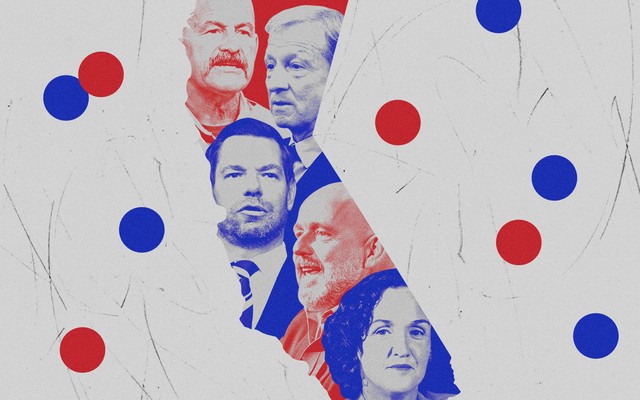
On a chilly Saturday late last month, I met Eric Swalwell at a Little League diamond near Capitol Hill, where the Bay Area congressman and his wife, Brittany, would be watching their 8-year-old son. Swalwell, who was running to succeed Gavin Newsom as the next governor of California, had been gradually rising above a Lilliputian cast of candidates and had acquired a strong scent of momentum in the race.
“Impeccable timing for you,” he’d texted me on my drive over. He attached a just-published Washington Post article reporting that FBI Director Kash Patel was seeking to release files relating to a decade-old investigation into Swalwell that had turned up no evidence of wrongdoing. If true, the Post story presented a publicity godsend to Swalwell’s campaign, further elevating his status as a nemesis of the vindictive president.
The Sorrow and the Pity has lessons for how authoritarianism takes root—and how to fight against it.
The best thing I watched in the past year was an epically long movie about retired militants, but it wasn’t One Battle After Another, the Oscar winner for Best Picture. It was The Sorrow and the Pity, a four-hour documentary from 1969 about life in Nazi-occupied France. Reviewing the film in The Atlantic in 1972, David Denby called it “one of the greatest documentaries ever made,” and that remains true. What makes the film so effective is not how it looks at the Germans, a spectral presence, but how it chronicles the way that many ordinary citizens simply lived their lives as if nothing had changed.
The director Marcel Ophuls, who died last year at 97, explores collaboration and resistance through the lens of a small city, Clermont-Ferrand. It’s about an hour from Vichy, where the Nazis established a puppet government headed by the World War I hero Philippe Pétain. Pétain’s former protégé Charles de Gaulle fled to Britain, coordinated resistance to the Nazis, and returned to lead a free France. The idea that the French almost uniformly opposed Nazism, with only a few bad apples collaborating, is foundational to France’s postwar identity. The problem, as Ophuls, a Franco-German Jew, demonstrates, is that this is a myth.
This article was featured in the One Story to Read Today newsletter. Sign up for it here.
Maybe you’ve seen photos of Tehran in the 1970s, just before the Islamic Revolution: images of young women going to work in miniskirts, of couples making out in parks while wearing bell-bottoms, of people at pools in bikinis. It looks like Paris or Milan or Los Angeles. But in 1979 the revolution happened, and now Tehran looks like something from an earlier century.
Sometimes I think that our whole world has become kind of like that—going backwards in time. The religious movements thriving in today’s secularized age are the traditionalist ones that dissent from large parts of contemporary culture—not only the Shiite Islam of post-revolution Iran, but Orthodox Judaism and conservative Catholicism. Young Americans are flooding into Eastern Orthodox churches.
A shocking number of the president’s supporters have turned against him.
Tomas Montoya has sold festival foods—funnel cakes, burgers, hot dogs—across the American Southwest for years. But lately, business has been rough. Costs are up, so he’s increased his prices. Employees are begging for hours he can’t give them. In Arizona, where he lives, Montoya pays $6 a gallon to fill up his food trucks with diesel. This summer, he may have to skip the California leg of his festival route because fuel is even more expensive there.
“It’s Trump,” Montoya told us outside a popular Hispanic grocery store in Casa Grande, Arizona, much of which sits in one of the most evenly divided House districts in the country. Montoya voted for President Trump in 2024, but now, well, frustrated doesn’t begin to cover how he’s feeling. The president is bragging about the economy, even though everyone Montoya knows is hurting; he promised to stop wars, but started one in Iran. “When Trump opens his mouth, three-quarters of what he says is stories, lies,” Montoya said. He’s planning to vote in the midterm elections this fall. But he may not choose a Republican.