Political leaders across the world voice their disapproval of Trump’s travel ban, U.S. soldiers killed in Yemen, Myanmar's ruling party lawyer is shot and killed at an airport, and the Philippines bombs suspected terrorists.
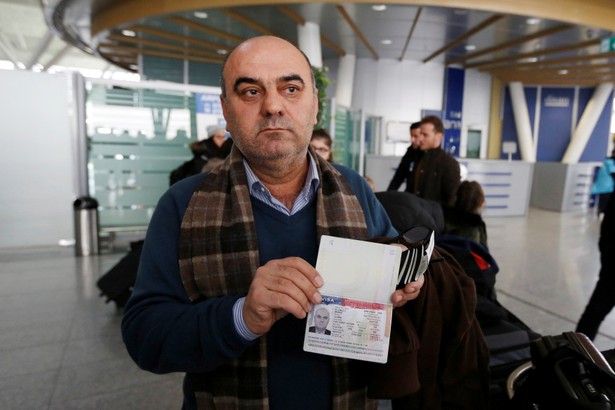
Fuad Sharef Suleman shows his USA visa to the media after returning to Iraq from Egypt.
Ahmed Saad / Reuters
—Some U.S. politicians on both sides of the aisle and world leaders voice their disapproval of Trump’s travel ban that targets seven majority-Muslim countries.
—U.S. soldiers targeting al-Qaeda militants in Yemen died in an operation, the first casualties of Trump’s administration.
—The legal adviser to Myanmar's ruling National League for Democracy was shot and killed by a gunman at the airport.
—The Philippines killed 15 Muslim militants in the country’s south with targeted airstrikes.
—We’re tracking the news stories of the day below. All updates are in Eastern Standard Time (GMT -5).
Gunmen killed at least five people at a mosque in Quebec City who had come for a Sunday evening prayer service, according to the mosques’ president. About 40 people were inside the Quebec City Islamic Cultural Center, located in the Sainte-Foy neighborhood, and two suspects have been arrested. Police have set up a perimeter surrounding the area. Quebec has seen increased incidence of Islamophobia in recent years, particularly after a 2015 political debate over whether the city should ban the niqab, a Muslim face covering; The majority of the city was in favor of the ban. This same mosque was the focus of an investigation in June, after a severed pig’s head was dropped at its doorstep, wrapped and left with the message, “Bon appétit."
The negative reaction to President Donald Trump’s ban on travelers from seven majority-Muslim countries came in the form of protest in cities across the country, at airports, and in the form of donations to The American Civil Liberties Union (ACLU), whose lawyers have filed suits against the ban.
Throughout the weekend lawyers with the human rights organization met banned travelers at airports all over the country, and in several cities they filed injunctions against Trump’s executive order, winning stays from federal judges.
From Saturday to late Sunday more than 290,000 donors had sent the ACLU $19 million—the organizations typical annual average is $3 million. That figure, as well as the growth in membership, was “unprecedented,” according to Anthony Romero, the ACLU’s executive director.
The donations were supported in part through social media, where celebrities like the singer Sia, and actor Rosie O’Donnell offered to match donations to the ACLU of up to $100,000. Tech companies like Lyft pledged to donate $1million to the ACLU, and tech investors like Chris Sacca, an early backer of Uber and Instagram, matched up to $150,000.
The French Left Chooses Benoit Hamon as the Socialist Presidential Candidate
Christian Hartmann / Reuters
In France’s primary vote to determine who will run for president under the Socialist Party’s banner, voters handed the election to the traditional leftist Benoit Hamon. His win is a rebuke of the more-centrist policies of his rival, Manuel Valls, a former prime minister. Polls give Hamon little chance of winning the two-stage presidential election, with votes in both April and and May. Analysts believe his victory will likely turn more moderate leftists to vote for Emmanuel Macron, a 39-year-old independent centrist and former economy minister who wants to bridge the Left and the Right. Macron, however, is polled behind both Conservative Francois Fillon, and the far-right leader Marine Le Pen, who are both seen as most likely to face off in May. The Socialist Party has suffered massive unpopularity after the presidency of Francois Hollande, who was criticised for U-turns on major policies, and because of several high-profile terrorist attacks, was perceived as unable to keep the country safe
Protests Against Trump's Executive Order Spread Nationwide
Trish Badger / Reuters
Late into the night on Saturday, protesters flooded airports around the country to condemn President Trump’s executive order on immigrants and refugees.
On Sunday, they flooded American cities.
Protesters seemed to have multiple goals as they carted banners and signs to various metropolitan downtowns: to tell the brand-new president that his executive order restricting immigration and refugees was un-American; to decry Trump and his top advisers personally; and to demonstrate to the world that U.S. citizens are actively rejecting the new policy.
The protesters came by the thousands, and by Sunday mid-afternoon showed little sign of dispersing. For some cities, this was the second straight weekend they’d seen massive protests: Last Saturday, women’s marches were held in the United States and internationally to protest Trump and his new administration.
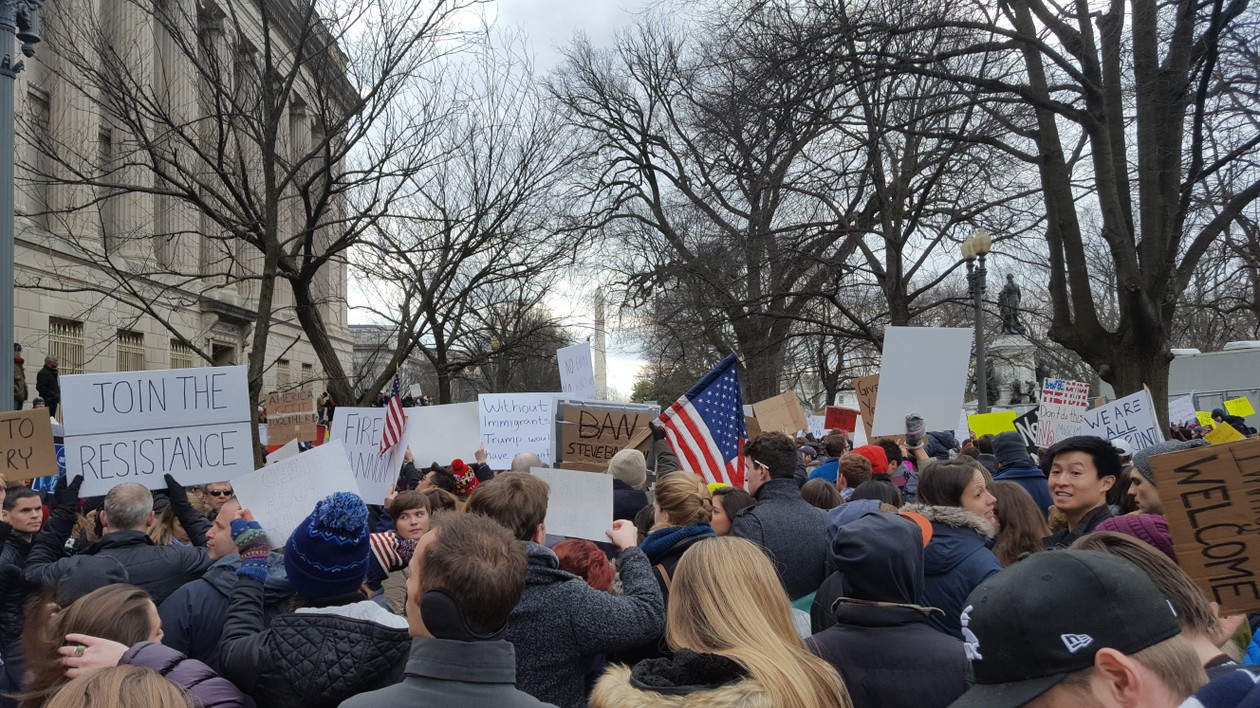
In Washington, D.C., demonstrators on Sunday took their chants to Trump’s new Pennsylvania Avenue hotel—and down the street to Lafayette Square, just outside his White House. Here are scenes from some of the protests:
An estimated 1,200 people at Turner Park protest today against Trump's executive order on immigration, W-H reporter says. Full story later. pic.twitter.com/iMAik7YSUp
Protest happening along Avenida De Las Americas in front of the GRB Convention Center. It is a peaceful protest with security everywhere. pic.twitter.com/S5KF64uYGU
Philippine Airstrike Gravely Injures the Top ISIS Leader in Southeast Asia
Bullit Marquez / AP
Philippine military leaders confirmed Sunday that an airstrike in the country’s south killed 15 Muslim militants with ties to ISIS, and seriously injured an Indonesian leader considered one of Southeast Asia’s top terror suspects. Isnilon Hapilon, who is also known as Mohisen, is the leader of Abu Sayyaf, a group of militants notorious in the region for kidnapping tourists and holding them for ransom. Last year the group beheaded two captured Canadian tourists, and the U.S. has placed a $5 million bounty on Hapilon’s head. Philippine military Chief of Staff General Eduardo Ano said Hapilon was believed to be seriously injured, and is somewhere on the outskirts of Butig, a town in the country’s mountainous south, which has long been a haven for extremists. Jet fighters carried out the strikes, dropping six 500-pound bombs Wednesday night and Thursday on the group’s encampment. Officials said that while Hapilon has not yet been captured, their intelligence says he is being moved around on a stretcher by his followers, who are surrounded by Filipino troops.
Protesters Outside the White House Chant Against Trump's Immigration Order
(Elaine Godfrey / The Atlantic)
Protesters have filled Lafayette Square outside the White House in Washington, D.C., in response to the executive order on immigration that President Trump signed Friday that severely restricts immigration from seven Muslim countries, suspends all refugee admission for 120 days, and bars all Syrian refugees indefinitely. Since they can’t get close to the White House, protesters are lining Madison Place, and climbing the steps of the nearby U.S. Court of Federal Claims. They’re chanting “Let them in” and “No hate no fear, refugees are welcome here.” A few are shouting “Fire Bannon,” a reference to Steve Bannon, the president’s chief strategist and senior counselor. After every round of chants, the crowd breaks out into cheers. On the perimeter of the square, I caught a young man named Tom, wrapped in the American flag, sprinting to the protest. The immigration order is, “just disgusting,” he said, and kept running. Four Iranians who said they had green cards told me they were afraid their family members won’t be able to visit them—and they won’t be able to see their relatives. One woman, who said her name was Mehnoosh, brought her two daughters to the protest. She cried telling me she isn’t sure her sister, who was supposed to be visiting soon, will be able to get in. “I’m very sad ... I’ve been crying the past few days.”
The First Combat Casualty of the Trump Administration
Fawaz Salman / Reuters
A U.S. soldier was killed Sunday in a raid in Yemen that targeted local al-Qaeda militants, making it the first casualty of President Donald Trump’s administration. The soldier was a member of a Navy Seal unit, and three others U.S. soldiers were injured during the crash-landing of their aircraft, which was later intentionally destroyed. The operation’s goal was to collect intelligence, including computer equipment, that was believed to be linked to possible future attacks. The local wing of al-Qaeda in Yemen, which is in the midst of a civil war, has proved a powerful threat. The U.S. has mostly relied upon drone strikes to fight militants in the area, and this operation had reportedly been planned for months. It received authorization by Trump, The Washington Postreported. Fourteen militants died in a firefight with U.S. soldiers, and there are reports of more than a dozen dead civilians.
U.K. Citizens Start a Petition Against Trump, and Other Reactions to the Travel Ban
Kate Munsch / Reuters
President Donald Trump and his administration stood defiant Sunday, despite growing, global criticism over his travel ban. Some world leaders have weighed in on the executive order, including German Chancellor Angela Merkel. She said on Sunday that she is “convinced that the necessary, decisive battle against terrorism does not justify a general suspicion against people of a certain origin or a certain religion.” Similarly, U.K. Prime Minister Theresa May said Britain does not support Trump’s ban, and citizens there started an online government petition titled "Prevent Donald Trump from making a State Visit to the United Kingdom." Its text reads, in part, that Trump’s "well-documented misogyny and vulgarity disqualifies him from being received" by Queen Elizabeth or Prince Charles. By Sunday at 1 p.m., nearly a half-million people had signed the petition, well beyond the 100,000 signatures needed for parliament to consider it. Among members of the U.S. Congress, the ban is also getting pushback. Ohio Republican Senator Rob Portman said: "I think we should slow down.” Arizona Republican Senator John McCain said “it’s been a very confusing process,” and that it would likely “give ISIS some more propaganda." Meanwhile, Trump’s team seems unfazed. A top adviser and former campaign manager, Kellyanne Conway, said Sunday on Fox News that the order was about "preventing, not detaining," and said not many people had been impacted by the travel ban. The day before, she’d tweeted this:
Get used to it. @POTUS is a man of action and impact.
Promises made, promises kept.
Shock to the system.
And he's just getting started https://t.co/AoUsZWClXt
The shooting at the correspondents’ dinner made clear who gets saved first.
This article was featured in the One Story to Read Today newsletter. Sign up for it here.
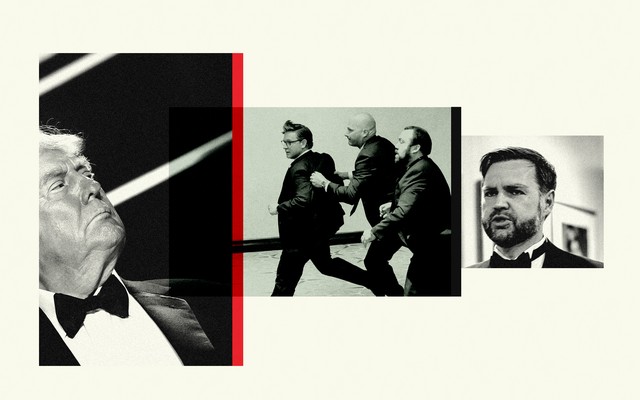
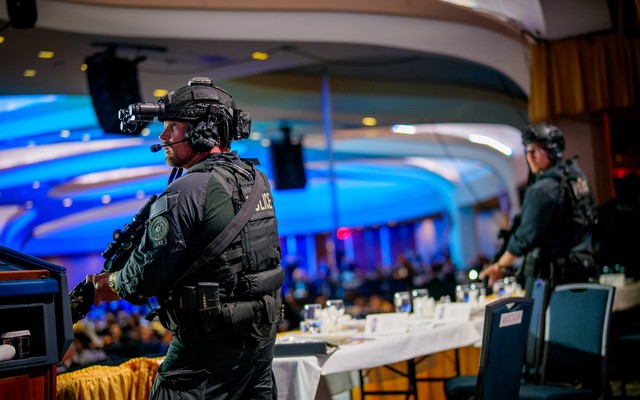
On one level, the system worked. The perimeter held. A would-be assassin was tackled in the hallway outside the White House Correspondents’ Association’s annual dinner. The one bullet that found a human target—a U.S. Secret Service agent—was halted, in part, by the officer’s phone and bulletproof vest, according to a law-enforcement summary report that we reviewed. A counterassault team promptly swarmed the stage with assault rifles and night-vision equipment in case the lights were cut. The government’s top leaders—president, vice president, Cabinet officials, speaker of the House—were ushered to secure locations in a matter of minutes. No one died in the attack.
For the richest men on Earth, everything is free and nothing matters.
At the end of Paul Thomas Anderson’s 2007 movie, There Will Be Blood, Daniel Day-Lewis’s oil-baron character, old now and richer than Croesus, beats Paul Dano’s preacher to death with a bowling pin. Dano’s Eli Sunday, a nemesis of Day-Lewis’s Daniel Plainview during his seminal, wealth-building years, has come to sell Plainview the oil-rich land that he once coveted. But Plainview doesn’t need the land anymore, because—as he explains in one of the most famous monologues in modern cinema—he has sucked out all the oil hidden beneath it from an adjoining property, like a milkshake.
Desperate for money, Eli begs for a loan. Instead, Plainview chases him around a bowling alley and murders him with great enthusiasm. Once it’s over, a butler comes to see what all the noise was about. “I’m finished,” Plainview yells.
Instead of a crackdown on his enemies, Trump wants his ballroom.
When an assassin murdered Charlie Kirk in September 2025, the MAGA movement seized the moment to demand a campaign of repression. Vice President Vance called for an ambitious program to “go after the NGO network that foments, facilitates, and engages in violence.” He named the Ford Foundation, Open Society Foundations, and The Nation magazine as examples of candidates for the retaliation he had in mind. The people who faced consequences after the killing almost universally did so for things they had written or said, not for acts of violence. In November, Reuters counted some 600 cases of people who were fired, suspended, or otherwise disciplined for their speech about Kirk’s life and death.
Now another gunman has attacked political targets. At the White House Correspondents’ Association dinner, a man discharged a firearm in the vicinity of hundreds of people from the worlds of politics, media, and business—among them, the president and vice president of the United States. Although much about the event remains unclear, the available evidence suggests that the gunman was motivated by an anti-Trump agenda. Yet this time, MAGA’s immediate response to political violence has been much less aggressive. At his press conference after yesterday’s attempted shooting, President Trump cited the attack as proof of the need for his wished-for White House ballroom. Social-media accounts that take their cues from the White House promptly echoed the message.
A manifesto-like email allegedly sent by the dinner shooter suggests a murderous obsession with Trump’s politics.
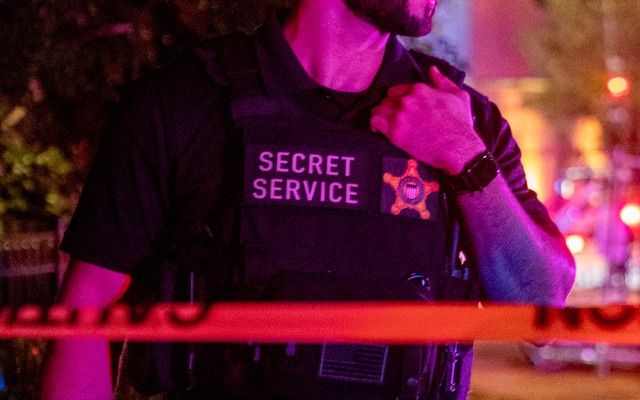
The line “I experience rage thinking about everything this administration has done” could probably have been written in an email to friends by any number of the attendees at last night’s White House Correspondents’ Association dinner. But the line was apparently written by a man who showed up with a shotgun and pistol and was ready to kill “most everyone” there to get to Donald Trump and assassinate him and his Cabinet. In a manifesto-like email that he reportedly sent to family minutes before allegedly shooting, Cole Tomas Allen wrote that the assembled journalists and machers “chose to attend a speech by a pedophile, rapist, and traitor, and are thus complicit.” Allen never came near the president or the gala floor. A Secret Service agent was shot in the vest before Allen was tackled and arrested.
This weekend’s failed attack highlighted a risk that often goes unspoken.
In the chaotic swirl of events after President John F. Kennedy’s assassination, doctors feared that Vice President Lyndon B. Johnson had suffered a heart attack upon arrival at Parkland Memorial Hospital in Dallas. The signs were ominous: Johnson’s face was ashen, and he was clutching his chest. “There was the real possibility that the No. 3 in the line of succession would become president,” the historian Michael Beschloss told me. Johnson was reportedly examined and a heart attack ruled out—but not before then–House Speaker John McCormack was told that he might be the next president. The declaration prompted a severe bout of vertigo in the 71-year-old.
Few moments in history have so starkly exposed the vulnerabilities of the presidential line of succession—or the lack of clarity about how it is protected. Last night provided another illustration of them. If events at the White House Correspondents’ Association Dinner had gone differently, a gunman who breached security at the Washington Hilton could have reached a ballroom containing an unusually dense cluster of American power. The president and the vice president were seated a few feet apart. Congressional leadership and many Cabinet secretaries were also on hand. In other words, much of the presidential line of succession was in the same spot—and subject to the same vulnerabilities.
Tragedy was averted at a Washington hotel, but such moments will happen again.
Except for what appears—thank God—to be only a minor injury to a Secret Service officer who was shot near a security checkpoint, no one was hurt at the White House Correspondents’ Association dinner last night. News reports are reassembling the mosaic of the attacker’s movements; he apparently took a train and transported some weapons with him, checked into the hotel, and then made his run at the event.
These are the basic contours of all that we know, and it will take time for more credible information to emerge. In the meantime, the vacuum of facts has been filled by a certain amount of hysteria and the usual conspiracy theories, as well as understandable demands to make changes so that such a thing can never happen again.
Priests and theologians want to shape the future of AI. Big Tech is listening.
In 1633, Galileo Galilei stood in the convent of the Santa Maria sopra Minerva church in Rome, where a tribunal of Catholic authorities forced him to “abjure, curse, and detest” his belief that the sun—not Earth—was the center of the universe.
Almost four centuries later, in 2016, the Vatican invited a group of the world’s most prominent technologists to the same church to discuss AI ethics. That was the start of the Minerva Dialogues, annual closed-door conferences in Rome that have become the centerpiece of a decade-long exchange between Silicon Valley and the Catholic Church.
The Valley and the Vatican seem like strange bedfellows: The oldest institution in the world meets secular upstarts bent on creating godlike technology. When the venture capitalist Reid Hoffman first attended the dialogues, he told me he was struck by the portraits lining the walls that depicted Catholic inquisitors like those who persecuted Galileo. “It feels a little bit weird to be walking in voluntarily past these,” he remembers thinking.
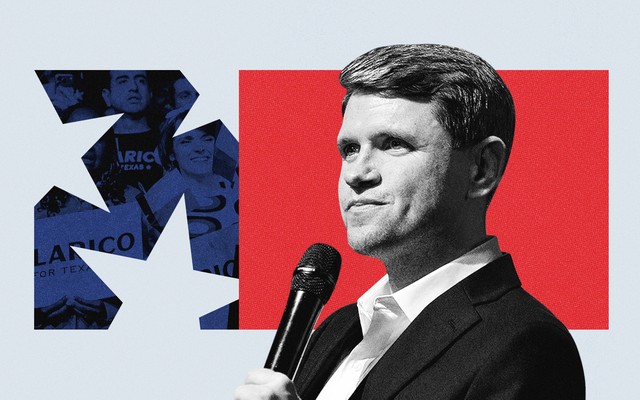
James Talarico is trying to sell a novel brand of Christian politics in a deep-red state.
Updatedat 11:25 a.m. ET on April 24, 2026
While some might pray for hope or peace in such dark times, others are praying for the death of Texas Democrat James Talarico, who is running for the U.S. Senate. During a recent episode of the right-wing Protestant podcast Reformation Red Pill, host Joshua Haymes told the pastor Brooks Potteiger that he prays that “God kills” Talarico, given that the politician seems to be possessed by demons. Potteiger agreed, offering that Talarico should be “crucified with Christ.” Both Haymes and Potteiger later insisted that their remarks were not sincere expressions of violent intent, but rather metaphorical calls for Talarico, a Presbyterian seminarian, to find salvation in their brand of Christianity. Talarico shrewdly responded by offering forgiveness: “You may pray for my death, Pastor, but I still love you. I love you more than you could ever hate me.”
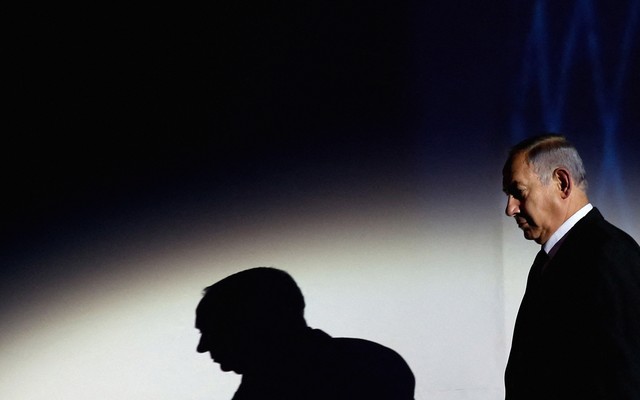
The Israeli prime minister’s focus is, as always, on himself and his near-term political needs. The plight of American Jews is simply not his concern.
The relationship between the United States and Israel is in crisis. Six in 10 Americans have a negative view of Israel, and a majority of those under 50 in both major parties view Israel as well as its prime minister, Benjamin Netanyahu, negatively. After the brutal Gaza war, a large percentage of liberal-leaning Generation Z considers Israel a pariah state. Democratic candidates are scrambling to distance themselves from Israel and its controversial leader; earlier this month, 40 of the 47 Democratic senators voted against a military aid package for the country. And hostility toward Israel is spilling over into hostility toward Jews. Liberal influencers, activists, podcasters, and even politicians are invoking age-old anti-Semitic tropes with frightening regularity.
A New York Times podcast hosted Hasan Piker and a New Yorker staff writer for a discussion of lawbreaking, which they both endorsed as resistance to tyranny.
The late political scientist James C. Scott endorsed what he called “anarchist calisthenics”—the regular practice of small acts of lawbreaking and disobedience. Jaywalk at an empty intersection. Have a beer in the park. Smuggle a pudding cup past the TSA agents. The point, Scott said, was to keep the civic muscles strong. Without constant reinforcement, these muscles will atrophy, and when real tyranny arrives, the flabby citizen will be powerless to resist. Scott particularly enjoyed telling Germans to get their reps in, because their grandparents had not.
On Wednesday a New York Times podcast hosted the Twitch streamer Hasan Piker and the New Yorker staff writer Jia Tolentino for a discussion of lawbreaking, which they both endorsed not as a habit of mind but as resistance to actual tyranny, today. They agreed that shoplifting from grocery stores such as Whole Foods is laudable, because (as Tolentino says, without evidence) “every major grocery chain” steals from workers and customers. Streaming services—they specifically name Spotify, which carries the Times podcast—are bad for creators and, they say, worthy of being ripped off. Piker said he would steal cars, “if I could get away with it.” Channeling Abbie Hoffman, Tolentino encourages people to steal from her own employer, The New Yorker, but does not explain which high crimes David Remnick has committed to earn this comeuppance.