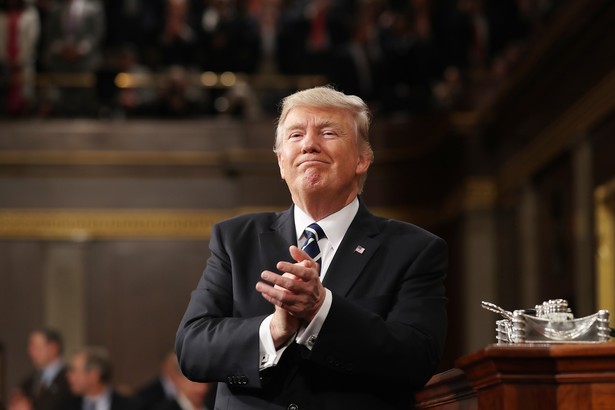
—In a speech packed with policy proposals, a dark view of the past, and hope for the future, President Trump addressed a joint session of Congress. More here
—Authorities will investigate the shooting at a Kansas bar that resulted in the death of an Indian man as a hate crime, the FBI announced. More here
—We’re tracking the news stories of the day below. All updates are in Eastern Standard Time (GMT -5).
In a speech packed with policy proposals, a dark view of the past, and hope for the future, President Trump addressed a joint session of Congress Tuesday evening. As my colleague Clare Foran notes, the speech was “perhaps more notable for its tone than its substance.” She writes:
It marked a striking change of tone from his campaign and his early days in office, from a president who has frequently feuded with critics, including members of his own party. The optimistic tone was equally a departure from Trump’s inaugural address, in which he painted a picture of a country in decline and memorably promised to end “American carnage.” On Tuesday, he acknowledged that “the challenges we face as a nation are great,” but he added “our people are even greater.”
For a full breakdown of the moments of the speech and what the president proposed, check out our full coverage here.
Malaysian authorities charged two women in the death of Kim Jong Nam, the half-brother of North Korean leader Kim Jong Un. The women, Siti Aishah from Indonesia and Doan Thi Huong from Vietnam, face the death penalty if convicted. Kim was killed on February 13 at the Kuala Lumpur airport when the women allegedly rubbed a VX nerve agent on his face. Lawyers for the women have said they thought they were playing a prank on a gameshow. Kim died within 20 minutes of the attack. The North Korean government is suspected in orchestrating the attack. Leaders in Pyongyang have denied those accusations. Authorities in Malaysia are seeking to question a diplomat in the North Korean embassy in Kuala Lumpur.
FBI to Investigate Shooting of 2 Indian Men in Kansas as a Hate Crime
Alok Madasani, who was wounded in the bar shooting, attends a candlelight vigil alongside his wife in Olathe, Kansas on February 26, 2017. (Dave Kaup / Reuters)
Authorities will investigate the shooting at a Kansas bar that resulted in the death of an Indian man as a hate crime, the FBI announced Tuesday. The decision comes nearly one week after 51-year-old Adam Purinton allegedly yelled at Srinivas Kuchibhotla and Alok Madasani, both 32-year-old Indian men, to “get out of my country” before opening fire, killing Kuchibhotla and wounding Madasani. Ian Grillot, another bar patron who tried to intervene in the shooting, was also injured. Purinton, who was charged with first-degree murder and first-degree attempted murder, reportedly believed Kuchibhotla and Madasani to be of Middle Eastern descent. The incident has since prompted fears within the Indian community of future racially-motivated attacks, and Madasani’s father, Jaganmohan Reddy, cautioned Indian parents against sending their children to the U.S., adding: “The situation seems to be pretty bad after Trump took over as the U.S. president.” In a press briefing Friday, White House Press Secretary Sean Spicer called suggestions of a correlation between the shooting and President Trump’s immigration policies “absurd.”
2 Police Officers Shot in Houston; Suspect at Large
(Richard Carson / Reuters)
Updated at 3:42 p.m.
Two Houston police officers responding to a burglary were shot Tuesday in the southwest portion of the city, prompting a shelter-in-place for residents of the area. Both officers were shot multiple times and are being treated at local hospitals. One, identified as Officer Jose Munoz, a 10-year veteran, received non-life-threatening injuries; the other, Officer Ronnie Cortez, a 24-year veteran of the force, was critically injured, Chief Art Acevedo said at a news conference. Acevedo said there were two suspects, one of whom was killed at the scene, and the other who is at large.
Update: two officers shot during incident at 8714 Sterlingame; both being treated at hospitals; conditions not being released at this time
Female and Child Migrants Face Rampant Abuse in Libya, UNICEF Says
Migrants sit at a detention center in Tripoli, Libya, on May 17, 2015. (Hani Amara / Reuters)
Female and child migrants making the dangerous journey across the Mediterranean to Europe face sexual abuse, violence, and exploitation at the hands of smugglers and traffickers, a report published Tuesday by UNICEF finds. According to the UN agency, there are more than 250,000 migrants in Libya; women make up 11 percent and children 9 percent. These migrants are often held within any one of the 34 government-run detention centers identified throughout the country, though UNICEF said many of them are also held in unofficial detention centers run by armed groups. Of the 122 women and children interviewed by UNICEF, three-quarters “said they experienced violence, harassment, or aggression at the hands of adults” while in detention, and nearly half of them reported sexual abuse. Those interviewed also reported a lack of access to proper nutrition, sanitation, health care, and legal access—conditions UNICEF described as “living hellholes.” Afshan Khan, the UNICEF Regional Director and Special Coordinator for the Refugee and Migrant Crisis in Europe, said in a statement that migration routes from Libya to Europe are “controlled by smugglers, traffickers and other people seeking to prey upon desperate children and women who are simply seeking refuge or a better life,” adding: “We need safe and legal pathways and safeguards to protect migrating children that keep them safe and keep predators at bay.” Indeed, there are few safeguards for migrants attempting to cross the Mediterranean. Of the more than 180,000 who attempted the journey from Libya to Italy last year, more than 4,500 drowned—a figure which made 2016 the deadliest year for migrants on record.
UPDATE: Samsung's Chief, 4 Executives Charged in Corruption Scandal
Lee Jae-yong (Jung Yeon-Je/ Pool / Reuters)
Updated at 9:19 a.m. ET
South Korean prosecutors say they charged Lee Jae-yong, the Samsung heir, and four other company executives with corruption and embezzlement in a scandal that has already resulted in the impeachment of President Park Geun-hye. Three of the four executives, who were named in Tuesday’s announcement, resigned from the company. Lee was arrested earlier this month. My colleague Yasmeen Serhan previously reported: “The arrest concerns multimillion-dollar donations the Samsung executive made to companies associated with Choi Soon-sil, a longtime friend of Park whose Rasputin-like relationship with the president prompted allegations of undue influence and ultimately led to Park’s impeachment. Prosecutors allege Lee made the donations in exchange for political support for a 2015 merger between Samsung and Cheil Industries, an affiliated firm. Though Lee confirmed he made the donations, he denied that they were bribes.” The charges could have major implications for Samsung; Lee has run the conglomerate since his father, Lee Kun-hee, suffered a heart attack in 2014.
UPDATE: 'I Don’t Think We’ve Explained it Well Enough to the American Public,' Trump Says
Updated at 9:01 a.m. ET
President Trump toldFox & Friends he’d give himself an “A” on his achievements so far, but would give himself a “C or C-plus” for messaging. “I think I’ve done great things, but I don’t think I have—I and my people—I don’t think we’ve explained it well enough to the American public,” he said. The remarks came hours before his scheduled remarks to a joint session of Congress. Trump said he’d use the address to elaborate on his plans for the military, border security, the economy, and health care. The speech isn’t technically a State of the Union address, which is given a year after a president has been in office. The address, which begins at 9 p.m., comes a little more than a month after Trump’s inauguration as president. My colleague Molly Ball assessed his time in office so far.
The shooting at the correspondents’ dinner made clear who gets saved first.
This article was featured in the One Story to Read Today newsletter. Sign up for it here.
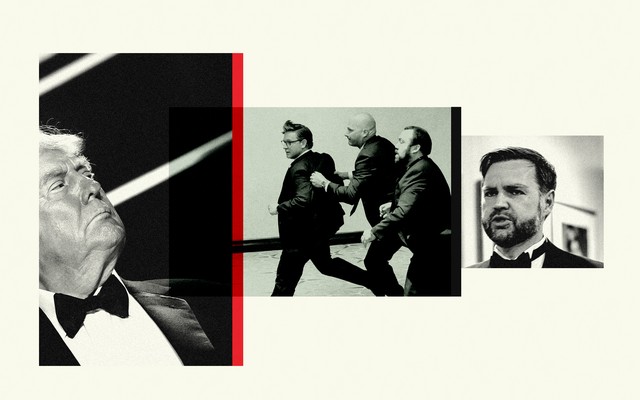
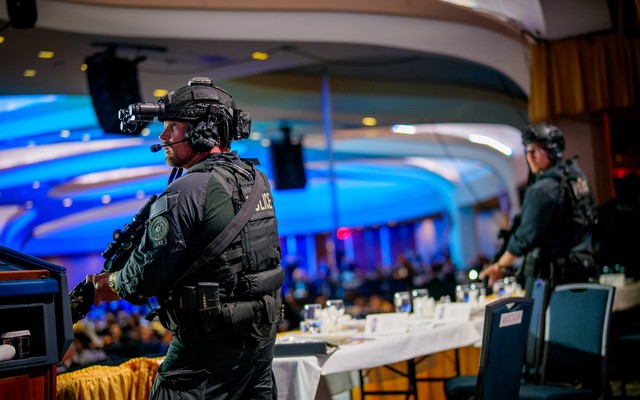
On one level, the system worked. The perimeter held. A would-be assassin was tackled in the hallway outside the White House Correspondents’ Association’s annual dinner. The one bullet that found a human target—a U.S. Secret Service agent—was halted, in part, by the officer’s phone and bulletproof vest, according to a law-enforcement summary report that we reviewed. A counterassault team promptly swarmed the stage with assault rifles and night-vision equipment in case the lights were cut. The government’s top leaders—president, vice president, Cabinet officials, speaker of the House—were ushered to secure locations in a matter of minutes. No one died in the attack.
Instead of a crackdown on his enemies, Trump wants his ballroom.
When an assassin murdered Charlie Kirk in September 2025, the MAGA movement seized the moment to demand a campaign of repression. Vice President Vance called for an ambitious program to “go after the NGO network that foments, facilitates, and engages in violence.” He named the Ford Foundation, Open Society Foundations, and The Nation magazine as examples of candidates for the retaliation he had in mind. The people who faced consequences after the killing almost universally did so for things they had written or said, not for acts of violence. In November, Reuters counted some 600 cases of people who were fired, suspended, or otherwise disciplined for their speech about Kirk’s life and death.
Now another gunman has attacked political targets. At the White House Correspondents’ Association dinner, a man discharged a firearm in the vicinity of hundreds of people from the worlds of politics, media, and business—among them, the president and vice president of the United States. Although much about the event remains unclear, the available evidence suggests that the gunman was motivated by an anti-Trump agenda. Yet this time, MAGA’s immediate response to political violence has been much less aggressive. At his press conference after yesterday’s attempted shooting, President Trump cited the attack as proof of the need for his wished-for White House ballroom. Social-media accounts that take their cues from the White House promptly echoed the message.
For the richest men on Earth, everything is free and nothing matters.
At the end of Paul Thomas Anderson’s 2007 movie, There Will Be Blood, Daniel Day-Lewis’s oil-baron character, old now and richer than Croesus, beats Paul Dano’s preacher to death with a bowling pin. Dano’s Eli Sunday, a nemesis of Day-Lewis’s Daniel Plainview during his seminal, wealth-building years, has come to sell Plainview the oil-rich land that he once coveted. But Plainview doesn’t need the land anymore, because—as he explains in one of the most famous monologues in modern cinema—he has sucked out all the oil hidden beneath it from an adjoining property, like a milkshake.
Desperate for money, Eli begs for a loan. Instead, Plainview chases him around a bowling alley and murders him with great enthusiasm. Once it’s over, a butler comes to see what all the noise was about. “I’m finished,” Plainview yells.
This weekend’s failed attack highlighted a risk that often goes unspoken.
In the chaotic swirl of events after President John F. Kennedy’s assassination, doctors feared that Vice President Lyndon B. Johnson had suffered a heart attack upon arrival at Parkland Memorial Hospital in Dallas. The signs were ominous: Johnson’s face was ashen, and he was clutching his chest. “There was the real possibility that the No. 3 in the line of succession would become president,” the historian Michael Beschloss told me. Johnson was reportedly examined and a heart attack ruled out—but not before then–House Speaker John McCormack was told that he might be the next president. The declaration prompted a severe bout of vertigo in the 71-year-old.
Few moments in history have so starkly exposed the vulnerabilities of the presidential line of succession—or the lack of clarity about how it is protected. Last night provided another illustration of them. If events at the White House Correspondents’ Association Dinner had gone differently, a gunman who breached security at the Washington Hilton could have reached a ballroom containing an unusually dense cluster of American power. The president and the vice president were seated a few feet apart. Congressional leadership and many Cabinet secretaries were also on hand. In other words, much of the presidential line of succession was in the same spot—and subject to the same vulnerabilities.
A manifesto-like email allegedly sent by the dinner shooter suggests a murderous obsession with Trump’s politics.
The line “I experience rage thinking about everything this administration has done” could probably have been written in an email to friends by any number of the attendees at last night’s White House Correspondents’ Association dinner. But the line was apparently written by a man who showed up with a shotgun and pistol and was ready to kill “most everyone” there to get to Donald Trump and assassinate him and his Cabinet. In a manifesto-like email that he reportedly sent to family minutes before allegedly shooting, Cole Tomas Allen wrote that the assembled journalists and machers “chose to attend a speech by a pedophile, rapist, and traitor, and are thus complicit.” Allen never came near the president or the gala floor. A Secret Service agent was shot in the vest before Allen was tackled and arrested.
The Israeli prime minister’s focus is, as always, on himself and his near-term political needs. The plight of American Jews is simply not his concern.
The relationship between the United States and Israel is in crisis. Six in 10 Americans have a negative view of Israel, and a majority of those under 50 in both major parties view Israel as well as its prime minister, Benjamin Netanyahu, negatively. After the brutal Gaza war, a large percentage of liberal-leaning Generation Z considers Israel a pariah state. Democratic candidates are scrambling to distance themselves from Israel and its controversial leader; earlier this month, 40 of the 47 Democratic senators voted against a military aid package for the country. And hostility toward Israel is spilling over into hostility toward Jews. Liberal influencers, activists, podcasters, and even politicians are invoking age-old anti-Semitic tropes with frightening regularity.
Tragedy was averted at a Washington hotel, but such moments will happen again.
Except for what appears—thank God—to be only a minor injury to a Secret Service officer who was shot near a security checkpoint, no one was hurt at the White House Correspondents’ Association dinner last night. News reports are reassembling the mosaic of the attacker’s movements; he apparently took a train and transported some weapons with him, checked into the hotel, and then made his run at the event.
These are the basic contours of all that we know, and it will take time for more credible information to emerge. In the meantime, the vacuum of facts has been filled by a certain amount of hysteria and the usual conspiracy theories, as well as understandable demands to make changes so that such a thing can never happen again.
Priests and theologians want to shape the future of AI. Big Tech is listening.
In 1633, Galileo Galilei stood in the convent of the Santa Maria sopra Minerva church in Rome, where a tribunal of Catholic authorities forced him to “abjure, curse, and detest” his belief that the sun—not Earth—was the center of the universe.
Almost four centuries later, in 2016, the Vatican invited a group of the world’s most prominent technologists to the same church to discuss AI ethics. That was the start of the Minerva Dialogues, annual closed-door conferences in Rome that have become the centerpiece of a decade-long exchange between Silicon Valley and the Catholic Church.
The Valley and the Vatican seem like strange bedfellows: The oldest institution in the world meets secular upstarts bent on creating godlike technology. When the venture capitalist Reid Hoffman first attended the dialogues, he told me he was struck by the portraits lining the walls that depicted Catholic inquisitors like those who persecuted Galileo. “It feels a little bit weird to be walking in voluntarily past these,” he remembers thinking.
Silicon Valley venture capitalists are wining and dining 18-year-olds.
This article was featured in the One Story to Read Today newsletter. Sign up for it here.Updated at 8:22 a.m. ET on April 25, 2026.
When I was a freshman at Stanford University, I learned to shotgun a beer from a guy in a frat. Soon after, he dropped out and started an AI company. Six months later, it was valued at more than $1 billion.
For most students, Stanford is a normal competitive school, where people go to class and coffee shops and fall in love and freak out over finals. But a select few attend something else: a Stanford inside Stanford, where venture capitalists pursue 18- and 19-year-olds, handing out mentorships and money and invites to yacht parties in an attempt to convert promise into profit.
A New York Times podcast hosted Hasan Piker and a New Yorker staff writer for a discussion of lawbreaking, which they both endorsed as resistance to tyranny.
The late political scientist James C. Scott endorsed what he called “anarchist calisthenics”—the regular practice of small acts of lawbreaking and disobedience. Jaywalk at an empty intersection. Have a beer in the park. Smuggle a pudding cup past the TSA agents. The point, Scott said, was to keep the civic muscles strong. Without constant reinforcement, these muscles will atrophy, and when real tyranny arrives, the flabby citizen will be powerless to resist. Scott particularly enjoyed telling Germans to get their reps in, because their grandparents had not.
On Wednesday a New York Times podcast hosted the Twitch streamer Hasan Piker and the New Yorker staff writer Jia Tolentino for a discussion of lawbreaking, which they both endorsed not as a habit of mind but as resistance to actual tyranny, today. They agreed that shoplifting from grocery stores such as Whole Foods is laudable, because (as Tolentino says, without evidence) “every major grocery chain” steals from workers and customers. Streaming services—they specifically name Spotify, which carries the Times podcast—are bad for creators and, they say, worthy of being ripped off. Piker said he would steal cars, “if I could get away with it.” Channeling Abbie Hoffman, Tolentino encourages people to steal from her own employer, The New Yorker, but does not explain which high crimes David Remnick has committed to earn this comeuppance.