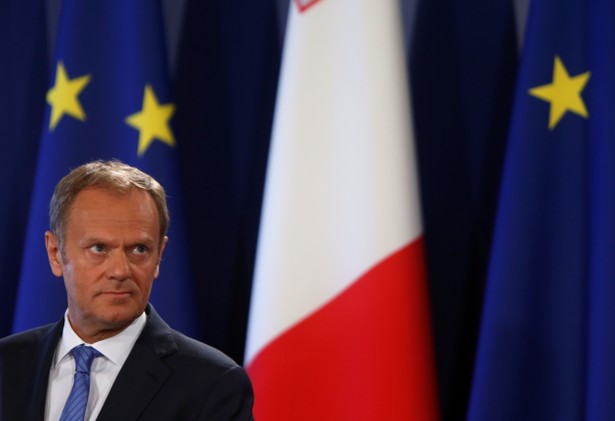
European Council President Donald Tusk discusses Brexit in Valletta, Malta, on March 31.
Darrin Zammit Lupi / Reuters
—The EU’s draft on Brexit talks propose a “phased approach,” suggesting talks on a trade deal with the U.K. can begin once there’s enough progress on a financial settlement.
—Mike Flynn offers to be interviewed in exchange for immunity from prosecution, the Wall Street Journal and other are reporting. More here
—We’re tracking the news stories of the day below. All updates are in Eastern Daylight Time (GMT -4).
President Trump signed two executive orders on Friday, aimed at assessing the fairness of U.S. trade deals. The move represents a more cautious approach from when Trump, as presidential candidate, promised to scrap the North American Free Trade Agreement (NAFTA), which he called “the worst trade deal ever.” The first order Trump signed calls for a 90-day study to look country-by-country, product-by-product, at abuses that contribute to the U.S. trade deficit. The study would serve as a template for rule- and decision-making when the administration evaluates how to reorganize trade deals. The second order will step up duties collected from countries the U.S. finds to be dumping products at below production costs, often done with heavy subsidies from their governments. The orders come a week ahead of Trump’s meeting with President Xi Jinping of China, which Trump has accused of taking advantage of the U.S. Trump has called the U.S. trade deficit—more than $500 billion last year—a job-killer, and has said he will renegotiate deals like NAFTA to put American interests first. But more so than trade deals, economists have pointed to the increased robotization of factories as the major cause for lost factory jobs. At the signing ceremony Friday, after taking a few questions from the media, Trump abruptly left without actually signing the order. Vice President Mike Pence instead picked up the document and chased after the president.
The meeting next week with China will be a very difficult one in that we can no longer have massive trade deficits...
New York Mayor De Blasio Plans to Close Rikers Island Jail Within 10 Years
Lucas Jackson / Reuters
New York City Mayor Bill de Blasio announced Friday plans to shutter the Rikers Island jail complex within the next decade in a bid to end the era of mass incarceration in the city.
Rikers Island is an expression of a national problem. The mass incarceration era did not begin in New York City but it’s going to end here.
Closing the 85-year-old facility will be a “long and arduous” process, de Blasio said in a statement, adding “our success in reducing crime and reforming our criminal justice system has paved a path off Rikers Island and toward community-based facilities capable of meeting our criminal justice goals.” De Blasio said the project would require cutting the jail’s nearly 10,000-person population in half, as well as constructing several smaller facilities to replace it. The announcement follows the formation last year of an independent panel commissioned to examine the facility, which, as The New York Times reports, recommended the jail be demolished and replaced with new jails built in each of the city’s five boroughs. More details from the commissions findings are expected to be announced Sunday.
A Federal Judge Approves a $25 Million Trump University Settlement
Carlos Barria / Reuters
A federal judge on Friday approved a deal for President Trump to pay $25 million to settle lawsuits against him over Trump University, the defunct real-estate education program created by Trump. The ruling, by U.S. District Court Judge Gonzalo Curiel in the Southern District of California, ends seven years of legal battles, with class-action suits in New York and California. The cases came to national attention during Trump’s election campaign, with plaintiffs saying they’d signed up to learn Trump’s real-estate investment secrets, but instead forked out thousands of dollars for worthless information that could be found free online. Trump had refused to settle the suits, and even promised to reopen the university once he won the court battle. At one point, he complained that Curiel could not possibly oversee the case impartially, because of the Indiana-born judge’s Mexican heritage. Trump later apologized for this comment, reversed his stance on the lawsuit, and after he won the election in November agreed to settle for $25 million. That figure comes to about 90 percent of the money his university took from customers. Not everyone is happy, and there were two plaintiffs who objected to the settlement, one on the grounds that Trump owed them an apology.
Germany Says NATO's Spending Target Neither 'Reachable nor Desirable'
U.S. Secretary of State Rex Tillerson speaks at NATO’s headquarters in Brussels, Belgium on March 31, 2017. (Virginia Mayo / Reuters)
Germany called the 2-percent spending goal for all NATO allies neither “reachable nor desirable” Friday in response to repeated calls by the U.S. for members of the military alliance to meet their financial commitments. “Two percent would mean military expenses of some 70 billion euros,” Sigmar Gabriel, Germany’s foreign minister, said at a NATO meeting in Brussels, where U.S. Secretary of State Rex Tillerson was in attendance. “I don’t know any German politician who would claim that is reachable nor desirable.” His remarks follow repeated demands by the U.S. that NATO members fulfill their treaty obligations and contribute 2 percent of their gross domestic product to defense spending by 2024—a goal that five of the NATO’s 28 members have met. Germany spends about 1.2 percent of its GDP on defense. Tillerson said Friday all allies should by May “either met the pledge guidelines or will have developed plans that clearly articulate how … the pledge will be fulfilled.” He also reaffirmed the U.S. government’s commitment to the alliance—one which President Trump has previously criticized as “obsolete,” having at one point appeared to suggest that U.S. commitment to the body should be predicated upon its members’s defense spending. But Trump reaffirmed his “strong support for NATO” this month during a joint news conference with German Chancellor Angela Merkel, who also reaffirmed support for NATO and Germany’s commitment to the the 2 percent spending target. She said: “Last year we increased our defense spending by 8 percent, and we’re going to work together again and again on this.”
The Wall Street Journal and others reported last night that Mike Flynn, President Trump’s national-security adviser, old the FBI and congressional investigators he is willing to be interviewed in exchange for immunity from prosecution. As Matt Ford wrote: “Why does someone request immunity from prosecution before speaking with federal investigators? That question will likely consume Washington in the weeks ahead after Thursday night’s bombshell...” Robert Kelner, Flynn’s attorney, said: “General Flynn certainly has a story to tell, and he very much wants to tell it, should the circumstances permit.” But The New York Times cited an unnamed congressional official as saying investigators are not willing to broker a deal “until they are further along in their inquiries and they better understand what information Mr. Flynn might offer as part of a deal.” But as Matt wrote last night: “A request for immunity isn’t an admission of guilt or wrongdoing. It may be sought by witnesses who fear that their words could be used against them, as a condition of their testimony. … But the move could also be a purely prophylactic measure.”
The European Union is suggesting a “phased approach” to Brexit in which it will discuss a trade deal with the U.K. only when there’s sufficient progress made on the nature of their separation. The EU’s draft plan, which was released today in Brussels, must now be approved by the bloc’s 27 other members (the U.K. remain the 28th member until its separation from the EU is final; the process is expected to take at least two years). The release of the plan comes two days after the U.K. invoked Article 50 of the Lisbon treaty, the process by which Brexit negotiations formally begin. The U.K. wants talks on its exit and trade relations to be discussed simultaneously. Donald Tusk, the European Council president, said in Malta that “will not happen.” “Only once we have achieved sufficient progress on the withdrawal can we discuss the framework for our future relationship,” he said.
The shooting at the correspondents’ dinner made clear who gets saved first.
This article was featured in the One Story to Read Today newsletter. Sign up for it here.
On one level, the system worked. The perimeter held. A would-be assassin was tackled in the hallway outside the White House Correspondents’ Association’s annual dinner. The one bullet that found a human target—a U.S. Secret Service agent—was halted, in part, by the officer’s phone and bulletproof vest, according to a law-enforcement summary report that we reviewed. A counterassault team promptly swarmed the stage with assault rifles and night-vision equipment in case the lights were cut. The government’s top leaders—president, vice president, Cabinet officials, speaker of the House—were ushered to secure locations in a matter of minutes. No one died in the attack.
Instead of a crackdown on his enemies, Trump wants his ballroom.
When an assassin murdered Charlie Kirk in September 2025, the MAGA movement seized the moment to demand a campaign of repression. Vice President Vance called for an ambitious program to “go after the NGO network that foments, facilitates, and engages in violence.” He named the Ford Foundation, Open Society Foundations, and The Nation magazine as examples of candidates for the retaliation he had in mind. The people who faced consequences after the killing almost universally did so for things they had written or said, not for acts of violence. In November, Reuters counted some 600 cases of people who were fired, suspended, or otherwise disciplined for their speech about Kirk’s life and death.
Now another gunman has attacked political targets. At the White House Correspondents’ Association dinner, a man discharged a firearm in the vicinity of hundreds of people from the worlds of politics, media, and business—among them, the president and vice president of the United States. Although much about the event remains unclear, the available evidence suggests that the gunman was motivated by an anti-Trump agenda. Yet this time, MAGA’s immediate response to political violence has been much less aggressive. At his press conference after yesterday’s attempted shooting, President Trump cited the attack as proof of the need for his wished-for White House ballroom. Social-media accounts that take their cues from the White House promptly echoed the message.
The Israeli prime minister’s focus is, as always, on himself and his near-term political needs. The plight of American Jews is simply not his concern.
The relationship between the United States and Israel is in crisis. Six in 10 Americans have a negative view of Israel, and a majority of those under 50 in both major parties view Israel as well as its prime minister, Benjamin Netanyahu, negatively. After the brutal Gaza war, a large percentage of liberal-leaning Generation Z considers Israel a pariah state. Democratic candidates are scrambling to distance themselves from Israel and its controversial leader; earlier this month, 40 of the 47 Democratic senators voted against a military aid package for the country. And hostility toward Israel is spilling over into hostility toward Jews. Liberal influencers, activists, podcasters, and even politicians are invoking age-old anti-Semitic tropes with frightening regularity.
For the richest men on Earth, everything is free and nothing matters.
At the end of Paul Thomas Anderson’s 2007 movie, There Will Be Blood, Daniel Day-Lewis’s oil-baron character, old now and richer than Croesus, beats Paul Dano’s preacher to death with a bowling pin. Dano’s Eli Sunday, a nemesis of Day-Lewis’s Daniel Plainview during his seminal, wealth-building years, has come to sell Plainview the oil-rich land that he once coveted. But Plainview doesn’t need the land anymore, because—as he explains in one of the most famous monologues in modern cinema—he has sucked out all the oil hidden beneath it from an adjoining property, like a milkshake.
Desperate for money, Eli begs for a loan. Instead, Plainview chases him around a bowling alley and murders him with great enthusiasm. Once it’s over, a butler comes to see what all the noise was about. “I’m finished,” Plainview yells.
A New York Times podcast hosted Hasan Piker and a New Yorker staff writer for a discussion of lawbreaking, which they both endorsed as resistance to tyranny.
The late political scientist James C. Scott endorsed what he called “anarchist calisthenics”—the regular practice of small acts of lawbreaking and disobedience. Jaywalk at an empty intersection. Have a beer in the park. Smuggle a pudding cup past the TSA agents. The point, Scott said, was to keep the civic muscles strong. Without constant reinforcement, these muscles will atrophy, and when real tyranny arrives, the flabby citizen will be powerless to resist. Scott particularly enjoyed telling Germans to get their reps in, because their grandparents had not.
On Wednesday a New York Times podcast hosted the Twitch streamer Hasan Piker and the New Yorker staff writer Jia Tolentino for a discussion of lawbreaking, which they both endorsed not as a habit of mind but as resistance to actual tyranny, today. They agreed that shoplifting from grocery stores such as Whole Foods is laudable, because (as Tolentino says, without evidence) “every major grocery chain” steals from workers and customers. Streaming services—they specifically name Spotify, which carries the Times podcast—are bad for creators and, they say, worthy of being ripped off. Piker said he would steal cars, “if I could get away with it.” Channeling Abbie Hoffman, Tolentino encourages people to steal from her own employer, The New Yorker, but does not explain which high crimes David Remnick has committed to earn this comeuppance.
The president is safe after chaos at the Washington Hilton, and a suspect is reportedly in custody.
Updated at 1:29 a.m. ET on Sunday, April 26, 2026
We were under the table before we knew what was happening. One moment, a military band was parading out of the Washington Hilton’s cavernous ballroom; hundreds of government officials, diplomats, and journalists, including more than a dozen of us from The Atlantic, dressed in our best or borrowed black tie, had turned to our spring-pea-and-burrata salads.
The next moment, armed agents—maybe Secret Service, maybe police, maybe hotel guards; it was hard to tell from where we were huddled under a tablecloth—were pushing their way through mounds of people, climbing over chairs, rushing to the stage, where President Trump and First Lady Melania Trump had shortly before been seated.
Requiring schools to endorse biblical laws is both unconstitutional and counterproductive.
When you were in elementary school, did your mind occasionally rise above the smell of pencil shavings and the sound of squeaking desk chairs to contemplate whether you ought to commit murder? Did you ponder what it would mean to covet your neighbor’s wife? Ordinarily those aren’t questions addressed in grade-school classrooms, but according to legislators in Alabama, Louisiana, Texas, and Arkansas, they ought to be.
In those districts, state Republicans are rallying behind laws that would mandate posting the Ten Commandments in public-school classrooms and common areas, such as cafeterias and libraries. This fad began in 2024, when Louisiana Governor Jeff Landry signed such a bill, reviving a debate long silenced by the Supreme Court’s 1980 decision in Stone v. Graham to strike down a similar Kentucky law.Other states followed suit: Arkansas and Texas last year, and Alabama just this month. Although these laws pose a threat to the First Amendment rights of students and teachers, the trend is spreading, so far unchecked by courts. Opponents of Texas’s law suffered a defeat last week when an appellate court decided in the state’s favor. The ACLU and other organizations representing the plaintiffs—a multifaith group of Texas families—are expected to appeal this decision to the Supreme Court.
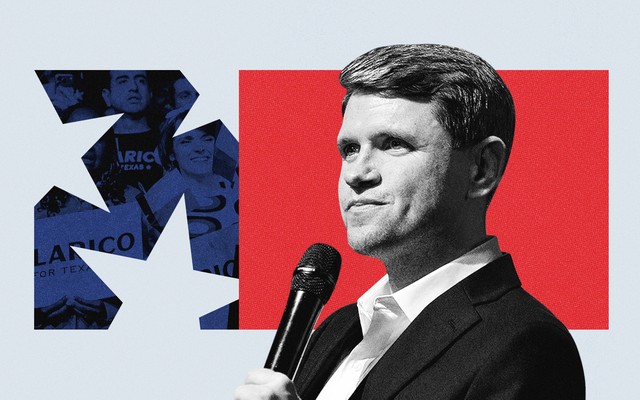
James Talarico is trying to sell a novel brand of Christian politics in a deep-red state.
Updatedat 11:25 a.m. ET on April 24, 2026
While some might pray for hope or peace in such dark times, others are praying for the death of Texas Democrat James Talarico, who is running for the U.S. Senate. During a recent episode of the right-wing Protestant podcast Reformation Red Pill, host Joshua Haymes told the pastor Brooks Potteiger that he prays that “God kills” Talarico, given that the politician seems to be possessed by demons. Potteiger agreed, offering that Talarico should be “crucified with Christ.” Both Haymes and Potteiger later insisted that their remarks were not sincere expressions of violent intent, but rather metaphorical calls for Talarico, a Presbyterian seminarian, to find salvation in their brand of Christianity. Talarico shrewdly responded by offering forgiveness: “You may pray for my death, Pastor, but I still love you. I love you more than you could ever hate me.”
Silicon Valley venture capitalists are wining and dining 18-year-olds.
This article was featured in the One Story to Read Today newsletter. Sign up for it here.Updated at 8:22 a.m. ET on April 25, 2026.
When I was a freshman at Stanford University, I learned to shotgun a beer from a guy in a frat. Soon after, he dropped out and started an AI company. Six months later, it was valued at more than $1 billion.
For most students, Stanford is a normal competitive school, where people go to class and coffee shops and fall in love and freak out over finals. But a select few attend something else: a Stanford inside Stanford, where venture capitalists pursue 18- and 19-year-olds, handing out mentorships and money and invites to yacht parties in an attempt to convert promise into profit.
Priests and theologians want to shape the future of AI. Big Tech is listening.
In 1633, Galileo Galilei stood in the convent of the Santa Maria sopra Minerva church in Rome, where a tribunal of Catholic authorities forced him to “abjure, curse, and detest” his belief that the sun—not Earth—was the center of the universe.
Almost four centuries later, in 2016, the Vatican invited a group of the world’s most prominent technologists to the same church to discuss AI ethics. That was the start of the Minerva Dialogues, annual closed-door conferences in Rome that have become the centerpiece of a decade-long exchange between Silicon Valley and the Catholic Church.
The Valley and the Vatican seem like strange bedfellows: The oldest institution in the world meets secular upstarts bent on creating godlike technology. When the venture capitalist Reid Hoffman first attended the dialogues, he told me he was struck by the portraits lining the walls that depicted Catholic inquisitors like those who persecuted Galileo. “It feels a little bit weird to be walking in voluntarily past these,” he remembers thinking.