Time Works Wonders
VERY seldom do we realize the extent of the relations involved in the distinctions we make in the talk of every-day life. You call your dog Fido, and in so doing you draw three broad distinctions between him and the rest of creation : —
1st. In that he is a dog, and not a cat or a sheep or a bear.
2d. In that his name is Fido, and not Cæsar or Pompey. 3d. In that he is your dog, and not the property of some other man.
But this is not all: for Fido is of the male sex and is two years of age ; he belongs to the variety called Black and Tan Terrier ; he has never been cropped, and he has an extra toe upon one fore foot ; and, finally, he differs from all other dogs of that sex and age possessing the extra toe, in the proportionate extent of the black and the tan colors upon his legs ; or in his precise weight or height, or length of tail ; or in his disposition ; or, if you choose, in the exact number of the hairs with which he is clothed ; or at least in the peculiar combination of all these attributes which, by the doctrine of chances, it is wellnigh impossible should ever be found repeated in another individual. Here you may conclude that Fido has already received a sufficiently extensive designation ; but your sporting acquaintance remind you that Fido is not the same dog he was a year ago ; and, once started on this matter of age, reflection soon convinces you that this is true not only of a year ago, but of last week, of yesterday, of the previous hour and minute, and that, according to some authorities, it is probable that, in seven years hence, there will not remain in your pet a single atom which now enters into his composition, and that strictly speaking it will be, not Fido, but another dog. From tin’s rather distressing metaphysical conclusion you are recalled by your friend the zoologist, who informs you that your terrier is a variety of the species familiaris, and only thereby preserved from being a wolf or a fox, or some other species of the genus Cam’s y and that this entitles him to a place in the family Can ides, the order Carnivora, the class Mammalia, the type Vertebrata, and the animal kingdom ; and that as such he holds an individual place upon this planet and so in this great universe, and as such is the recipient of life from the Creator.
All this is undeniable : all these attributes are embraced by the single name you have given your pet ; from the individual you have risen through all the characteristics of an individual, and the more and more comprehensive relation of age, sex, variety, species, genus, family, order, class, type, and kingdom of nature ; from the least to the greatest things, from the most concrete to the most abstract ; from nature up to nature’s God. But this is only one of the two roads which lead from the visible to the invisible, from the knowable to the unknowable, from the finite to the infinite ; and, beginning with the individual again, you might proceed analytically and consider the various ways in which it may be subdivided into smaller and smaller units. The dog is made up of a right and a left half, which, however similar, are more or less distinct from each other, not only in position and direction, but in all other respects ; each of these halves is again composed of a fore and a hind region, between which, as may be hereafter shown, there are distinctions similar in kind to those between the right and left halves, though differing in degree. Any one of these quarters, say the right hind quarter, is fundamentally a series of vertebral segments, and to one of these segments is attached the hind leg. From among the various organs which make up this limb we select the patella, or knee-pan ; and from its several component tissues, fatty, cartilaginous, and bony, we designate the latter ; and from its many osseous cells, a particular one, and from the several crystals of carbonate of lime, one ; out of this, one of its chemical elements, the lime, and from this at least one of those hypothetical, physical units which goes by the name of atom.
Designating now this hypothetical atom as x, it is chemically lime, and microscopically, part of a bone cell, which helps to make up the osseous tissue of the organ called patella ; this again is a part of the leg, and this is an appendage of the pelvic segment of the vertebral column and in the hinder half of the right side of your dog Fido ; he is only one out of many other Fidos ; he is one of the masculine half of the dog race, and is one of the many others of the same age, two years ; from all of which he doubtless differs somewhat in size and weight, or color or disposition, or at least in the number and exact length of his hairs (for no possible ground of difference should be omitted): he belongs to the tan terrier variety, of the species familiaris, of the genus Cani’s, of the family Ca-nidæ, of the order Carnivora, of the class Mammalia, of the type Vertebrata, of the animal kingdom. And all these are simply broader and broader natural distinctions which exist, and which we may recognize, between any two constituent atoms of the same individual being and between any one individual and all others. No wonder that Agassiz, after a somewhat similar recapitulation, says (Essay on Classification, Part I., Chap. II., Sect. VI.): “Viewing individuals in this light, they resume all their dignity ; and they are no longer so absorbed in species as to be ever its representatives without being anything for themselves. On the contrary, it becomes plain, from this point of view, that the individual is the worthy bearer, for the time being, of all the riches of nature’s wealth of life.”
In this and succeeding articles let us examine some of the objects in nature with reference to the differences which mark their age, which characterize their right and left sides, which belong to the male and the female sex, and lastly, those which serve to distinguish each individual of the same sex from all others.
The butterfly lays an egg. This egg, aside from its protecting envelopes, is the germ of a new being. After a time it is hatched and comes forth as a little worm-like caterpillar. This eats voraciously, grows rapidly, and ends its larval existence by casting its skin, and changing as to form and appearance and habits so as to become a pupa or chrysalis, which neither eats nor moves. But under the brown skin a wonderful change occurs ; in place of thick and horny jaws there comes a long and tubular tongue ; the enormous reservoir of masticated leaves dwindles into a slender stomach which craves only honey; broad wings appear upon the shoulders, the legs increase in length, delicate hairs are formed upon the surface ; and all at once, after an interval of apparent death, these and many other transformations are disclosed by the splitting of the pupa skin and the resurrection, so to speak, of the insect under the form of a butterfly : and this, by laying its eggs, sets in motion again the same wonderful cycle of changes which to the Greeks seemed to typify the birth and death of the body and the resurrection of the immortal soul; for Psyche was one of their names for the butterfly.
Again, at a given hour to-day, each of us is in a certain condition of body. To-morrow we see no change with the eye, but one has occurred ; we have lost a hair from the head or beard, or our morning bath has cost us a few effete branny scales of the outer skin ; and this loss, were it but a single hair, or a single scale, is an all-sufficient cause of a difference between to-day and yesterday. We cannot ignore this as too insignificant and say it is unessential ; for it is the gradual loss and replacement of just such minute scales which cleans off the thickened covering of a wound and leaves the skin smooth and soft as before.
From the extraordinary transformations of insects, involving as they often do not merely a casting off of the outer covering, but an essential modification of form, and the loss or acquisition of appendages accompanied by a more or less complete change of habit, from all this to the gradual gain or loss of epidermal scales or of hairs in man, seems at first an impossible step. And yet it is really but a long one ; for if we consider all that takes place upon the surface of the human body, and especially of the bodies of the lower animals, and if also we make allowance for the longer periods of their existence, we shall be convinced that the two extremes we have mentioned are connected by such a variety of intermediate grades of transformation that a natural passage exists between the two.
The time required for a complete change of the body has been variously estimated by different authors : so variously, indeed, that it is idle to discuss the subject; except to remind ourselves that by experiment some tissues and organs are found to undergo this change more rapidly than others, so that while one part is being once replaced, others may undergo the process half a dozen times.
But it is neither easy nor desirable to embrace the whole organism in our search for gradual or periodical transformations. And it is amply sufficient for our present purpose to trace the more easily recognized, yet not always appreciated, gains and losses and alterations which occur in the vertebrate type of the animal kingdom.
Let us, then, inquire how far the periods of growth and development in animals and in man are attended by alteration in size, shape, and proportion ; in color, texture, and function ; and how far the phrase at the head of this article may apply to the change in all created things.
From the surface of the sun and the crust of our globe to the drop of protoplasm that circulates in the one-celled plant, all is motion ; and motion implies a change of position at least, and that of molecular relation, which is the simplest form of structural differentiation. Motion is the vital process, and time the physical condition under which it is carried on ; and the two together give us in more or less definite divisions all that we call seasons and epochs and ages and states.
The riddle of the Sphinx, which only Œdipus was able to solve, has been greatly improved upon by modern comparative anatomy; for, not confined to going first upon four, then upon two, and finally upon three legs, man is by some believed to be the animal which, as the head and archetype of all inferior species, actually represents them all in his development; the several stages through and beyond which he passes typifying the states which the various species merely reach and in which they remain.
As a theory it is a very pretty one, and there are plenty of facts to be given in its support; the difficulty has been and is, to restrain our inclination to extend the theory far beyond what is justified by the facts; and as doctors still disagree upon its precise limitation, let us avoid controversy and look only at a few striking features in the development of the human body which shall at least confirm our modest thesis that time works wonders, without attempting to say just what the wonders mean.
The ante-natal existence of a human being is a period of miracles, if by this word we understand things which are astounding, and apparently independent of familiar laws. But to give full details of these embryonic changes is impossible without figures and a long description ; so let us take up the child again upon its entrance into the world. The strange atmosphere carries a sudden shock to its sensorium, and the response is a first effort to breathe and a cry, — the never-failing sign of life. The lungs now act regularly, for their structure has been perfected during the long season of total inaction when the mother’s own blood supplied the vivifying oxygen to the little one. The stomach soon craves food from without; and the organs of sense by degrees accustom themselves to the rude impressions of light and sound and material contact.
But there are other peculiarities of this early age which are more easy to describe. At birth the kidneys form one eightieth part of the whole body; they grow less rapidly, and so the proportion is reduced to a third of that in adult life, when they are only one two hundred and fortieth of the whole body.
The liver also loses ground as the body increases, and its left lobe is far outgrown by the right. The peculiarductless gland, called thymus, which lies just under the upper end of the breastbone, is large at birth and reaches its full size at the end of the second year, after which it gradually dwindles until at puberty it has almost disappearedThe brain of the infant is larger in proportion than that of the adult, being to the body as one to eight in the former and as one to forty-three in the latter. The head is proportionally larger than the face at the early age ; and this is so striking in the quadrumana that in the young of some apes and monkeys the head and face have a relative size closely approximating that which exists in the full-grown man.
The following from Dalton shows how greatly the relative weight of the several viscera changed during growth : —
New-born Adult.
Entire body 1,000.00 1,000.00
Brain 148.00 23.00
Liver 37.00 29.00
Heart 7.77 4.17
Kidneys 6.00 4.00
Renal capsules 1.63 0.13
Thyroid body 0.60 0.51
Thymus body 3.00 0.00
Whoever undertakes to ascertain that all-important fact, What does the baby weigh ? will find it necessary to have the chief support under the upper part of the belly, at or near the umbilicus, where centred the embryonic artery and vein, and where is now the middle of its length ; but in a man lifted in the same way, or, more conveniently, laid upon a balanced platform, the centre of gravity is found to be much lower down and nearer to his centre of length, the hips. The difference is due partly to the natural flexion of the infant’s legs, as if in readiness to creep and in imitation of the quadruped’s natural mode of progression, but chiefly to the fact that the legs of the infant are very much shorter in proportion to the length of the whole body.
The chest is laterally compressed as in quadrupeds, for the wide and flat chest of the adult would render creeping far more laborious ; and the prominence of the abdomen, with the single forward curve of the spine, leaves no constriction at the waist, and renders the contour of the trunk comparable to that of an ape.
Much has been written upon the epochs of human existence, and many are the proposed divisions ; all of them based in part upon facts, but too often also upon preconceived notions and analogies. At any rate, their wide disagreement suggests great caution in proposing any new arrangement, and warns us to avoid the rock upon which most of them split. This seems to be the effort to assign definite limits in years to each subdivision of life ; and the periods are made to be multiples of certain numbers, as three or five or seven, in utter disregard of the fact that one of the universally admitted epochs, that of puberty, varies in its occurrence in different individuals, in different races, and under different climatic and social conditions ; and that the close of the reproductive period, called the turn or change of life, and one of the grand climacterics, must likewise vary according to the same conditions. And, therefore, while fully admitting the supernatural significance of certain numbers, let us do away with them and with the arbitrary divisions based upon them, and look for undeniable epochs and states of life as they occur in natural succession.
All men are born, and we all must die ; birth implies death, and both epochs are attended with marked changes in all the vital processes ; it is the beginning of respiration which announces the birth, and the cessation of it which marks the legal death of the individual; and with the entrance and exit of the breath comes and goes the distinctively animal powers of consciousness and voluntary motion : but there is life in the unborn babe and in the motionless corpse before and after the lungs begin and cease to act ; a life which in the one case induced all the wonderful changes elsewhere described, and in the other shines out to mourning friends in the placid smile of the dead.
Between birth and death is a long interval; it is the period of active life, and has been generally divided into growth, maturity, and decline, as to both mental and physical power; or Into youth, manhood or womanhood, and old age. But however easily recognized as general states, they offer very numerous and great exceptions, and are wholly incapable of exact limitation by years ; for we know not the natural duration of human life, and the averages which it is so easy to collect mean nothing, until we know whether the various causes of early death affect the entire life, or only certain periods of it.
There is, however, a part of the life of men which stands off boldly from the years that precede and those which follow; a period during which the individual is not only in the fullest enjoyment of health and strength and mental vigor, and can thus work best for himself and his fellows of the present, but when he is endowed with peculiar powers and the instinct to use them for the future of the species. This, the reproductive period, is ushered in by marked changes in the organism ; the essential ones it is not necessary to speak of here, but the accessory ones are none the less remarkable and constant. The bony framework solidifies, and the growing ends of the long bones become fixed to their epiphyses ; the beard appears ; the voice changes, more decidedly in the male ; and the features take on the expression which they generally wear through life. All these changes, extending through several years, mark the epoch of puberty, and the beginning of the state when boy and girl, youth and maiden, are man and woman.
The end of this state is marked by less decided phenomena, and by little which can be definitely described ; but the practical recognition of the peculiar dangers attendant upon this epoch and the following period is the publication of distinct works upon the diseases of old age.
We have, then, six undeniable epochs of human life, which may be approximately designated by years, but which depend upon various attendant changes which are identical in no two individuals ; and, separated by these six epochs of conception, birth, puberty, sterility, death, and disorganization, we have five states of greater and less duration, which are endowed with certain powers for certain general purposes.
That the absolute weight and stature of the body changes from year to year, and that the increase is not uniform throughout the period of growth, is a matter of common observation. Draper thinks that the infant triples its weight during the first year ; that during the succeeding seven years this weight itself is doubled, and that this again is doubled before the age of fifteen ; and probably this statement will be found true in regard to the majority of individuals below the age of puberty.
But the rates and limits of increase in stature and weight are far less uniform in different adult individuals than in young persons ; for at puberty the body seems to acquire its permanent habit, as full or spare ; and the conditions of existence as to diet, occupation, and exercise are variable in the highest degree.
Obviously the most reliable conclusions are to be drawn from military statistics, since there the above conditions are as uniform as possible, and a tendency to excessive obesity would disqualify a man for active service.
The late war for the Union has furnished us with a greater amount of material than was ever before accessible ; and the United States Sanitary Commission showed their appreciation of this, as well as their conviction that no such opportunity would ever again occur, by devoting a part of their surplus funds and the talents and energies of their best agents to the careful collection and thorough study of the facts furnished by more than two million soldiers.
The more important and conclusive results of this work have been reached under the direct superintendence of Dr. Benjamin A. Gould, who not only brought to it the qualities which have elsewhere distinguished his work, but also, through the premature exhaustion of the funds devoted to this purpose, made it a labor of true scientific devotion.
I quote from his work, — “ Statistics of United States Volunteers.”
“ Examination of the materials collected leads to the following inferences for white soldiers : —
“ 1. That the rate of growth undergoes a sudden diminution at about the age of twenty years, the increase of stature continuing nevertheless uninterruptedly until about the age of twenty-four.
“2. That for a year or two after this latter epoch the height remains nearly stationary, if, indeed, it does not diminish, after which a slight increase again manifests itself, and continues until the full stature is attained.
“3. That the normal epoch of maximum stature must generally be placed, at least for American States, as late as thirty years, but that it varies for different classes of men.” (p. 108.)
That the height and the weight are by no means coequal in their rate of increase at given ages, and that their respective limits are not reached simultaneously, may be seen from statements made further on in the work.
“ An empirical determination of the mean weight belonging to each age shows that the increase between the ages of twenty-one and forty-five cannot well exceed five pounds, great as is the change in many individual cases.” (p. 428.)
I add a selection of items from the table, showing the average weight of a certain number of white soldiers at given ages (Table XXVII., page 438), and place by its side a selection from Table VIII., page 113, giving the heights by ages for all white soldiers of all nativities.
Age. No. Weight. Height.
17 446 128.8 65.26
18 1,100 133.5 66.23
19 1,150 137.7 67.01
20 1,357 67.52
21 1,446 142.7 67.77
23 1,108 145.0 67.97
25 745 146.6 67.99
28 512 147.0 68.02
35 239 147.5 68.00
40 98 147.7 67.98
42 102 147.8
45 67 147.8
The above table confirms the three conclusions already given respecting the rate and limit of increase in stature, and also allows us to make a very suggestive comparison between them and the rate and limit of increase in weight.
The weight increases nearly five pounds between 17 and 18, about four between 18 and 19, three during the next year, two the next, then at the rate of a pound and two tenths a year to 23, eight tenths to 25, two tenths to 28, one fourteenth to 35, one twentyfifth to 40, and about the same to 42; after which no increase occurred, but rather, as our common observation tells, a diminution. The rate of increase in weight then steadily decreases from 17 to 42, and the limit is reached between 40 and 45 with soldiers; but this law can hardly apply to persons at home, with superabundance of food and no regular exercise, added to a full habit of body which would generally exclude them from military service.
That the circulatory and respiratory movements are more rapidly performed in extreme youth than at a later age is a matter of common observation with all who have watched or handled kittens, puppies, and babies; but only with the latter have accurate observations been recorded and compared with what exists in the adult. According to Dr. Guy, the pulsations of the heart in the unborn child are pretty uniformly 140 per minute ; at birth about 136; during the first year of life it gradually diminishes to about 128, and during the second to 107. From two to seven years of age the average pulse is 97. And it then steadily diminishes until forty or fifty years, after which it may again increase several beats per minute. But while this is true of both sexes, there is a very marked difference in the diminution of the pulse for the two sexes between the seventh and fourteenth years. In the male its average during that period is about 84, while in the female it is 94; and during the next seven years it is 76 for the former and 82 for the latter, preserving a difference of five or ten beats thereafter through life, with a greater acceleration in the aged female than in the male.
The rapidity of the heart’s action is also greatly influenced by the internal and external condition of the system In regard to digestion, posture, and exercise, temperature and mental emotion. That the heart stops from sudden fright, anger, and grief is commonly believed, and is no doubt the fact; syncope and even death may result from it; and we all have noted in ourselves the rapid and forcible beating of the heart against the walls of the chest when excited in a less violent degree by fear, love, and expectation. It would lead us too far to express in full my conviction that these responses of the bodily organ to mental emotion are due to something far beyond the mere anatomical connection of heart and brain ; that the heart is really, as common people think, the outward representation of affection, and that the correspondence is as close as that between the ear and the quality of obedience.
It has been found by experiment that “the pulse may be doubled by exposing the body to extreme heat for a few moments ; and also that it may be greatlyreduced in frequency for a short time by the cold douche. It has also been remarked that the pulse is habitually more rapid in warm than in cold climates.” 1
The pulse may be increased to more than twice its usual rate by severe exercise ; and even the position of the bodywill make a very decided difference; the rapidity being greater while sitting than while lying, and greatest while standing; for to maintain either of these positions requires considerable muscular exertion. It does not appear that the pulse of sleep differs materially from that of repose in the recumbent position ; at least not in males, though Quetelet has said that in women and children it is slower during sleep.
After each meal there is a temporary increase in the pulse of from five to ten beats per minute ; while prolonged fasting may reduce its frequency by an even greater number. Alcohol first diminishes and afterward accelerates, and it has been found that the pulse is quickened by animal food more than by vegetable.
The statistics of respiration are less complete, but they indicate the same liability to be affected by internal and external conditions. Soon after birth the infant breathes about 44 times per minute; at five years the number has diminished to 26 ; at from fifteen to twenty years it is 20; and at thirty years, 16; during old age a slight increase occurs. During sleep the number of respirations is decidedly less, by about twenty per cent.
Here is the place to mention a change which occurs in the heart itself during early life, other than the rapid ones already described with the phenomena attendant upon birth.
The wall of the right ventricle is at first nearly equal in thickness to that of the left; but the latter begins at once to increase in order to perform the constantly augmenting labor of sending blood over the growing body. The work of the right ventricle increases to a less extent, and its growth is less in that proportion, for it has only to force the blood through the lungs.
The statistics given by Dr. Gould upon the foregoing points are very instructive ; perhaps the most remarkable result is that expressed upon pages 521 and 523. in respect to the comparative constancy of both pulse and respiration during the years of military eligibility. For instance, of 8,284 whites in usual vigor, all had between 16 and 17 respirations per minute; and the highest fractions are .55 for 17 years, .53 for 21, .50 for 24, .51 for 29, and .50 for 35 and over. The lowest fractions being in like manner scattered through the years from 17 to 35. The same facts appear when the pulse is compared at different ages ; and although these results are not in accordance with the observations of Hutchinson, Quetelet, and others, yet as the present series far outnumbers all previous ones, and as moreover, it includes men of average good health, we must accept the results as more conclusive.
The following table (compiled from Tables IX. and XI., pages 521 and 523) exhibits the principal facts concerning pulse and respiration: —
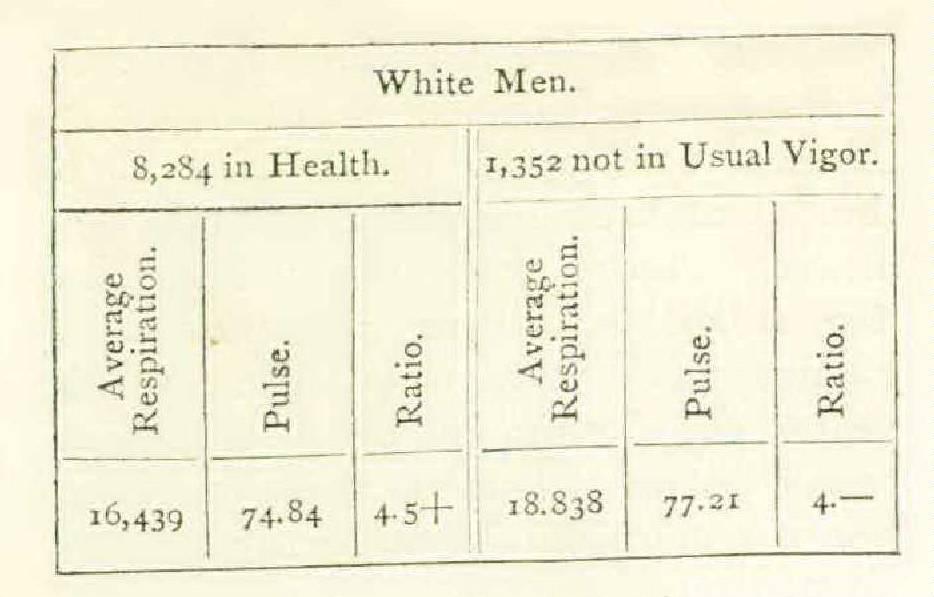
White Men.
8,284 in Health. 1,352 not in Usual Vigor.
Average Respiration. Pulse. Ratio. Average Respiration. Pulse. Ratio.
16,439 74.84 4.5+ 18.838 77.21 4.-
The first fact is the decided acceleration of both processes during ill health, amounting to four tenths of a respiration, and about two and a half pulsations per minute.
And the second is that this increase is less marked in the latter than in the former; in other words, a lack of usual vigor from all causes increases the frequency of the respiration more than that of the heart’s action, although it is by the pulse that we generally detect any febrile condition.
And this is not only true of the two processes during ill health, but a comparison of the averages for the several ages has convinced Dr. Gould that there is no apparent definite ratio between the two, and that they appear to be normally independent of each other, although the abnormal manifestations of each are more frequently in the form of acceleration than of retardation. The well-established facts, that in any individual case increased frequency of respiration is attended by an increased frequency of the pulse, and that the pulse may be greatly affected by voluntary modification of the respiratory movements, as shown by Mitchel, do not seem at all opposed to this inference regarding the non-existence of a definite normal ratio of frequency, (p. 524.)
Dr. Gould then compares the pulse and respiration in the different races, and finally shows by the figures that the idea of Rameaux and Sarrus, which was cited by Quetelet with apparent approval, that the pulse diminishes with the stature according to a distinct law, is wholly inapplicable to our soldiers ; and that indeed the relation between the stature and the pulse scarcely appears to follow any general law. (p. 525.)
The statistics of range of distinct vision are quite remarkable in several respects; but we can speak only of those which refer to differences according to age and state of health. The best object employed was a paragraph of twelve lines in “ double-leaded small pica type,” and this was held at the distance of distinct vision for each individual, with the following result : —
The average distance for 6,564 white soldiers in usual vigor was 47.77 inches ; for 1,357 not in usual vigor was 45.10 inches. Here is a marked difference; but this average difference is by no means constant when the individuals of a single age are compared; for instance, the average at eighteen years of 428 in usual vigor was 47.8 inches, while that of 49 not in usual vigor was 48 inches; and that for twenty-five years of 331 in usual vigor was 46.3 inches, while that of 71 not in usual vigor was 48.9 inches ; and the same and even greater differences in favor of the “ weaker parties ” exist among the numbers for other ages, where the individuals were few. So that we must bear in mind that this is one of the most indefinite measurements, and that the answer in a given case must be greatly affected by the interest taken by the subject of the examination, and by his ability to discriminate between what is distinct and what is indistinct. It shows how important large numbers are in statistics, and also that the number which would be adequate in one part of the investigation may be quite insufficient in another part, where the individual results are liable to be affected by the bias of either examiner or examined, and by the number or extent of the variable quantities concerned.
The figures representing the distance of distinct vision by ages are extremely unsatisfactory to those who have believed and taught that, in spite of exceptions, people grow long-sighted as they advance in years ; partly through actual flattening of the crystalline lens, and partly through diminution of the power of accommodation. But there seems to be no regularity of either increase or decrease of distinct vision from 16 to 50 years, the least capable ages being 45 and over, 36, 16 and under, 25, 31, 34, and 41, while the ages of longest vision are 17, 19, 23, 28, 37, and 42 ; the ages from 17 to 28 including the largest number of individuals and the longest ranges of vision. To quote from the work itself (p. 536): —
“ It is evident that the outer limit of distinct vision gradually diminishes with advancing years, although we have here no means of learning whether the decrease is greater than would result from the well-known diminution of the power of accommodation. The maximum mean value would seem to be between the ages of 17 and 25, and the subsequent decrease to amount to not less than ten per cent before the age of 50. The fact that the minimum limit increases with the age is well known, so that it would appear that increasing age brings with it a diminution of the range of vision by curtailment at each of its limits.”
The belief that baldness is, as a rule, an accompaniment of advancing years finds complete confirmation in the statistics of 15,005 white soldiers in usual vigor; under 21 years the proportion was of 1 to 4,339 ; and the proportion increases steadily, so as to be .032 at 35 years, .093 at 42 to 44, and .100 at 45 and over. (p. 567.)
The condition of the teeth also, and the number of teeth lost at different ages, are also given ; but the results are only interesting as confirmatory upon a very large scale of the opinions based upon individual and general observation.
To pass now to the lower mammalia, we need only allude to the fact that their teeth, like those of man, are produced in an orderly succession ; with the horse, the period of appearance is succeeded by a wearing down of the crowns, which is generally so uniform as to serve the initiated for a tolerably sure indication of age, up to the ninth or tenth year ; after that time the marks of age are less definite, although there are some who assert that in the teeth alone there are annual changes until the twenty-first year which maybe relied upon, in addition to the familiar marks of age, such as deepening hollows over the eyes, sinking of the back, and appearance of gray hairs about the eyes and muzzle. In the opinion of some, every year after the ninth is indicated by an additional wrinkle upon the upper eyelid, and, as there are plenty of horses more than nine years old, it would not be difficult to test the criterion.
The facility with which the age of a stag may be judged from the number of tines upon the antlers is well understood by sportsmen.
Many reptiles annually shed the skin, and in the rattlesnake a ring is added with each year’s moult; but the frequent and irregular loss of the terminal rings renders it impossible to determine the age by their number.
The young of birds have almost always a different plumage from the adult, and great care is necessary to avoid placing them in different species. Still more remarkable is the difference between the larval and adult condition of many batrachians ; for the tadpole is fitted for swimming and for aquatic respiration, and might naturally be ranked among fishes, so long as we remained ignorant of its transformations. The same is true, in a less degree, of some fishes, of which the young and old have been at first described as distinct species.
We have thus far considered only those changes in the structure and function which normally succeed each other, and occur but once in the life of the individual ; they are, strictly speaking, the only alterations due to age. But there are, especially with the lower animals, other and no less striking changes, which appear to be closely dependent upon, or at least associated with, the natural divisions of time, and which may, therefore, be repeated indefinitely according to the duration of life of the individual. These again may be subdivided. For some of them, such as the annual increase of hair and feathers upon animals, and the indescribable, yet not the less real, adaptation of the system to a given temperature which makes a fall of the mercury to a given degree attended with tar more suffering to us in summer than in winter, appear to be in reference to purely physical necessities ; for they disappear with them. But the vast majority of these changes are more or less distinctly referable to the periodical manifestation of the reproductive instinct, and are indeed of the same kind often as those already described as attendant upon its original appearance, of which indeed they are, as it were, the periodical repetition.
The voice, which undergoes a great and permanent alteration at puberty, is in many animals modified once a year, or is even heard only at the reproductive season, as in the porcupine, the giraffe, and the deer tribe.
The modification in the song of birds at the season of mating is owing perhaps to both internal and external conditions ; for it has a gladsome, happy note, in perfect harmony with the spring-time of surrounding nature.
The horns of the deer tribe are the organs which exhibit the most decided sympathy with the periodical development of sexual instinct They often exist in the males alone ; and even when both sexes possess them, the male has the longer, and employs them in fierce combat with his rivals, uttering at the same time characteristic cries which are seldom or never heard at other seasons. These horns or antlers are sometimes immense ; in the extinct Irish elk they measure eight feet from tip to tip, and in a red deer of Wallachia, described by Professor Owen, each antler measured five feet and eight inches along the curve, and the pair weighed seventy-four pounds avoirdupois.
But more noteworthy than the actual size of these appendages and the use to which they are put is the fact that they are annually shed and reproduced. The shedding and the beginning of the new growth takes place in the spring, the exact time varying with the species ; and it is to be noted that at the same time the fawns are dropped ; otherwise they might be in danger from the vicious propensities of the fully armed males.
The blood-vessels of the skin about the pedicle or persistent base of the horn now begin to deposit additional osseous material; and this process goes on so rapidly that by early autumn the antlers are completed, larger and with more branches than those of the previous year. But they are still covered, as with a sheath, by the skin which has kept pace in its growth and has afforded support to the nutritive vessels. This skin finally dies and dries up, and the horns are freed of it and burnished by friction against a tree. They are now ready for action, and continue so during the winter until the time of shedding arrives in the spring. In estimating the change which takes place during this process, we must not forget that, in order to support and use such an enormous weight at the end of a long neck, the muscles which move the head, and the spines and ridges of the backbone and the skull, must also be strengthened and increased in proportion.
Now all this is wonderful enough and fitly closes our list of illustrations of the changes which occur in animals at the various stages of their existence ; but I would like to call attention to what seems to me the significance of the phenomenon last considered, in view of the real or assumed difficulty which some believers in transmutation theories find in admitting the succession of being in time to have been other than direct and genetic.
The serial connection of the horns of successive years is not less close than that which all admit to exist between the species of animals found in successive strata of the earth’s crust. Yet each, as it falls, loses forever and entirely all possible influence upon its successor; just as fully as, according to Agassiz, species have been destroyed in the various convulsions which limited geological epochs. There is not the least chance for an egg, or a germ of any kind, to guide the next year’s growth to a resemblance to itself; but in the blood which mounts and presses upward there is something more than the mere earthly material which is needed ; there is in its every particle a definite aim and effort inspired by influx from God himself, which impels it to deposit the lime and the gelatine in such a way as to construct a horn differing from its predecessor to a certain extent, according to the needs of the animal.
And so in like manner, why may we not conceive the orderly succession of organized beings as produced by the direct influx of life into matter, moulding it into more and more complex forms, which resemble each other closely enough to appear like parent and child, yet which are really no more such than the horns of the first year are the ancestors of the horns of the second ?
Once admitting that the succession is a mental and not a physical one, it matters not whether the various forms originated as eggs or as fully developed beings. For however impossible the latter miracle seems to our finite understanding, we can set no limits to Divine Omnipotence, especially when it is as impossible for us to create an egg as a full-grown man.
- Flint.↩