Music
THE recent performance of Lohengrin by the Strakosch opera troupe has been an interesting one in many ways. The mere fact that it was the first instance of a dramatic work of Richard Wagner’s being presented to our Boston public in anything approaching to the spirit the composer and poet intended (the two or three so-called performances of Tannhäuser that were inflicted upon a long-suffering public at the Boston Theatre, some few years ago, were so grimly ludicrous in their wretchedness as to be unworthy consideration) makes it an important event. In spite of the many imperfections in the performance (we will mercifully only hint at the distracted and distracting cacophonists who regarded themselves in the light of a chorus), the general quality was good, fully as good as the performances of the larger modern French operas that we are accustomed to. The most marked defect (always excepting the chorus) was the One that most thinking musicians could have easily enough foretold ; namely, a want of comprehension of Wagner’s peculiar dramatic style by singers bred in a thoroughly Italian school of singing and operatic acting. The essentially lyric parts of the work, those parts which have most in common with the traditional operatic form, were, upon the whole, very well given, but the dramatic dialogue, of which there is so much in Lohengrin, was for the most part spoiled, by the singers evidently mistaking it for recitative, and singing or declaiming it accordingly. This was more perceptible in the parts of Telramund and Ortrud than in Lohengrin and Elsa. Almost the entire scene between Telramund and his wife at the beginning of the second act was dragged out to the stately proportions of Händelian recitative. The traditional way of letting the orchestra strike its chord first, and then coming in after it with the voice and action, was one of the most marked blemishes. The one thing that Wagner chiefly requires is perfect unity of action between singers and orchestra. To take one instance among many, we will mention the scene in the second act where the king, Lohengrin, and Elsa are stopped at the church door by Telramund, when he bursts out with his passionate appeal: “ O König, trughethörthe Fürsten, haltet ein ”1 (we must quote from the German copy). At this point the calm, stately march in C major is interrupted by a crashing diminished-seventh chord, followed by two hurried bars in the orchestra. The stage direction in this place is, “Enter Friedrich on the steps of the cathedral; the women and pages draw back in terror from him.” But no Friedrich appeared ! Consequently no one drew back. The procession stopped very punctually at the diminished-seventh chord, but they seemed to the audience to have stopped simply because the marchmusic had stopped playing. The king, Lohengrin, and Elsa seemed peculiarly embarrassed by this hitch in the order of ceremonies, and stood looking rather foolishly into the church as if for explanation of this unaccountable freak of the orchestra (it would have been more natural, all things considered, to have applied to Signor Muzio for information), when at last, the whole stage having by this time fallen into complete syncope, Friedrich made his appearance and the action continued. In some passages of the scene dramatic action is indicated, and fittingly accompanied, although the characters have nothing to sing.
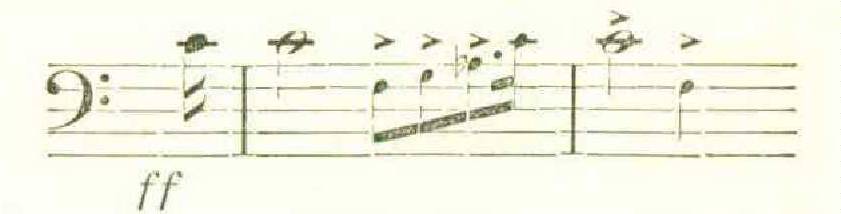
Just before the fall of the curtain upon the second act, while the king, Lohengrin, and Elsa are entering the church to tlie stately music of the orchestra and organ, the trombones suddenly strike in fortissimi with the theme of " Nie sollst du mich befragen.” 2The stage direction is, “At this point the king and the bridal couple have reached the top step of the cathedral ; Elsa, strongly affected, turns to Lohengrin : he receives her in his arms. From this embrace she looks down the steps in timid ap prehension and sees Ortrud raising her arm towards her as if sure of victory; Elsa turns her face away in terror.” We remember Fräulein Nanitz in Dresden raising her arm and hurling this terrific trombone blast, as it were, at Elsa. At the performance here, Elsa turned round, to be sure, but as there was nothing doing on the stage that could in any way have frightened her, she had rather the air of having done so to inquire what the trombones were making such a noise about,—a question that the audience might well have asked without receiving any satisfactory explanation. But there were many excellences in the performance. In the first place Messrs. Strakosch and Muzio cannot be thanked enough for the evident pains they took with the orchestra. The exceptionally full score was absolutely filled. The three flutes, three bassoons, English-horn, and bass-clarinet were all palpably there. The trumpets on the stage were not in full force (Wagner has written parts for sixteen, we believe), but the four trumpets managed to get through without leaving any very noticeable bare places. One effect was, however, unaccountably left out: that is, the deafening roll of snaredrums (indicated in the score, we believe, by the simple word “ Trommelwirbel ”), which completes the climax of the trumpets in the gathering of the army on the field by the Scheldt, in the third act. But we have never heard an opera orchestra play so well in Boston. Mademoiselle Albani made a charming Elsa, and although she did not show any marked histrionic power, her conception of the part and her singing were alike fine and sympathetic. Signor Carpi was exceedingly good as Lohengrin. His singing was especially marked by rare purity of intonation, even in the most trying passages, with, however, a certain Italian exaggeration in the undue holding of long notes, as for instance at the words “ Elsa, io t’ amo,” in the first act. Signor del Puente, as Friedrich von Telramund, acted and sang extremely well, with the exception of too great a tendency to turn the dramatic dialogue to recitative, which we have already noticed. Miss Cary’s beautiful voice and firm intonation went far to make her Ortrud acceptable, but her dramatic capacity by no means comes up to the requirements of the part, which is an exceptionally difficult one, and her musical conception left much to be desired. Signor Scolara, as King Henry, only wanted a more powerful voice. The part is written for a bass voice of extremely low tessitura, like Sarastro in the Magic Flute, or the Cardinal in La Juive.
So much has been written and rewritten about Wagner’s peculiar “ theory,” that we shall not say anything on that head here. Lohengrin is the last of his operas.
His subsequent works bear the title of Handlung — transaction. But it may not be uninteresting to many of our readers to know what importance the poet-composer attaches to this very Lohengrin. We will quote several, we hope not too disconnected, passages from his A Communication to my Friends, first referring the reader to a passage we quoted in The Atlantic for November, 1873, from a published letter to M. Francois Villot. After speaking of the old German epic Der Sängerkrieg (The Singers' Contest) Wagner goes on to say : —
“ This poem (the Sängerkrieg) stands, as is known, in immediate connection with a longer epic poem, Lohengrin; I studied this also, and a new world of poetic material was laid open to me all at once, a world of which I had previously had no idea, having been for the most part in pursuit of what was already in a complete form, and adapted for operatic treatment. . . . .
“ As the main feature of the myth of the Flying Dutchman is seen in a still intelligible shape in the Hellenic Odysseus; as the same Odysseus expressed — in disentangling himself from the embraces of Calypso, in his flight from the fascination of Circe, and in his longing after the earthly, confiding wife of his home — the fundamental idea, as the Hellenic mind conceived it, of a longing, the expression of which we find again, infinitely enlarged and enriched, in Tannhäuser ; so we find in Greek mythology the outline of the myth of Lohengrin, though probably by no means in its oldest form. Who does not know Zeus and Semele ? The god loves a human woman, and comes to her in human shape for the sake of this love ; but the loving woman discovers that she does not see her lover in his real shape, and asks him, impelled by the true zeal of love, to show himself in the full, sensual aspect of his real nature. . . .
“ Lohengrin sought the woman who believed in him; who should not ask who he was, nor whence he came, but who should love him as he was, and because he was what he appeared to her to be. He sought the woman to whom he should not have to account for himself, to justify himself, but who should unconditionally love him. He had therefore to conceal his higher nature, for just in this not discovering, this nonrevelation of his higher — or, more properly speaking, exalted — essence lay his only security against being merely admired and wondered at on account of this nature, or against receiving adoring homage as one not comprehended, whereas he desired, not admiration and worship, but that which could alone redeem him from his solitude and still his longing: love, to be loved, to be comprehended through love. With his highest sense, in his inmost consciousness, he wished to be nothing else than a full, entire, warmly feeling, and warmly felt man, a man above all things, not a god : that is, an absolute artist. Thus he longed for woman, — for the human heart. He stepped down from his blissful, barren solitude, on hearing the cry for help of this woman, of this heart, out from the midst of humanity down below. But the treacherous halo of his exalted nature still adheres to him, not to be stripped off; he cannot but appear wonderful ; . . . doubt and jealousy confirm to him that he is not comprehended, but adored, and tear from him the avowal of his divinity, with which he returns, crushed in spirit, to his solitude. . . .
“ It is, to-day, hardly conceivable to me how the deeply tragic character of this subject and of this figure can pass unperceived, and how its nature can be so misunderstood that Lohengrin seems but a cold, repulsive apparition, more capable of exciting aversion than sympathy. This objection was first raised by a friend of mine, whose mind and knowledge I highly esteem. It was in his case that I first made the discovery, which has been often repeated subsequently, that on first becoming acquainted with my poem he only manifested a thoroughly affecting impression, and that objection of his arose only when the immediate effect of the work began to be wiped away, to give place to a colder, more reflecting spirit of criticism. Thus, his objection was not; an involuntary act of immediate emotional perception, but a voluntary act of the mediate understanding. This phenomenon showed me the tragic element in Lohengrin’s character and situation as one strongly confirmed in modern life; it repeats itself in the work of art and its creator, just as it manifested itself in the hero of this poem. I now recognize with the clearest conviction the character and situation of Lohengrin as the type of the only really tragic material, as, upon the whole, the tragic element in modern life, of the Same significance in the Present as Antigone was — in a different relation, to be sure — in Grecian civil life. Beyond this highest and truest tragic moment of the Present stands only the complete unity of sense and intellect, the only really joyous element in the life and art of the Future at their highest potency. . . .
“ I come here to the main point in the tragic nature of the true artist’s relation to life at the present day, exactly the same situation that I put into an artistic form in my version of Lohengrin: the most natural and urgent longing of the artist is to be accepted and comprehended through the emotions; and the impossibility that modern art-life has brought about of finding the emotional nature of that ingenuousness and undoubting directness which is necessary for such comprehension, — the compulsion the artist is under to appeal almost entirely to the critical intellect, rather than to the emotions, — that is, above all, the tragic part of the situation which I, as an æsthetic man, inevitably perceived, and which I was destined to become conscious of to Such a degree in the path of my further development, that I broke out in open rebellion against the tyranny of the position. . . .
“ Elsa is the antithesis to Lohengrin, yet of course not the diametrically opposed, absolute antithesis, but rather the other part of his own being, —the antithesis which is contained in his own nature, and is that complement of his own masculine individuality which he is instinctively impelled to seek. Elsa is the unconscious, involuntary element, through which the conscious, voluntary individuality of Lohengrin seeks its highest development; but this seeking is in itself again the unconscious, involuntary element in Lohengrin, which he feels to be the connecting link between himself and Elsa.”
— The best of Gottschalk’s posthumous works that we have yet seen is his Tarantelle de Bravura3 (it seems impossible for publishers to confine themselves to any one language when composing a title-page). Here we have Gottschalk in his most fascinating vein. If the composition were to be put into the retort of criticism on high art principles, very little real musical value would probably be found at the bottom, after the more volatile parts, such as brilliant piano forte effects, curious combinations of chords, and a certain indescribable charm and vivacity of style had been distilled off. But we have no desire to subject the piece to such a process. It is commonplace enough, if you will, but full of brilliancy, fascinating effects of sonority and rhythm, and is worked up with neverflagging spirit from beginning to end. The true aim and end of a tarantella, namely, frenzied hilarity, is never for a moment lost sight of. It is extremely difficult in the sense of requiring great strength and power of execution, but even players who are far from being able really to play it, can appreciate the consummate skill and ingenuity with which the most sparkling effects are produced, and the ease with which the fingers adapt themselves to what are apparently the most hand-racking passages. Probably only those who have heard Gottschalk play, and can vividly call to mind the maddening fascination of his playing, will get much enjoyment from the piece. With the memory of the composer’s playing still strong upon us, we had rather stumble through its pages ourselves and by ourselves, than hear any one else attempt it. Really to play anything by a man who had such a disheartening command over his wrist and fore-arm as Gottschalk had, and who never seemed contented unless he kept the whole seven and a quarter octaves in full vibration at once, is what few of us can aspire to with any reasonable hope of leaving any room for spirit and entrain. Unless the thing is done with consummate case and abandon, it had better be left undone.
— The Souvenir de Lima4 is an innocent enough mazurka, not wanting in strongly marked effects of rhythm and certain rather queer vagaries of style, which Gottschalk himself, and probably very few others, could have made fascinating. The edition is unfortunately rather too full of misprints.
— Francis Boott’s The Brooklet,5 apart from being a very pleasing, easily flowing duet for soprano and tenor, contains one of the most ingenious and skillfully carried-out contrapuntal conceits that we remember to have seen as yet. The words are from Longfellow. The soprano begins in E flat major, and sings,
As sang the bards of old,
Running with feet of silver
Over the sands of gold.”
This little limpid melody in E flat is followed by a more solemn strain for the tenor in C minor (the relative key) to the words,
There rolled a turbulent wave,
Now singing along the sea-beach,
Now howling along the cave.”
At this point both voices unite on the words,
Though they flowed so far apart,
And has filled with its sweetness and freshness
That turbulent, bitter heart,”
both voices singing their previous melodies note for note. What is most curious is that the C minor melody harmonizes perfectly with the one in E flat; in fact, it really becomes itself a melody in E flat when brought into conjunction with the other, thus carrying out the expression of the text, “ And has filled with freshness and sweetness that turbulent, bitter heart,” to the fullest extent.
- O King, deceived Princes, stop !↩
- Never shalt thou ask me, etc.↩
- Célébre Tarantetlle de Bravura.↩
- Souvenir de Lima. Mazurka. Par L. M. GorrSCHALK. Œuvres posthumes, publiés sur manuscrits originaux avec autorisation de sa famille, par N. R. Espadero. Boston : O. Ditson & Co.↩
- The Brooklet. Duet for soprano and tenor, or baritone. Words from Longfellow’s Aftermath Music by F. BOOTT. Boston : O. Ditson & Co.↩