Music
THE late series of symphony concerts by the Harvard Musical Association, and those given by Mr. Theodore Thomas, taken together with the various comments they have occasioned on the part of the press and the public at large, furnish the thinking critic with matter enough and to spare for reflection. The Harvard Musical Association have just completed their tenth year of symphony concerts (one hundred concerts in all); Mr. Thomas has just completed his first season, for the symphony concert must he looked upon as the really proper sphere for an orchestra like his, and the various, too miscellaneous concerts he has given in Boston for the last five years can only be recorded as so many light, fascinating hors d'œuvres to whet the appetite of a confessedly uncertain public, but of no marked nutritious properties. Now that the season is well over, we find ourselves forced to admit that Mr. Thomas’s concerts have been in general far more successful than those of the Harvard Musical Association. We do not care to conceal the fact that we are sorry for this. We think that the success of the Harvard concerts as belonging properly to Boston, is and should be more valuable to musical culture and the advancement of a pure musical taste in our city, than the success of any orchestra having its head-quarters in another city, and paying us merely transient visits, can be. But we are far more sorry to see the cause of this want of success in the Harvard concerts.
The Saturday Evening Gazette of March 20 says: “In summing up, we think that we can conscientiously say that the work of the orchestra has been better done than during the two seasons immediately preceding this. There is, however, much more to he done before the Harvard can be considered a worthy representative of the musical culture of Boston. In order to reach the position to which its directors should strive to elevate it, there are many old traditions, effete prejudices, aud absurd conventionalities to be swept away. The step that has been taken in this direction, in arranging the programmes for the present season, leads us to hope that a yet greater stride may be made in future. What is most needed is an infusion of younger and more energetic blood in the management, and a more complete harmony of feeling than seems to reign at present. It also needs a body of directors who can bear to hear the truth told of their efforts, without feeling it incumbent upon them to attempt to cry down all adverse criticism as unjust or partisan, simply because it is adverse. The public has advanced too far to be blinded by indiscriminate puffing in musical matters. It judges for itself, and judges severely, and, in the main, justly. The efficiency and prosperity of the Harvard Association are hindered at present by the obstinacy and short-sightedness that need eliminating from the conduct of its managers. We think, however, that the lessons they have received during the past two years from the growing indifference of the public to the Association, and the palpable rebuke it has given to senseless conservatism, will have the effect of inspiring the directors with a broader eclecticism. At least we hope so, because we cannot afford to lose the Harvard entirely, and we shall assuredly lose it if its rulers do not manifest greater wisdom than they have as yet shown. We have been given to understand that the season has not been profitable ; that there will remain a loss after the expenses have been paid. We hope this is not so, but if there is even the shadow of a ground for the prevalence of such a rumor, it should teach those who are interested how necessary a change of policy has become.” We quote this as the deliberate opinion of one of our best critics, and because there is so much truth in it. But yet, widely accepted as we know this opinion to be, we do not think that it quite hits the mark. To justify our own opinion we must go hack a few years.
The only at all successful orchestral concerts in Boston ten or twelve years ago were the Wednesday afternoon concerts of the Orchestral Union. They were, as far as we remember, very well attended and greatly enjoyed. They were popular concerts in the best sense of the word, and far better, as to the programmes, than anything of the sort we have now. The programme usually comprised a symphony, one classical and one light (Rossini, Auber, Herold) overture, a Strauss waltz, some operatic selection arranged for orchestra (finale to first act of Don Giovanni, to the third act of Robert, duet from Hans Heiling, march from Tannhäuser or Lohengrin, etc.), and some solo for piano-forte, violin, English-horn, clarinet, etc. The performances were very rough, but not without a certain enthusiasm and unity of purpose. The old Philharmonic evening concerts died a very lingering death somewhere about the winter of 1863 or 1864, hut the Orchestral Union concerts flourished well. The orchestra was the best that could he had under the circumstances, but was ridiculously small. On one occasion Beethoven’s A-major symphony was given with three first, and, we think, two second violins. But this was an exception, and the usual number of players was from twenty-four to thirty. There was only one bassoon, and only two horns. In 1865 came the symphony concerts of the Harvard Musical Association, with an orchestra of fifty players. The first programme was: 1. Overture to Euryanthe; 2. Mendelssohn’s violin concerto (Carl Rosa); 3. Bach’s Chaconne with Mendelssohn’s piano-forte accompaniment (Rosa) ; 4. Mozart’s G-minor symphony; 5. Short violin pieces by Joachim and David ; 6. Overture to Leonore, No. 3. The concert was eminently a success, as was, in fact, the whole season of six. We shall never forget the thrilling effect of the orchestra in the opening bars of the Euryanthe overture and in the great, crashing chords of the slow part of the Leonore. Compared with the wretchedly small orchestra of the Orchestral Union, it sounded positively tremendous. The success of the symphony concerts was all the more gratifying because the previous utter failure of the Philharmonic concerts seemed to show that the taste for good music was on the wane in Boston, Besides, those monstra hoirenda, infiormia, ingentia, star-concerts of the nomadic sort, were particularly successful that year, and Five o' Clock in the Morning and M. Lévy’s cornet seemed to have turned all heads more or less. Mr. Bateman had brought over a dilution of the fashionable concert of the Loudon season (of the London fashionable spring and summer season, not by any means of the London musical, winter season, which is a different affair toto cœlo), and all musical earnestness seemed to be crushed out of us by the gaudy monster. But the symphony concerts did succeed in fanning the smoldering embers of our musical feeling into quite a respectable flame, and the prospects for the future were as sunny as possible. Here are some quotations from a prospectus of the concerts, published in Dwight’s Journal of Music, December 9, 1865 : —
“ It is not a money-making speculation. There is no possible motive for undertaking it except the desire of good music, and the hope of doing a good thing for art in Boston. Every dollar received will be spent in making the concerts more perfect. . . . The concerts are so well guarantied as to have no motive for catering to any interests but the higher one of art. They have no need to sink their character to make them pay. The determination is to make them as good in matter and in execution as the orchestral means of Boston (too limited indeed!) will allow. But if we cannot have a great orchestra, we can make out a very respectable one of fifty instruments or more, and one point we can at least secure, that of pure programmes, which one excellence, persisted in, will be a greater gain than we have yet had opportunity to realize except in small chamber-concert circles. By pure programmes is meant those into which nothing enters which is not in good taste, artistic, genial, such as outlives fashion; nothing which is coarse, hackneyed, shallow,
’sensational ’ in a poorer sense; nothing which does not harmonize by contrast or affinity with all the other pieces, and serve a general unity of design. . . . Finally, it is the belief of those who have undertaken this enterprise, that a fair measure of success in this experimental series will ‘ pave the way to a permanent organization of orchestral concerts, whose certain periodical recurrence, and high, uncompromising character, may be always counted on in future by the friends of good music in Boston.’ ”
So the Harvard Musical Association started on its enterprise with the fairest possible wind and weather, and grew in public favor. But note this phenomenon, which is significant of much. As nearly as possible two years after the Harvard Musical Association’s concerts began, the Wednesday afternoon Orchestral Union concerts died of actual starvation. The fact was that, after hearing symphonies and overtures with ten first violins, the public, even the general public, would not listen to the same symphonies and overtures, or even to Strauss waltzes and operatic arrangements, with only four or five. The public had been spoiled for the playing of the Orchestral Union orchestra. There is at least one advancement in the public taste that the Harvard Musical Association can lay undisputed claim to. As time went on, the Harvard orchestra improved in quality, the programmes were kept up to a high level. Some unwise things were done, but not manv. Some of the airs from Bach’s Passion-Music were given, and very unsatisfactorily given, leaving the most dreary impression upon the public, who were just so far convalescent after the paralyzing effects of Bach’s great toccatas and fugues for full organ, as to be able to hear the great John Sebastian’s name mentioned with comparative equanimity, when these airs from the Passion came to give their shaken faith in Bach another knock - down blow. These very airs are to be ranked with all that is most beautiful in music, but they are the worst possible means of making an unfamiliar public favorably acquainted with Bach, unless they are given to perfection. Now they are not only extraordinarily beautiful, but they are also extraordinarily difficult both for singer and for orchestra, and the chances of their being even respectably given under the existing circumstances were too small to have warranted the attempt. Another mistake the management made was the Haydn symphonies. For about two seasons Boston was absolutely flooded with Haydn symphonies. We were all of us glad when the Haydn revival began — for it was really a revival. The pleasant, sunny old gentleman had been too long banished from our concert-room, and we received his symphonies back with open arms. But we soon began to tire of our bargain. As St. Dunstan’s broomstick kept bringing on beer, so did the symphony concert programmes keep bringing on Haydn symphonies, until at last the very mention of Haydn, to use Berlioz’s words, “nous donna de véritables nausées.”But the fever ended at last, and things went on smoothly enough until Mr. Thomas came and gave some concerts here in the last part of October, 1869. We will quote from Dwight’s Journal for November 6, 1869.
“ It was truly and exclusively Thomas’s New York Orchestra, — fifty-four instruments, picked men, most of them young, all of them artists, all looking as if thoroughly engaged in their work, eager above all things to make the music altogether sound as well as possible. . . . There was nothing which our people, our musicians, needed so much as to hear just such an orchestra. They came most opportunely; for our musicians, teaching by example; for our public (and there is no better public in the world for music of the highest character than that which fills the Music Hall at all good symphony concerts), to show us that, with all our pride in our own orchestra, we are yet very far this side of perfection, and must take a lesson from what is better done elsewhere. Well-informed musical persons here have always known the superiority of the New York orchestras (the Philharmonic and that of Mr. Thomas) to our own; but such has not been the imagination of the public; their own glowing sympathy and aspiration, meeting the intention of the noble music half-way, have always fondly found the execution better than it was; nay more, the reluctantly confessed sense of weariness and ennui after many a noble composition has been too willing to accuse itself, if modest, or, if not, that venerable ‘ old fogy,’the composer, never suspecting that the coarse, blurred, lifeless execution may have been at fault. We have an audience that deserves the best; we have at last a quickening example of what, in execution at least, comes very near the best thus far ; it will be our own fault if we do not improve the lesson, and take a new start in orchestral music, finding it impossible now to shut out of sight the new and higher standard which has so vividly impressed itself on every mind.”
Now has the Harvard Musical Association acted upon this excellent advice ? We should like to ask one categorical question, which, we admit, the Association is by no means bound to answer: Has the Association acted up to the promise in Dwight’s Journal, that " Every dollar received will be spent in making the concerts more perfect ” ? The result has certainly not been all that could have been desired. Some sort of impulse was given to the Harvard orchestra by Mr. Thomas’s example. Extreme attention was for some time paid to pianissimo effects on the strings, which were carried to an undue extent for a season or more. Mr. Thomas’s Träumerei took our public by storm (we hope to live to see the day when it will be thought uncharitable to mention that wanton distortion and vulgarizing of Schumann’s fascinating little pianoforte piece, in connection with Mr. Thomas), and our orchestra blossomed out into some astounding pianissimos. In this last season, indeed, we heard a sort of opposition Träumerei, which was even more outrageous than Mr. Thomas’s, inasmuch as it parodied a much stronger work. We mean the sickly sweet omission of the wind instruments from the second part of the Pastorale from the Messiah. It was as if some of Ary Scheffer’s flimsily sentimental angels had strayed into the midst of one of Michael Angelo’s frescoes. But the pianissimo furore did not last very long, and the Harvard orchestra made no very marked improvement. At all events the playing of Mr. Thomas’s orchestra has been so much finer, that for the most part our public has become so impatient of the Harvard’s inferior playing as to have lost its interest in the Harvard concerts. And we insist that this loss of interest is principally due to the inferior playing of our orchestra. If we compare Mr. Thomas’s programmes for this winter with those of the Harvard Musical Association (remembering that the latter gave ten concerts to Mr. Thomas’s six), we shall see that there is nothing in them to warrant any overweening preference for Mr. Thomas. We do see in Mr. Thomas’s list an amount of things by Sebastian Bach and Gluck that ought to make the cheeks of the Harvard Musical programme committee tingle, but beyond this we do not see any particular attraction in Mr. Thomas’s programmes that the other list cannot fairly counterbalance, Mr. Thomas has given us, to be sure, more Wagner, Raff, and Berlioz, but none of these composers can be justly called favorites in Boston. Concert performances of most of Wagner’s music have met with lukewarm response in Boston at best, what enthusiasm we ever had for Raff is at present more than questionable, and a very small minority of our public regard Berlioz otherwise than as a hideous bore. We subjoin a comparative list of the things given this winter by Mr. Thomas, and by the Harvard Musical Association: —
HARVARD MUSICAL ASSOCIATION.
J. S. BACH. — Organ passaeaglia in C-minor (J. K. Paine).
BEETHOVEN.— Symphonies No. 4 in B-flat, No. 7 in A, No. 8 in F ; Violin concerto in D [first movement) (Listemann); Overture to Coriolan ; March from Fidelio.
BENNETT. — Overture: The Naiads.
BURGMÜLLER. — Unfinished symphony No. 2 in D, Op. 11*
CHERUBINI. — Overtures : Abencerrages ; Anacreon.
CHOPIN. — Piano-forte concerto in E-minor (Madeline Schiller).
DURANTE. —Magnificat in B-flat (Cecilia Club).
Franz.— Slumber Song, “ Er ist gekommen ” (Osgood).
GERNSHEIM. — Piano-forte concerto in C-minor * (Perabo).
GLUCK. — Chaconne from Orpheus.*
HÄNDEL.— Pastorale from Messiah.
HAYDN. — Symphony No. 1 in E-flat.
HILLER. — Piano-forte concerto in F-sharp, Op. 69* (B. J. Lang).
LACHNER. — Suite No. 1 in D-minor.*
MENDELSSOHN. — Scherzo from the Reformation symphony; Meeresstille overture; Piano-forte concerto in G-minor (J. C. D. Parker); Piano-forte capriccio in B-minor, Op. 22 (Miss Finkenstaedt); Concert aria, " Infelice; ” Four-part song, The Lark; Walpurgis Night;1 Fragments from Loreley 2 (Cecilia Club); War march, from Athalie.
MOZART. — Symphony No. 1 in D; Aria from Don Giovanni, “ Dalla sna pace” (Osgood); Marches from Figaro and the Magic Flute.
PARKER. — Four-part songs, The River Sprite, The Sea hath its Pearls (Cecilia).
REINECKE. — Overture to Dame Kobold.*
RIETZ. — Overture in A, Op. 7.
SCHUBERT. &EMDASH; Song, “Sei mir gegrüsst” (Osgood).
SCHUMANN. — Symphonies No. 2 in C, No. 4 in D minor; Overture to Genoveva; Incantation and entr' acte from Manfred; Piano-forte concerto in A-minor (Hugo Leonhard); Paradise and the Peri* (Cecilia Club).
SPOHR.— Overture to Faust.*
WEBER. — Overtures to Oberon, Euryanthe ; Finale to first act of Euryanthe* (Cecilia).
THOS. WEELKES. — Madrigal, “When Thoralis”* (Cecilia).
MR. THEODORE THOMAS.
J. S. BACH. — Suite in B-minor; * Suite in D ; Concerto for two violins (Arnold and Jacobsohn).
BEETHOVEN.—Symphonies No. 3 in E-flat [Eroiea], No. 5 in C-minor, No. 9 in D-minor [with chorus]; Violin concerto in D [first movement] (Jacobsohn); Overture No. 2 to Leonore ; Terzetto, “ Tremate, empi, tremate,” Op. 116.
BERLIOZ. — Symphony No. 2, Harold in Italy ; * Overture, Les Francs Juges.
BRAHMS. — Song of Destiny * † (chorus); Hungarian Dances.
CATEL. — Overture to Semiramis*
GLUCK. — Scenes from Orpheus † (Miss Cranch and chorus); Overture to Paris and Helen.*
GRIEG. — Piano-forte concerto, Op. 16* (Boaco-
witz).
MENDELSSOHN.—Fest-gesang, To the Sons of Art (Boylston Club).
RAFF. — Symphonies No. 3 in F [Im Walde], No. 6 in D-minor* [Gelebt, gestrebt; gelitten, gestritten ; gestorben, nmworben]; Piano-forte concerto, Op. 185* (Mad. Schiller).
SCHUBERT. — Four-part song, Nachthelle (Boylston Club).
SCHUMANN. — Symphony No. 1 in B-flat.
WAGNRR. — Introduction and finale to Tristan und Isolde; Wotan’s Abschied und Feuerzauber,* from. Die Walküre (Remmertz).
One slight cause of public feeling against the Harvard Musical Association may have been the persistent antagonism of Dwight’s Journal of Music (which the public has rightly or wrongly come to look upon as the official organ of the Association) to the socalled school of the future ; an antagonism that some persons have oddly enough construed into a personal enmity to Mr. Thomas, who has been to a certain extent identified with the “ future ” school. But such a cause is too puerile. The all-sufficient cause is, as we have said already, the great inferiority of the playing of the Harvard orchestra.
Now we are particularly sorry for this, as with all the perfections of Mr. Thomas’s orchestra, we cannot but feel that his performances of the great classic music belong to a bad school, and are, by their very brilliancy, calculated to vitiate the public taste. This is simply an expression of
opinion on our part, and must be taken as such. Our opinion is by no means largely shared, as we know, but it is our firm and mature conviction, nevertheless. We will take one or two examples. Of the performance of Beethoven’s C-minor symphony on the evening of December 2, the Saturday Evening Gazette says: “Beethoven’s C-minor symphony followed. It was given with a grandeur and consistency and a power that were never before bestowed upon its interpretation in any hearing of it at which we have assisted. As one listened, it was impossible not to feel that this must be the presentation of the work as conceived by its composer. The audience was again enthusiastic, and gave a demonstrative expression to its feelings which for fervor and heartiness is but seldom manifested at such entertainments.” The Daily Advertiser says of the same performance : “ The concert closed with Beethoven’s Fifth Symphony, and we shall hazard the assertion that that incomparable composition has never been so grandly played here as on this occasion. It seemed as if Mr. Thomas’s orchestra entirely surpassed itself; the familiar symphony had not a single hackneyed suggestion for the most blasé; concert-goer; it came to the ear and to the mind again as if it were entirely fresh, renewing its youth and the wonder of its immortal beauty, and at times almost overpowering the listener with its magnificence and sublimity. Applause is not the best possible proof of appreciation, but hearty applause generally implies interest and pleasure ; and we can testify that never within onr recollection has the performance of a symphony been in Boston received with such manifestations of delight as attended this interpretation last evening.” One virtue the performance certainly had, that of great brilliancy; hut it was a more than questionable brilliancy, to our thinking, and smacked rather of gilding and tinsel. One particular effect was given just as Beethoven had indicated, and most superbly given too, and that was the perfectly even pianissimo for forty-two bars at the close of the scherzo before the entrance of the finale. The crescendo began exactly eight bars before the end of the scherzo, as it is written. Our orchestra invariably begins the crescendo too soon. This even, persevering, dead pianissimo is one of the strongest and most original of Beethoven’s effects, and is very rarely well given. But on the other hand, the an-dnnte con moto was dragged out to the most ultra-sentimental adagio. Of all Beethoven’s slow movements, this one can be made the weakest by undue sentimentalizing. If there ever were a movement that ought to be played to the beating of a metronome, this one ought. It is con moto throughout; its impulse is ever onward; there should not be the slightest holding back or laziness about it. As Mr. Thomas played it, it was simply emasculated, and the phrase
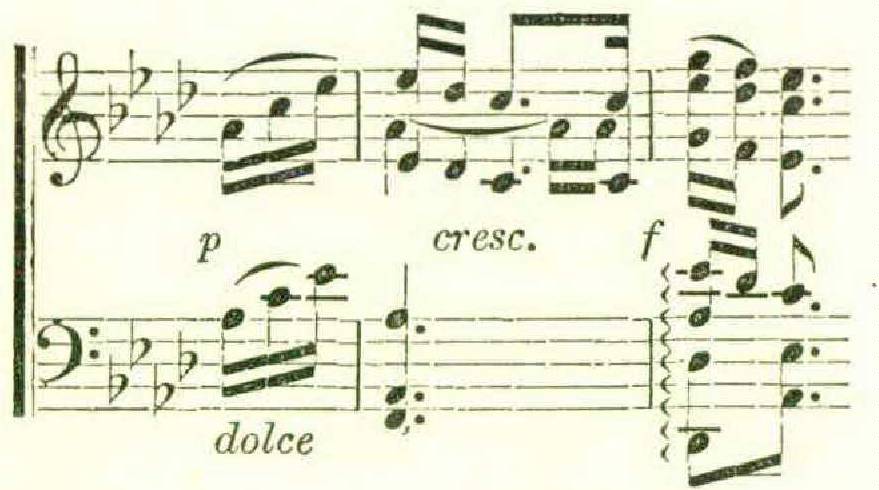
brought up before our mind the Donizettian tenor in his unhappiest moments. Many other exaggerated effects were noticeable, such as the undue hurrying of quick movements, sudden dynamic changes, etc. We merely give this example as a good type of Mr. Thomas’s conducting of classic music. The same tendency was noticeable in his conducting of the Eroica symphony. Now the only way to counteract this influence upon the public taste is for the Harvard Musical Association to sacrifice everything to getting as good and efficient an orchestra as possible, and to show the public how much better a right rendering is than a wrong one, which can only he done with an orchestra that plays really well. One thing is certain, that Boston has been educated up to the point of not enjoying poor orchestral playing. The Harvard Musical Association have done much towards educating the public, hut let them look to it that they really keep in advance of public taste instead of behind it. That Mr. Thomas is taking the lead now is evident enough, and we would not he thought to underrate what he has done for music in Boston. The things of Bach, Handel, and Gluck that he has given us to hear, if no others, claim our sincere gratitude. At the very least we have to thank him for stirring up our too torpid musical interests in a way that must bring about some decided result. We trust it is to be a good one.
— Vincenzo Cirillo’s The Storm3 has some good points, and a certain unforced Italian quasi-national local coloring that carries its own peculiar charm with it.
— Henry Smart’s The Broken Ring4 is a very good song on a rather worked-out subject. It has much more real pith and sentiment than most songs of its class, and is moreover well and concisely written.
— Millard’s Alas !5 is weak enough to do
ample justice to the meteorological, flimsy woe of the text, a weakness which the very elegant title-page does not satisfactorily compensate for.