Music
Music, the art of moving by means of combinations of tones intelligent persons gifted with special and practiced organs. — HECTOR BERLIOZ: A Travers Chants.
It is agreed that every one has tho right to talk and write about music ; it is a frivolous art, and made for everybody ; the phrase is consecrated. . . . It is evident that persons who ascribe to themselves the right of discoursing on music without knowing anything about it, and who would take good care not to give an opinion on architecture, sculpture, or any other art to which they are strangers, are cases of monomania. They think themselves musicians, as other monomaniacs believe themselves to be Neptune or Jupiter. There is not the slightest difference.— HECTOR BERLIOZ : Les Grotesques dela Musiqtte.
CARLYLE has said, in speaking of the dunce, that “ there is, in this world, no other entirely fatal person,” Of all the various incarnations of blockheadedness that walk this patient earth, the unmusical man who is “ fond of music ” is perhaps the most difficult phenomenon to completely understand. There ever have been, and in all probability ever will be, men in all walks of life who discourse long-windedly and dogmatically on any subject in the direct ratio of their ignorance of it. But these persons, although much to be dreaded by the thinking man, are easily enough accounted for. The chaotic jargon with which they bemuddle their theme is no more surprising than the noise made by a drum; the hoi lower the instrument, the more deafening the noise ; nothing can be more natural. But before the unmusical man who dilates upon music, human comprehension retires baffled and discomfited. The self-elected dogmatist on science, painting, politics, socialism, or even on cookery or horseflesh, at least pretends to know what he is talking about. He assumes to have dived to the bottom of his subject. But the unmusical dogmatizer on the art of tones invariably prefaces his didactic discourse by telling you at once that he knows nothing at all about it. What musician has not been driven to the verge of distraction by the man who always plunges headlong into a musical discussion with ” Now, I don’t know anything about music, but”— Such a man has logical immortality ; it has been considered a desideratum to know at what point any argumentative individual becomes logically defunct; of this man it may be safely predicted that he will never become so. He is a very Achilles in debate, Achilles with bullet-proof heel-caps on. Of such a person it would be wholly profitless to speak, for the disease is incurable, were it not that the musician who wisely declines to encounter him in discussion is generally decried as a Pharisee, too much puffed up with his own exclusive wisdom to deign to commune with his less assuming brother, as a high-priest of music who would exclude all lay persons from participation in the sacraments of the divine art. Let any of our readers ask themselves if they have not at times thought musicians most intolerant prigs because they have called certain “ light, simple, and pleasing” compositions utterly worthless and vulgar. It would seem, to us at least, that a main who has given the better part of his life and faculties to studying a subject must end by knowing something about it.
But if there is no cure for the musical dunce, for mit der Dummheit kämpfen selbst Götter vergebens, there is a large class of quite musical people to whom we would speak a friendly word, — the people who from greater or less practical experience in music, either from singing, playing the piano-forte, or habitually attending good concerts, are entitled to talk On the subject. Why cannot they take the trouble to learn the correct use of musical terms ? The ignorance of musical terminology is unaccountably great in this country. In France and Germany we hear people who have as little as possible to do with music use musical terms correctly and understandingly; but here it is very different. It is surprising how few English translations we see of French, German, or Italian books on musical topics, in which there are not many gross mistakes in the use of: technical terms. Now that we have so much to do with German and French music, especially as German editions of music are so much used among us, our musical people ought to know at least the most important terms in German and their corresponding English translations. We will mention here some of the mistakes that are most commonly made. The different German and English names of the notes give many of us much trouble. We often see on concert programmes pieces set down in the most adventurous keys. We remember finding Herr Rubinstein announced to play a trio in B-sharp! That is, in twelve sharps ! The trio in question was really in B-dur (German), i. e., in B-flat major. Let us glance at a comparative table of the English, French, and German names of the notes : —
English German french and Italian
C C ut do
D D ré
E E mi
F F fa
G G sol
A A la
B H si
These are the simple notes of the scale of C, what pianists call the white notes. For the sharps and flats the French add dièse and bémol, and the Italians diesis and bimmolle, respectively, to the name of the note, as G-flat = sol bémol, etc. In German the names are as follows : —
English German English German
C-sharp Cis C-flat Ces
D-sharp Dis D-flat Des
E-sharp Eis E-flat Es
F-sharp Fis F-flat Fes
G-sharp Gis G-flat Ges
A-sharp Ais A-flat As
B-sharp His B-flat B
Remember that the German B is our B-flat, and our B is the German H. The German dur and mol correspond to our major and minor.
In a certain life of Mozart, translated from the German, it is stated that Mozart had great trouble in the grave-yard scene in Don Giovanni to get a man to play “the bass-trumpet ” part correctly. The German is Bassposaune, that is bass-trombone. Luther uses the word Posaune for the instruments upon which the archangels are to play at the last judgment. In Gervinus’s German version of Händel’s Messiah, “ The trumpets shall sound ” is very correctly rendered, “ Sie schallt die Posaun’;” but as a musical term Posaune means trombone.
There is one word that people make the most distracted use of in reference to music, and that is discord. It seems generally understood to mean something false, cacophonous, or unmusical. If a singer strikes a false note, people are fond of saying, “ He makes a discord.” Now a discord is by no means necessarily disagreeable to the ear. A chord is a combination of at least three tones heard simultaneously. Richter numbers ten different kinds of chords as belonging to the major and minor scales. By inversion this number is more than trebled ; by chromatic changes many other varieties of chords are added to the list, not to speak of suspensions, by which almost endless combinations are formed. Now of all these various combinations of tones there are only two that are not discords, namely, the major and minor triads. Some discords, to be sure, sound harsh when they strike the ear without preparation, but let any one ask some musical friend to strike the chords of the dominant seventh or ninth, or the diminished seventh, on the piano-forte, and see if the ear finds anything disagreeable in them. It can very well be questioned whether a false note can properly be said to make a discord, for a discord is something essentially musical, whereas a false note is wholly foreign to music and something that music entirely ignores the existence of. Let us say, then, that a singer sings out of tune, but not that he makes a discord.
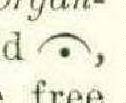
A term that has worked much ruin unto translators is the French point d’orgue. This is almost invariably translated by organpoint. A point d’orgue is simply a hold , and is sometimes used to mean the free cadenza which singers introduce towards the end of a song. An organ-point is a totally different matter. Richter defines it thus: “ We often find, especially in the bass, . . . a long-continued note, while the other parts, apparently without any relation to it, continue their harmonic movement. When this tone lies in the bass, it is called organ-point.” The French for organ-point is pédale.
In the English translation of Berlioz’s Art of instrumentation we find the heading, “ The bass-tuba, the double-bass of harmony.” Let any one make of it what he can ! The original is, “ Le bass-tuba, contre-basse d’harmonie.” The word Harmonic is often used in Germany and France to denote the combined wind-instruments in an orchestra, in contradistinction to the mass of stringed instruments, which are called the Quartette, Berlioz’s heading should have been rendered, The bass-tuba, the double-bass of wind-instruments. The double-bass is the huge stringed instrument that our country cousins call the big fiddle. People are too fond of calling it a bass-viol, a totally different instrument. The whole family of viols disappeared from this earth about a hundred years ago, and are now only to be found in archæological museums.
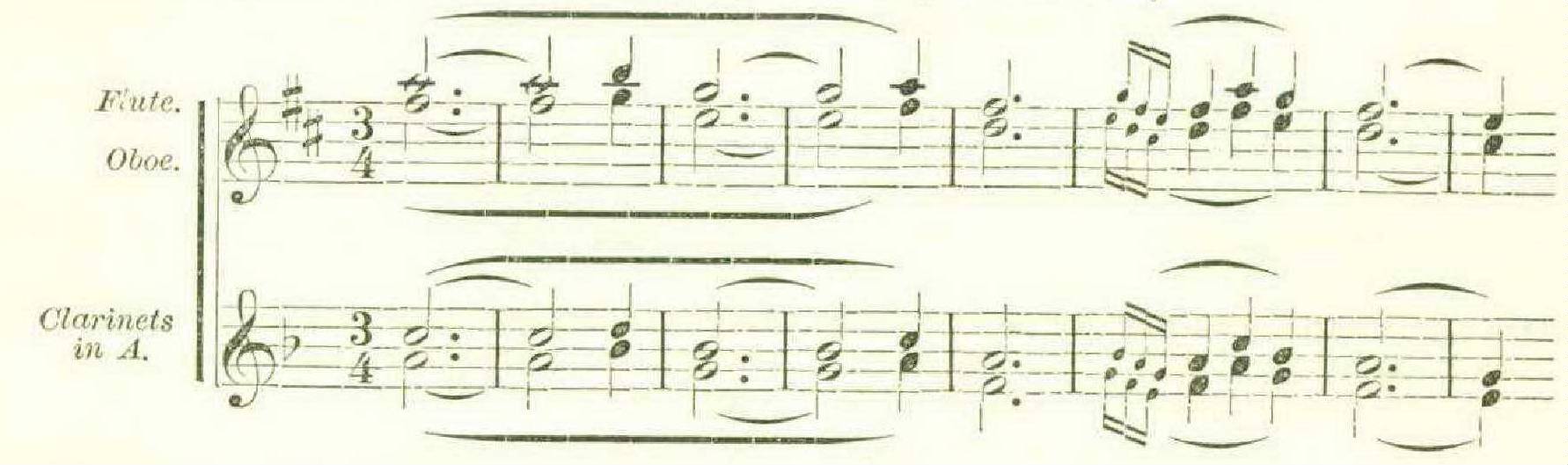
In an article that appeared some time ago in The Galaxy, an attempt was made to explain the nature of transposing instruments. The explanation was good and clear enough, but the flute was given as an example of a transposing instrument. This is as if a lecturer on zoölogy should explain the difference between the cetaceans and fishes, and then give the common porpoise as a good example of a fish. There are certain instruments in the orchestra which do not sound the notes as they are written. Take, for instance, the clarinet in A. This instrument has its perfect scale, like any other, but its C, that is, the note it calls C, the C of its scale, is in unison with the A of the rest of the orchestra. Its C sounds A, its D sounds B, its E sounds C-sharp, etc. Thus if the clarinet in A is to be used, the part it plays from must be written in a different key from the music for the other instruments, which sound the notes as they are written. Thus in the, following phrase from Beethoven’s symphony in A, the clarinets sound an octave below the flute and oboe, though they seem to be playing in an entirely different key.
But as for calling the flute a transposing instrument, we will quote the following from Berlioz, who is as good authority on the subject as can well be found : —
“ Let us begin by establishing a line of demarkation between those instruments from which the sound is produced as it is indicated by musical notation, and those from which the sound comes either above or below the written note. From this classification will result the two following categories : non-transposing instruments, which produce the sound as it is written ; and transposing instruments, which produce sounds different from the written notes.” (Here follows a complete table of the instruments in the modern orchestra.) “ It will be seen from this table that if all the nontransposing instruments, said to be in C, produce sounds as they are written, those, like the violin, the oboe, the flute, etc., which bear no designation of any particular key, belong absolutely to the same category ; they are thus, as far as the composer is concerned, similar to instruments in C in this respect. Hence the nomenclature of certain wind instruments that is based upon the natural resonance of their tube has led to the most singular and absurd consequences; it has made the art of writing for transposing instruments a very complicated task, and has rendered the musical vocabulary thoroughly illogical. Here then is the place to revise this custom, and to restore order where we find so little of it.
“ Players say sometimes, in speaking of the tenor trombone, the trombone in Bflat; in speaking of the alto trombone, the trombone in E-flat; and still more frequently, in speaking of the common flute, the flute in D.
“ These designations are correct in the sense that the tube of these two trombones with the slide closed really does produce, in the former, the notes of the chord of Bflat, and in the latter those of the chord of E-flat; the common flute with all its holes stopped and its keys shut also produces the note D. But as the players have nothing to do with this resonance of the tube, as they really produce the written notes, as the C of the tenor trombone is a C and not a B-flat, as that of the alto trombone is still a C and not an E-flat, as that of the flute is equally a C and not a D, it evidently follows that these instruments do not belong, or no longer belong, to the category of transposing instruments ; that they consequently belong to that of non-transposing instruments, and that they are to be considered to be in C, like oboes, clarinets, horns, cornets, and trumpets in C, and that either no designation of the key should be applied to them, or else they should be said to be in C. When this is established it will be conceivable of what importance it was not to call the common flute a flute in D; the other, higher flutes having been named according to the difference existing between their pitch and that of the common flute, people have got to speak of them not simply as the tierce flute and ninth flute, which would have at least brought about no confusion in terms, but as the flute in F and the flute in E-flat. And just see what this leads to! In a score the small clarinet in E-flat, of which the C really produces the sound E-flat, can play the same part as a tierce flute, which you speak of as being in F, and these two instruments, bearing the names of different keys, are yet in unison with each other. Is not the name of one or the other wrong ? and is it not absurd to adopt solely for flutes a nomenclature and method of designating the key different from that in use for all other instruments ?
“ Hence the principle that I propose, and which renders any misinterpretation impossible. The key of C is the point of comparison that should be taken to specify the keys of transposing instruments. The natural resonance of the tube of non-transposing wind-instruments can never be taken into consideration. All non-transposing instruments, or those which transpose only to the octave, of which the written C really produces C, are to be considered as in C.
“ Moreover, if an instrument of the same sort is tuned above or below the pitch of the typical instrument, this difference will be indicated according to the relation it bears to the key of C. Consequently the violin, flute, or oboe which plays in unison with the clarinet in C, with the trumpet in C, or the horn in C, is in C ; and if a violin, flute, or oboe is tuned a tone higher than the common instruments of the same name, that violin, flute, or oboe, playing in unison with the clarinets in D or trumpets in D, is in D.
“ From which I conclude that he old way of designating flutes should be abolished, and the tierce flute should no longer be called the flute in F, but in E-flat, since its C produces E-flat; and the ninth and minorsecond flutes should be called the great and little flutes in D-flat, and not in E-flat, since their C produces D-flat; and so on for the other keys.”
If this last point appear a thought too technical to interest the general reader, we humbly beg his pardon; the best we can do is to advise him, with the Irishman, “ to go back and skip it.”
There is one more class of persons to be noticed. Who does not know the well-intentioned, wholly unmusical man, who, as soon as he meets a musician, thinks himself obliged to talk music at him ? He generally begins with asking whether he — the musician—likes operatic music or instru mental music best! We have often felt like asking in return, “ Sir, which do you like best, food or drink ?” There are operas and operas, and we know of some instrumental music that is as vile as need be. Upon the whole, it may be safely said that the last subject a musician wants to talk about is music, that is, talk about in the way of commonplace society chitchat. Either he has been giving lessons all day, in which case he had rather not hear the word music mentioned until he has had a good night’s rest, or he is so full of some glorious work that he has just heard or played through, that he cannot bear to talk upon the subject with any one between whom and himself there can be no rational sympathy. Again, there is the modest man who heartily enjoys negro minstrelsy or opéra bouffe, hut who is overcome by a sense of his own aesthetic short-comings. He often pounces upon the musician with “ Now I know yon must look upon me as an outer barbarian for liking Offenbach.” A barbarian, my dear sir ! No, never, by the immortal gods, never! You are an oasis in a dreary desert of misspent enthusiasm. We will take you by the hand and revel in Offenbach with you to the top of our bent, and our cachinnating souls shall commune together in divine sympathy. Not enjoy Offenbach, forsooth ! Show me the man possessed of enough ear to discriminate between Pop goes the Weasel and Old Hundred who does not enjoy Offenbach, and I will call him but half a man. It is good and wholesome to enjoy Offenbach, as it is to enjoy Gavarni’s and Cham’s caricatures. It is not very good music, and the wit is none of the finest, but what of that? Because we have the School for Scandal and the Comedy of Errors, shall -we not also laugh at Morton’s farces? Shall Dogberry and Polonius forbid our liking Poor Pillicoddy and the worthy Mr. Grimshaw? Shall Mozart’s Figaro and Rossini’s Dottore Bartolo hunt the Grand Duchess and the Baron de Gondremark from the boards? Never, by Parnassus! But this does not make Offenbach good music, nor Morton a high grade of literature. They are irresistibly funny and fascinating ; let that be enough for them and their admirers.
To conclude with, let us beg young ladies, however good judges of prettiness they may be, not to call the Seventh Symphony pretty.