Music
WE have rarely got more pleasure from studying a new work than Mr. Otto Singer’s cantata, The Landing of the Pilgrim Fathers, has given us. Even if Mr. Singer’s dedication of the work to his old master did not give one a palpable clew to the fact, it would take no great amount of insight to see from the work itself that he has been a thorough and loving student of Liszt’s compositions. Apart from a certain family resemblance that the pervading theme of Mr. Singer’s cantata bears to a class of themes Liszt is fond of developing in his works, Mr. Singer’s mode of proceeding, in working out this predominant figure, is wholly identical with Liszt’s. Looking through several of Liszt’s compositions, for instance, his Tasso, Les Preludes, his piano-forte concerto in A major, we are struck by one marked peculiarity: the various phases in which his leading musical motive is successively presented owe their variety not so much to contrapuntal elaboration and different harmony, excepting always the traditional alternations between the major and minor modes, as to strongly marked contrasts in rhythm. Liszt is by no means the man to shirk any amount of contrapuntal labor in working out his themes, and he has often given us striking examples of the effect of two contrasted themes placed in immediate contact with each other; but his methods in this respect are in no wise peculiar to himself, and the distinctive peculiarity of his style is his great rhythmic variety. Take, for example, the different physiognomy given to one of the themes in his Les Préludes simply by a change in rhythm. Contrast the first of the following passages with the second : —
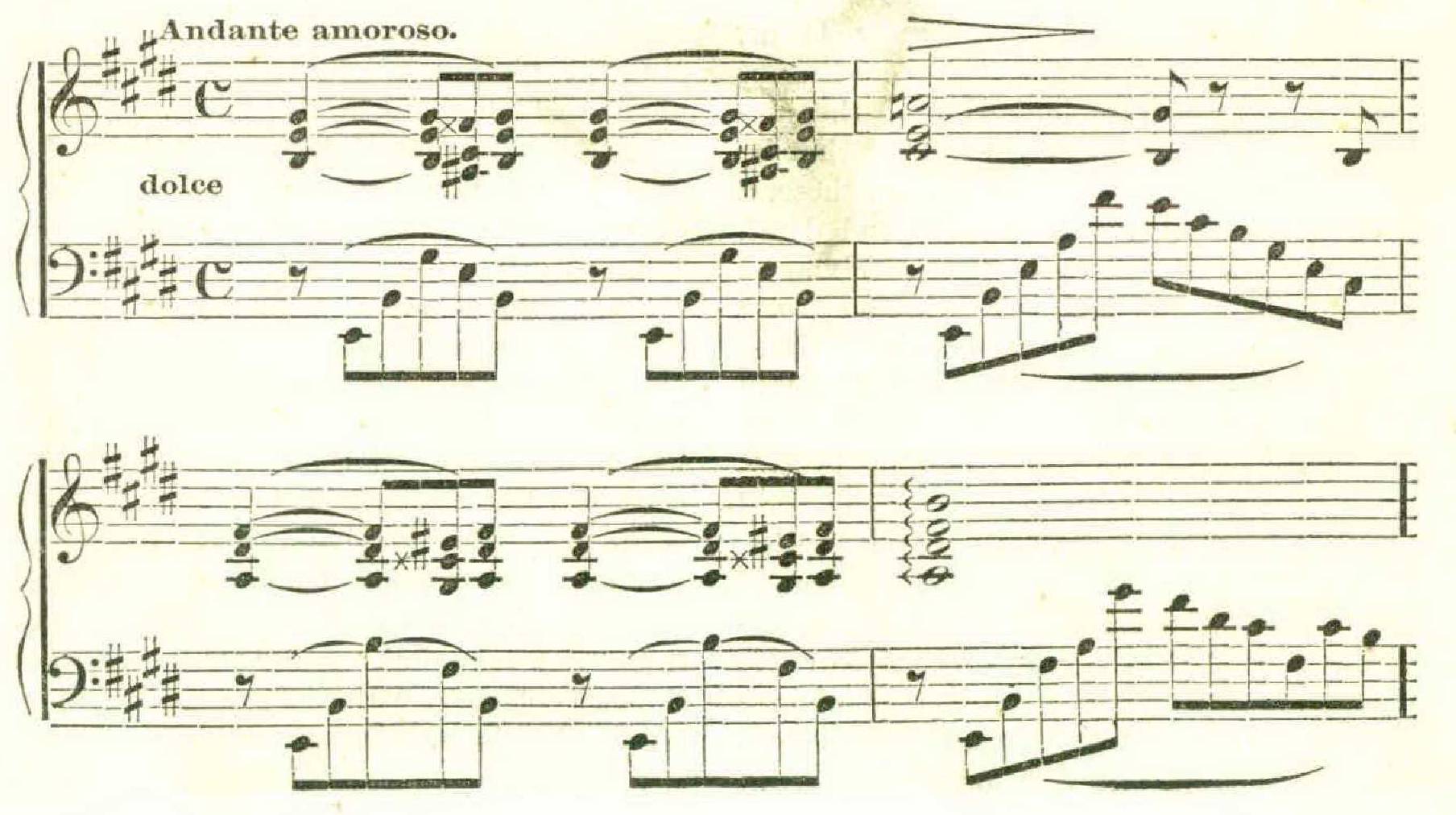
Allegro marziale animato.
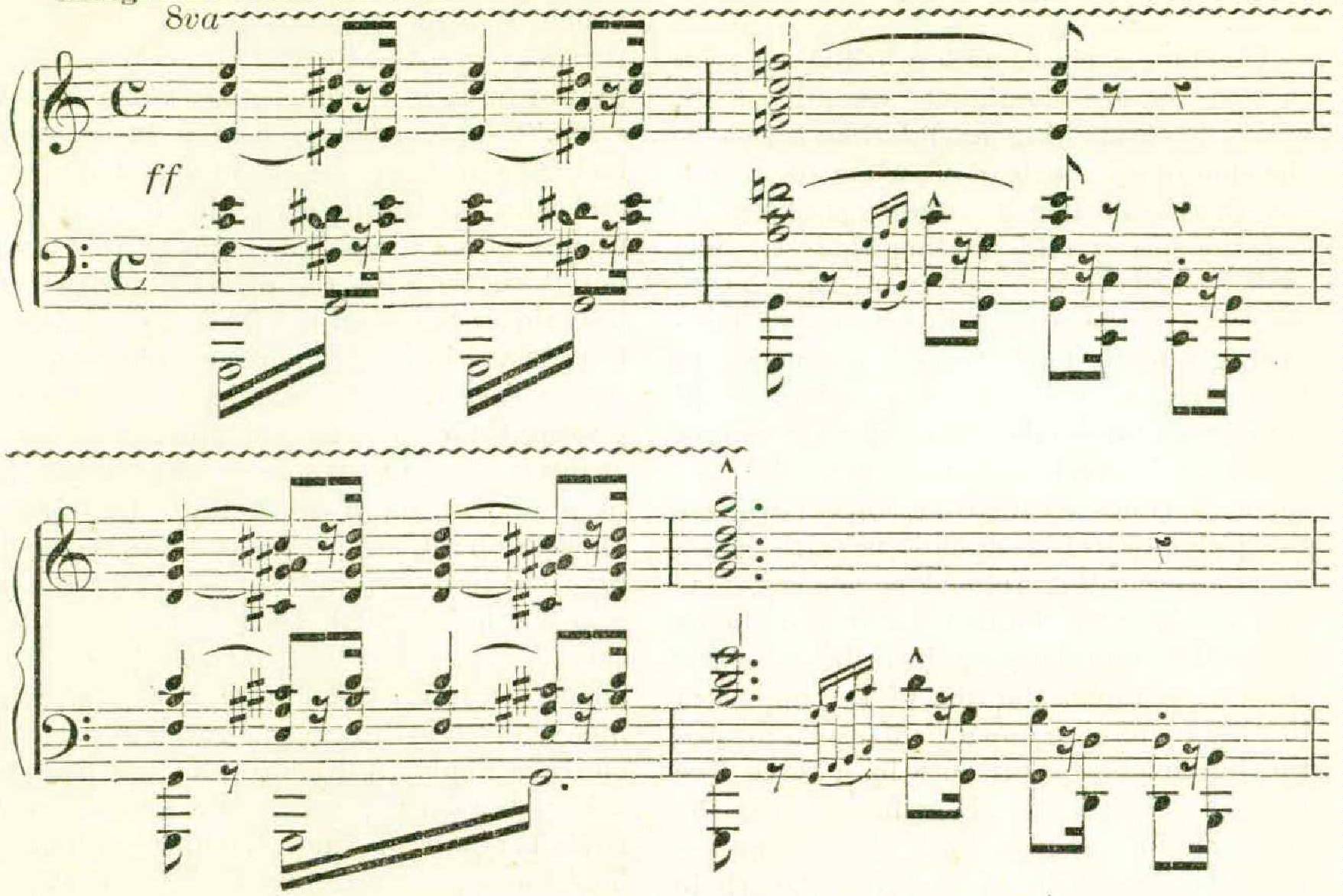
Here we see in a moment what variety can be obtained without having recourse either to counterpoint or to essentially altered harmony.
It is just this rhythmic variety that we find in Mr. Singer’s cantata. A constant use of enharmonic modulation, which is one of the notable characteristics of Liszt’s style, is also a prominent trait in Mr. Singer’s work.
The orchestral introduction to the cantata begins with a long-held, swelling and diminishing chord of C major, after which the leading motive of the work is announced :
Con moto
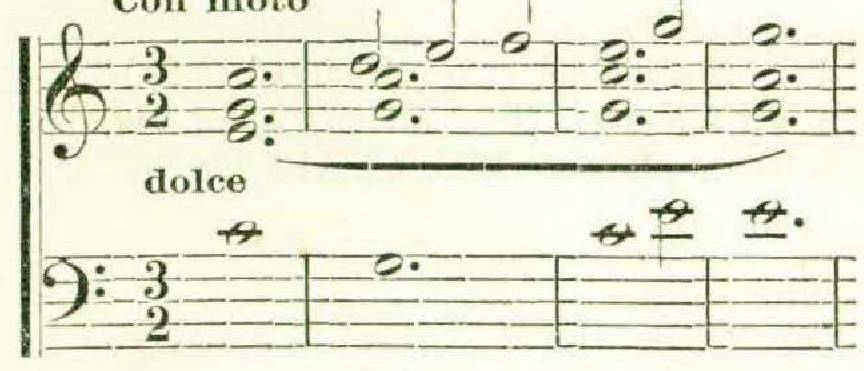
This is really a happy and pregnant figure, such as any writer might congratulate himself upon. The leading motive, which is based upon this figure, is given out at length in the same strain, and then repeated fortissimo. There is some rather mediæval-sounding harmony, of a somewhat ascetic character, in it, but it is quite in keeping with the Puritan spirit of the subject. We would only protest against such a passage as this nest one, as being unnecessarily ugly.
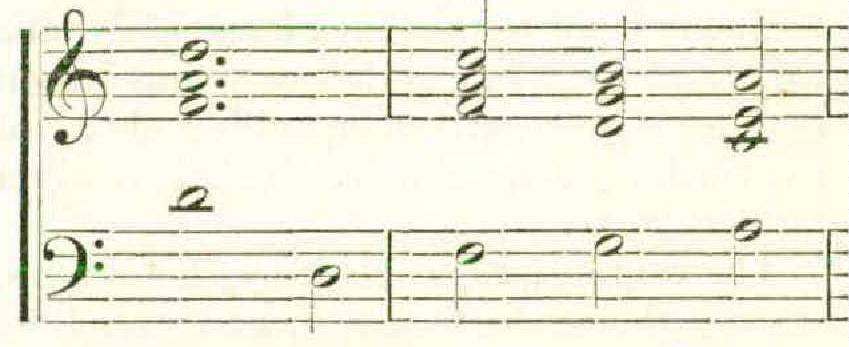
Such a cross-relation as the plain triad of F followed by the plain triad of G is really too much for modern ears to bear, unless insisted upon with the most convincing decision. Liszt’s appalling device in The Bells of Strasburg Cathedral is certainly quite as harsh musically, but it is incomparably stronger: —
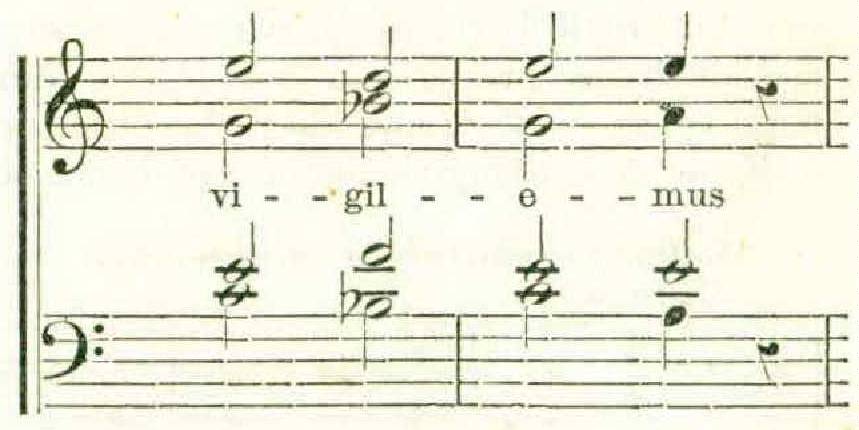
The unrhythmic character of Liszt’s phrase gives the harsh progression in a more commanding prominence; it impresses itself upon the ear with a degree of authority that Mr. Singer’s progression, coming as it does upon the weak part of a markedly rhythmic phrase, does not possess. As it stands, it can be compared in hideousness only to the distressing close of the second phrase of Nicolai’s harmony to “ Ein’ festo Burg.”
The theme closes with a brilliant exclamation on the dominant seventh of E, which by a striking modulation passes to the dominant ninth of C, when on a sudden the theme appears again, piano, in Eflat, the basses still holding their G, thus giving us the rara avis of an organ-point on the third of the scale. The harmony, however, gradually tends from E-flat major to C minor, giving the sustained G its natural character of a dominant pedal. Mr. Singer seems to be fond of pedal basses, and uses them at times with strong effect; witness the pedal on the dominant near the close of the succeeding fugued movement in C minor, where the high A-flat in the violins grates for four bars against the G in the basses, then joins the rest of the orchestra in wildly plunging down, as if drawn toward the immovable pedal note by a force like that of gravitation. How fine also is the close of this organ-point ! Just as we expect the long-held G to bring the whole harmony home to the tonic, it suddenly falls to F, and the whole orchestra stands frozen stiff, as it were, on an appalling chord of the sixth in D-flat major. This is really a master-stroke.
The cantata proper begins with a strong, stormy theme in C minor, announced by the basses; after a few measures the male chorus begin upon a rhythmic variation of the leading motive, the orchestra opposing an inversion of the same theme to the voices. A fine stormy passage follows, which reaches its climax on the dominant, when after a bar’s silence the male voices blaze out with the theme in C major, answered by the orchestra. This very brilliant outbreak is repeated, when it is succeeded by a passage in which the four male voices come in one after the other on a simple descending theme of five notes, to the words, “ Not as a conqueror comes,’ which is soon opposed to an ascending theme (very like the leading motive itself) to the words, “ They, the true-hearted, came.” This passage begins in F minor and ends in A-flat minor, in which key the orchestra strikes in with the leading motive in march tempo, the male chorus singing, “ Not with the roll of stirring drums,” in trumpet-like strains. This is immediately repeated in E major, after which the female voices at last come in, the basses repeating their “ Not as a conqueror comes ” at intervals. The whole chorus is brought to a climax on a fortissimo diminished seventh chord, when the leading theme is repeated in its original shape in G, the alto solo singing, “ With their hymns of lofty cheer,” while the full chorus repeat the whole strain in much more agreeable harmony, a pedal G running through nearly the entire passage. A dreamy horn solo leads to a very beautiful pastoral movement, interrupted now and then by alto recitative. The whole passage is exceedingly beautiful, and, to judge from the scanty indications of the scoring given in the piano-forte arrangement, none of the magical effects of the combination of the high, soft violin and reed tones have been spared. This passage ending in F-sharp major is followed by some very brilliant choral and orchestral writing, full of striking enharmonic changes, the harmony oscillating between B-flat major and B major with perfect freedom. Later on, the leading motive comes in again in march tempo, giving us the following succession of keys: D-flat major, F-sharp minor, D major, G minor. Once in G minor, the tempo changes to a faster rate, the chorus ending as before on a crashing diminished seventh chord, followed by total silence. The chorus then comes in with a phrase which we will let speak for itself: —
Moderato con molto espressione.
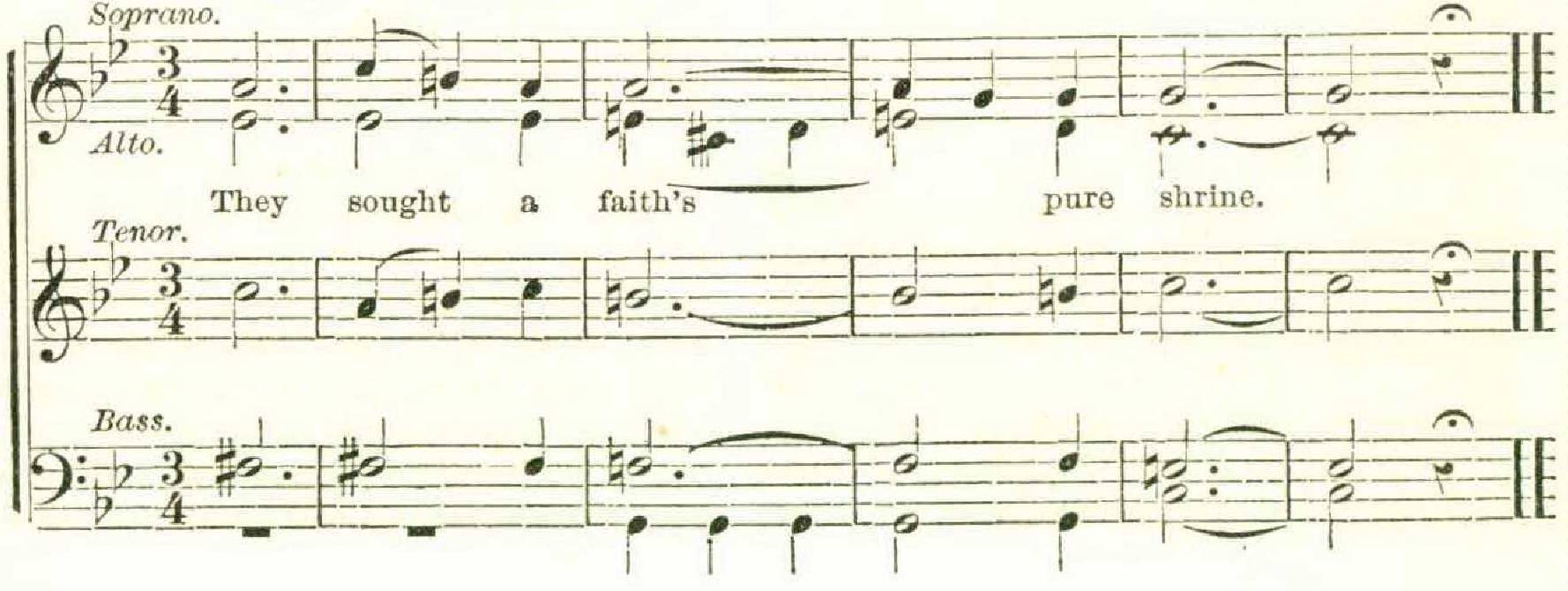
This is followed by another orchestral thunderbolt, when the chorus repeats: —
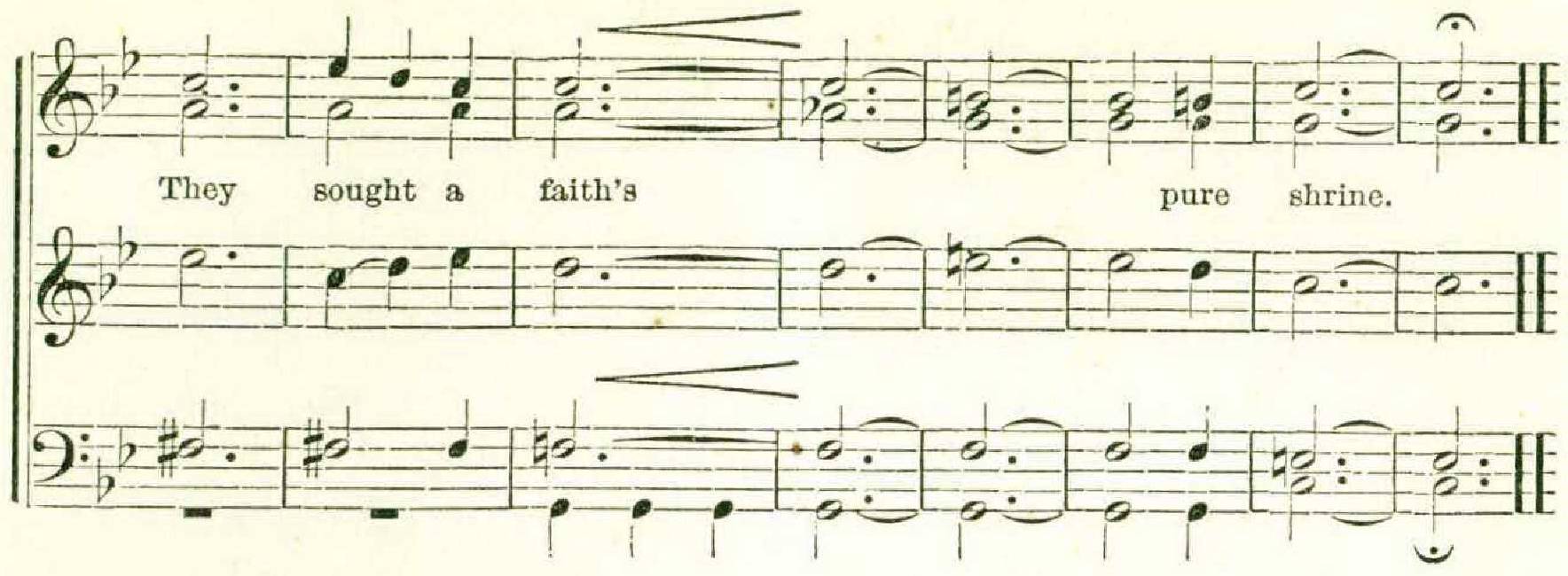
Immediately afterward comes the final chorus, — not, thank Heaven, a fugued one. We hold the fugue to be the very highest of all modes of musical expression of impassioned and lofty sentiments and aspirations. But it is only a very strong man who can wield such a strong weapon effectually. Bach and Händel could, but after seeing so many of the later composers struggle on to glory in their fugued finales, we can only be thankful when anyone has the good sense and modesty to let the fugue alone. This finale of Mr. Singer’s, which begins in F minor and ends in C major (we have, perhaps, rather too little of C major in the course of the work), is very brilliant, dramatic, and strong; a fitting culmination to a very excellent work.