Crude and Curious Inventions at the Centennial Exhibition
IX.
IV. COTTON, SILK, AND SPINNING.
COTTON is the principal textile fibre of the world. Wherever in tropical and semi - tropical countries the people go clothed, it is in cotton, and in temperate climes it forms a part of the usual dress. If the wider use, and therefore greater importance, of cotton than wool, flax, or silk be the measure of dominion, then “cotton is king.” We know it by a name derived from the Arabic goton, which reminds us of the great people, the Saracens, who introduced it to European notice when they became possessed of Spain. Previous to this the knowledge and reputation of the fabric depended upon the notices by travelers and writers, and upon limited importations from the East.
On our side of the Atlantic cotton has been known from time immemorial, but the kind now cultivated in the United States is from seed which originally came from the Levant to England, thence to the Bahamas, and from those islands to Georgia late in the last century. Columbus found cotton to be the principal material for clothing among the Mexicans; Magellan describes it as common in Brazil in 1519.
There is no knowledge of the time when in the south of Asia cotton was otherwise than what it is now, the principal dependence for clothing; while its common use in Europe north of the Mediterranean countries, and in our own country, is a matter about one hundred years old. Machinery has given it its importance with us, but the Hindoo methods are probably just what they were when Herodotus spoke of the tree wool, and mentioned that the Indian contingent of the army of Xerxes wore cotton drawers.
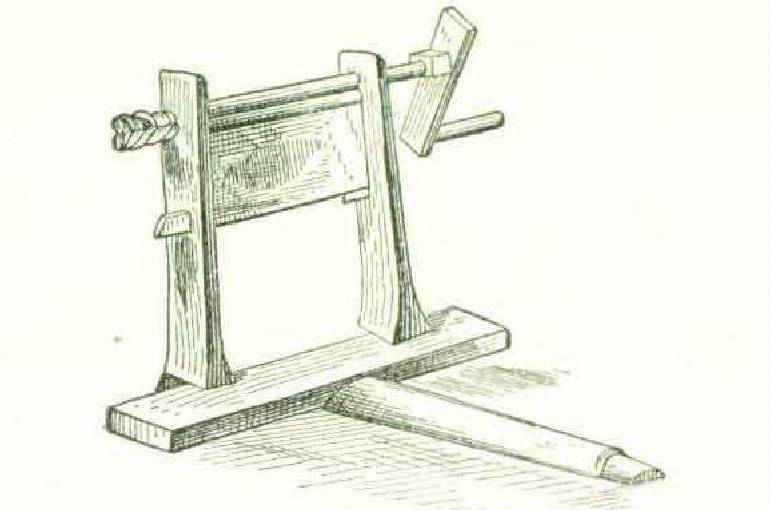
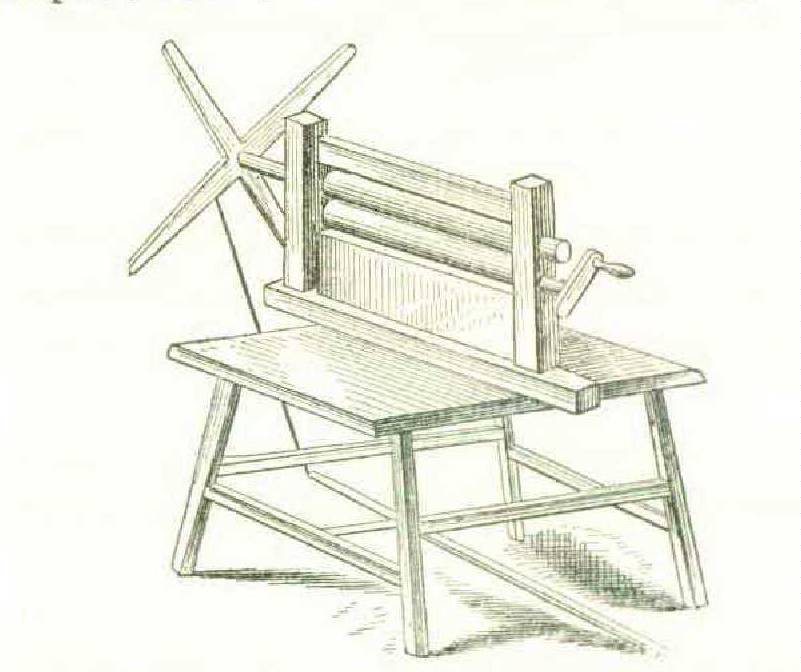
Figure 227 is a view of the roller cotton-gin of Hindostan as exhibited in the British colonies collection in the Main Building at the Centennial. It has rollers about six inches long, having oblique gears on the ends of each, mashing together so as to rotate in unison when the crank on the end of the upper roller is turned. It was this roller-gin which was used to a slight extent in the Carolinas and Georgia before Whitney’s invention of the saw-gin. The Chinese cotton-gin (Figure 228) is similar in all substantial respects. This, however, has an upper roller of iron, on one end of which are four heavy arms at right angles, to act as a fly-wheel. The roller frame is bound to the table with cords. The lower roller has a crank on the end, and a treadle can be connected to the fly-wheel by a cord so as to enable it to be worked by foot power. The rollers are set at such proximity as to pinch the fibre and draw it through while opposing an obstacle to the passage of the seed. The same contrivance is used in Japan, Java, and elsewhere, being the usual implement all over Southern and Southeastern Asia. It does not seem to have been noticed in savage Africa, notwithstanding cotton is grown commonly enough there. Egypt is not included in this statement; her position is exceptional. There are more steam plows in Africa than in America, but the poor fellahs are none the better off. We learn from Sir Stamford Raffles that in Java one pound and a quarter of cotton is cleaned in two days’ work of one person by the roller-gin.
The written records of India are fuller of religious and dynastic information than of domestic matters, but one item from the Singhalese books of a date answering to our A. D. 1153 notices a festival practice that has been in vogue in Ceylon for many centuries: cotton is plucked from the plant at daybreak, cleaned, spun, woven, dyed, and made into garments before the setting of the
sun. The method in Java is perhaps a fair specimen of the process: the cotton is ginned with the roller, beaten with a rattan to loosen it, picked to remove motes and trash, bowed to bring it to a downy condition, pulled out in loose slivers, and wrapped on a distaff from which it is drawn in spinning. The thread is boiled, dressed, combed with rice water, and then reeled.
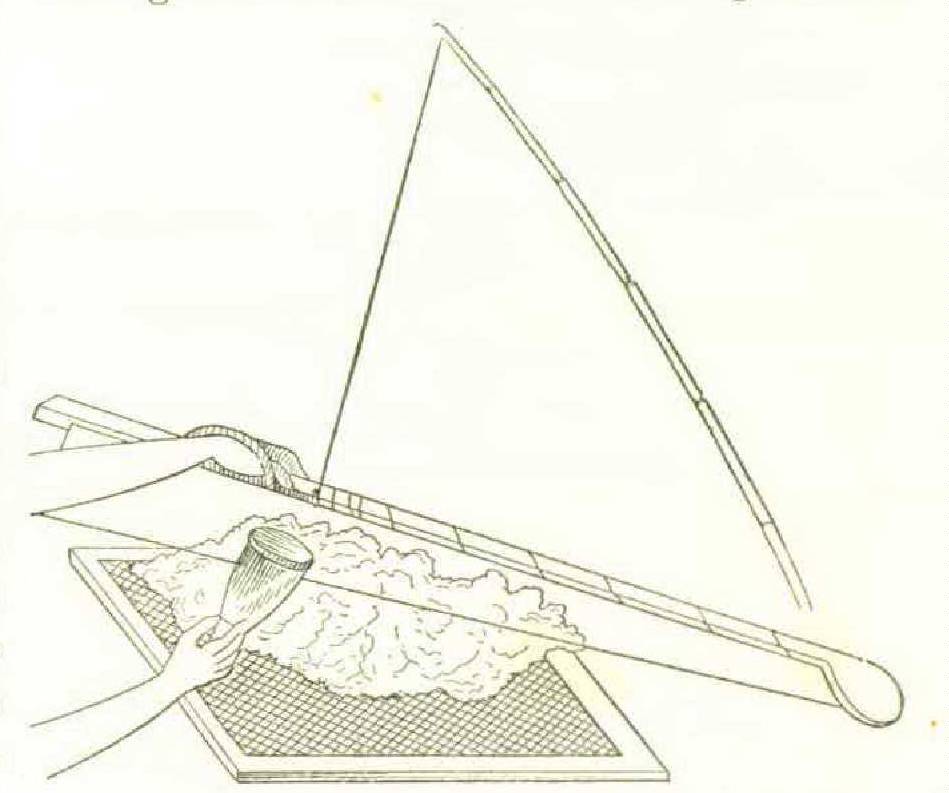
Figure 229 shows the Japanese mode of bowing cotton, the same that was adopted in England and elsewhere before the invention of the carding-machine, a little over a century ago. It is the same as now used by hatters in spreading a thin layer of fine felting fur. The Japanese bow was shown in the Main Building, and is about the same as the American hatter’s implement, being a bow and string supported by a cord from a pliable pole, which prevents the wearying of the left hand by the weight of the bow. In the hatter’s practice the string is twanged by the thumb of the left hand, but in the Japanese the string is beaten by a mallet in the right hand. All dirt and pieces of leaves or of the capsule fall through the meshes of the sieve upon which the fleece of cotton lies.
The simplest form of spinning is by laying together a few fibres and rolling them by the hand upon the thigh. This is what the Australian lubra does with the bulrush root, which she chews for the nutriment contained in it, and then picks the fibre out of her mouth, straightens, rolls, and twists it into a very serviceable thread for making nets for fishing, etc. The Australian does not weave, though he makes mats by a process of wattling, and uses this thread for interlacing the reeds, of which the mat is principally composed. Many of us have seen a sailor make a lashing from a bunch of oakum much in the same way, and a hay or straw band is made upon occasion about as quickly.
Thread is made in Madagascar by pulling out the fibres by hand, no cards being used, and twisting them together in a peculiar manner. Instead of a weighted whorl and suspended roving, the natives take the spindle in the right hand and pay out the roving from the left, by which hand also they twist the roving as the hands separate. When the length of the expanded hand is twisted, it is wound on the spindle, and the work is resumed.
The customary method of hand-spinning, however, the world over, is by spindle and whorl. The Egyptian paintings show this with perfect clearness, and there is no difference between the practice of thirty-five centuries since and that common in Asia and Africa at the present day. The notices in the Bible and in Homer indicate that Syria and Æolia had the same method at about the same time. The excavations of Dr. Schliemann in the hill of Hissarlik have unearthed from great depths numerous whorls, mostly of terra cotta, with Aryan symbols. Some are of lead and others of marble. Leaden whorls. elaborately ornamented, are found in British barrows. An English tree, the euonipnus or spindle-tree, has obtained its name from its use for this purpose.
The Peruvian distaffs, found in great quantities in the rifled graves of that country, have usually two canes about twenty-four inches long and wrapped with party-colored thread. At the top of some of them is a bunch of combed fibre from which the thread is drawn. Such may be seen in the Peabody Museum, and at the Musée de St. Germain, Paris.
The distaffs of Egypt were principally employed upon flax; cotton was unknown there except as a curiosity, and the hemp which Herodotus describes as a Scythian plant, wild and cultivated, does not seem to have reached the Nile land. The historian considered it in some respects superior to flax, and states that the Thracians excelled in its manufacture into clothing. The wrappings of the mummies are of linen; wool, as an animal product, being considered unclean for priests or religious uses. Linen thread of remarkable fineness was spun in Egypt, as we shall have occasion to remark apropos of looms.

Figure 230 represents the spindle and whorl used by the Makah Indians of Puget Sound in making cordage of cedarbark fibre, which is obtained by chopping or breaking the bark until the coarser material is separated from the long fine fibre. The spindle is of wood, with a bone whorl. It manifests a considerable advance in ingenuity: as we have seen, the Malagasy have no whorl and twist by hand; the Australians have no spindle and twist on the thigh. The Makah Indians, it may he remarked, do not use the spindle in twisting spruce-root fibres, which are roasted and pounded and then twisted by hand. The tough strings of spruce root are used to lash their tools to the handles, to make their wattled baskets, and to sew together the pieces which form their canoes. The Pimo Indians, far to the south, use a slender spindle, two feet long, passed through a wooden block, which keeps up the rotation imparted to it. One end of the spindle rests in a wooden cup held between the toes, while the other is twirled by the fingers of the right hand. The left hand is busied in drawing out the roving from the supply of cotton which is coiled upon the left arm in loose rolls. It would be useless to attempt to enumerate the different lands where the spindle is used. Loanda-land, La Plata, Java, and other distant countries showed the primitive implement or its results.
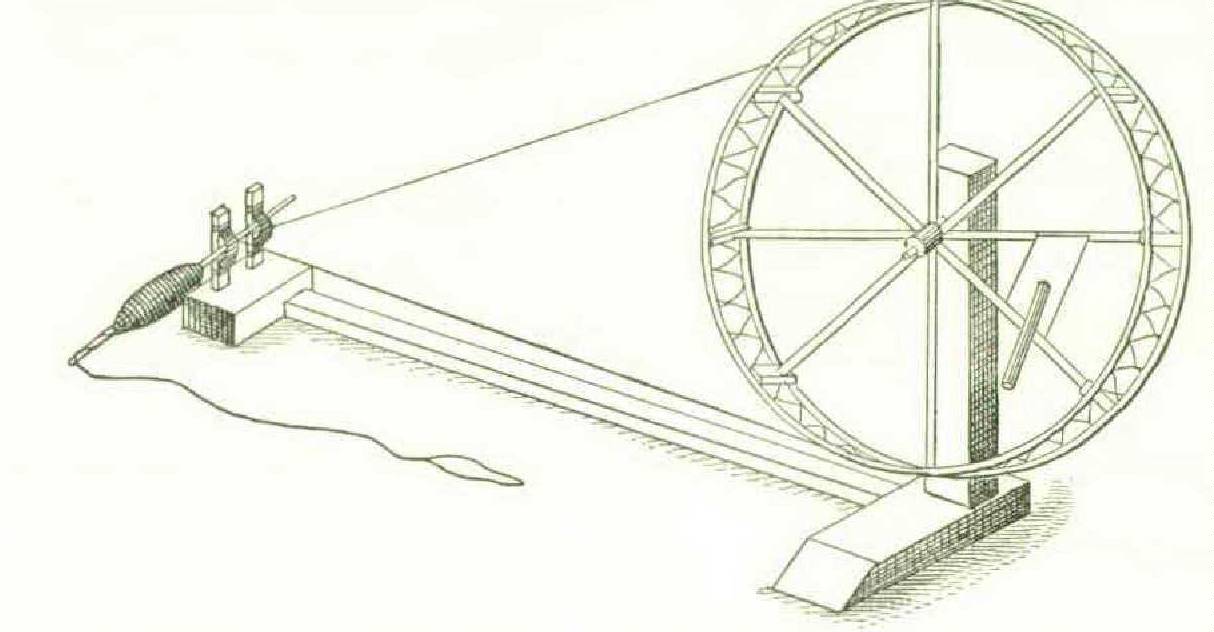
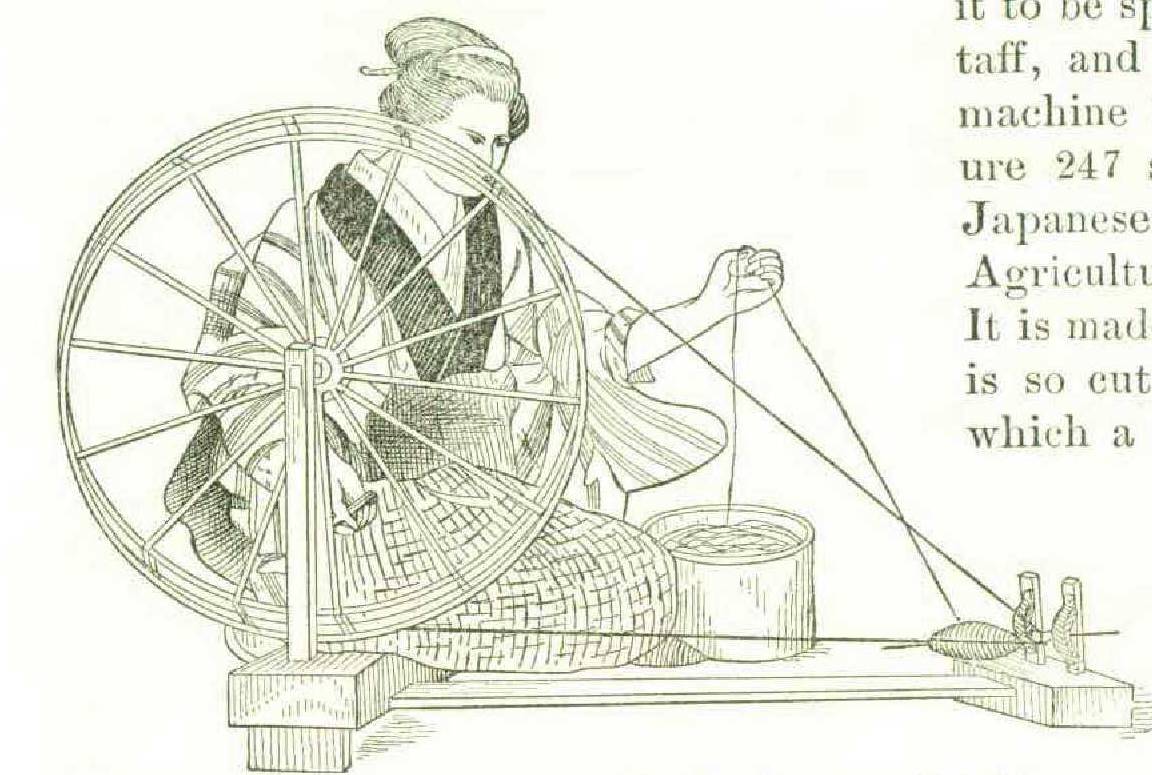
Not alone is the device of a distaff and Spindle widespread in point of geographical distribution, but, as we have stated, it prevailed in the earliest historic times. It was a great advance when the spinning-wheel was invented. The earliest known use of it points to India as its birthplace. Figure 231 shows the Japanese spinning-wheel for cotton. It does not differ in material respects from the English wheel of the fourteenth century, as shown in an illuminated manuscript in the British Museum; in fact, except in mere shape and proportions, it is like all others of its class. The large wheel has a light skeleton frame and a band to Exhibit. the spindle of the bobbin. To say it is extremely cheap is not to say it is actually rude. It is adapted to the use of a person sitting upon the ground, a posfuru which the lithe Oriental assumes with grace and comfort. The Javanese spinning wheel (jantra) is similar. So also is that used by the Arabs.
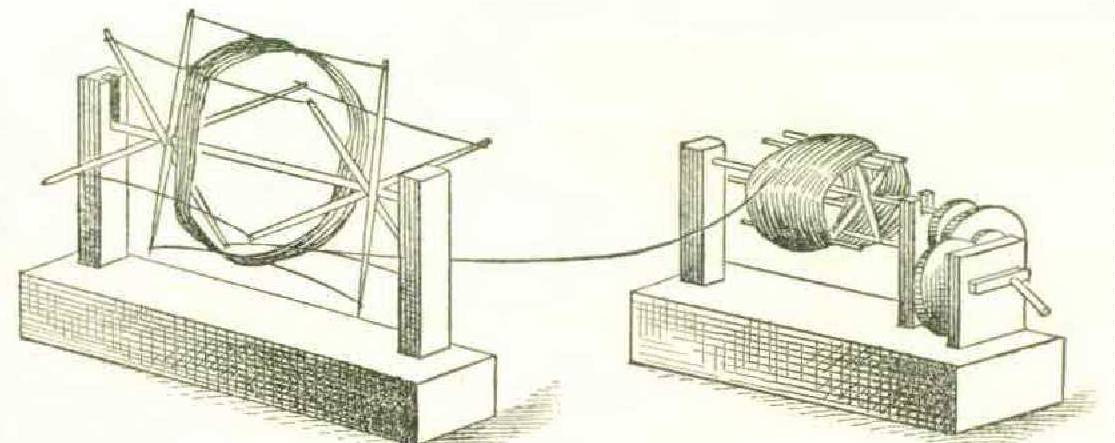
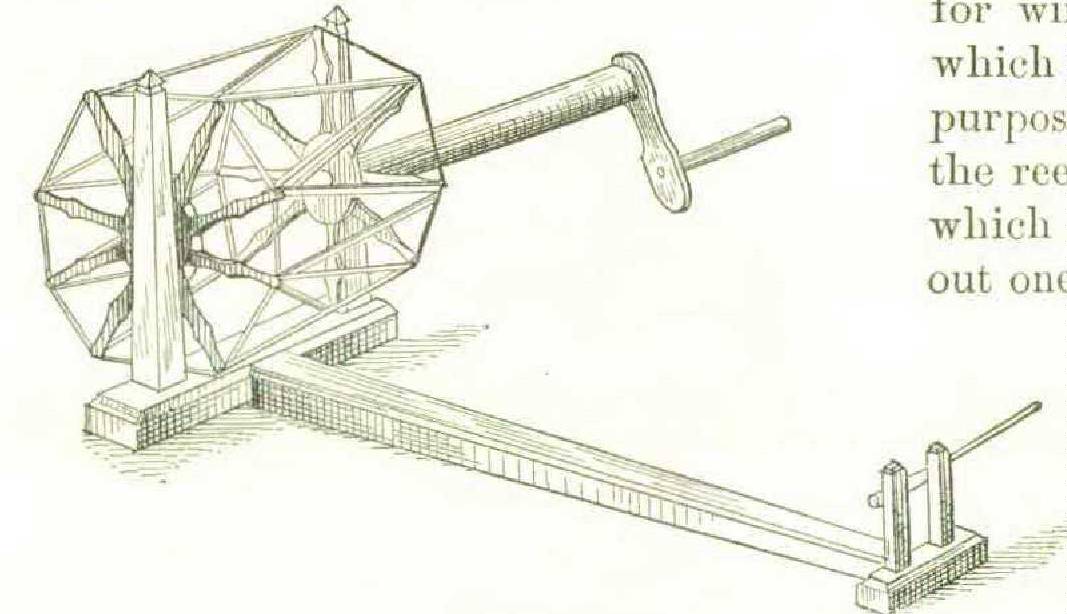
Figure 232 exhibits the Siamese reel for winding the thread off the bobbin, which is placed on the skewer for that purpose. The thread is received upon the reel in the form of a skein or hank, which is afterwards removed by taking out one of the bars.
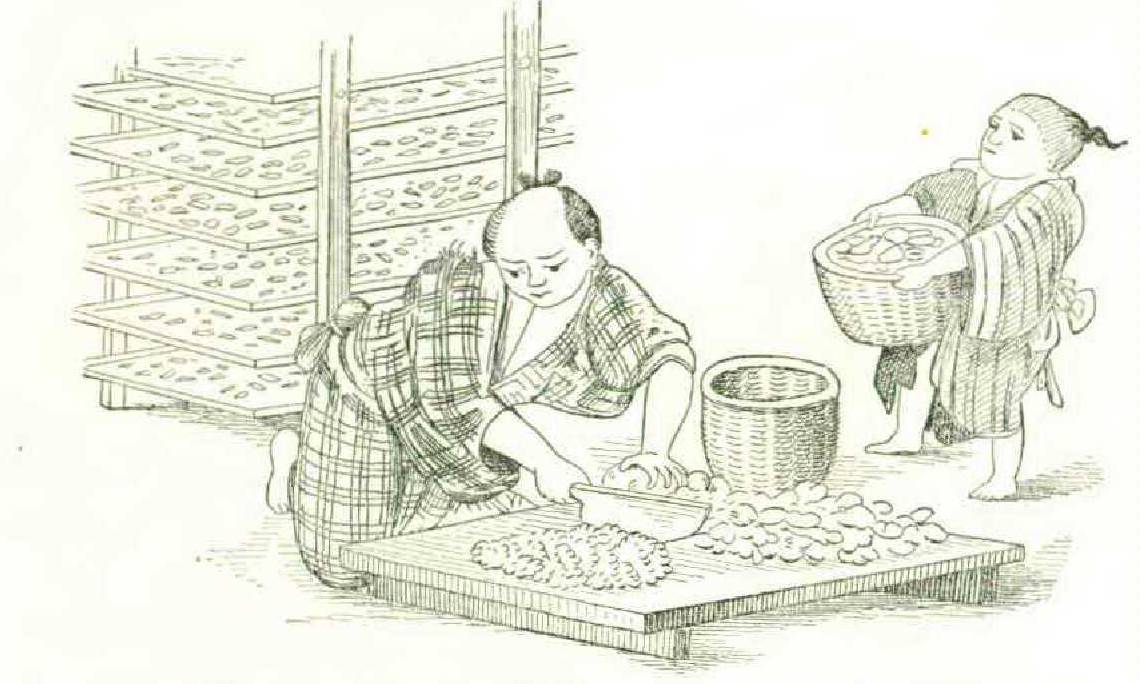
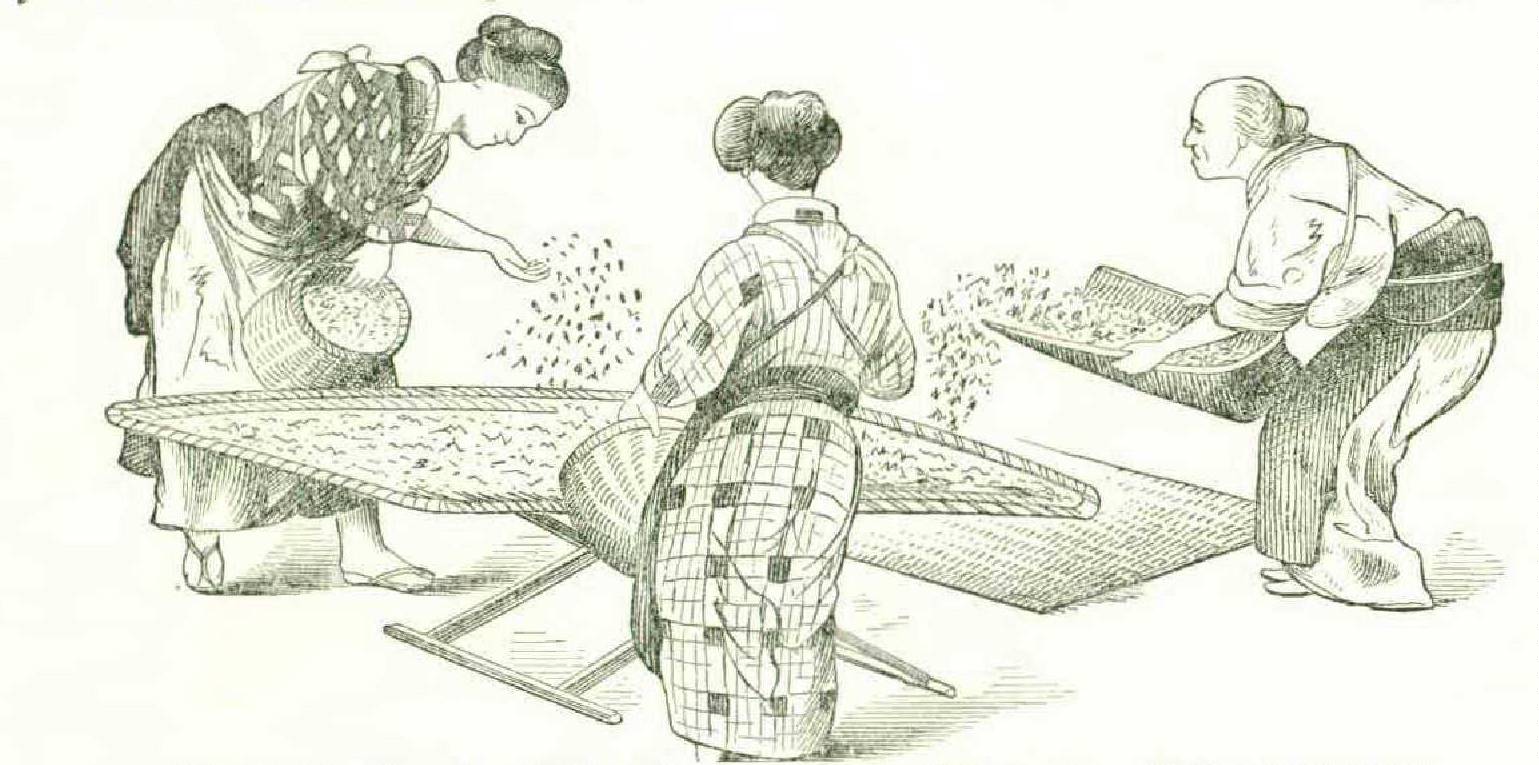
The Japanese winding-machine (Figure 233), like the other allied devices, is marked by simplicity and cheapness of structure. The loose skein is placed on a swift, one arm or string of which is removable to enable it to be placed in position, and is wound on the smaller reel with rapidity by means of the crank and multiplying gearing. Sericulture is one of the most important interests of Japan and China. The Japanese collection in the Main and Agricultural buildings exhibited all the processes, from the gathering of the mulberry leaves and the feeding of the worms are about to undergo their transformation to the chrysalis form, they seek a place on which to attach their silken envelope that screens and protects them from birds and other enemies; this may, in a certain sense, be supposed to be the object. The cocooneries are trays with rows of sticks arranged in ridgelike form (Figure 236), to afford the crotches in which the worms prefer to place the cocoons; they in fact resemble a multitude of divergent limbs, where the worm standing upon one may reach the other with his mouth to attach the silken filament, and so on, back and forth and around and around, in a gradually narrowing space, until he spins a ball around himself, to the reeling and skeining of the silk thread. No silk looms were exhibited. Figure 234 shows the cutting of the leaves for feeding the worms; a boy is seen bearing in leaves which have been picked in the plantation; a man in kneeling posture cuts the leaves into small shreds upon a board; behind him are the trays for the worms. Figure 235 shows the feeding of the worms upon the trays, the shreds being strewed by hand or by the dexterous flirting of the handy wicker trays of which the Japanese make so much use. The succeeding operations of changing feed and the care of the moulting worms involve nothing particularly curious. When the caterpillars have attained their full growth and working on the. inside. In Figure 237 is seen the stripping of the cocooneries.
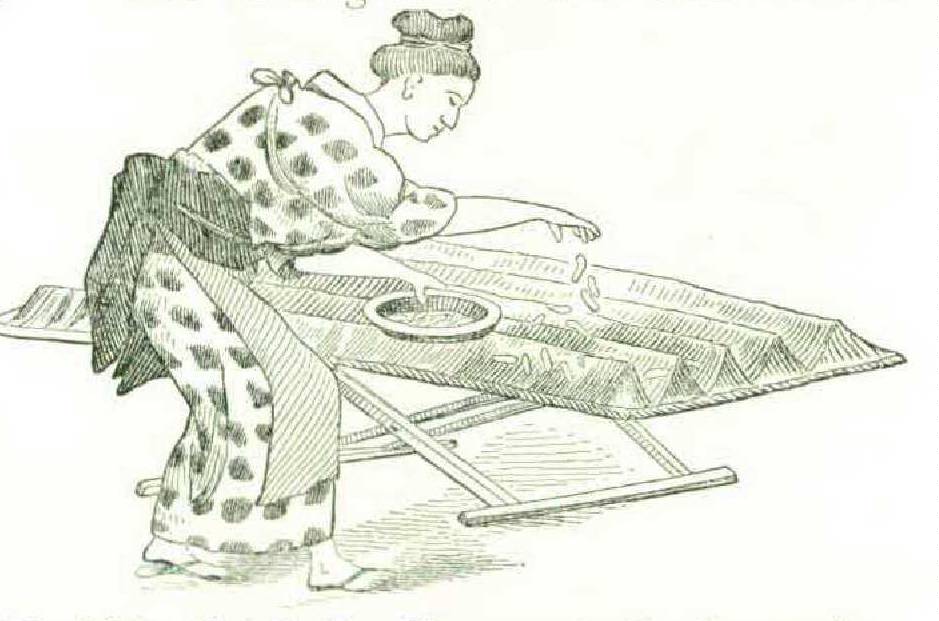
The reeling of the silk from the co-
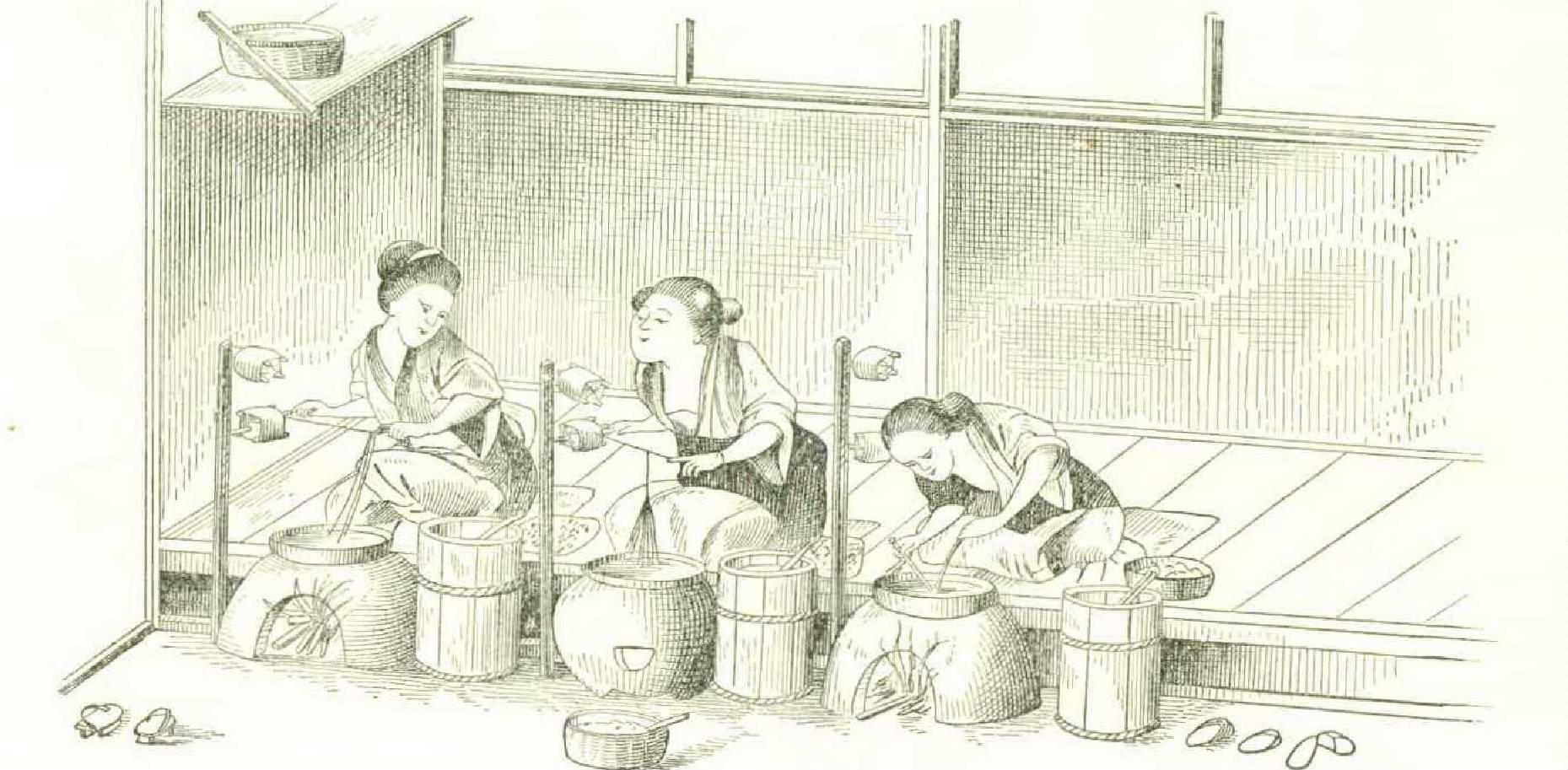
coons was shown in several exhibits at the Centennial. The one which attracted most attention was an apparatus from Brazil, but as we are after the crude and curious, and not the most perfect, we will show a few of those from Japan. Figdred thousand yards or over five hundred miles of the single filament. The silk that we see passing from the cocoons in the pan of water to the reel is made up of from five to ten distinct filaments from as many cocoons. It seems as if nothing could supersede hand care at this point. It is hard to believe that the time can arrive when we can compete with the rice-eating population of the world in sericulture. In silk manufacture we may. Each of the three almond-eyed girls in Figure 238 turns the little hand reel and allows the silk to run over her finger; if a filament should break it will be readily noticed, for the cocoon ure 238 exhibits a trio of maidens, each with a small portable furnace to heat the water in which the cocoons are floating, the warm water dissolving the gum of the silk so that the filaments part from the cocoon. The length of a filament is a b o u t three hundred yards; two hundred and fifty a v e r a g e cocoons weigh one pound; twelve pounds of cocoons yield one pound of silk; therefore three thousand cocoons produce one pound of silk, which is about nine hunbelonging to it will cease to jump about in the water, and the end must then be found and brought into the cluster. Figure 239 shows an apparatus on a better scale, two reels being employed and the silk running through little eyes on the ends of pliable rods. We do not call this “crude” but insist upon the “curious.”
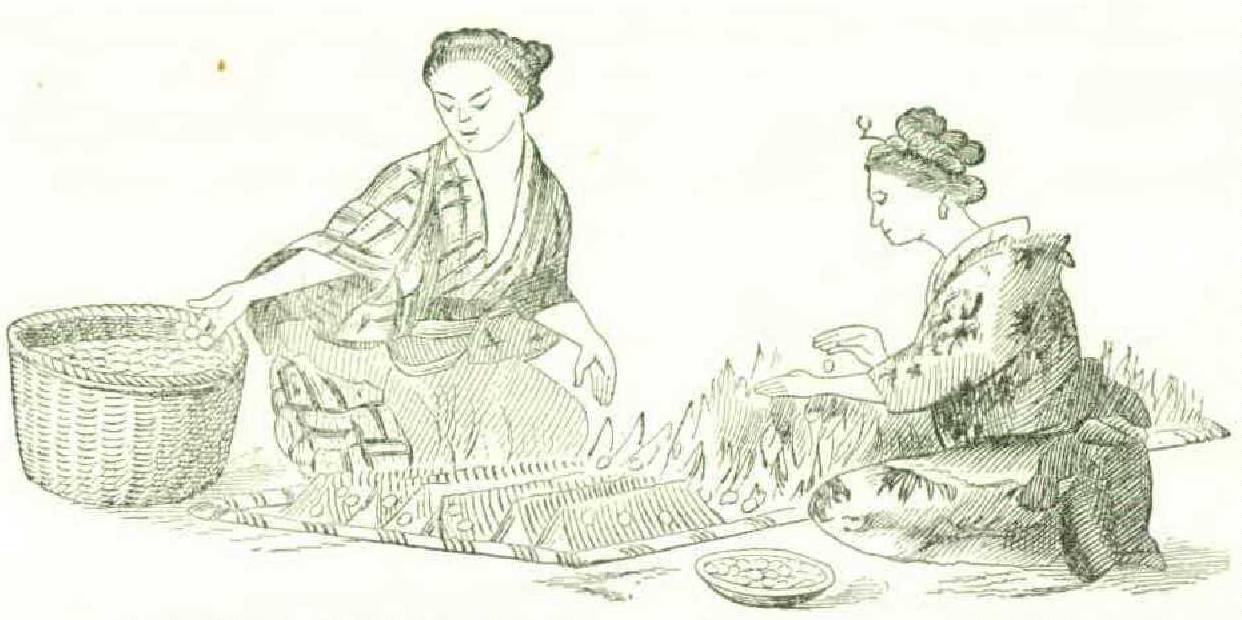
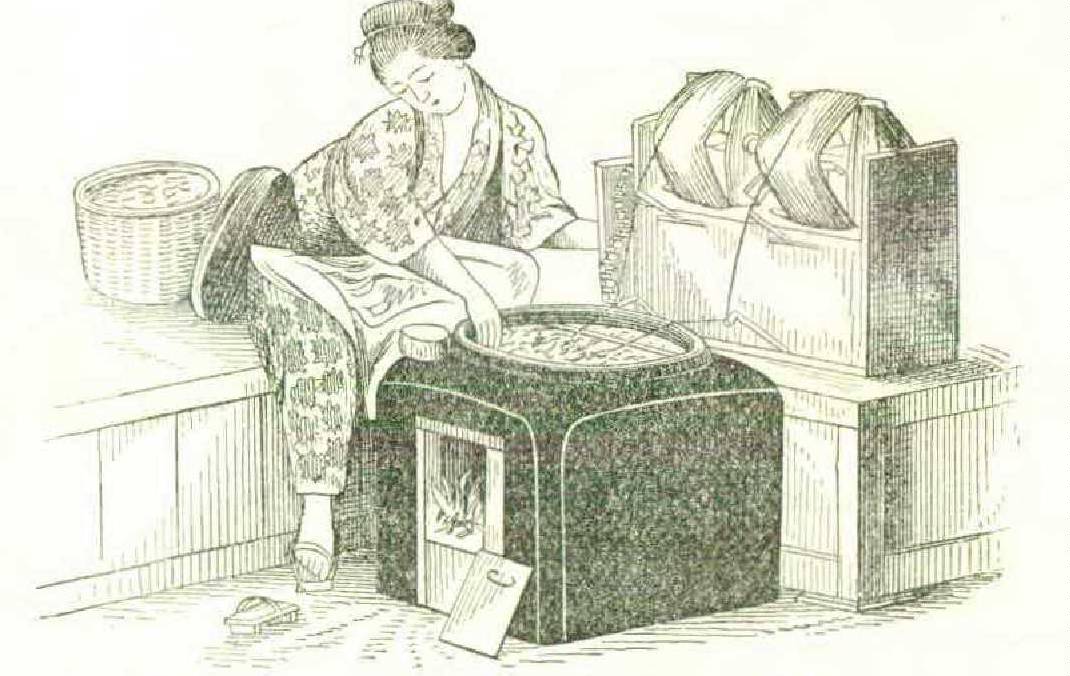
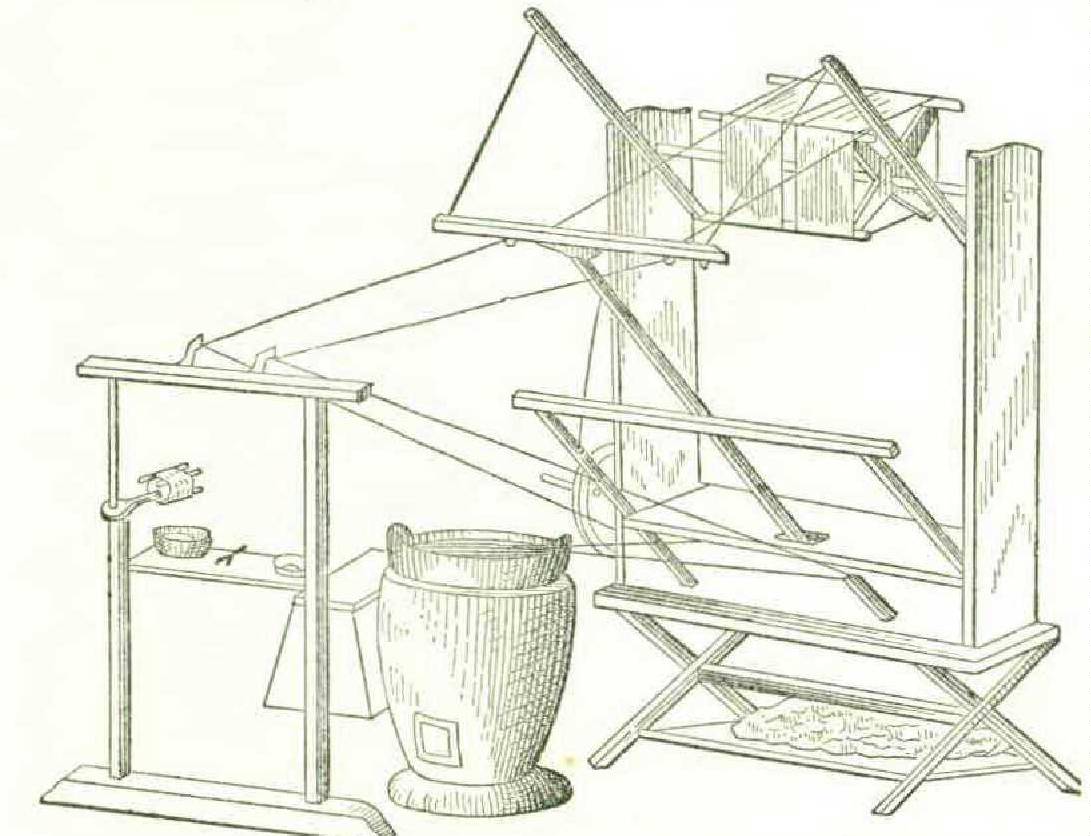
The arrangement in Figure 240 gives
the most graphic idea of the apparatus, the parts being shown in skeleton, so that the course of the silk may be readily traced.
Silk is unlike any other fibre which is spun or made up into a textile fabric. While cotton, flax, wool, hemp, and jute have a comparatively short staple, silk is perfect throughout the whole length of the filament. The treatment, therefore, has to be essentially different. With cotton and the other materials named with it, the fibres are laid alongside of each other in a thick and soft roving, which is by turns, or simultaneously, pulled and twisted so as to make it longer and harder by means of the drawing and spinning action. It was the mode of combining these two so that they proceeded together and continuously that constituted the invention of Sir Richard Arkwright, which had such a wonderful sequence of results. Cotton could be cheaply worked in factories; flax and wool were partially superseded; the cotton of the United States became its principal export; and divers political complications ensued which we will not particularize.
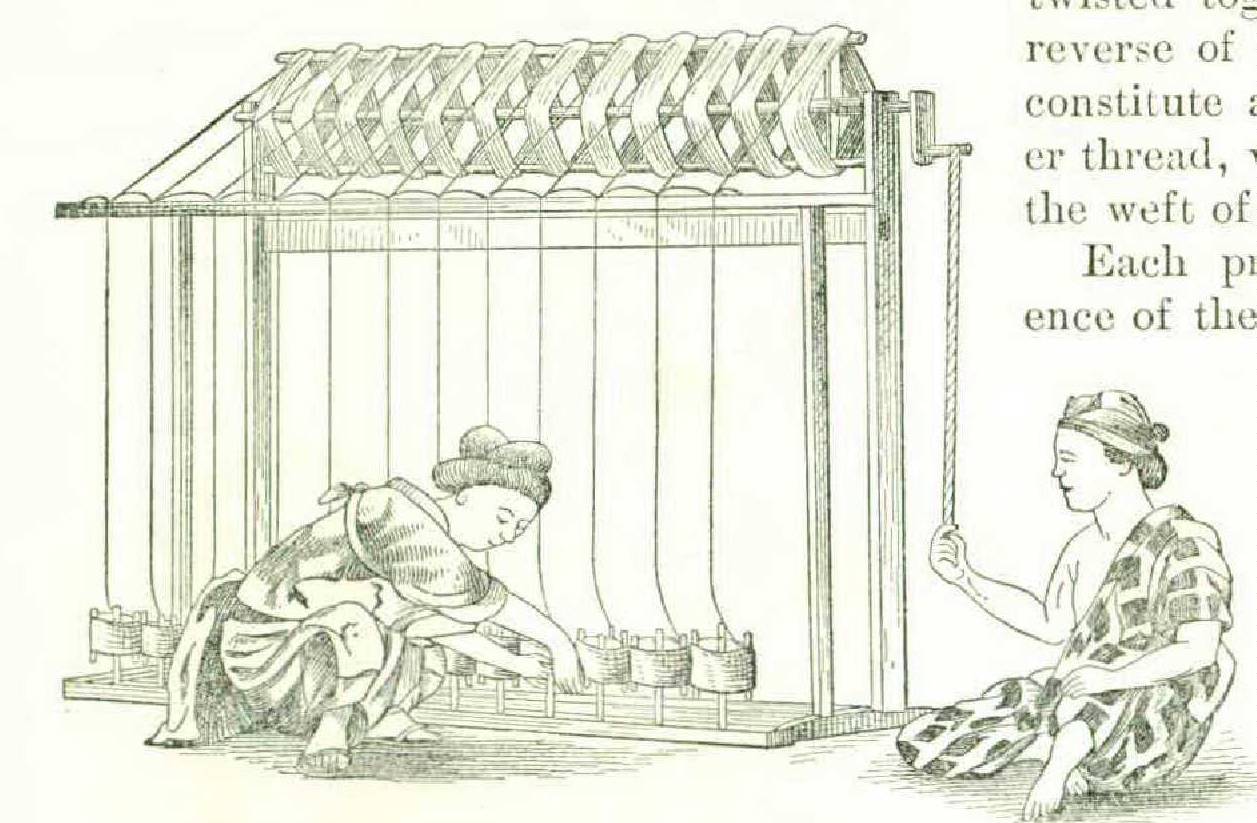
The various operations with silk consist in twisting and doubling, the latter term being employed in describing the laying up of several threads into one, though as many as seven may be thus run together at one time. The sequence is about as follows: the silk reeled from the cocoon is twisted and wound on a bobbin ; several of such twisted singles are laid together and twisted in the opposite direction, known as doubling; these being by successive operations separately twisted, laid together, and then twisted together in a direction the reverse of the twist of the doubles, constitute a still larger and stronger thread, which may be suitable for the weft of the silk loom.
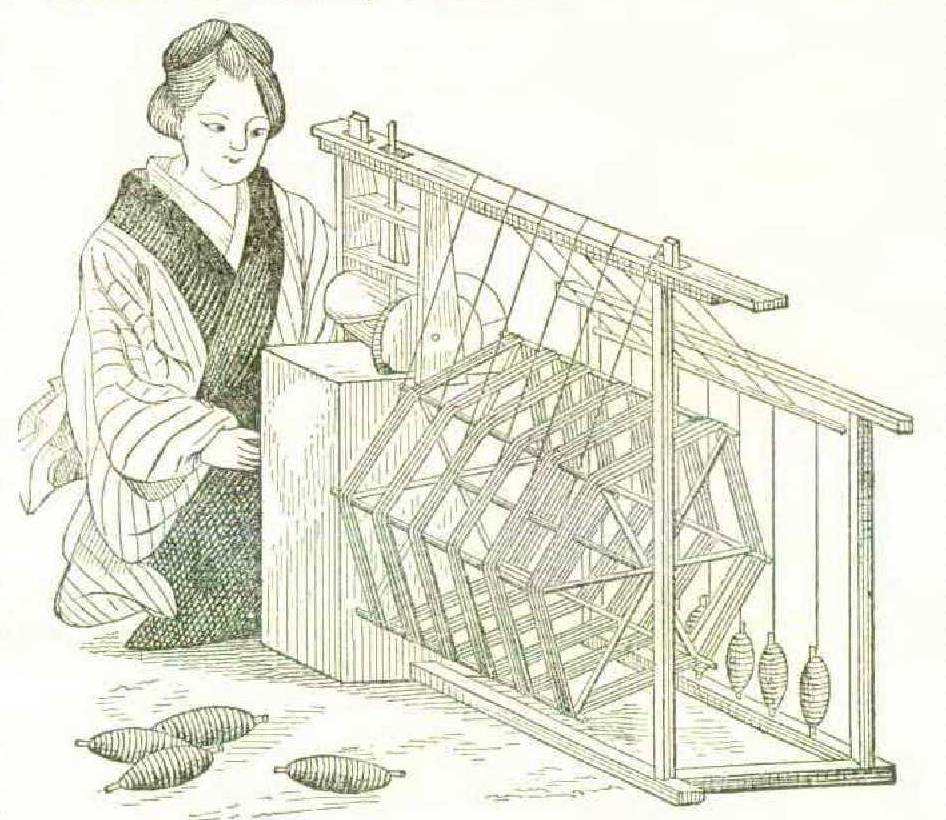
Each process causes a transference of the silk from a reel or swift to a bobbin, or conversely, the twisting being performed in transitu and at such a strain that the filaments shall not kink. The silk reel of Bhagulpoor in Eastern India is about as primitive as one can well imagine. It is a conical frame on a vertical axis, and is twirled by one hand, while the thread from four or five cocoons is twisted on the thigh, the cocoons are adjusted, and broken threads joined by the other hand. Figure 241 shows a machine in which the small skeins, such as those made by the young ladies on the veranda (Figure 238), are wound on to a swift or larger reel. Figure 242 shows a silk spinningwheel; the skein is laid orderly in a box, and a length is first twisted by the spindle, and then wound on to the bobbin;
then another length is twisted, and so on. Figure 243 shows the winding of the spun silk from the bobbins, making it into an open, soft skein, ready for dyeing. Figure 244 exhibits the process of stretching and glossing the silk in skeins, the bight of the skein being placed over the hook and the force of the man exerted to stretch it, which increases the lustre of its surface.
It is not alone the bombyx mori that yields the silk of Japan; neither is it all silk that can be treated in the normal manner which has just been described.
A large quantity of silk on the outside of the cocoon is loose, and the extreme exterior filaments having been attached to the branches in the cocoonery are broken in stripping. This irregular silk, known as floss silk, is picked off before the cocoon is thrown into the water bath to be reeled off, and is treated in an essentially different manner, more resembling the process with cotton or wool.
The floss-silk winder (kuzu-walatoridogu) of Japan (Figure 245), shown in the Agricultural Building, is used for taking the floss silk off the cocoons. When it is an object to save the chrysalis uninjured, the work is done very carefully, so that it shall not be crushed. The cocoons are placed below the grating and the silk ends brought up between the bars and wrapped around the roller, which is rotated to strip off the floss silk (mesenito). This having been cut to a short staple is bowed, as seen in Figure 246, to loosen it up and permit it to be spun. This is done from a distaff, and the silk roving is spun on a machine like that in Figure 242. Figure 247 shows the distaff used by the Japanese as it was exhibited in the Agricultural Building at the Centennial. It is made from a stick of bamboo, which is so cut as to leave a sharp point on which a bunch of silk is impaled; from this the fibres are pulled out in a roving, just as in the oldfashioned method by distaff and spindle, yet practiced in Asia, in those parts of Africa where spinning is known, and among the peasantry of the south of Europe.
In this country we are compelled to call in the aid of machinery or to reject the floss silk as a material for textile goods. With us, the floss silk is sorted, pulled over gills to set the fibres straight, combed in a filling engine and then in a drawing-frame, cut to a staple of tolerably even length in a cutting-machine, the fibres converted by a scutcher into a sort of down, which is washed in soap
and water, boiled in pure soft water, pressed, dried, again scutched to loosen it up, then carded, made into slivers, drawn, doubled, drawn, rove, and spun like cotton.
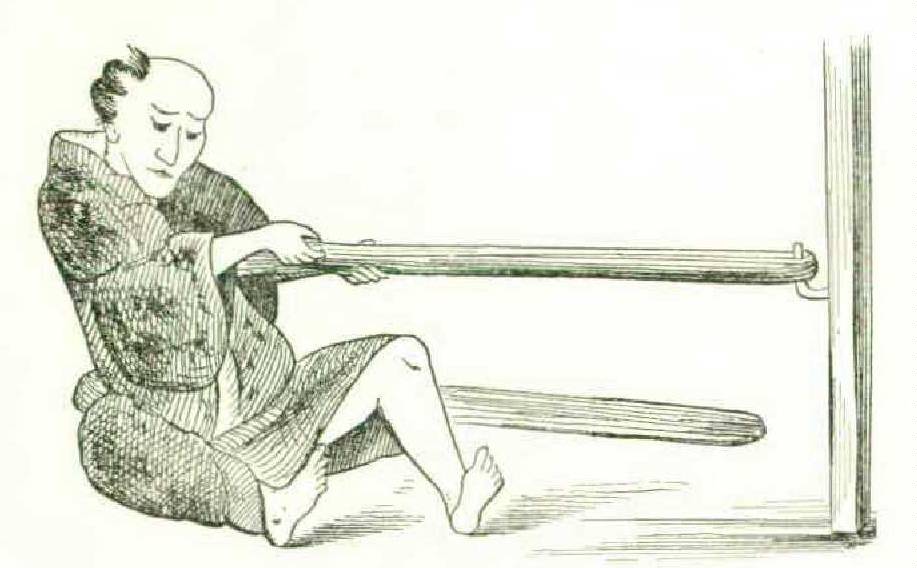
Braiding is a form of plaiting for narrow articles, in which the strands, flat
or round, assume an oblique direction across the web, returning on themselves and following a zigzag course. The braided coir of the Fiji and Marquesas islanders is the neatest of the Polynesian, and forms the rope of the country; it is what the sailors term sennit, a flat rope suitable for a gasket, and much more pliable than a round rope. Very fine specimens may be seen in the National Museum, at Washington, amongst the Wilkes Expedition curiosities.
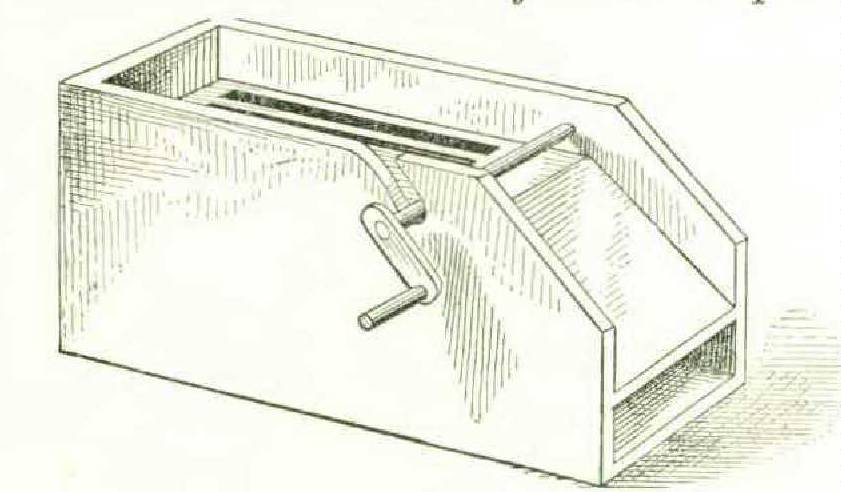
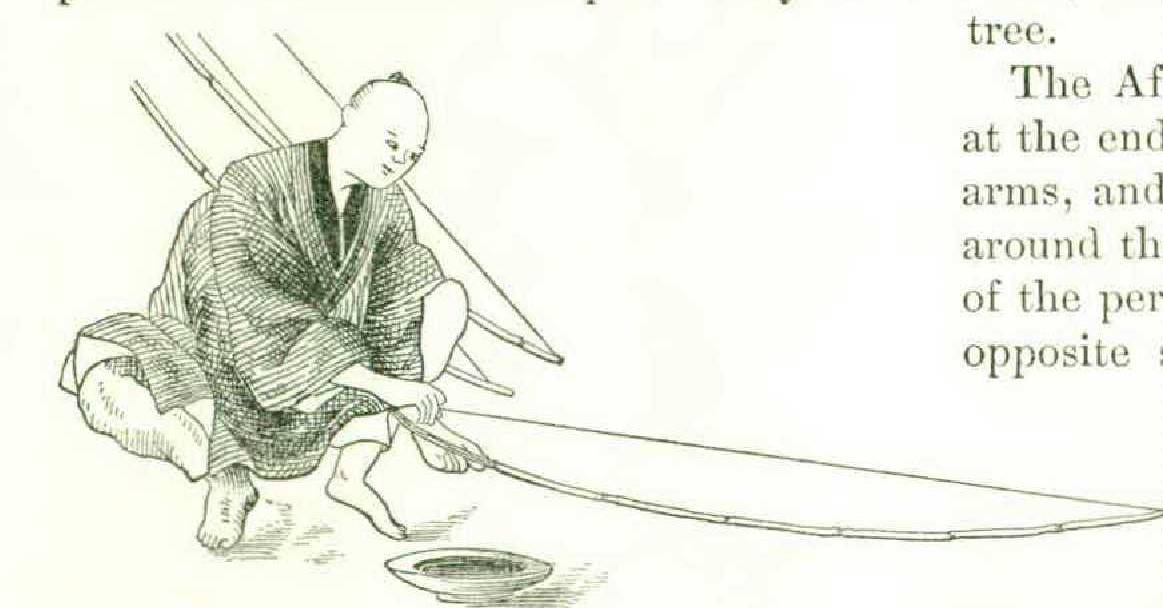
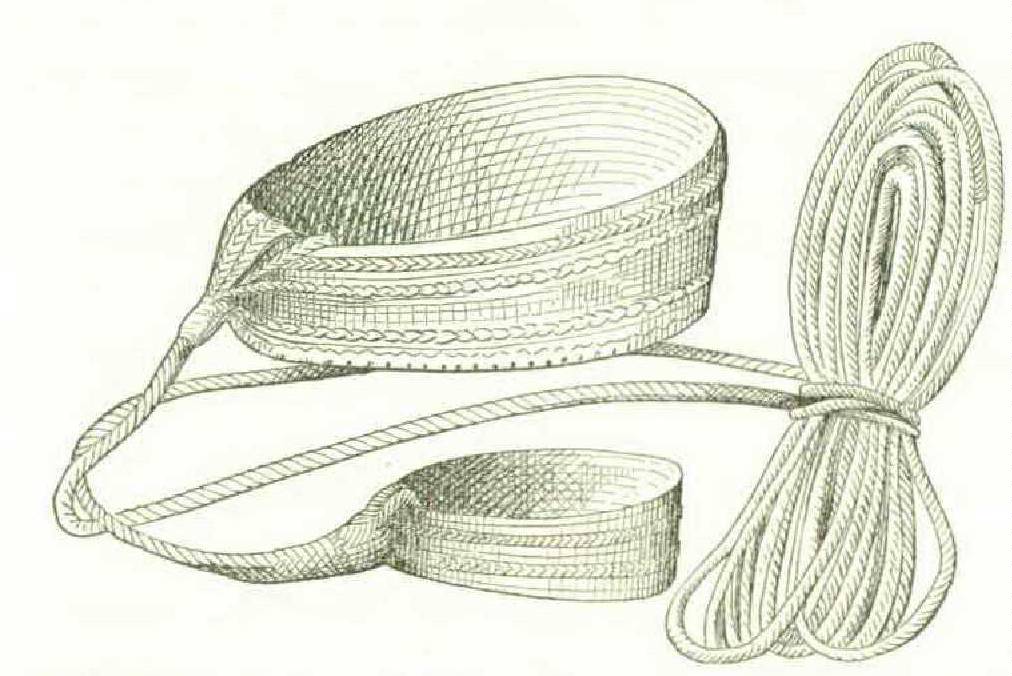
A peculiar specimen was exhibited in the Gold Coast section of the English colonies collection, consisting of a rope and bands used by the natives in climbing palm-trees to draw toddy. The palm-tree wine of Western Africa is obtained by boring a hole below the crown of the tree and catching the sap in a calabash. The native, taking with him several empty calabashes and a boring tool, climbs the tree by means of a pliant creeper or by a belt. If he use the mere hoop of creeper he ties the ends firmly together, but loosely around the tree, and gets into it, so that his back rests against the hoop while his feet are pressed against the tree. He ascends the tree by a succession of hitches, lifting the hoop at each hitch while his feet are planted against the tree. When he reaches the top of the tree he bores a hole just below the crown, rolls up a piece of leaf to form a spout, and suspends a calabash underneath it to catch the dripping sap. This runs principally at night, and the calabash is emptied each morning. In twenty-four hours the juice ferments, but this process is expedited by the remains of a previous brewing left in the vessel. The tree yields a flow of sap for about three weeks, and the hole is then plugged with clay to prevent the ravages of insects, which would enter and kill the tree.
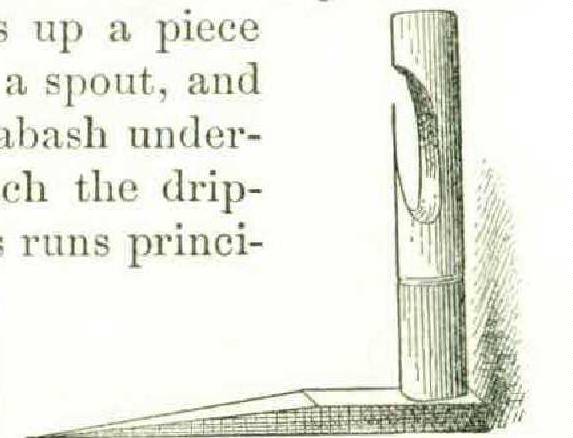
The African climbing rope has loops at the ends ; the bands are placed on the arms, and the rope is long enough to go around the tree and, crossing at the back of the person, go to the shoulders on the Opposite sides. The rope is of a grass which is stronger than hempen string of the same size. It may be a bine, for it has a pith and a brown bark, and appears to be the same that is used on that coast for the strings of the native harp, illustrated in article four of this series. It is made into a regular rope, twenty - five to a strand, three of which are laid up together. The bands, one of which is double the size of the other, are made of bamboo splits plaited together with rattan and lashed to the rope.
The same plan is adopted in the northern part of Africa in climbing the palms to pick dates, and by the Singhalese in climbing the cocoa-nut palm to gather the fruit. It is said that every cocoanut tree in Ceylon has an owner; the possession of a certain number is equivalent to a living. In India, trees are rented: a mango-tree for one rupee per annum; a cocoa-nut-tree for eight annas; a lime-tree, four annas. See also Pliny, 1. xiii.
While the larger portion of mankind uses and is satisfied with cotton, flax, wool, and silk, there is a great variety of other fibres more or less widely used. A few have been adopted in civilized countries, and have had special machinery contrived for their working, such as jute (from the cochorus capsularius and C. olitorius) and alpaca; others show so excellent a staple that the machinery for their manufacture is yet a desideratum. Such are ramie (China grass, bœhmeria nivea), New Zealand flax (phormium tenax), and agave.
The variety of new fibres shown at the Centennial was something remarkable, — from Brazil, Malaysia, the Philippines, and Australia especially, — and doubtless will, as it deserves, be the subject of a full report. Our business is with the more rude and primitive, of which we will cite a few from North and South America, Africa, Madagascar, Ceylon, Malaysia, Polynesia, and Australia.
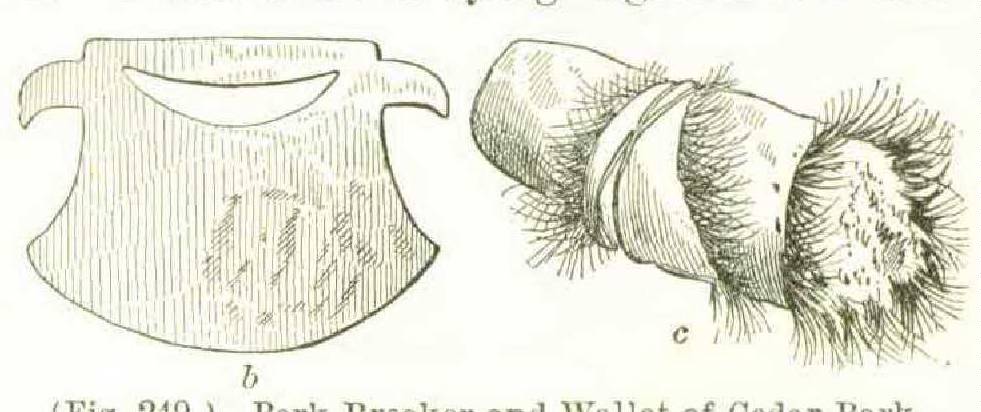
Figure 249 represents a bone barkbreaker and a wallet of the cedar-bark fibre which is used as a thread by the Haidah Indians of British Columbia. The use of the cedar bark and spruce root by the Pacific coast Indians has been before adverted to; indeed, there are but few purposes of cord and thread for which they are not adapted. Hemp was formerly treated in the same manner, the Roman mallet (malleus) answering the purpose of the modern brake. The Makah Indians of Cape Flattery and the Ahts of Vancouver’s Island also make mats of cedar-bark fibre.
The hammock twine of tire Uaupé Indians of Brazil is from the fibres of the leaves of the mauritia flexuosa twisted on the thigh.
The aloe (caraguatay quazu) supplies the fibre from which the people of La Plata make ropes, fishing-lines, and thread. It has been spun and woven into cloth.
The bark of acacia capensis (karroodorn) of South Africa yields the string used by the Kafirs in tying together the grass stems which form their mats. It is also used in tying together the flexible sticks which form the frame-work of their huts. The bark is stripped from the tree, steeped in water, pounded between two stones; it is sometimes chewed, as with the Australian women in preparing fibre of bulrush root for nets. The fibre of the karroo-dorn is made up into yarns by rolling the bunch on the thigh: two being brought together are then rolled in the contrary direction, making a two-strand cord with considerable rapidity. The Hottentots use cords of acacia-bark fibre in stringing the reeds which form their mats.
On the Zambesi the bark of the milola, an umbrageous hibiscus, is made into cordage to be attached to harpoons for killing the hippopotamus. The ife fibre (sanseviera), a species of aloe, yields when bruised a strong fibre which is made into ropes, nets, and wigs. The pandanus or screw palm also furnishes a fibre in this region. The attendants of Dr. Livingstone slept in fumbas or double mats made of palm leaf.
The ropes of Uganda are braided or plaited of various materials, like the sennit of Fiji, which is, however, of coir.
The rope of Madagascar is made from the bark of the hibiscus and other native plants, and a species of long, tough grass. No wheel or spindle is used, but the material is twisted by hand and the cordage and rope are laid up in the same way.
In the Mauritius sugar bags are made of fibre from the pandanus or screw palm.
A long grass called mâdoor katee is used for making mats in India.
Palm-leaf strings are formed into ropes in Ceylon.
Our gunny bags are made from jute (several species of cochorus); the word is Hindoo. Burlaps is of jute, flax, manilla, or hemp. Manilla is the fibre of a species of banana.
Rope in Sooloo and Celebes is made, besides coir, of gumatty fibres, like black hair, from the reticulum at the base of the leaves of the gomuti palm.
In Java several species of pandanus, a grass called mandong, and various palms are used in making mats. The Dyaks of Borneo use strips from the dried leaves of the nipa palm.
The rope of the Fijians is made of coir, the fibrous covering of the cocoanut. This is carefully removed from the nut, baked, and combed. The fibre is then made into a plait (sennit), and into ropes by twisting several plaits of sennit together. The rolls of sennit among the ingenious islanders have created much astonishment, bales twelve feet long and seven in diameter having been seen in store. Belts with fringes — not ample — are made by the women of Fiji by braiding fibre obtained from several sources, — bark of the van, a kind of hibiscus, wild roots, grass. The material is dyed, braided in patterns, and has a fringe of from six to ten inches. Thongs are also plaited by the Fijians from the bark of van. Fijian floor mats, sleeping mats, and sails are made of the fibres of the cocoa-palm leaf.
The mats of the Kingsmill islanders are plaited of strips of pandanus.
The thread of the Australian natives for the best uses is from the tendons of the tail or legs of the kangaroo. When they kill one of these animals the tendons are dissected out, dried in the sun, and kept till required. They are steeped to soften them, beaten on stones to separate them, and two of the fibres are rolled up together on the thigh. These are used for lashings, for making hair nets, and for many other purposes. Fishing nets and ordinary twine are made by the lubras of the fibre of bulrush root, obtained by chewing. The Australian mat is made from the zostera or sea-grass.
Mat making, however, is a kind of weaving, and that will form the subject of the next article.
Edward H. Knight.