Weak Sight
THE inability to use the eyes continuously, without pain or confusion of vision, for near work, as in reading, writing, and like occupations, constituting the affection called asthenopia, or weak sight, is so prevalent in this country that a wider knowledge of the nature and management of the disorder would seem to be of some importance.
In order that we may clearly comprehend the exact nature of weak sight, let us consider for a moment the structure of the eye, and how we see. The figure numbered A gives an idea of the anatomy of the eye, sufficiently full for our purpose. The rays of light from an object enter the eye through the pupil (P), and, passing back to the inner coat of the eye, the retina (R), form an image of the object upon it very much as an image is formed on the plate in the camera of the photographer. Indeed, quite lately experiments have been made that show a very close relation between the nature of photography and the nature of the process that goes on in the act of seeing. Rabbits have been held a few seconds before a window, and then immediately killed, when the picture of the window has been found distinctly photographed on the retina of their eyes. After the reception of the image upon the retina, the act of seeing is completed by the transmission of the impression to the brain through the optic nerve (O N in the figure). But in order that the image of an object on the retina shall be distinct, it is necessary that the rays of light passing into the eye through the pupil should be properly focused. See Figure B.
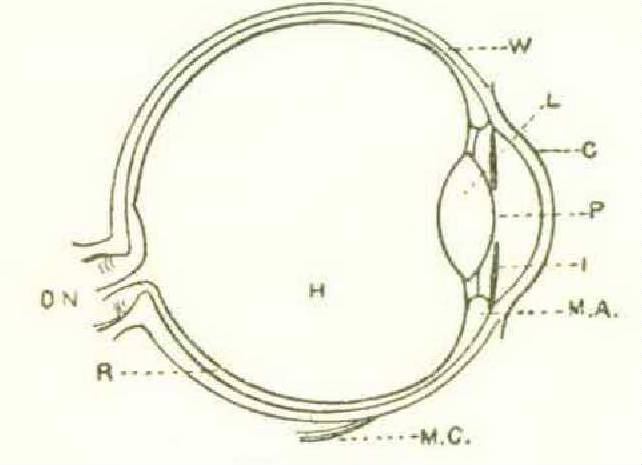
Figure A gives a profile view of the eye ; that is, the eyeball is divided into two equal parts, just as one might divide an apple or an orange, and the flat, cut surface held up to view.
W points out the white of the eye, a strong protective coat extending quite around the eyeball except in front. It is called the sclerotic coal.
C, the cornea, or transparent front of the eye ; and, behind it,
I, the iris, or colored part of the eye, extending in a circle around
P, the pupil, which is a circular hole in the iris, that admits the light into the eye, and out of which the eye sees.
L is the crystalline lens directly behind the pupil. In health, the lens is transparent, like the front of the eye, and offers no obstruction to the passage of rays of light; but if it becomes opaque, it is called cataract, and the eye is more or less blind from the obstruction of the passage of light.
M A is a little muscle, called the muscle of accommodation, that adjusts the focus of the lens and the eye for near objects.
M C is a muscle attached to the white of the eye on the outside, that converges or turns the eyes inward, and is the muscle of convergence.
R points to the inner lining of the eye, the ret ina, Upon which images Of objects are pictured ; and
O N is the optic nerve that conveys these pictures to the brain.
H is the body of the interior of the eye, filled by a transparent humor.
Vision will be clearest and easiest if the rays of light are brought to a point exactly as they reach the retina. If they are focused just before, or if they reach the retina before being focused, the sight will be more or less blurred. When we look at distant objects, if our eyes are neither near-sighted nor farsighted (over-sighted), the rays of light that enter the eye are focused on the
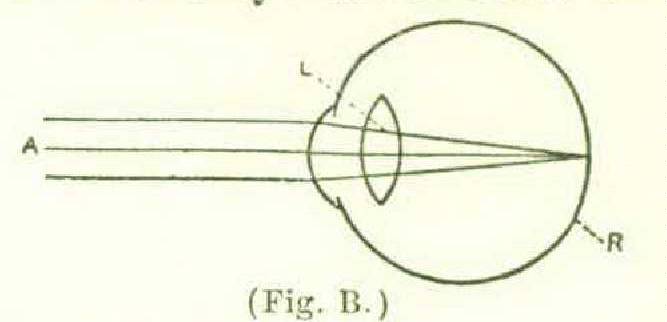
A, the rays of light entering the eye.
R, the retina, where they should be focused.
L, the lens by the aid of which the rays of light are focused.
retina, as seen in Figure B, without effort; but if we regard near objects, as in reading or sewing, there is an effort of the eye to focus the light; otherwise it would reach the back of the eye without being brought to a point.
The reason of this is that rays of light from small objects — as in letters, for example — approach the eye, not in parallel lines, as seen in Figure B, but in lines that diverge as they pass into the eye, as seen in Figure D. To converge such lines to a point on the retina requires more focusing power than if they entered the eye in parallel lines, as seen in Figure B. This power of increasing the refraction, which is called the accommodative power of the eye, is furnished by a muscle (M A, Figure A). This muscle we may call the muscle of accommodation, and when it is brought into use, the lens (L in the figures) is made more convex or full, and thus a
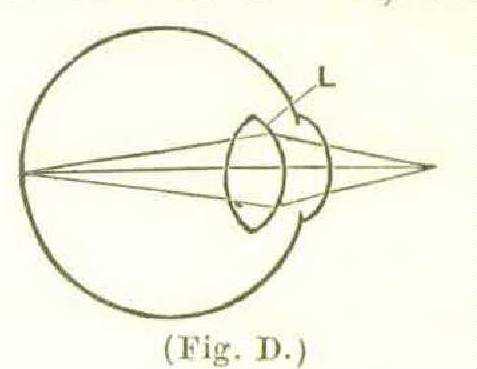
greater refractive power is given to the eye. The fuller or more convex the lens, whether the natural one within the eye, or a glass lens such as is used in spectacles, the greater its power of bending rays of light to a point.
Figure D represents the eye accommodated for near vision, the lens (L) being more convex than in Figure B, where the eye is fixed for distance. Though involuntary, the accommodation or adjustment of the eyes for near objects is an effort; hence the relief that comes from looking up and off from near work, so especially grateful to fatigued and sensitive eyes.
Another factor in the act of adjustment of the eyes for near objects is convergence. By this is meant the turning inward of the eyes so that both may be directed to the same object. If we hold up a finger before the face, at a distance of four or five inches, and look at it fixedly with both eyes, it will be noticed that a distinct effort is made to turn the eyes inward; and if we continue to look at the finger in this position, the act will soon become painful. The convergence of the eyes is brought about by a muscle on the outside of each eyeball, attached to the white of the eye on the side towards the nose. This muscle (M C, Figure A) we may call the muscle of convergence. There are other muscles which modify the action of this one, but they need not be considered here.
Weak sight is therefore nothing more nor less than a disorder of the accommodative apparatus; or, we may say, a disorder of the two muscles of accommodation and convergence. In health, these two muscles work together in perfect harmony. If either one becomes affected, this harmony is disturbed, and weak or painful sight may follow. It is plain, then, that as in distant vision this muscular apparatus is not used, and as in near work it must of necessity be brought into service, if sight is weak or painful, and we wish to improve and cure it, we must carefully regulate the way in which we use our eyes.
Persons having a tendency to weakness of sight, or those experiencing unusual fatigue of the eyes in reading or similar occupations requiring close vision, should carefully observe the following rules: —
(1.) Cease to use the eyes for the time being, and look away from the work, when sight becomes in the least painful, blurred, or indistinct. After perfect rest for a moment, or longer, work may be resumed, to be discontinued as before when the eyes feel again fatigued.
(2.) See that the light is sufficient, and that it falls properly upon your work. Never sit facing it. It is best that the light should fall upon the work from above and behind. Failing this, it may fall from the side. Never use the eyes at twilight. Any artificial light for the evening is good if it is brilliant enough and steady. When artificial light is at all painful, it is safer to read or write only during the day.
(3.) Never read in the horse or steam cars. It requires too great an exertion of the accommodative power to keep the eyes fixed on the letters. Business men are in the habit of reading the evening papers on their way out of the city, and the morning papers on their way in. This dangerous practice is a somewhat frequent cause of weakness of sight. There are those who can follow it with impunity year after year, but there are more who cannot.
(4.) Never read when lying down; it is too fatiguing for the accommodative power. Many a tedious case of weak sight has been traced to the pernicious habit of reading in bed after retiring for the night.
(5.) Do not read much during convalescence from illness. Before the muscular system generally has quite recovered its healthy tone, we ought not to expect the muscles of accommodation to bear the continuous use to which they are subjected in reading or writing. We cannot be sure that, the delicate muscles of the eye are in a condition to be used until the muscles of the leg and the arm have regained their strength and firmness.
(6.) The general health should be maintained by a good diet, sufficient sleep, air, exercise, amusement, and a proper restriction of the hours of hard work. One ought not to expect strong eyes in a body weakened by bad habits or an injudicious amount of labor. Bright gas-lights in crowded rooms, and the impurity of the air in such places, are especially to be avoided. Medical advice should be sought in regard to any nervous debility, disorder of the organs of digestion, or functional disturbances of a general nature, whether they appear to have a direct connection with the weakness of sight or not.
(7.) Take plenty of sleep. It is a sovereign balm for those who suffer from weak sight. Retire early, and avoid the painful evening lights. Ten hours’ sleep for delicate eyes is better than eight.
If the weak sight does not improve satisfactorily under the observance of the rules given, it will be necessary to resort to the use of convex glasses. Such glasses aid in focusing the light from near objects, and so assist the accommodative power. For the benefit of such as cannot consult an oculist, it may be well to say that the convex glasses will probably require to be of about forty-eightinch focus, and that they are to be worn only in reading, sewing, and such occupations as require the accommodative apparatus of the eye to be brought into use. The moment the eye tires, the glasses must be removed; to be replaced again, after a rest of the eyes, when work is resumed.
To accustom the eyes to the help of glasses may require some days or weeks, and considerable patience. After beginning with them, it is best not to omit their use in reading or sewing, even temporarily, but to work or read always by their help; limiting the amount of reading at first, and then increasing it day by day, or week by week, until the sight becomes strong.
We have thus far been considering what are called perfectly formed eyes. But there are certain imperfections of form in the eyeball that are very common, and that render the eye optically defective and tend to the production of weakness of sight. One of these malformations produces what is called oversight or far sight. This is a defect of a nature exactly the opposite of near-sight. In near-sight the eye is adjusted or accommodated for a point nearer than the object looked at, and consequently does not see distinctly. In over-sight it is fixed for a point beyond the object looked at, and does not see well either. In near-sight the eyeball is too full or convex, and in over-sight it is too flat. Being too flat, the rays of light entering the pupil reach the retina at the back before being focused, as represented in Figure E, and therefore vision is blurred and indistinct.
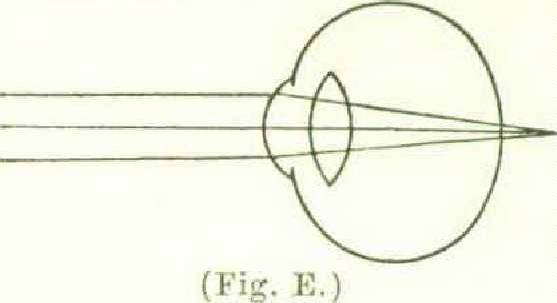
Figure F shows a profile view of a near-sighted eye. Here the rays of light are seen to come to a focus before reaching the retina, because the eyeball is too full or too long from front to rear.
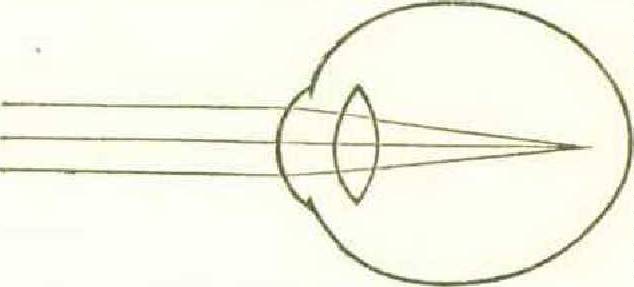
We have seen that weak sight is the result of overworking the muscles of accommodation and convergence. Now an over-sighted eye being too flat, a constant use of the muscles of accommodation is necessary in order that rays of light may be focused before reaching the retina. Such an eye is almost certain to become weak-sighted. Having to use its accommodative power for distant as well as for near objects, there is no rest for it except during the hours of sleep. The remedy for over-sight suggests itself at once. If the eye is too flat, of course a convex glass makes it less so, practically, and thus removes the effect of its defective form. Convex glasses in the form of eye-glasses or spectacles are therefore imperative to prevent the development of weak sight as well as to aid vision. What the strength of the glasses should be will depend upon the degree of faulty formation of the eyeball.
Old sight is due to a partial loss of the accommodative power of the eye. Hence, in looking at a distance, the accommodative or adjusting power not being required, the eye sees as well, or nearly as well, as ever; but in regarding near objects, as for instance in reading, the accommodative power being required and not being available, vision is imperfect. The loss of the accommodative power is not from disease of the eye at all, but is owing chiefly to the natural increase of the hardness of the lens and consequent loss of its elasticity. We must bear in mind that the accommodation of the eye for near work, as in reading, means the calling into action of the muscle of accommodation. (M A, Figure A.) This action results in making the lens more convex, as seen in Figure D, which represents the eye accommodated or adjusted for near vision. As the lens grows harder with advancing age, this change of form becomes more and more difficult.
Convex glasses are of course the remedy for old sight, as their effect is to increase the refractive power, and thus supply the partially lost accommodation for near objects. The spectacles should be sufficiently strong to enable one to read the finest type as near as ten or twelve inches; if too strong, the print must he brought nearer than ten inches, and this will tire the muscles of convergence that turn the eyes inward; if too weak, the fine print will have to be held farther than twelve inches away, and the letters are too small to be seen easily much beyond this distance from the eyes.
The putting on of suitable glasses should not be neglected after the early evening symptoms of old sight are noticed. Nothing is gained by waiting, and much may be lost. We lose, in the first place, a great deal of amusement and instruction from the necessity of giving up our evening reading, avoiding small print, resting our eyes, and neglecting fine work of all kinds. In the beginning these interruptions in our ways of life are not so serious and frequent as to give much annoyance, but as old sight increases they become of importance. In the second place, and of greater moment, is the risk we run of fatiguing and straining the accommodative power of the eyes, and so: causing weak sight.
In these days of weak sight and eyeglasses, there need be no fear that the adoption of glasses will be interpreted as a confession of old age. Old sight comes very early—much earlier than forty —in most over-sighted eyes, and this flat formation of the eye is more common than any other. Glasses as strong as those usually worn by people sixty and seventy years old are sometimes required by young persons. Frequently, even in the best-formed eyes, ill health, nervous debility, or a constant and severe use of the vision in fine work or night work will develop the symptoms of old sight as early as the age of twenty-five or thirty. All things being equal, a farmer, if he is not studious, may postpone the use of glasses longer than a professional or literary person, or any one who reads a great deal. But if we take the age of forty or forty-five as the average age for the beginning of old sight, it can by no means be considered as the time of that decline of the faculties which marks the beginning of old age. Most men and women do the serious and best work of their lives after the age of forty, and some even after the age of sixty.
Another defective form of the eye which sometimes causes weakness of sight is that the front of the eye is too oval, so that rays of light are not uniformly refracted. To such eyes vertical and horizontal lines do not appear equally black and distinct. The remedy is to be found in wearing glasses ground in such a manner as practically to restore the spherical shape of the cornea. These glasses help vision for all distances, near as well as far, and the relief they give to eyes weakened and congested by unnatural effort to see clearly is sometimes remarkable.
Either blue or smoke-colored glasses are useful in weak sight, if there is great dread of light. But if not really necessary, it is better not to wear them, as the eye may become so habituated to a subdued light as to be intolerant of ordinary daylight. They may be worn profitably, if needed, in bright sunlight on the snow, sand, or water. When the dread of light is great, one may also have glasses of the proper number, convex or concave, for over-sight or nearsight, slightly blue-tinted, so as to soften the glare of the white page in reading. Colored glasses should not be too dark in tint, lest it require too much exertion to see clearly through them.
In near-sight, as we have seen, the eye is too full, so that rays of light from a distance are brought to a focus before reaching the retina. (See Figure F.) The exercise of the accommodative or adjusting power of the eye is of no use, or even worse than useless, because, when brought into service, its function is to make the lens more convex, and this addition to the refractive power of the eye would of course focus the light still sooner, and so increase rather than help the difficulty.
To render vision clear in near-sight, it is obviously necessary to resort to some means by which the rays of light may be prevented from being focused too quickly after entering the pupil. That is, we wish to do exactly the opposite of that which we wished to do in over - sight. This is accomplished by putting before the eyes concave glasses, either in the form of eye - glasses or spectacles. A concave glass is one which is hollowed out, or thinner at the centre than at the edges. A convex glass, suitable for farsight or over-sight, is one thicker at the centre than at the edges. Such glasses help to focus the rays of light; while a concave glass, by diminishing the effect of the convex form of the eyeball, lessens its focal power, and permits the light to reach the back of the eye in proper form for good vision.
Near-sight is usually complicated by a disease in the back part of the eye. This is nearly always the case in the nearsight of children and youth. Besides this disease, such eyes are. often weaksighted, — the weak sight being mostly due to weakness and fatigue of the muscles of convergence. These muscles are very liable to be overworked, because print in reading and fine objects of all kinds must be held quite near, which necessitates a strong turning inward of the eyes.
Progressive near-sight in children is noticed usually at about the age of seven or eight, or earlier, if the tendency is inherited; and from this age up to that of fifteen or sixteen, if acquired. It is probably very often acquired, —oftener than is generally supposed; at least, it is observed when neither parents nor relatives, so far as can be learned, are similarly affected. Too much study, too much school, too continuous use of the eyes on near objects, too little out-door life and exercise of the eyes in distant vision. — these are, apparently, sufficient to cause near-sight, without hereditary influence. Acquired near-sight almost invariably comes in the weakly, ill-nourished, studious, precocious child. And this general weakness and ill health favor the rise and progress of the disease at the back of the eye.
It will be remembered that in this defect the eyeball (as seen in Figure F) is too long; that the refractive or focusing power of the eye, therefore, brings the rays of light, to a point before they reach the retina. A tendency to nearsight, or even a deficient light without the tendency, inclines the child to hold the book rather near, and this requires the turning inward or convergence of the eyes, so that both may be brought to bear upon the same point of vision. Now, a studious boy or girl of ten or fifteen years, besides the five or six hours’ work in school, studies also more or less at home, while the leisure hours are spent over novels or books of travel. In short, the eyes are not only used almost continuously in regarding near objects, but their use for distance is almost wholly neglected. It is not surprising that, under such training, an organ should lose some portion of its functional power. It is to be remembered that in youth the tissues of the eye are soft, yielding, and undeveloped; that it is a growing organ, easily molded; that its future, like other parts of the body, is to be very much what it is made by training, use, or abuse. When we regard near objects, there is the action of the accommodative power, the convergence, the movement of the pupil and the adjacent tissues, and a forward movement of the whole eyeball. All this is muscular exercise; and whether this exercise is kept up all through the day or not cannot be a matter of indifference to an immature and growing eye. It is supposed — and very reasonably, I think — that the muscular pressure upon the yielding eyeball, and especially the pressure in turning the eyes inward, promotes indirectly a bulging of the eye at the back, and so contributes to the progress of near-sight.
The elongation of the eyeball in nearsight is at the back, and of course, as the outer or protective coat of the eye is stretched, the two inner tissues (the vascular and nervous coats) are unnaturally distended also. The inner tissues do not bear this distention well; they become thinned, congested, inflamed, degenerated, and finally are partially lost over a limited portion of the interior of the eye near the entrance of the optic nerve.
It seems almost needless to say that an affection at the back of the eye, capable of destroying its tissues, may if neglected lead to blindness. Every oculist is sought now and then for advice in regard to an eye blind from neglected myopia. Vision from this cause is, however, not often lost before adult age, — usually between the age of thirty and forty-five, perhaps. Fortunately, the destruction of the tissues, under abuse of the eyes in progressive myopia, does not advance with equal rapidity in both eyes; so that if sight be lost in one, the sufferer is quite sure to adopt every means for its preservation in the other. It is clear, therefore, that a myopic eye is not, as is frequently supposed, a strong eye, but on the contrary a weak one; or at least liable to become, if abused, a weak one. It is true that inherited myopic eyes are sometimes strong, but the greater number are nevertheless weak and diseased. Acquired myopia almost invariably threatens the integrity of the eye and its functions.
There is no doubt that deficient and improperly admitted light in schoolrooms is one cause of the rapid progress of this optical defect. To sit facing a light during study, for instance, is extremely injurious to the best eyes. On looking up, the eye becomes saturated with light, and then, on turning to the printed page, an extra accommodative effort must be made to overcome the dazzling and clear up the vision. The light should enter from above and at the side, so as to strike the page of the book, and not the eyes; and it should be, if possible, a direct rather than a reflected light.
A deficient illumination is injurious, because it requires the book to be brought near the eye; and this, as we have seen, tends to promote the posterior bulging already noticed.
School furniture is also often ill adapted for the scholar, even if properly placed as regards light. The bench is too high for the desk, so that the pupil must bend over his work, thus promoting congestion to the head, and contributing to the congested condition at the back of the eyes; or the seat is too far away from the desk, and the head is thereby brought too near the book, so that the growth of near-sight is directly encouraged.
The first and the best thing to do for progressive near-sight in children is to take them from school, stop their reading and all use of the eyes for near objects as far as practicable, and see that they use their eyes for distance. Encourage them to climb the hills and look miles and miles away. I remember a boy of twelve in whose case the above advice was fully carried out, and in less than one month his power of vision for distant objects had doubled. The quick improvement in the sight for distant objects brought about by the method above described is surprising.
It is probably understood by the reader, from what has been said, that the immediate cause of weak sight is very often a defective form of the eyeball. It is too flat, too full, or of irregular form. This makes vision an effort under all circumstances, and sooner or later the result is weak sight. General ill health may also account for some of the inability to use the eyes. There are, however, some people who appear to have eyes nearly perfect in form, and, having also a large power of accommodation, see apparently with slight effort. Such persons can be very careless of their sight; can read in the steam-cars by night or day; in fact, neglect all the nice rules that I have given. But such individuals are not common.
All eyes, including such as are considered perfect, arc, optically considered, far from perfect. These faults, unlike those already noticed, are irremediable, and are chiefly as follows —
(1.) There is a want of transparency in the cornea (C, Figure A) and the lens (L, Figure A), and fluorescence of both. Fluorescence is the property that certain substances have of becoming faintly luminous from blue or violet light. The bluish tint of a solution of quinine in water is an example of fluorescence. A blue light thrown into the eye shows a haziness of both cornea and lens. These parts of the eye are therefore inferior to the clear and transparent lenses used by opticians in the manufacture of optical instruments.
(2.) Spherical aberration, due to a lack of corresponding symmetry in the cornea and lens, or to a lack of correspondence in their axes. This makes the refractive power of the two inharmonious, creating a slight astigmatism. The traditional figure of a star has five points. The eye sees a star with more or less luminous points, when, if it were optically perfect, it would see it as it is; that is, without the points.
(3.) Achromatism, or chromatic dispersion of rays. The solar rays being made up of the different colors of the spectrum, and each color being refracted in a different degree by the same medium, they are not united by it in a single focus. Look at a street-lamp at a distance through a violet - colored glass. This stops the intermediate green and yellow rays, and allows the first and last rays — the violet or blue and the red — to pass into the eye. The result is that the red is focused, but the violet and the blue are seen in a broad halo around the red gas-light. Optical instruments are free from this defect.
(4.) Slight color-blindness is common to all eyes. The eccentric portion of the retina does not perceive red as soon as other colors. If we fix our eyes steadily on something in front of us, and then move a red object from the centre of the visual field towards either side, we shall find that the color is not recognizable as far away as the outline of the object. The eye also fails to distinguish a difference between a white produced by the union of scarlet and bluish-green light and a white made by yellowish-green and violet; yet the first comes out black in a photograph, the latter very bright.
(5.) There is a blind spot on the retina of every eye, due to the space occupied by the entrance of the optic nerve. If we make a small cross on a sheet of paper, and three inches at the right of this a black dot, then close the left eye, hold the paper at arms-length, and fix the right eye on the cross, it will be found, on bringing the paper nearer, that at about eleven inches from the eye the dot will not be seen. The blind spot is large enough to hide the face of a man at six or seven feet distance.
((b) The yellow spot—the centre and most sensitive point of the retina — is by virtue of its yellow tint unable to recognize weak blue light. The smaller stars are seen better by astronomers if they look slightly at one side rather than directly towards them.
This formidable array of common optical defects is unnoticed chiefly because, having two eyes in almost constant motion, one makes up for the temporary visual disturbance in the other. Even with one eye, these faults are rarely noticed, owing to the great mobility of the eye and its continuous change in direction, and to the fact that the imperfections are mostly away from the centre of the field of vision. Habit, inattention, experience, the power of accommodation, may also be given as reasons why our natural visual defects are mostly unobserved. Nevertheless, these optical defects do exist in all eyes; and, as Professor Helmholtz observes, if an optician offered for sale an instrument with these faults, one would be justified in refusing to buy it.
H. C. Angell, M. D.